ICD-10 Code S42.444P: Medial epicondyle fracture, right humerus
ICD-10 Code S42.444P: full descriptor and code validity ICD-10 Code S42.444P car...

Last Updated: Oct 13, 2026
Billable Code Specific Code
C54.2 is the billable ICD-10-CM code for malignant neoplasm of myometrium.
Let Pabau's smart automation suggest the right codes, reduce claim denials, and keep your practice compliant—effortlessly.
Automate repetitive tasks and focus on what matters most—your patients.
Reduce coding errors and ensure compliance with the latest regulations.
Clean claims, fewer denials, and faster reimbursements.
Powerful insights and reporting to help your practice thrive.
HIPAA compliant SOC 2 certified GDPR-compliant Trusted by 4,000+ clinics worldwide

ICD-10 Code C54.2 is the billable, site-specific diagnosis code for malignant neoplasm of the myometrium (the muscular wall of the uterus), valid for FY 2026 reimbursement.
C54.2 is distinct from C54.1 (endometrium): pathology confirmation of myometrial involvement is required before assigning C54.2 rather than the unspecified C54.9.
Research published in Pharmacoepidemiology and Drug Safety explicitly excludes C54.2 from endometrial cancer case-finding algorithms, making site-specific documentation critical for claims accuracy.
Pabau’s claims management software and AI-powered clinical documentation tools help gynecologic oncology practices capture the site-specific detail needed to support C54.2 without querying or audit risk.
ICD-10 Code C54.2 designates a primary malignant neoplasm arising from the myometrium, the thick smooth-muscle layer that forms the middle wall of the uterus between the endometrium (inner lining) and the serosa (outer peritoneal covering). Tumors assigned to this code originate in or primarily involve the myometrial tissue itself rather than the endometrial glands and stroma that are the source of the far more common endometrial carcinomas.
The most clinically significant malignancy coded under C54.2 is uterine leiomyosarcoma, a rare and aggressive smooth-muscle tumor that accounts for roughly 1-2% of all uterine malignancies. Other histologic subtypes coded here when they arise from myometrial stroma include undifferentiated uterine sarcoma with myometrial origin and, in some pathological interpretations, endometrial stromal sarcoma when confirmed to primarily involve the muscle layer rather than the endometrial surface. The pathology report is the authoritative document for code selection in every case.
Clinicians at OB/GYN practices and gynecologic oncology programs need this code readily available alongside C54.1 and C54.9. The clinical picture of myometrial malignancy often overlaps with benign leiomyomata (fibroids) on initial imaging, making pathological distinction and precise documentation especially important for coding accuracy.
Multiple clinical terms map to ICD-10 Code C54.2 in the tabular index. Coders and clinicians should recognize these synonyms when reviewing operative reports and pathology narratives:
Note that not every uterine sarcoma maps automatically to C54.2. Carcinosarcoma of the uterus (malignant mixed Müllerian tumor) has no dedicated code. It is assigned to the corpus uteri site identified in the pathology report, most often C54.1 since the majority arise from the endometrium, rather than automatically to C54.2. Always confirm the histologic type and anatomic layer against the tabular list before assigning C54.2. Keeping a code lookup current matters more than keeping it comprehensive.
Understanding where C54.2 sits in the ICD-10-CM hierarchy helps coders navigate adjacent codes and avoid misclassification. The WHO ICD-10 classification places this code within the following structure:
C54.2 is a valid, billable ICD-10-CM code for FY 2026. It carries a full code designation, meaning it can stand alone as the principal or secondary diagnosis on a claim without requiring an additional specificity digit. Verify current billable status annually against the CDC/NCHS ICD-10-CM web tool, which reflects each fiscal year’s official tabular updates.
The C54 ICD-10 codes cover all malignant neoplasms of the corpus uteri. Each subcategory represents a distinct anatomic site within the uterine body:
When pathology reports reference involvement of multiple uterine body sites, consider C54.8 (overlapping sites) rather than defaulting to C54.9. C54.9 should be a last resort when site specificity cannot be determined after querying the provider.
The distinction between C54.2 (myometrium) and C54.1 (endometrium) is the most consequential code selection decision in the C54 family. Getting it wrong affects MS-DRG grouping, cancer registry accuracy, and population-level epidemiological research.
A 2023 peer-reviewed study in Pharmacoepidemiology and Drug Safety validated ICD-10 case-finding algorithms for endometrial cancer in US insurance claims data and explicitly excluded C54.2 from its endometrial cancer definition. That exclusion reflects a clinical reality: myometrial malignancies are biologically and prognostically distinct from endometrial carcinomas.
A common coding trap occurs when an operative note describes a “uterine mass” removed during myomectomy and the pathology returns “leiomyosarcoma.” Without a coder querying the provider to confirm myometrial origin (rather than a degenerated fibroid extending to the serosa), C54.9 or even an incorrect C54.1 may be assigned. The same site-specific coding discipline used for other organ-layer malignancies applies equally here: when in doubt, query before coding.
C54.9 is appropriate only when the pathology report or clinical documentation confirms a corpus uteri malignancy but does not specify the sub-site. Per the ICD-10-CM Official Guidelines for Coding and Reporting maintained by CMS and NCHS, coders should not assume a site-specific code from ambiguous documentation. Assign C54.9 when the record genuinely cannot support C54.0, C54.1, C54.2, C54.3, or C54.8, and document the query in the medical record workflow.
Flag every uterine malignancy diagnosis for a documentation query at the time of coding. Ask the provider to confirm in writing whether the tumor is endometrial (C54.1), myometrial (C54.2), or involves overlapping sites (C54.8). A one-line addendum in the EHR supports site-specific coding and eliminates the audit exposure that comes with repeated use of C54.9.
C54.2 is a fully billable ICD-10-CM diagnosis code, meaning it can be submitted on a claim as the sole diagnosis code for the relevant encounter without requiring an additional specificity extension. This is significant in gynecologic oncology billing, where some practitioners incorrectly treat C54.2 as a “non-specific” placeholder because myometrial malignancies are relatively rare.
C54.2 also carries a sex-specific claim edit. Because it describes a uterine site, payer scrubbers reject it on a male patient record, so confirm patient sex is captured correctly before the claim goes out. The code is exempt from Present On Admission (POA) reporting on the standard CMS exempt list, but that does not lower the documentation bar for site specificity. Batch submissions group many claims into one claim file, and one malformed record can hold up the batch.
The International Federation of Gynecology and Obstetrics (FIGO) staging system applies to uterine sarcomas including leiomyosarcoma. FIGO stage does not change the ICD-10-CM code assigned (C54.2 is used regardless of stage), but stage documentation directly influences the CPT procedure codes billed alongside C54.2 and the MS-DRG the case falls into.
A FIGO Stage I leiomyosarcoma confined to the uterus will group differently than a Stage IV case with distant metastasis. Coders should capture metastatic spread with additional secondary neoplasm codes (C78-C79 range) when documented.
When C54.2 serves as the principal diagnosis, CMS groups the case within several MS-DRGs depending on whether a procedure was performed and the patient’s complication/comorbidity (CC/MCC) status. C54.2 maps to MS-DRG v43.0 groupings in the uterine and adnexa procedure categories. The exact DRG assignment shifts based on:
Verify the current-year DRG assignment using the CDC/NCHS ICD-10-CM tool or your facility’s grouper software, as MS-DRG version numbers update annually and weightings change.

Pabau’s claims management and clinical documentation tools help OB/GYN and oncology practices capture the site-specific detail that supports ICD-10 Code C54.2 and reduces audit exposure. See how it works for your practice.

Coding C54.2 correctly depends on a clear documentation chain from the clinical encounter to the pathology report to the coding workflow. Gynecologic oncology practices that build structured documentation habits into their EHR templates can eliminate most querying delays and claim denials before they occur.
The following elements must appear in the medical record to support C54.2 on the claim:
Practices using structured clinical record templates for oncology consultations can embed these documentation checkpoints directly into the note-writing workflow. Capturing the pathologic layer at the time of result review, rather than during retrospective coding, dramatically reduces query volume.
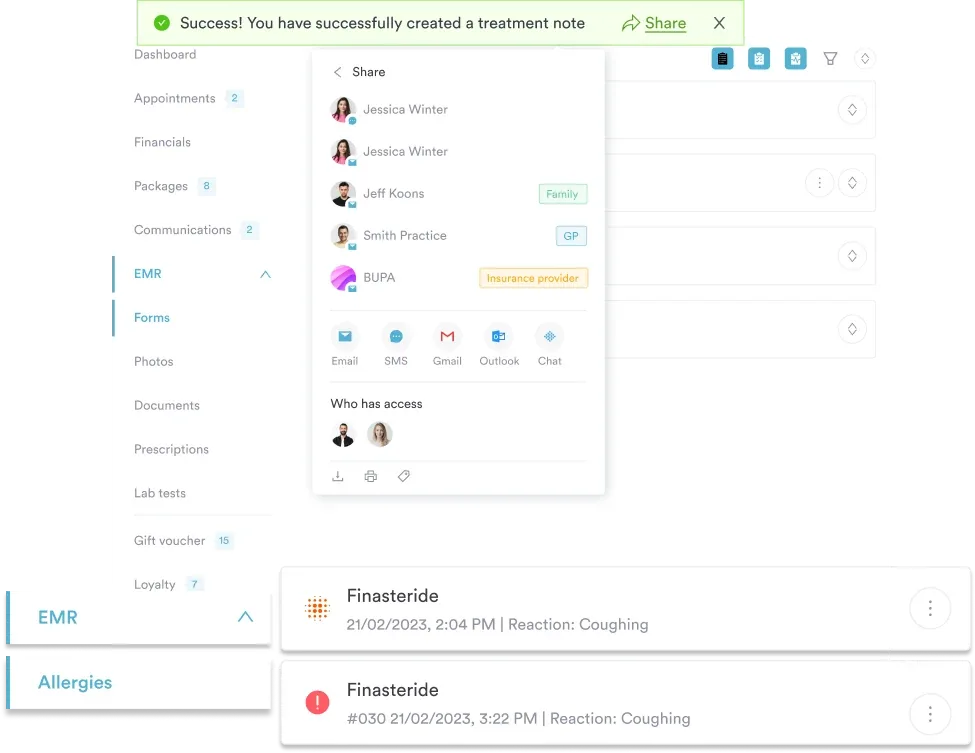
Three EHR habits support consistent C54.2 documentation in gynecologic oncology:
For practices managing claims across multiple oncology encounters, building a problem-list entry for C54.2 that carries forward across visits (with status updates for remission or recurrence) keeps the diagnosis code consistent throughout the treatment course and reduces the risk of conflicting codes across claims dates.

Document the specific uterine layer in the pathology review note on the same day results are received, before they are filed into the patient record. A one-sentence addendum from the treating clinician confirming ‘myometrial primary as per pathology dated [date]’ is all that is needed to support C54.2 and move the claim without a query.
Correct sequencing and awareness of adjacent codes prevent over-coding and under-coding in uterine malignancy encounters. This section covers the sequencing logic for C54.2 in common clinical scenarios, the historical ICD-9-CM equivalent, and the codes most often reported alongside C54.2.
C54.2 follows standard ICD-10-CM sequencing rules for malignant neoplasms:
The approximate ICD-9-CM equivalent of C54.2 is 182.0 (Malignant neoplasm of corpus uteri, except isthmus). This crosswalk is approximate rather than exact because ICD-9-CM code 182.0 encompasses both endometrial and myometrial malignancies of the corpus uteri without sub-site specificity. The move to ICD-10-CM in October 2015 introduced the granularity that separates C54.1 (endometrium) from C54.2 (myometrium) from C54.9 (unspecified).
When reviewing historical claims data or conducting retrospective research that spans the ICD-9/ICD-10 transition period, treat 182.0 as a parent code that may correspond to C54.0, C54.1, C54.2, or C54.9 depending on the clinical context. For bidirectional code mapping tools, the CMS ICD-10 general equivalence mapping (GEM) files provide the official forward-backward crosswalk.
In clinical practice, C54.2 rarely appears in isolation. The following codes are frequently reported alongside it, depending on the encounter type and disease stage:
Practices running HIPAA-compliant billing workflows for oncology services should build problem-list templates that capture the full code set for each uterine malignancy patient, including the primary C54.2, any secondary neoplasm codes, and the current encounter-type codes (Z51.xx, Z79.xx for long-term medication use).
This prevents the common scenario where a coder on an encounter for follow-up imaging submits C54.2 as the sole code without the Z08 follow-up code (encounter for follow-up examination after completed treatment for malignant neoplasm) or the Z85.42 personal-history code that correctly describes the encounter purpose.
ICD-10 Code C54.2 is a site-specific, billable diagnosis code for myometrial malignancies that demands pathology-confirmed documentation before it can be assigned. The distinction between “uterine cancer” and “myometrial malignancy” looks small on paper but has real consequences for MS-DRG grouping, cancer registry accuracy, and claims audit risk. Practices that capture the anatomic layer at the point of pathology review settle that distinction before it becomes a billing problem.
Pabau’s claims management software and compliance management tools help gynecologic oncology practices build the documentation checkpoints that support site-specific coding like C54.2 throughout the treatment course. To see how Pabau handles this for oncology and women’s health practices, book a demo.

Need a framework for managing oncology documentation compliance? Compliance management software covers how Pabau structures audit-ready documentation workflows for regulated clinical specialties.
Coding depressive disorder under ICD-11? ICD-11 depressive disorder coding guide covers 6A70, the ICD-11 code mental health practitioners use to document a single episode depressive disorder.
Want to reduce coding errors across your claim submissions? Digital forms explains how structured intake and clinical forms prevent the missing documentation that leads to unspecified-code defaults like C54.9.
ICD-10 Code C54.2 is the billable, site-specific ICD-10-CM diagnosis code for malignant neoplasm of the myometrium, the smooth-muscle wall of the uterus. It is classified under the WHO block C51-C58 (malignant neoplasms of female genital organs) and is most commonly assigned for uterine leiomyosarcoma confirmed by surgical pathology.
C54.1 designates malignant neoplasm of the endometrium (the inner mucosal lining of the uterus) and applies primarily to endometrioid adenocarcinoma, the most common uterine cancer. C54.2 designates malignant neoplasm of the myometrium (the middle smooth-muscle wall) and applies primarily to leiomyosarcoma and related uterine sarcomas. The distinction requires pathology confirmation of the tumor’s layer of origin and cannot be inferred from imaging alone.
Yes. C54.2 is a fully billable, specific ICD-10-CM code valid for FY 2026 reimbursement. It can be submitted as the principal or secondary diagnosis on a claim without a further specificity digit. Verify its status each fiscal year using the CDC/NCHS ICD-10-CM web tool.
The approximate ICD-9-CM equivalent is 182.0 (Malignant neoplasm of corpus uteri, except isthmus). This is an approximate mapping because ICD-9-CM 182.0 did not differentiate between endometrial and myometrial sites the way ICD-10-CM does. Use CMS General Equivalence Mapping (GEM) files for official bidirectional crosswalk data when analyzing historical claims spanning the October 2015 transition.
C54.2 maps to MS-DRG groupings in the uterine and adnexa categories under MS-DRG v43.0, with the exact DRG varying based on whether a major pelvic procedure (such as hysterectomy) was performed and the patient’s CC/MCC status. Medical-only encounters group into the malignancy medical DRGs. Confirm the current-year DRG assignment through your facility’s grouper software, as MS-DRG weightings update annually.
Uterine leiomyosarcoma is coded to C54.2 (malignant neoplasm of myometrium) when surgical pathology confirms the tumor arose from the myometrial smooth-muscle wall. If the report does not specify myometrial origin, assign C54.9 (corpus uteri, unspecified) rather than defaulting to C54.2.
Uterine carcinosarcoma (malignant mixed Müllerian tumor) has no dedicated ICD-10-CM code. It is assigned to the documented corpus uteri site, most often C54.1 (endometrium) because the majority arise there, and it is not coded to C54.2 by default. Confirm the anatomic site in the pathology report before assigning any C54 subcode.