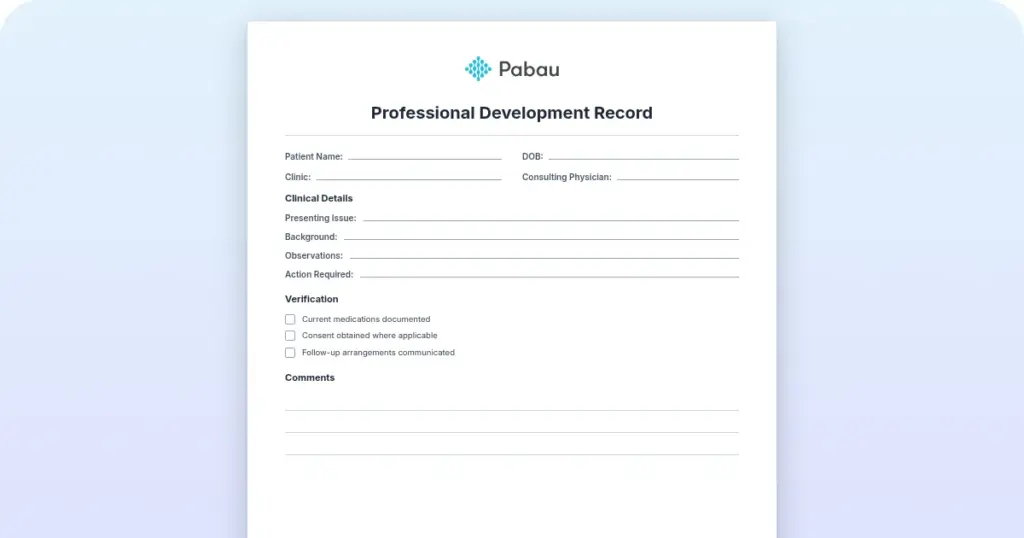
Professional development record
A professional development record is a structured log of a healthcare practition...

8
Last Updated: Oct 8, 2026

An OSHA emergency action plan is a written safety document required by 29 CFR 1910.38, and it must be in writing above 10 employees.
The regulation lists six mandatory elements. The employee alarm system sits in a separate provision, 1910.38(d), which is why many templates count seven.
OSHA does not mandate an annual review. It requires a review with each employee at initial assignment, when their duties change, and when the plan changes.
Healthcare settings add patient evacuation, infection control, and record security, because patients in treatment cannot always leave on their own.
Practice management software like Pabau stores the plan, assigns the training, and logs who completed it, so an inspection request takes minutes.
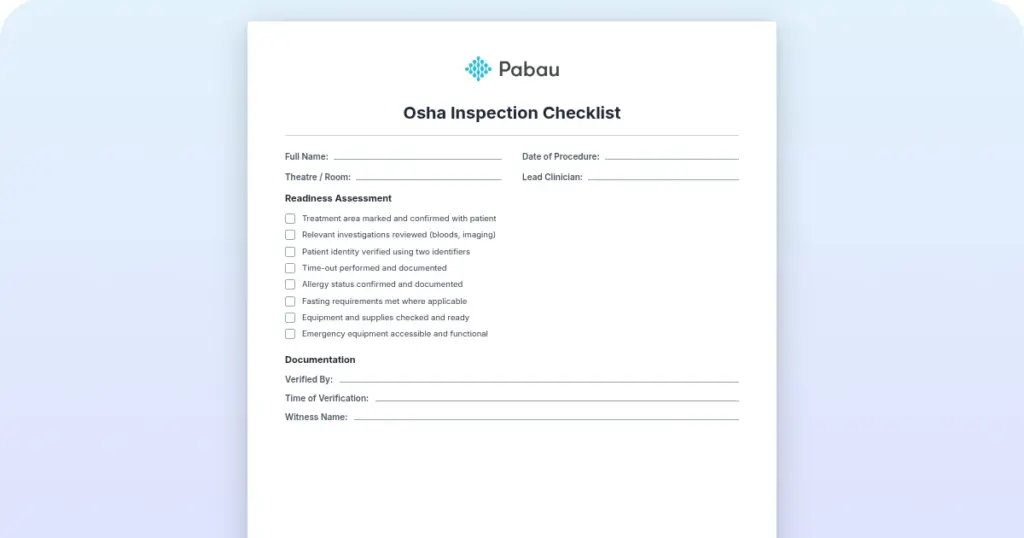
Fill-in sections for evacuation routes, assembly points, emergency roles, and contacts for the fire department, police, and EMS. It also carries response procedures, a communication plan, and space to log drills and training.
Download templateAn OSHA emergency action plan (EAP) is the written document that tells your staff what to do when an emergency hits the building. Under 29 CFR 1910.38, that plan has to be in writing once you employ more than 10 people. Below that headcount, you can deliver it verbally.
The regulation is shorter than most guides suggest. It names six required elements and three moments when you review the plan with an employee. It says nothing about how far your assembly point should sit from the building.
This guide covers each element, then walks you through building the plan for a practice with patients on site. The template above gives you the document to fill in.
It is a written procedure for getting people out of your building safely and accounting for them afterward. Under 29 CFR 1910.38, it covers reporting emergencies, evacuation, employees who stay behind, headcounts, and rescue or medical duties.
The standard applies across general industry, which includes medical offices, therapy practices, med spas, and laser clinics. Employers with more than 10 employees keep the plan in writing and available for staff to read. Smaller employers may communicate it orally, though writing it down is still the safer choice.
Employ more than 10 people and you need a written plan, whatever your specialty. Nurses, physicians, therapists, estheticians, and front desk staff all count.
The requirement follows the workplace, not the treatment menu. A laser clinic with 12 staff and a day spa with 12 staff carry the same obligation.
The 10-employee threshold is the federal standard. Another 22 state plans run their own OSHA-approved programs covering private employers, and those can set stricter rules than the federal floor. Washington, Oregon, Michigan, and California are among them, so check your state agency before you finalize anything.
Section 1910.38(c) lists six mandatory elements. Every one belongs in the written document and in what you tell staff.
Alarm systems are often listed as a seventh element. They sit in a separate provision instead. Section 1910.38(d) requires an employee alarm system, and 1910.165 sets how that system has to work. Your plan still has to say how staff raise the alarm, which is the first element above.
In a practice with patients on site, each element needs a healthcare version. Evacuation has to account for people mid-treatment, and your HIPAA compliance duties do not pause while the building empties.
Work through the five steps in order. Each one produces a section of the finished document.
OSHA separates three duties here, and only one of them is training in the usual sense.
Those dated records sit alongside the rest of your safety documentation. Your OSHA handbook holds the exposure control plan, the hazard assessment, protective equipment rules, and the training log behind them.
Generic templates stop at the six elements. A practice with patients in treatment rooms needs four more sections, because those patients cannot always walk out on their own.
Medicare and Medicaid providers may carry a second obligation on top of OSHA. The CMS Emergency Preparedness Rule covers 17 provider types, each under its own part of 42 CFR. Hospitals sit at 482.15, ambulatory surgical centers at 416.54, and dialysis facilities at 494.62. Independent physician practices and med spas are not on that list, so OSHA is the rule that governs them.
Most practices keep the plan in a binder at reception and the training record in a spreadsheet. The spreadsheet drifts as people join and leave. An inspector then asks who was trained in March, and nobody can answer without digging.
Practice management software like Pabau keeps the document and the proof of training in one place. Upload the plan, assign it as part of onboarding, and compliance management tracking shows who has signed off. Automated workflows send the reminder before each drill date, so chasing it stops being your job.
Every subscription includes these tools, so none of it sits behind a higher tier. Staff only follow a plan they have been shown, and Juvea Medical describes what happens when training is thin. Run more than one site and each location keeps its own plan, roles, and training record.

Pabau stores your emergency action plan, assigns it during onboarding, and logs every staff sign-off. You can produce training records and drill dates for an inspector in minutes.

The plan that works is the one your staff have walked, not the one that reads well on paper. Print the routes, name the wardens, and run a drill before you file the document away.
The trade-off is simple. A thorough plan nobody rehearses falls apart in the first 30 seconds of an alarm, while a plain one everybody has practiced holds up.
Download the template, adapt it to your building, and set a date for the first drill. Book a demo to see how Pabau assigns the plan during onboarding and keeps your training records ready for inspection.

Need a HIPAA notice for your patients? Notice of privacy practices template is a four-page notice covering patient rights, covered entity duties, and a signed acknowledgment page.
Need a wider crisis plan beyond OSHA drills? Crisis management plan template gives six steps to build your operational plan, including HIPAA and CQC reporting clocks.
Working in a skilled nursing setting? MDS assessment cheat sheet is a quick reference covering all 17 MDS sections and the updated Section GG scoring.
Not sure if the CQC applies to you? Understanding the Care Quality Commission explains what the CQC regulates in England and which treatments put your practice in scope.
Storing your emergency plans in an EHR? EHR security risks and best practices covers the technical, administrative, and physical controls that protect electronic health records from unauthorized access.
It protects employees and patients by setting out how you report an emergency, evacuate, perform rescue or medical duties, and account for everyone afterward. The plan means each person knows their role and where to go before anything happens.
Employers in general industry with more than 10 employees need the plan in writing. With 10 or fewer, you may communicate it orally, though a written version is strongly recommended. Medical offices, therapy practices, and med spas all fall under 29 CFR 1910.38.
Section 1910.38(f) sets three triggers rather than a schedule. You review the plan when it is written, when an employee is first assigned, when their duties under it change, and when the plan changes. An annual review is best practice, not a legal requirement, and reviewing after each drill keeps the document usable.
It is the OSHA standard that sets what an emergency action plan must contain in general industry. Paragraph (c) lists six elements. Those are reporting procedures, evacuation and exit route assignments, and procedures for employees who stay behind. The rest are employee accounting, rescue and medical duties, and a contact for questions. The employee alarm system is a separate requirement under paragraph (d) and 1910.165.
No. The regulation lets you communicate the plan orally at that size. A written version is still worth having, because it documents what you told staff, keeps the detail consistent, and makes training and audits far simpler.
Yes, for some facilities. Providers billing Medicare or Medicaid may fall under the CMS Emergency Preparedness Rule, which covers 17 provider types under separate parts of 42 CFR. Hospitals sit at 482.15, ambulatory surgical centers at 416.54, and dialysis facilities at 494.62. Independent physician practices and med spas are not on that list. State plans and local fire codes can also add requirements.