Pabau vs ICANotes: Psychiatry billing software compared
Psychiatry billing software decides whether your practice gets paid accurately, ...

Last Updated: Oct 14, 2026

Acuity Scheduling is a flexible booking tool best for solo practitioners who need scheduling, packages, and calendar sync but don’t require clinical documentation.
SimplePractice is an all-in-one platform for therapists and mental health professionals, with built-in HIPAA compliance, insurance billing, and progress notes.
Acuity’s HIPAA BAA requires the Premium plan ($49/month); SimplePractice includes HIPAA compliance across all paid plans.
Pabau is the stronger choice for multi-practitioner and aesthetic or medical clinics needing clinical documentation, treatment records, and multi-location workflows.
The acuity scheduling vs simplepractice debate comes down to a fundamental difference in scope. Acuity is a scheduling tool. SimplePractice is a practice management system. Comparing them head-to-head only makes sense if you understand what problem each one is designed to solve.
Acuity Scheduling, now owned by Squarespace, is built around one core task: making it easy for clients to book appointments online. It does that exceptionally well. SimplePractice, by contrast, was built from the ground up for health and wellness professionals, with HIPAA compliance, clinical documentation, insurance billing, and a client portal all included. These are different categories of software that happen to overlap on scheduling.
This guide covers scheduling, clinical documentation, HIPAA compliance, billing, pricing, and where each platform genuinely falls short, so you can make a clear decision. We also cover Pabau as an alternative for clinics that outgrow either tool.
Both platforms handle appointment scheduling, but their depth and target user are quite different.
Acuity Scheduling is built specifically for booking. Clients get a customizable booking page, can select appointment types, purchase packages or bundles, and pay at booking. Calendar syncing with Google Calendar, Outlook, and iCal is included. Automated reminders go out by email and SMS. For solo practitioners, coaches, or wellness providers who primarily need a polished booking experience, Acuity is hard to beat on ease of setup.
SimplePractice approaches scheduling from within a clinical workflow. Its calendar is integrated with the client record, meaning you can see intake status, outstanding forms, and session history from within the same view. Group appointments support up to 15 participants, confirmed on SimplePractice’s own support documentation. Calendar sync covers Google, iCal, and Outlook. Client-facing scheduling goes through the SimplePractice client portal, which also handles secure messaging and form collection.
The key difference: Acuity gives clients more flexibility and a more consumer-friendly booking experience. SimplePractice keeps everything within a HIPAA-compliant clinical environment, which matters for therapists and counselors.
HIPAA compliance is where this comparison gets genuinely consequential. Getting it wrong exposes you to regulatory risk. Understanding HIPAA compliance for clinic software is essential before committing to any scheduling platform.
SimplePractice is fully HIPAA-compliant across its paid plans. A Business Associate Agreement (BAA) is included, encrypted storage and transmission are standard, and the platform was designed from the start with therapists’ compliance obligations in mind. For US-based mental health professionals, this removes a significant decision burden.
Acuity Scheduling’s HIPAA compliance is plan-gated. Multiple third-party sources, including Upheal and Jotform, confirm that a HIPAA BAA is only available on the Premium plan, which is priced at approximately $49/month. The lower-tier plans do not include BAA coverage. This distinction matters: if you’re using Acuity on a Emerging or Growing plan without a BAA, you may be handling PHI without adequate legal protection.
For US therapists and health practitioners, the practical implication is clear. If HIPAA compliance is non-negotiable (and for anyone handling PHI in the US, it is), SimplePractice covers it on every paid plan. Acuity requires you to be on the right tier and to explicitly obtain the BAA. Check the HHS HIPAA regulations for the definitive requirements on BAAs and covered entities.
This is the sharpest dividing line between the two platforms.
SimplePractice includes a full suite of clinical documentation tools. Progress notes and psychotherapy notes are built in. Treatment plans, intake forms, and consent documents can be created and sent digitally to clients before appointments. Templates are customizable, and documentation is linked to client records. For therapists, counselors, and mental health professionals, this removes the need for a separate notes system entirely.
Acuity Scheduling has no native clinical documentation. It is a scheduling tool, not a clinical records system. Intake forms can be attached to appointment types and completed by clients at booking, which is useful for basic intake data. But there is no progress note functionality, no treatment planning, and no clinical record structure. Practitioners who use Acuity for clinical work typically run a separate EHR or documentation tool alongside it.
For any practitioner whose work involves clinical notes (therapists, physiotherapists, occupational therapists, medical practitioners), Acuity alone is insufficient. SimplePractice is the clearer choice within this comparison for documentation-heavy workflows.
Billing is another area where the platforms diverge significantly.
SimplePractice includes insurance billing and superbills. Practitioners can submit claims, track payer status, and generate superbills for clients who self-pay and seek reimbursement from their insurer. For therapists working with insurance panels, this is a significant operational feature. Online payment collection, invoicing, and credit card processing are also included.
Acuity Scheduling handles payment processing at the booking stage. Clients can pay when they book, and integrations with Stripe and PayPal are available. However, Acuity does not support insurance billing or claim submission. Practitioners who bill insurance cannot do so from within Acuity. This is a hard limit for clinicians in insurance-heavy markets.
A self-pay therapist or wellness coach can operate comfortably with Acuity’s payment tools. A therapist billing insurance panels needs SimplePractice’s claims functionality, or a third-party billing system alongside Acuity. Factor this into your decision before committing.

Pabau combines scheduling, clinical documentation, treatment records, and billing in one platform built for aesthetic, medical, and physiotherapy clinics. See how it handles your workflows.

Pricing structures differ substantially, and the right choice depends on which features you actually need.
Acuity’s free tier is useful for testing the booking experience, but it strips out most features. The critical point: HIPAA compliance on Acuity requires the Premium plan. A therapist who signs up for the $16/month plan and begins collecting PHI without a BAA is not adequately protected. SimplePractice’s 30-day free trial (confirmed on their official site) gives practitioners a more complete picture of the full clinical workflow before committing.
According to Capterra reviewers, Acuity Scheduling holds a 4.8/5 rating based on over 5,747 verified reviews. Users consistently praise its ease of setup, flexible booking pages, and package scheduling.
According to Capterra reviewers, SimplePractice holds a 4.6/5 rating. Positive themes include its all-in-one functionality for therapists, built-in HIPAA compliance, and the quality of its client portal.
Telehealth has become a standard expectation for many health and wellness practices. The two platforms handle it very differently.
SimplePractice includes built-in telehealth across its paid plans. Video sessions run through the platform’s own HIPAA-compliant infrastructure, meaning no separate Zoom account, no third-party data routing, and no additional cost. Sessions are tied directly to client records. For therapists delivering remote sessions, this integration matters for both compliance and workflow efficiency. Pabau similarly provides built-in telehealth tools for clinical practices that want everything in one system.
Acuity Scheduling does not have native telehealth. Video consultations happen through a Zoom integration. This works fine operationally, but it introduces a second platform into the workflow and means video session data sits outside Acuity’s environment. For practitioners with HIPAA obligations, this requires verifying that Zoom is configured correctly and that a BAA is in place with Zoom as well.
On integrations more broadly, Acuity has the wider general-purpose ecosystem. Connections to Squarespace, Zoom, Stripe, PayPal, Mailchimp, and a range of CRMs are available. SimplePractice’s integrations are more clinically focused: Google Calendar, Stripe, and select billing partners. For a practitioner who needs Acuity to fit into an existing website and payment stack, that breadth is genuinely useful.
If you’re using Acuity Scheduling and relying on Zoom for telehealth, verify your Zoom account has a signed HIPAA BAA in place. Acuity’s BAA only covers data within the Acuity platform itself. A Zoom session routed through an account without a BAA creates a separate compliance exposure.
Both Acuity Scheduling and SimplePractice are designed for solo or small-group therapy and wellness practices. They are excellent at what they do for that audience. Clinics that operate across multiple practitioners, disciplines, or locations often find both tools reach their limits quickly. That same ceiling is why many growing clinics also research Boulevard alternatives when shortlisting platforms.
Pabau is built for exactly that clinical complexity. Multi-practitioner calendar management, room and resource booking, automated reminders, and waitlist management sit within a single unified system. On the clinical side, customizable treatment note templates, medical history forms, consent management, SOAP notes, before-and-after photo management, injection plotting, and digital intake forms are all included. For aesthetic clinics, dermatology practices, physiotherapy, IV therapy, and other specialties not served by therapy-focused platforms, this breadth matters.
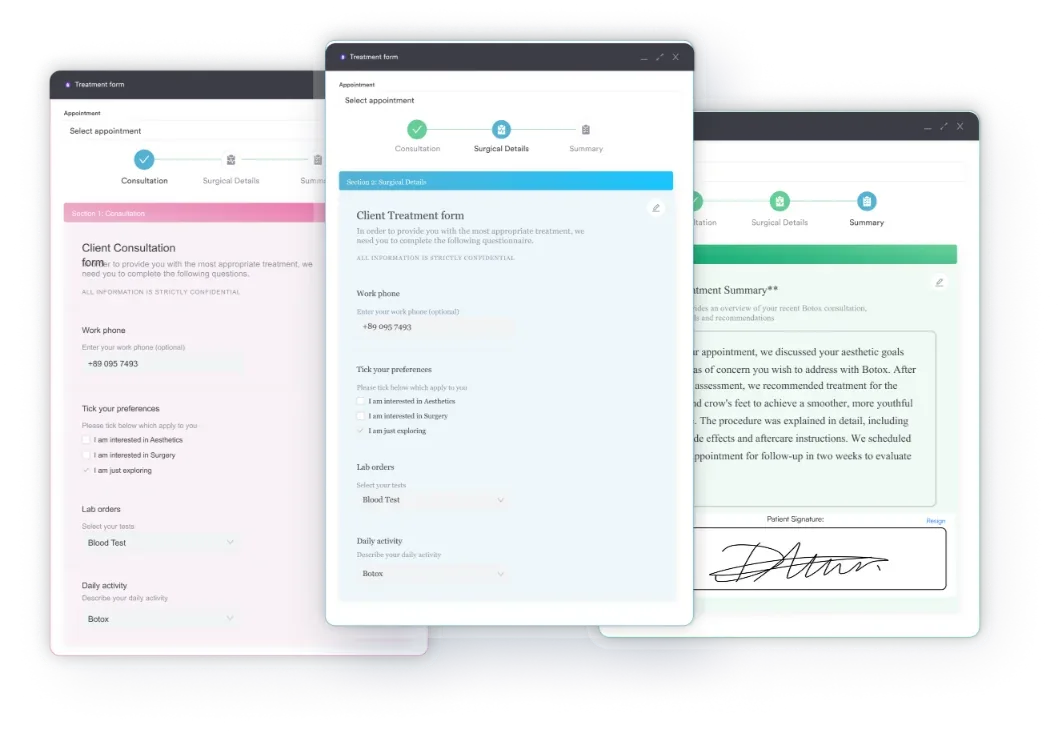
Billing in Pabau is integrated with treatment records rather than sitting as a separate layer. Invoicing, deposits, payment links, and financial reporting are all tied to the clinical workflow. Inventory management, which neither Acuity nor SimplePractice offers, is built in for clinics managing product stock alongside treatments.
According to Capterra reviewers, Pabau holds a 4.7/5 rating from over 600 verified reviews. Reviewers highlight comprehensive clinical and scheduling features, strong treatment record management, and its suitability for multi-practitioner environments. The learning curve is noted as steeper than Acuity’s, which reflects the greater operational depth of the platform rather than a design flaw.
Pabau operates under GDPR compliance for UK and EU markets. US-based clinics should assess their specific regulatory requirements before selecting any platform. Pabau pricing starts from $104/month, scaling with location and user count.
The decision is clearer than it might appear once you map your actual needs against each platform’s design focus.
Choose Acuity Scheduling if you are a solo practitioner, coach, or wellness provider whose primary need is a polished, flexible online booking system. You do not need clinical documentation, you are either self-pay or not HIPAA-governed, or you are willing to pay for the Premium plan and manage compliance yourself. Acuity’s package scheduling and broad integrations make it a strong choice for this use case. A side-by-side Pabau vs Acuity Scheduling comparison shows where Acuity’s booking depth ends.
Choose SimplePractice if you are a therapist, counselor, or mental health professional in the US who needs HIPAA compliance, clinical documentation, insurance billing, and a full client portal in one system. SimplePractice was built for this audience and covers it thoroughly. The 30-day free trial is a low-risk way to evaluate whether it fits your workflow.
Choose Pabau if you operate a multi-practitioner aesthetic, medical, physiotherapy, or multi-discipline clinic where scheduling is one part of a larger operational picture. If you need clinical records, treatment documentation, inventory management, and multi-location support, neither Acuity nor SimplePractice is designed for that environment. Explore therapy practice management capabilities and how Pabau handles multi-specialty operations.
Practices outside the US work from a different shortlist, since local billing and privacy rules decide which systems qualify. German practices, for example, start with German practice software built for the country’s own billing rules.
The acuity scheduling vs simplepractice comparison is really a question of scope. Acuity is a scheduling specialist with a low entry price and broad integrations. SimplePractice is a full practice management system built for therapists and mental health professionals, with HIPAA compliance, clinical notes, and insurance billing included from the start.
Neither is designed for multi-practitioner clinical environments that need treatment documentation, inventory, or multi-location workflows. If your practice has outgrown what either tool offers, book a Pabau demo to see how a unified clinical platform handles the operational complexity of a growing clinic.

Looking for Pabau alternatives? Pabau competitors and alternatives ranks 15 options for med spas, aesthetics, and healthcare practices by features and pricing.
Serving clinics in South Africa? Pabau vs Healthbridge comparison compares features, pricing, reviews, and compliance for South African clinics choosing practice management software.
Weighing aesthetic clinic software options? Pabau vs Portrait Care comparison compares how each platform approaches practice management, compliance, and the patient journey for aesthetic clinics.
Acuity Scheduling is primarily a flexible online booking tool with package scheduling and broad integrations, built for solo practitioners and coaches. SimplePractice is a full practice management system designed for therapists and mental health professionals, including HIPAA compliance, clinical documentation, insurance billing, and a secure client portal.
Acuity Scheduling can be used in a HIPAA-compliant way, but only on the Premium plan (approximately $49/month), which includes a Business Associate Agreement. Lower-tier plans do not include a BAA, meaning practitioners handling PHI on those plans may lack adequate legal protection.
Yes, SimplePractice offers a 30-day free trial on its paid plans, as confirmed on their official website. This allows practitioners to evaluate the full clinical workflow, including documentation, billing, and the client portal, before committing.
No. Acuity Scheduling does not support insurance billing or claim submission. It handles payment collection at the point of booking through integrations with Stripe and PayPal, but practitioners who bill insurance panels need a separate billing system or should consider SimplePractice instead.
SimplePractice is the stronger choice for most therapists. It includes HIPAA compliance on all paid plans, progress notes, treatment plans, insurance billing, and a full client portal. Acuity is better suited to wellness practitioners who need flexible booking without clinical documentation requirements.
Power Diary rebranded as Zanda in late 2024, but it’s the same allied health practice management platform, with built-in Medicare and DVA claiming for Australian clinics. SimplePractice is built for the US market, with insurance billing and HIPAA compliance included on every paid plan. Practices billing Australian Medicare fit Zanda’s workflow better; US-based mental health practices are served better by SimplePractice.
Splose is an Australian platform built for allied health and NDIS-funded practices, with direct NDIS claiming and per-practitioner pricing reported at around $27/month. SimplePractice targets US-based therapists instead, bundling HIPAA compliance, insurance billing, and clinical notes into one system. The right choice depends on which country’s funding rules and compliance requirements your practice operates under.