Tanja Lepcheska

Healthcare dashboard examples: 6 real-world use cases
The most useful healthcare dashboard examples fall into six types: executive, cl...

Last Updated: Nov 11, 2026
Free PDF 8 pages, print-ready Clinician-reviewed
Weekly goals are three to five specific, measurable targets you commit to finishing within one week. They sit between a daily to-do list and a monthly plan. A weekly goals template keeps them on one sheet, with tasks, a deadline, a priority and a status box for each goal. It closes the week with a short reflection. Seven days is short enough to finish and long enough to see progress. This guide covers how to set and review weekly goals, with examples for work, study, health and money.
Five goal blocks, each with space for tasks or actions, a deadline, a high, medium or low priority and a status box. The final page holds an end-of-week reflection and additional notes.
Start from scratch, or upload this PDF or any form you already use, and Pabau's AI Form rebuilds it with tick boxes, text fields and a signature. Attach it to the treatment once, and every patient gets it on time.
AI Form rebuilds the consent, history and aftercare forms you already use. You review each one, then publish.
Patients complete forms on their phone before they arrive, so the front desk stops retyping paper.
Every signed form is versioned and attached to the treatment record, ready when you need it.
Set how long a consent stays valid. Returning patients skip forms they have already signed.
Supports HIPAA and GDPR compliance AES-256 encryption 4.8 on G2 4.7 on Capterra Trusted by 4,000+ practices worldwide

Weekly goals bridge daily tasks and long-term plans with measurable, one-week targets.
Three to five focused goals are easier to finish than a long weekly to-do list.
The template gives each goal its own tasks, deadline, priority and status, then closes the week with a reflection.
Examples span work, health, learning, relationships and personal development.
Pabau’s digital forms let practices send the weekly goals template to patients and file each completed sheet.
Weekly goals are the specific outcomes you commit to completing within a seven-day period. They sit between daily task lists and monthly or annual plans, so each week moves you a step closer to something bigger.
Weekly goals also suit people who find long-range plans hard to act on. A target you can review on Friday is easier to discuss and adjust than a vague ambition for the year. Goal-setting research points the same way. Locke and Latham’s work on goal-setting theory links specific, challenging goals to better performance than general intentions such as “do your best”.
Use a weekly goals template by writing the week’s objectives on day one and reviewing them at the end of the week. The steps below follow the core purpose of the form: setting personalized objectives within one week, tracking progress and building accountability.
Each of those steps lands on a different part of the form, and the four stages below show which fields you use on which day.
Weekly goals template · one week, field by field
Where each part of the form does its work
Up to five goals per sheet, each with its own tasks, deadline, priority and status.
1 · Monday
Set up the week
Fill in the header, then write up to five goals.
NameDateWeek no.Goals
2 · Monday
Plan each goal
Break it into actions, date it and rank it.
Tasks/actionsDeadlineHigh · Medium · Low
3 · Midweek
Update the status
Tick the box that matches where each goal stands.
Not startedIn progressCompleted
4 · Friday
Reflect and carry forward
Note what got in the way, and what moves to next week.
ReflectionAdditional notes
How the fields of the weekly goals template map onto one week. Source: Pabau weekly goals template (8-page PDF), fields as printed on the form.
The form has no separate box for measuring progress, so build the measure into the goal sentence itself. “Walk for 30 minutes on four days” can be ticked off on Friday, while “exercise more” cannot.
Keep the template somewhere you check every day, such as your calendar or a shared folder, so the goals stay in view. If a goal has not moved for two weeks, shrink it rather than repeating it unchanged. A smaller step is usually more useful than another week of the same unfinished task.
Strong weekly goals are specific, time-bound and small enough to finish within seven days. A SMART goals worksheet applies the same tests to longer goals. The table below gives one example for each area of life, and the sections that follow add more detail for work, students and wellbeing.
Work goals are most useful when each one ends in something visible, such as a draft, a booked meeting or a closed task. Many people pick three priorities for the week and treat the rest of their workload as secondary.
Students often have several deadlines running at once, so weekly goals help rank the work. A goal that names a specific task and a finish day is much easier to act on than “study more”.
Small, achievable steps sit at the center of most wellbeing guidance, including the NHS Every Mind Matters program. A weekly health goal works best when it describes a behavior you control, such as a bedtime, rather than an outcome you cannot fully influence.
Running a practice? Book a demo with the team behind Pabau’s practice software to see structured templates working alongside patient records.
Weekly goals connect to monthly and long-term planning by acting as the smallest step in a planning cascade. Each daily action feeds a weekly goal, each weekly goal advances a monthly goal, and each monthly goal moves you toward a longer-term aim.
Monthly goals suit longer projects, and they are easier to plan when the weekly targets beneath them are already clear. A goal planner lays out those monthly targets and the longer aims they serve. Annual goals are not needed for every reader, but if you set them, weekly goals give the big target a concrete starting point.
In therapy, goals usually follow an assessment, so teams that use a structured psychiatric evaluation can link its findings to weekly targets. That keeps each week’s work tied to the reason it matters.
Review your goals at the same time every week, ideally at the end of the working week. A short review keeps the habit manageable, and the questions below cover what matters most.
Write the answers in the template’s reflection box, then carry them into next week’s sheet so the review shapes the plan. Over a few weeks, the pattern of completed and stalled goals shows which sizes and types of goal suit you best. When a coach or therapist reviews the sheet with you, an accountability worksheet can give that conversation a structure.
Therapists, coaches and wellbeing practices often hand out goal sheets on paper. The completed sheet then stays in a bag or a drawer, and the next session starts from memory.
Pabau, the platform behind our therapy practice management software, can run the weekly goals template as a digital form. Patients fill it in through the patient portal, and each completed sheet is saved to their record for the next review. Our overview of why practices choose Pabau covers the rest of the platform.
The sheets sit in the same record as session notes and scored measures such as PHQ-9, as our mental health EMR software overview shows. For less admin after each review, Pabau Scribe, our AI scribe, provides AI-powered clinical documentation by drafting the session note.
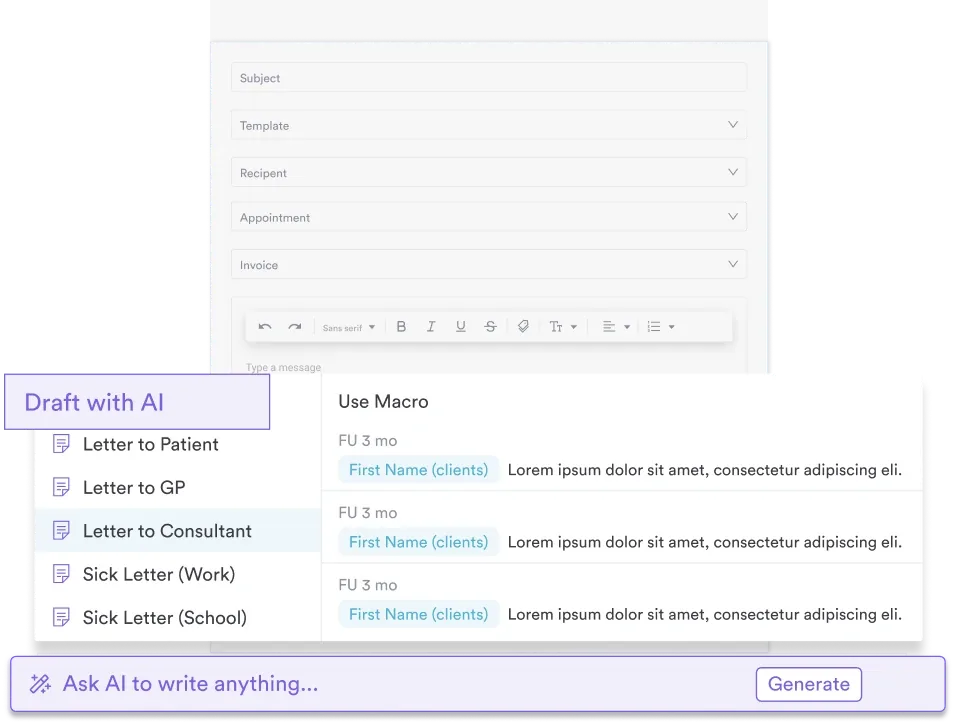

Pabau turns the weekly goals template into a digital form that patients complete online. Each sheet is saved to their record, ready for the next review.

Start smaller than feels necessary. Three goals that each end in something visible by Friday teach you more about your pace than five ambitious ones that stall.
The Friday reflection is what pays off over time. After a month of sheets, the finished and stalled goals show how large a weekly goal should be. They also reveal which kinds you tend to postpone.
For practices, the same sheet gives patients a written thread between sessions. Book a demo to see how Pabau sends the weekly goals form to patients and files each completed sheet in their record.

Want to track the daily habits behind each goal? Habit tracker template gives a simple form to log daily progress.
Need structure for each day of the week? Daily routine worksheet for adults helps plan the daily routines that weekly goals depend on.
Struggling to start the week’s goals? Motivational worksheet helps patients explore what motivates them.
Coaching clients through weekly targets? Coach planner is a planning template built for professional coaches.
Looking for prompts for the Friday reflection? Journal prompts for mental health offers prompts that support regular self-reflection.
A weekly goals template is a structured form for setting objectives for one week, tracking progress and reflecting on the outcome. It suits people who want a repeatable structure rather than a loose to-do list.
Daily goals are actions completed within one day, while weekly goals are measurable outcomes completed within seven days. Weekly goals give you a wider view of progress and room to adjust before the week ends.
Set no more than three to five goals, break each one into daily actions and review progress at the end of the week. Choose goals you can measure, so you can tell at a glance whether you finished them.
Include your weekly goals, the tasks that move each one forward, a deadline, priority and status, and a short end-of-week reflection. The template above follows this structure.