Antipsychotic medication list
An antipsychotic medication list is a structured reference that organizes psychi...

1
Last Updated: Oct 13, 2026
Journal prompts for mental health are guided questions that help people process emotions, notice thought patterns, and build self-awareness through structured writing. Free-form journaling starts from a blank page. Prompts give the writer a specific frame instead. Therapists and counselors assign them as between-session homework for anxiety, depression, stress, and emotional growth.
This page carries 35+ prompts grouped by need: anxiety, depression, stress relief, gratitude, and self-discovery. A morning and evening prompt for each day of the week follows them, along with guidance for therapists. The free PDF below is a daily mental health journal for tracking mood, emotions, gratitude, self-care, and coping.
A single-page daily journal covering mood, emotions, gratitude, self-care, and coping. Print one sheet per day, then review the completed pages together in the next session to spot triggers and progress.
Download template
Journal prompts for mental health are structured reflection questions that help people process difficult emotions and build self-awareness between therapy sessions.
Expressive writing research links regular journaling to lower anxiety and depressive symptoms, though the effect varies between studies and populations.
Therapists assign journaling prompts as homework in CBT and DBT to reinforce session content and track emotional patterns between appointments.
This page carries 35+ prompts for anxiety, depression, stress, gratitude, and personal growth, plus a free daily journal PDF for tracking mood and coping.
Journal prompts for mental health are guided questions that direct the writer toward emotional reflection and self-awareness. They work by supplying structure. Rather than facing an empty page, the writer answers a specific question about thoughts, emotions, or behavior.
Prompts also do clinical work. Therapists assign them between appointments to extend what happens in session, and mental health practice software can store the templates they use. Prompts help patients process difficult emotions, identify triggers for anxiety or depression, practice gratitude, and build insight into their own thinking.
Structured journaling is not the same as keeping a diary. It targets one goal at a time. That might be uncovering automatic negative thoughts in anxiety, building behavioral activation during depression, or strengthening self-compassion through gratitude.
Research on expressive writing, including studies in APA-published journals, links regular writing about emotional experience with lower anxiety and depressive symptoms. A review in Advances in Psychiatric Treatment compared expressive writing with neutral writing tasks. People who followed the writing protocol generally had better psychological outcomes. The same review notes that results are less consistent in psychiatric populations.
Journaling does not replace professional mental health treatment. It supports therapy, medication, and other evidence-based care.
Effective journaling needs consistency, a private writing space, and honest reflection. These five steps get the most out of the prompts below:
Therapists working through this list should assign one or two prompts as homework, then discuss the responses in the following session. Tracking patterns across several entries shows whether a treatment goal is moving.
The five sets below do different jobs, so the table maps each one to what it targets and when to reach for it.
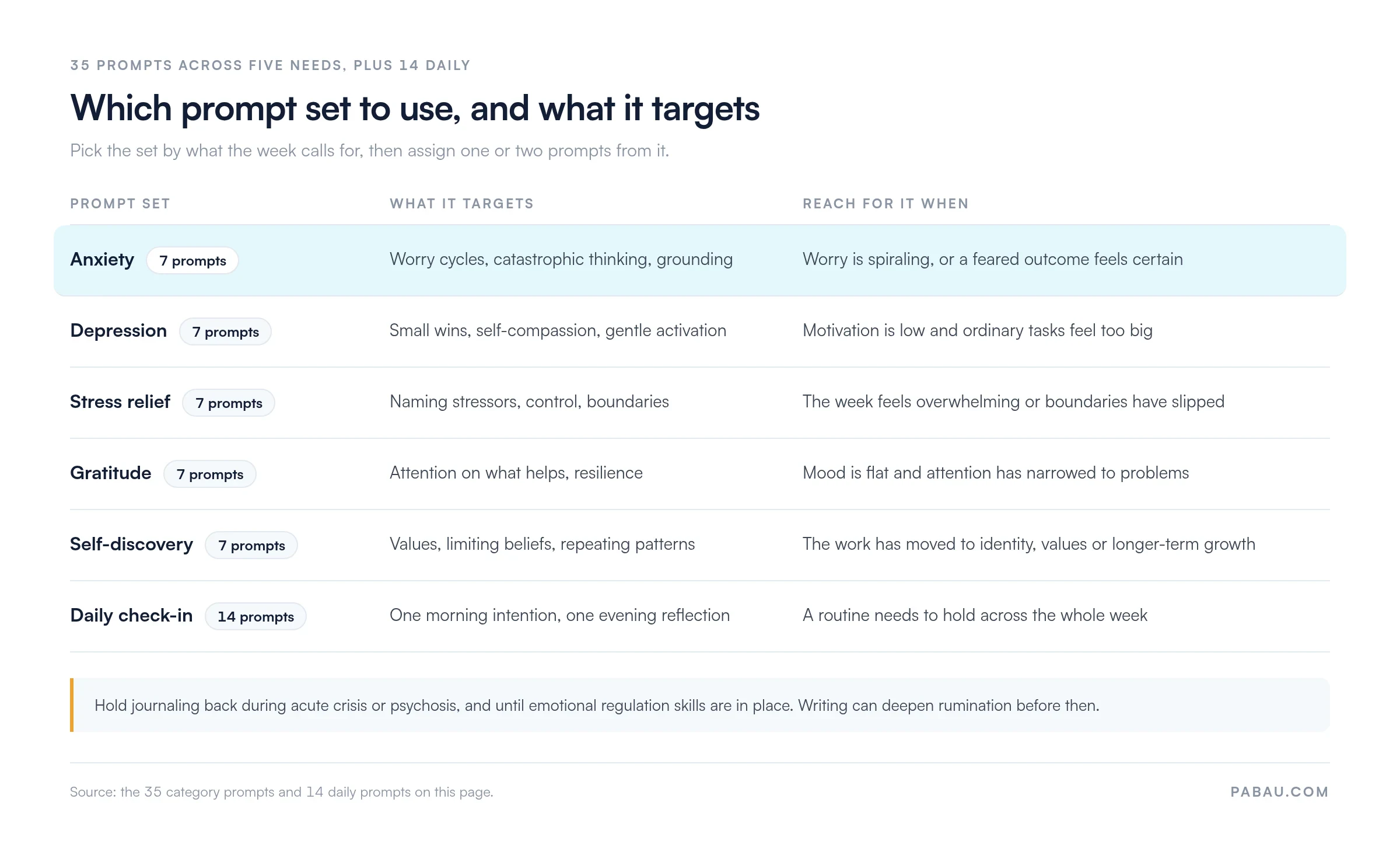
Anxiety prompts help the writer identify worry cycles, challenge catastrophic thinking, and practice grounding. They suit generalized anxiety disorder, social anxiety, and health anxiety:
Someone too anxious to settle into writing needs grounding first. Our grounding techniques worksheet covers the exercises to use before the last prompt makes sense.
Depression-focused prompts gently activate reflection and motivation during low mood. These are designed to be achievable and compassionate, not demanding:
Stress-focused prompts help identify stressors, develop coping strategies, and decompress. Use these when feeling overwhelmed or burned out:
Gratitude journaling shifts attention toward positive experience and supports resilience. Research links gratitude practice with lower depressive symptoms and higher life satisfaction. Use these daily or weekly:
Self-discovery prompts support identity work, values clarification, and personal development. They suit longer-form reflection or therapy focused on growth:
A structured daily routine keeps mental health work consistent. Use one morning prompt for intention-setting and one evening prompt for reflection:
Therapists integrate journaling homework into treatment across modalities. Cognitive-behavioral therapy (CBT) uses prompts to identify automatic thoughts and challenge cognitive distortions. Dialectical behavior therapy (DBT) assigns emotion regulation and mindfulness journaling to strengthen skills between sessions.
Clinicians track patient progress by reviewing entries for patterns. They look for the frequency of anxious thoughts, behavioral activation in depression, emotional triggers, and evidence that coping skills are being used. Digital intake forms in Pabau, the practice software we build, let therapists share structured questionnaires and store completed responses in the patient record.
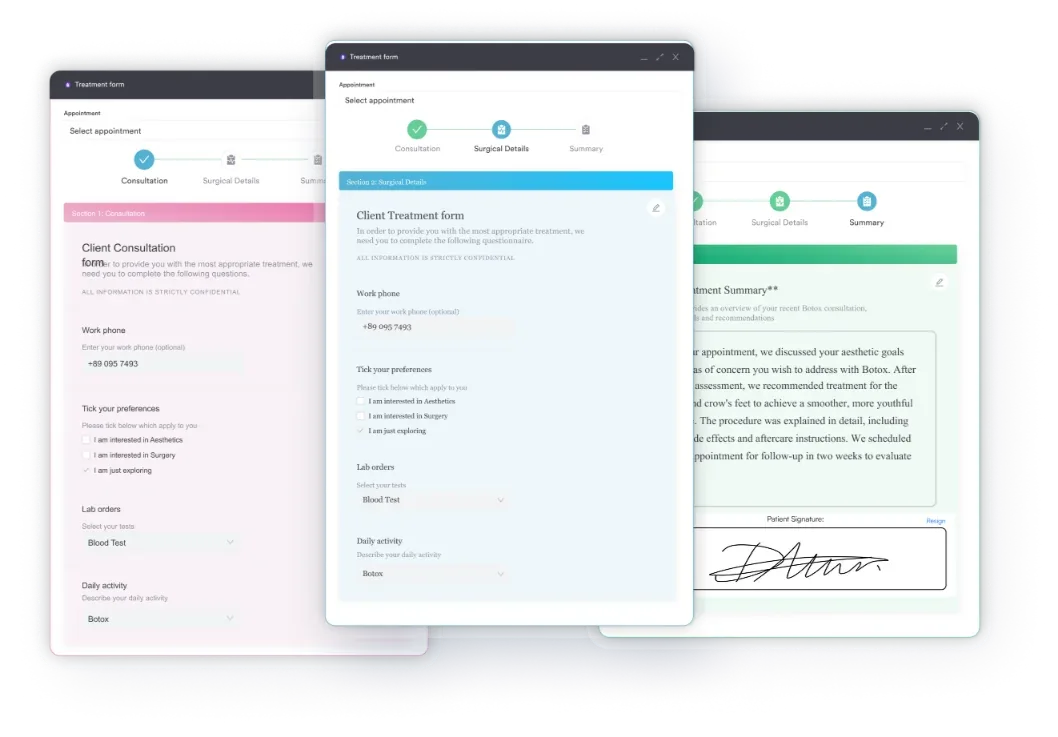
Best practice is to assign one or two prompts tied to the patient’s treatment goal, then discuss the responses in session. Some therapists read entries diagnostically, since patterns can reveal thought distortions, avoidance, or unprocessed trauma.
Documentation still has to happen after the session ends. Pabau Scribe, our AI medical scribe, helps draft session notes from the appointment. What you discussed about a patient’s entries reaches the record without a long write-up that evening.
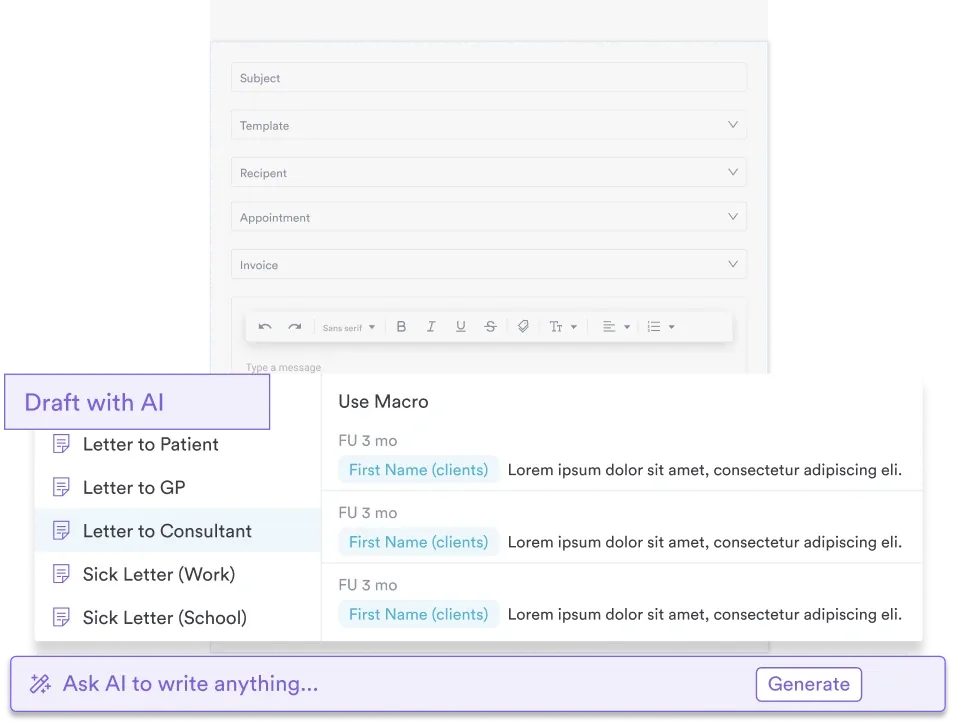
Assign one prompt at a time rather than handing a patient the whole list. Review the response in the next session and discuss what patterns emerged. That extends the therapeutic work and shows the patient their writing is being read.
Journaling works best for people with some capacity to reflect and put thoughts into words. It helps most with anxiety, depression, grief, and personal growth.
Writing can deepen rumination when someone is in acute crisis, experiencing psychosis, or still building emotional regulation skills. In those cases, behavioral activation, grounding, or crisis intervention takes priority, and journaling waits until the person is more stable. Where risk is present, a mental health safety plan belongs in the record before any homework is assigned.
Journaling homework is usually handed out on paper or in a one-off email. What comes back lives in a notebook, and the assignment itself never reaches the patient’s chart. The next session opens with a question about whether the writing happened at all.
Pabau, our therapy practice management platform, sends the same prompt set out as a digital form. The completed response is stored in the patient record, next to the treatment notes it relates to.
Automated workflows send reminders and follow-up messages to patients at set points, so a quiet week does not depend on you remembering to chase it. Pabau Scribe then drafts the session note from the appointment, while the detail of what you discussed is still fresh.

Pabau sends structured forms to patients, stores their responses in the chart, and reminds them when an entry is due. Your next session opens with the work already in front of you.

Prompts work when they are chosen for the moment rather than handed over in bulk. One question a patient can answer honestly on a bad day beats a page of thirty they will skim and abandon.
The harder judgment is knowing when to hold off. Someone in acute crisis, or still learning to regulate their emotions, usually needs grounding or safety planning before any writing assignment.
Start with one prompt set and the daily journal above, then review what comes back before assigning more. Book a demo to see how Pabau keeps journaling assignments, patient responses, and session notes in one record.

Need a structured first-visit assessment? Psychiatric evaluation template covers mental status examination and treatment planning for initial mental health appointments.
Want a quick between-session check-in? Mental health check-in worksheet gives patients a short structured review of mood, sleep, and coping.
Supporting a patient at risk? Mental health safety plan records warning signs, coping steps, and emergency contacts on one page.
Good prompts are specific, emotionally safe, and matched to the current need. For anxiety, they identify worry cycles and challenge catastrophic thinking. For depression, they gently activate motivation and self-compassion. This page carries 35+ prompts grouped by category.
Daily journaling for 10 to 15 minutes shows the strongest benefits in expressive writing research. Three to five sessions a week still help if daily writing is not realistic. Consistency matters more than the length of each entry.
No. Journaling is a complementary tool that supports therapy, medication, and other evidence-based treatment. It extends therapeutic work done in sessions but cannot provide clinical assessment, diagnosis, or crisis intervention. If you are experiencing a mental health crisis, contact a mental health professional or crisis line immediately.
Choose a quiet, private space. Set a consistent time each day. Select one or two prompts that match your emotional need. Write freely for 10-15 minutes without editing. There is no “correct” answer. Consistency matters more than length.
Yes, when used consistently. This page carries research-informed prompts for anxiety, depression, stress, gratitude, and self-discovery, and the journal PDF is free. Effectiveness depends on consistency and honest engagement, not cost.