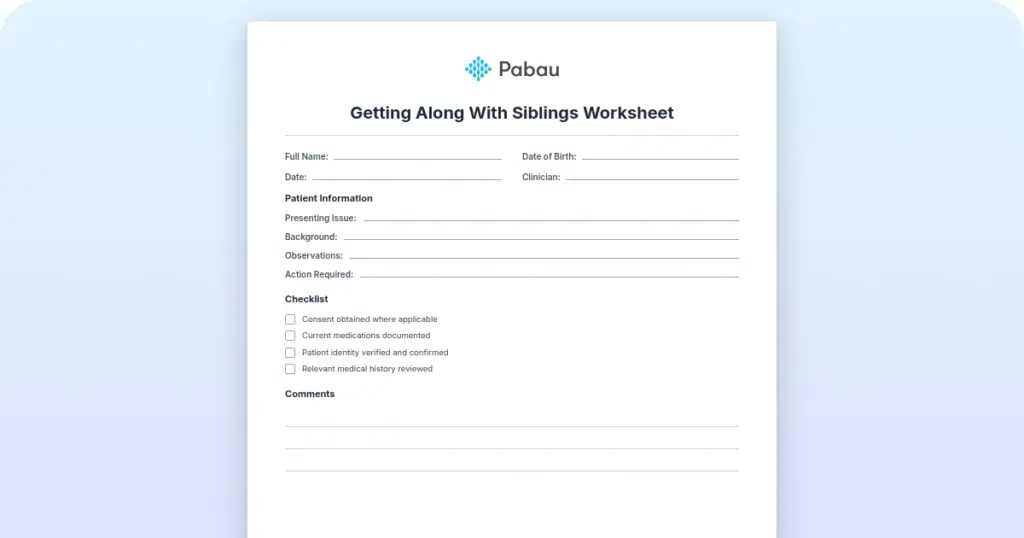
Getting along with siblings worksheet
A getting along with siblings worksheet is a printable that helps children and t...

3
Last Updated: Oct 23, 2026

A habit tracker gives patients a simple written record instead of relying on memory to report progress at each visit.
The free Pabau template covers a name field, a month selector, and an open notes area, so patients can log habits in their own format.
Patients can adapt the notes area to a daily, weekly, or monthly check-in, whichever cadence matches the habit’s difficulty.
Reviewing the notes together turns vague goals into a specific plan you can adjust visit by visit.
Practice management software like Pabau lets you embed the same habit-tracking questions into intake and follow-up forms automatically.
This one-page PDF keeps things simple: fields for the patient’s name and month, plus an open notes area. Patients log progress in their own words, at whatever pace suits the habit.
Download templateAsk a patient to “just keep track of it,” and most trackers stall within a week. A simple sheet that names the habit and leaves room for notes works far better than a vague mental tally.
This template gives you exactly that. Patients write their name, pick the month, and jot progress in an open notes box. It won’t do the tracking for them, but it gives every session a shared starting point.
A habit tracker is a structured way for patients to record daily routines and lifestyle choices. Instead of relying on memory, it gives you both a written record to review together. That record helps you spot patterns, celebrate progress, and refine goals at each visit.
For patient compliance, habit tracking creates accountability. When patients see a visual record of their efforts, marking off successful days or noticing missed ones, they invest more in lasting behavior change.
Research in behavioral psychology confirms that self-monitoring is a powerful motivator for consistency. This matters most in mental health settings, where patients often struggle to notice their own progress week to week.
For practitioners, a habit tracker template serves as a clinical conversation tool. During appointments, you can review the tracking sheet together, ask clarifying questions about barriers or successes, and collaboratively adjust the plan if needed. The template removes the need to create tracking systems from scratch.
Many practitioners ask patients to “just keep an eye on your habits” or “write down what you do.” This informal approach has three core limitations: it lacks structure, generates inconsistent data, and creates friction for busy patients who forget to track mid-week.
The template above keeps things simple: a name field, a month selector, and an open comments box. Here is a practical way to put it to work.
This approach fits neatly into visits across therapy, coaching, functional medicine.
Completed forms belong in structured medical records management, not a filing cabinet.
The beauty of the habit tracker template is its flexibility. Here are common habit categories clinicians use with patients:
Choose habits that directly support the patient’s stated health goal. For example, a patient managing anxiety might focus on sleep, movement, and breathing practice. A patient recovering from injury might emphasize prescribed exercises, hydration, and ice or heat protocols. Specificity matters.
The template doesn’t lock you into one rhythm. Patients can jot entries daily, summarize progress weekly, or add one monthly reflection in the comments box, depending on the goal.
Whichever rhythm you choose, keep the same sheet running for the full month. The comments build into a short, readable timeline you can scan together at the next visit.
Many wellness practitioners and patients use bullet journaling for personal tracking. A habit tracker fits neatly into a bujo system. Print the name-and-month header and paste it into your journal, then rule your own habit grid on the facing page. The comments box still works well as a weekly reflection space.
The same spread can also hold a mood tracker page, so patients log daily mood ratings next to their habits.
Bullet journalists often customize the symbols, using a checkmark for completed, a dash for partial, and an X for missed. Some use color coding or icons instead. The flexibility is part of the appeal, though the underlying tracking principle stays the same.
If you use digital habit-tracking forms in your practice system, offer both options. Patients who prefer paper get the printed template, while others fill in a digital check-in form in your patient portal.

Habit formation is not a mysterious process. Behavioral research by Phillippa Lally and colleagues (2010) shows it takes an average of 66 days for a habit to become automatic. That is well past the commonly cited 21 days.
The real range runs from 18 to 254 days, depending on the person and the habit’s complexity. That is why a single month of tracking rarely captures full automaticity. Sustained tracking across two to three months yields the best results for lasting behavior change.
A 12-week coaching program spans that same window, adding one new habit every two to three weeks.
Tracking works because it creates what behavioral psychologists call a cue-routine-reward loop. The tracking sheet itself becomes the cue, since the patient sees it every morning. Completing the habit is the routine. Marking it off is the reward, a small mental payoff that reinforces the behavior.
Tracking also creates what researchers call the commitment and consistency principle. Once patients write down a goal, or complete a habit, they feel more invested in continuing the pattern. A blank box on a printed tracker is a visual reminder of that commitment, far more powerful than a vague mental note.
This combination of cue, routine. They turn a good intention into a repeatable, evidence-backed routine.
To make habit tracking a natural part of your practice, weave it into your existing systems. This works whether you run a mental health practice or a wellness practice. Introduce the template at the first or goal-setting visit, and walk the patient through choosing their habits. Then print or email them the completed version. Software built for therapy practices treats the session note, not the invoice, as the center of the record.
Set a reminder to review the tracking sheet at each visit. It only takes two to three minutes, but it signals that you are invested in the patient’s progress. Pattern recognition gets easier over multiple visits, since you can see which habits stuck and which needed adjusting. This becomes useful material for clinical conversation and care planning.
A weekly text or email nudge can lift completion rates and keep the tracker top of mind.
Right now, most practices hand patients a printed sheet and hope it comes back at the next visit. Progress notes end up scattered across paper trackers, sticky notes, and whatever the patient remembers to mention.
Pabau turns that paper trail into part of the patient record. You can add habit-tracking questions to an intake or follow-up form, and every answer saves straight into the client’s file, next to their treatment notes.
Automated reminders can prompt patients to update their answers between visits, so the habit data keeps building even without an appointment on the calendar. By the time you sit down together, the pattern is already visible in one place.

Pabau’s digital forms and automated reminders keep habit-tracking answers in one place, so you and the patient see the full picture at every visit.

A habit tracker only works if it’s simple enough for a patient to actually use. This one-page form does exactly that, with space for a name, a month, and what actually happened.
The real value comes from what you and the patient build around it. That might be a hand-drawn grid, a weekly summary line, or an honest note in the comments box. Review it together, adjust the habits that aren’t sticking, and let the record grow month by month.
Book a demo to see how Pabau keeps that record connected to the rest of the patient’s file. Habit tracking becomes one more input into better care, alongside every other note you keep.

Need a full intake before opening a case? case management intake form captures demographics, medical history, referral sources, risk factors, and care needs.
Working on relationship skills alongside habit goals? Friendship worksheet gives therapists and teachers a structured way to talk through social skills that often pair with a tracking habit.
Suspect loneliness beneath the habits you are tracking? chronic loneliness test identifies chronic loneliness, with scoring guidance and interpretation bands for clinical documentation.
Ready to put a coaching business plan together? coaching business plan template runs from executive summary through three-year financial projections.
Treat it as useful information, not a failure. Ask what got in the way, then adjust the habit, break it into smaller steps, or change how often the patient checks in.
Yes. A parent, partner, or caregiver can complete the name and notes sections on the patient’s behalf. This works well for pediatric, elderly, or cognitively impaired patients.
Yes. Use the comments box to log each time the old habit shows up, along with what triggered it. That makes it easier for you and the patient to spot patterns together.
The PDF is not a fillable form, so most practices print a copy per patient. If you prefer digital, open it in a PDF annotator and type over the name and month fields.
Let them use their own shorthand or code words instead of full detail. The goal is a record they will actually keep, not a document written for someone else to read.
For more than two or three unrelated goals, yes. One sheet per goal keeps the comments box readable and makes it easier to spot progress on each habit.