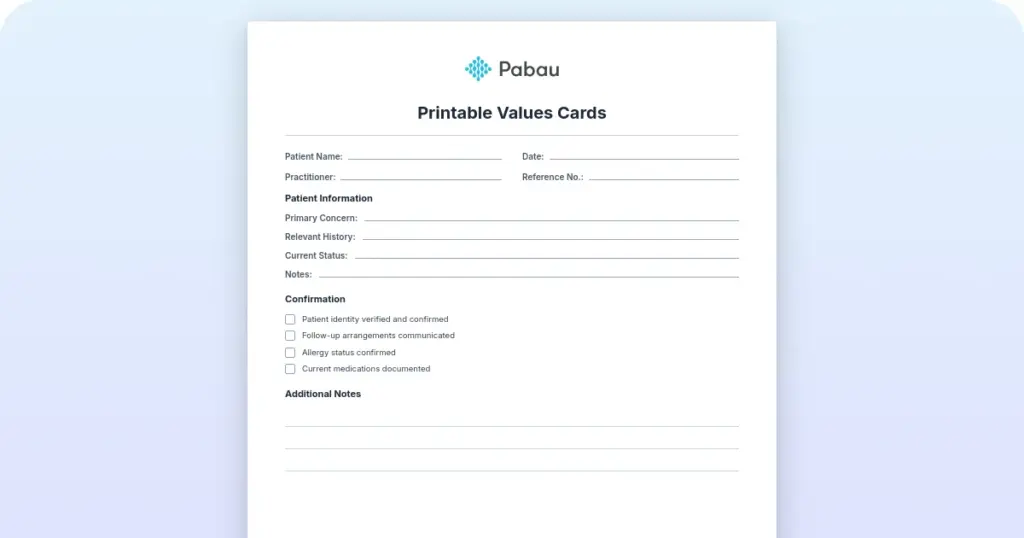
Printable values cards: What they are and how to use them in therapy
Printable values cards are a reflection tool that helps a patient work out which...

14
Last Updated: Sep 30, 2026

A coach planner keeps every client’s sessions, goals, and progress notes in one predictable place instead of scattered across memory, spreadsheets, and sticky notes.
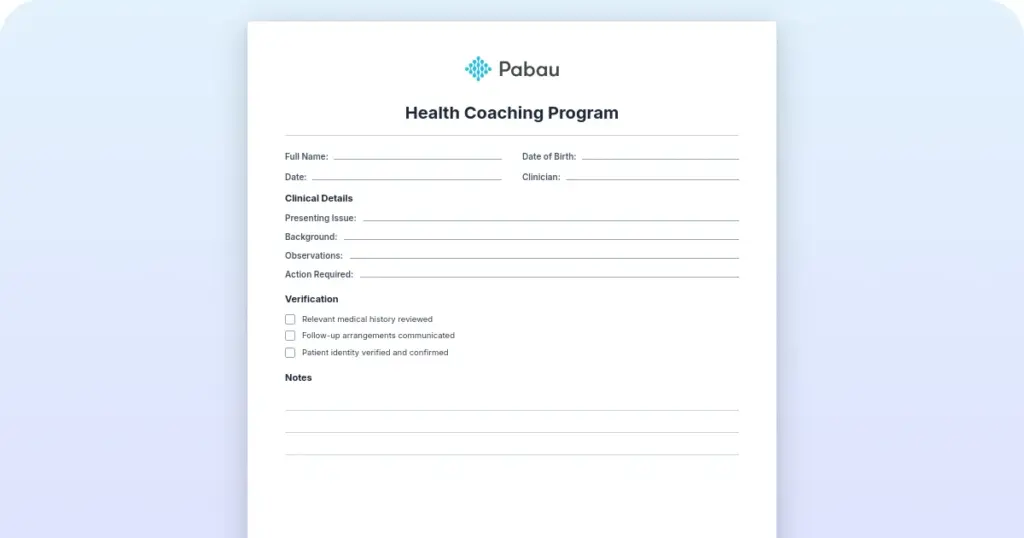
The free Coach Planner download on this page is a simple, ready-to-use form: coach and client contact details, a session schedule and notes box, a coaching goals section, and quick performance and engagement ratings.
A fuller planning system, the kind most established coaches build over time, adds a session agenda, SMART goal tracking, a progress table, and a weekly schedule grid.
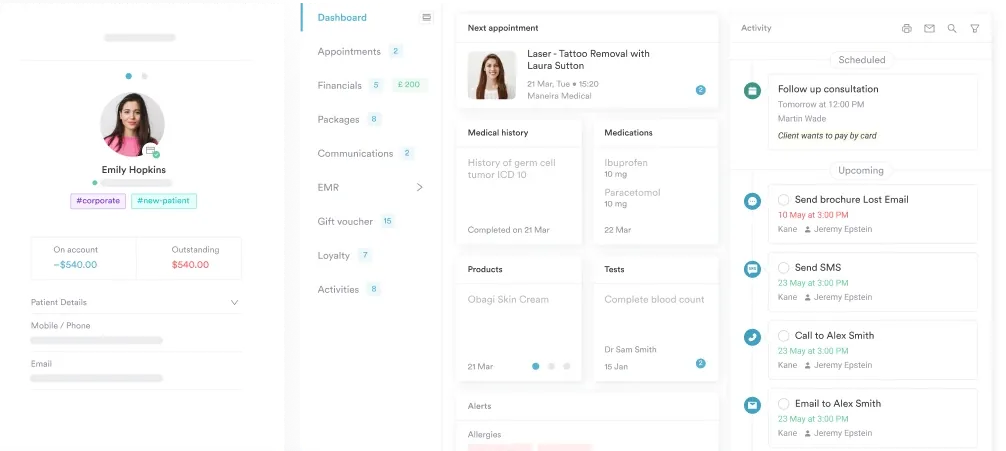
Practice management software like Pabau replaces static planner templates with live client records, automated scheduling, and progress tracking that updates itself.
A simple, ready-to-use coaching form: coach and client contact details, a session schedule and notes box, a coaching goals section, billing and payment tracking, and quick performance and engagement ratings. A practical starting point for a solo practice or a small coaching team.
Download templateMost coaches start with a notebook, a shared document, or a stack of printed session sheets. It holds up fine, until a fifth or sixth client joins the roster. That’s when session notes go missing and goals get forgotten between calls. A coach ends up rebuilding last month’s conversation from memory before the next one starts.
A coach planner fixes that by giving every client’s sessions, goals, and progress notes one predictable home. Grab the free form above to get started. Then use the rest of this guide to build a fuller system as your caseload grows.
A coach planner is a structured document system. It helps coaches organize client sessions, set and track goals, and keep progress documentation consistent. Unlike a generic planner, a coaching-focused version includes client-specific sections: intake information, session agendas, progress milestones, and follow-up action items.
The International Coaching Federation, or ICF, is the profession’s main credentialing body. It defines coaching as “partnering with clients in a thought-provoking and creative process that inspires them to maximize their personal and professional potential.” A coach planner puts that partnership into practice. It creates a shared record of goals, breakthroughs, and next steps that both coach and client can reference between sessions.
A functional coach planner balances comprehensiveness with usability. You need enough structure to stay organized across multiple clients, but not so much that documentation becomes its own chore. Here’s how each section earns its place.
Every new coaching relationship should start with a documented intake. Capture the client’s name, contact details, and coaching focus area, such as a career transition, health goals, relationship work, or business growth. Note preferred communication frequency and any accessibility needs too.
Before each session, outline the key topics and the outcome you want. A simple three-part structure keeps things focused and stops time slipping away on tangents:
Anchor coaching work to a goal framework, whether that’s SMART, GROW, or one you’ve adapted yourself. For each goal, define the outcome, how you’ll measure success, a realistic timeframe, and the milestones in between. A monthly check-in against that framework lets both of you see momentum building instead of just feeling it.
After each session, document key insights, breakthroughs, and action items. These notes are the institutional memory of the coaching relationship. New coaches often push this to the end of the day. By client three, the details from session one have already started to blur. Include what was discussed, what shifted for the client, and what they committed to.
A visual weekly calendar prevents double-bookings and protects time for prep, notes, and admin. Block out coaching hours, buffer time between sessions, and dedicated planning time. Color-coding by client or coaching focus area helps many coaches spot patterns in how their week actually runs.
Life coaches often work across several life domains at once: career, relationships, personal growth, and finances. A life coach planner needs flexible sections. They let you zoom out to the whole-life picture while staying grounded in specific, measurable changes. If you coach exclusively in this niche, a dedicated life coaching template helps. It builds these sections in from the start, rather than adapting a generic one.
Software designed for GP practices can attach this form to the consultation record automatically.
Health coaches combine behavioral change, nutritional guidance, and lifestyle coaching. Their planner needs to track baseline metrics, progress over time, and the behavioral experiments clients try between sessions. A printable weekly wellness planner gives that week of experiments a place to be recorded. As a wellness-focused practice grows past a handful of clients, a spreadsheet stops being enough.
Some health and wellness coaches bill sessions against insurance-recognized codes rather than charging clients directly. If that applies to your practice, take a look at our guide to coaching CPT codes. It covers what’s billable and how coaches typically use the codes.
Business coaches help entrepreneurs grow revenue, build teams, and scale operations. Their planner should focus on measurable outcomes, not emotional or behavioral ones: revenue targets, customer acquisition, team hiring, and strategic milestones.
Track quarterly revenue goals, pipeline activity, team growth metrics, and strategic initiatives in the same planner. Business coaching relationships often run for years, not months. Plan for both quarterly reviews and multi-year strategic goals from the start.
A visual weekly schedule prevents the chaos of managing multiple client sessions across a busy week. Here’s a sample structure you can copy directly:
Notice the buffer built in after each session for documentation. Coaches who skip this step end up writing notes after hours, or not writing them at all. Protect 20-30 minutes after each session to capture notes while the conversation is still fresh.
Use this template before and after every session to keep structure and accountability consistent across clients:
Filling this out right after each session keeps your client records current. You’ll always have a clear trail of progress to reference next time.
Coaches work with clients on long-term change. A goal-tracking section keeps both sides accountable to the bigger picture, not just to whatever came up last session.
Log baseline status when the goal is set. Then revisit it on a fixed cadence, monthly or quarterly both work, and record actual progress each time. This is what separates a tracker from a goal you wrote down once and never opened again. It shows momentum building. It also shows coaches exactly where a client is stuck and needs a different kind of support.
A static coach planner works well for a coach managing 5 to 10 clients. Past that, a spreadsheet or a stack of PDFs starts working against you instead of for you. Automating your planner with digital forms and appointment scheduling software changes how the whole practice runs. It’s not just how one client’s file looks.
Instead of typing client information into a template by hand, clients complete intake forms digitally before their first session. Appointments move online too: clients book their own sessions and get reminders automatically, rather than everyone updating a shared calendar by hand. Session notes stop living in folders as well, since everything sits in one client record that updates in real time.
Practice management software like Pabau takes over the administrative side of planning so coaching time stays coaching time. See how coaches use integrated client records, scheduling, and digital forms together by choosing to book a demo.
A structured coach planner is the difference between chaotic notes and a coherent coaching practice. It keeps clients accountable and preserves session insights. You’ll spot patterns in their progress over weeks and months instead of guessing at them. Download the free form above and adapt it to your coaching niche, whether that’s life, health, business, or wellness coaching.
As a coaching practice grows beyond a handful of clients, a paper or PDF planner stops being enough. That’s when practice management software like Pabau takes over. It replaces scattered planner templates with client records, scheduling, and progress tracking that all live in one place. Start with the free template, and graduate to software once you’re ready to scale past what a spreadsheet can hold.

Want a ready-made session structure? A coaching session agenda template gives you a repeatable format for check-in, focus, and next steps.
Pricing your coaching services? A coaching package template helps you build, price, and sell tiered offers instead of billing session by session.
Need a dedicated place for goals? A client goals template gives each client a standalone record for the outcomes you are tracking together.
Yes. The free download above is a simple, ready-to-use coaching form: coach and client contact details, a session schedule and notes box, a coaching goals section, and quick performance and engagement ratings. It’s a solid starting point for a solo practice; add a session agenda, SMART goals, or a weekly grid as your caseload grows.
Most one-to-one coaching sessions run 45 to 60 minutes, usually every one to two weeks. Shorter, more frequent check-ins suit accountability-heavy work like habit or business coaching, while longer, spaced-out sessions suit deeper life-coaching conversations.
Coaching isn’t regulated the way therapy is, so there’s no universal legal requirement. Even so, dated session notes protect you if a client later disputes what was agreed, and most professional coaching bodies recommend keeping records for at least a few years.
A treatment plan is a clinical document tied to a diagnosis, used by therapists and other licensed providers. A coaching plan carries no diagnosis. It simply tracks goals, actions, and progress for a client who’s functioning well but wants change.
Most solo coaches outgrow a paper or spreadsheet planner around 8 to 10 active clients. Past that point, cross-referencing notes and schedules by hand starts eating into session-prep time, which is usually when practice management software earns its keep.