HIPAA compliant texting: What you can send patients & how to communicate securely
HIPAA compliant texting is possible when a text holds no protected health inform...

Last Updated: Oct 16, 2026

Charm EHR sells three plans: Free, the Encounter Plan at $0.50 an encounter, and the Provider Plan at $200 per provider a month.
There is no Standard or Professional tier, despite what several software directories still list.
The free plan covers one provider, five users, 1,000 patient records and 50 encounters a month.
The two paid plans cross over at 400 encounters per provider a month, and the Encounter Plan carries a $25 monthly minimum.
e-Prescribing, EPCS and TeleHealth cost extra below the Provider Plan, which bundles all three.
Practice management software like Pabau prices by practice size and includes every feature in every subscription.
Charm EHR has three plans. The free plan costs nothing, the Encounter Plan costs $0.50 per encounter, and the Provider Plan costs $200 per provider per month. There is no Standard or Professional tier, whatever the software directories say.
The free plan stops at 50 encounters a month. A practice seeing 12 to 15 patients a day burns through that in roughly three to four working days. This guide covers each plan, the break-even point between the two paid ones, and the add-on prices that decide your monthly bill.
Every figure below comes from the pricing page CharmHealth publishes for the US market, checked on September 4, 2026. State sales tax applies on top of all of them.
Charm EHR does not use one pricing model. The Encounter Plan bills for the work you record. The Provider Plan bills for the clinicians you employ. You pick the model that fits your volume, then buy add-ons on top of it.
That choice moves the number more than the headline rate does. A three-provider practice recording 300 encounters a month pays $150 on one plan and $600 on the other, for the same software.
CharmHealth also publishes a $350 per provider per month version of the Provider Plan, which carries additional add-on credits. Enterprise pricing is quoted on request, and annual contracts attract a discount CharmHealth quotes case by case.
The free plan gives one provider 50 encounters a month at $0, with no credit card required. Fifty encounters across 22 working days works out at 2.3 visits a day. A part-time or pre-launch practice fits inside that. A provider building toward full-time volume does not.
What the free plan includes:
What the free plan leaves out:
Add-ons are still purchasable on the free plan. A solo provider can run e-prescribing for $15 a month without paying for a subscription, which is unusual among free EHR tiers. For a practice still building its patient list, that combination covers early-stage operations cheaply.
The Encounter Plan charges $0.50 for every encounter you record, with a $25 monthly minimum. Provider headcount has no effect on the bill. A four-clinician practice recording 60 encounters pays the same $30 as a solo provider recording 60.
Volume pricing starts above 2,000 encounters. Past that point CharmHealth bills $1,000 plus $0.30 for each further encounter, so 2,500 encounters costs $1,150 rather than $1,250.
Encounters pool across locations. Forty encounters at one facility and 100 at another bill as 140, which comes to $70.
The plan lifts every free-tier ceiling except storage. You get unlimited providers, users, patient records and encounters, 25 GB of document storage, 1,000 patient portal accounts, inventory management and unlimited CMS-1500 forms.
The Provider Plan costs $200 per clinician per month and removes the encounter meter. CharmHealth prices non-physician providers, including physician assistants, nurse practitioners and registered nurses, at $200 a month as well.
The plan also folds in three things the cheaper plans charge for: e-prescribing, EPCS and TeleHealth. Bought separately those run $15, roughly $21 and $20 per provider per month. That is about $56 of add-ons per provider already inside the $200 rate.
Storage rises to 50 GB and patient portal accounts become unlimited. The plan also includes 1,000 text or voice messages and 500 fax pages a month before overage charges start.
The break-even between the two paid plans sits at 400 encounters per provider per month. That is simply $200 divided by $0.50. Below the line the Encounter Plan is cheaper, and above it the Provider Plan is.
Divide your monthly encounter count by your provider count to see which side you land on. The chart below plots five practice profiles against CharmHealth’s published rates, with add-ons excluded.
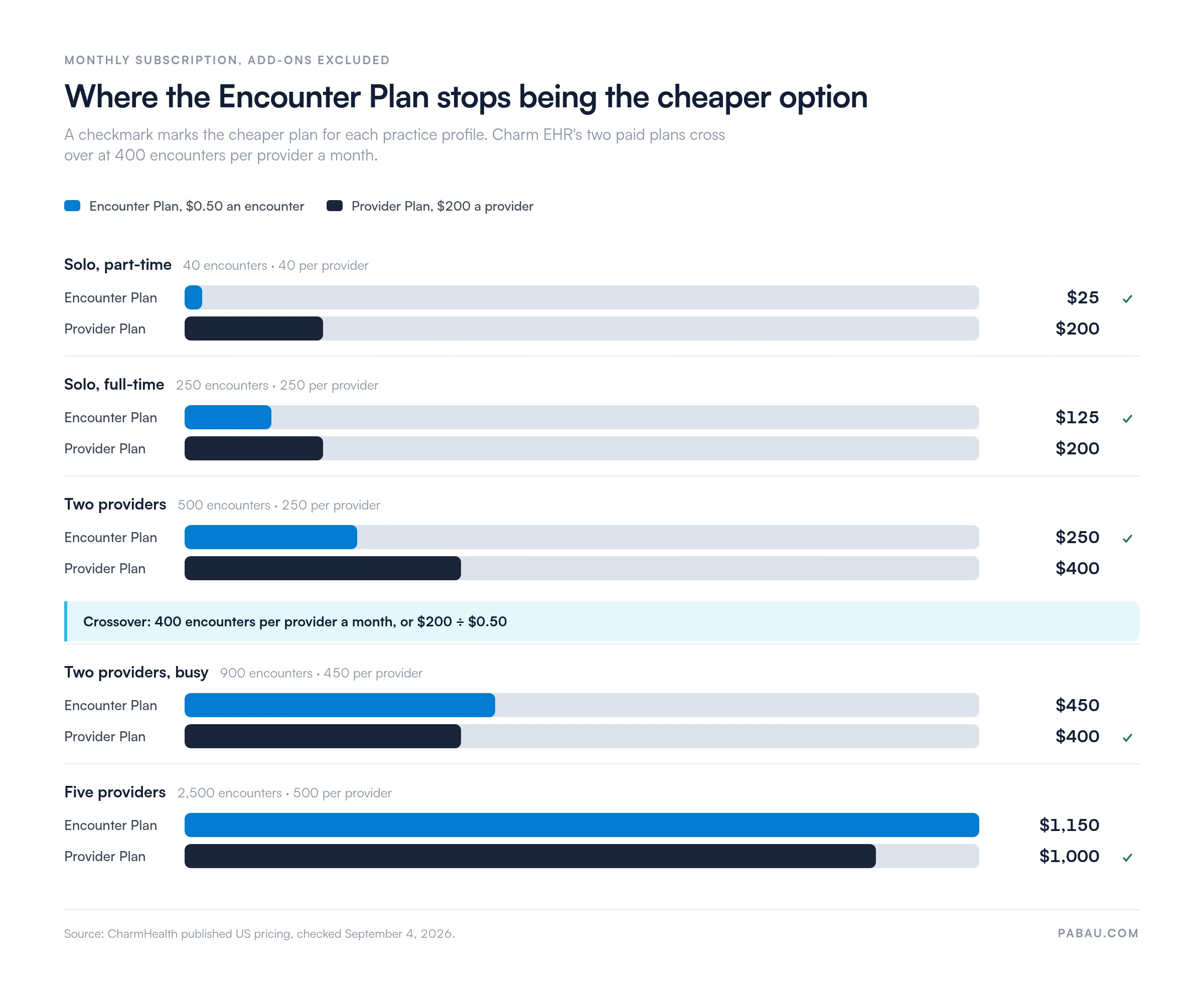
Two figures circulating elsewhere are wrong by an order of magnitude. A two-provider practice does not pay $70 a month, and a five-provider practice does not pay $175. At the volumes above they pay $400 and $1,000 on the Provider Plan, or $250 and $1,150 on the Encounter Plan.
CharmHealth prints a price for every add-on, so none of this is concealed. The difficulty is arithmetic rather than disclosure, because there are more than 25 separately billed line items.
Most practices need three or four of them. These are the ones that come up most often.
Stack the common ones and the headline rate stops being useful. A solo provider on the Encounter Plan who wants e-prescribing, telehealth, electronic claims and fax pays $25 in subscription plus $85 in add-ons. That is $110 a month, over four times the minimum. Add EPCS and the AI scribe and it passes $250.
Feature access follows the plan you pick rather than a ladder of tiers. The Provider Plan bundles the prescribing and telehealth add-ons. The other two plans charge for them separately, at the same published prices.
Lab and device connectivity sits at the same level on all three plans, so it is not something you buy your way up to. Compliance works the same way. All three plans are built for HIPAA-compliant workflows, and CharmHealth signs a business associate agreement on request.
Work out your encounters per provider per month before you pick a plan. Under 400, the Encounter Plan is cheaper. Over 400, the Provider Plan is. Practices with seasonal volume often start on the Encounter Plan, because it flexes back down to the $25 minimum in quiet months.
Charging the patient is included on every plan. Getting paid by an insurer is an add-on. That split is the most useful part of Charm EHR pricing to understand.
Inside the subscription you get superbills, CMS-1500 forms, custom billing codes, billing profiles and credit card processing. The free plan caps CMS-1500 forms at 50 a month, and both paid plans lift that cap.
Electronic claim submission, real-time eligibility checks and ERA download with payment posting are add-ons on both paid plans. The free plan does not offer them. CharmHealth runs claims through a partnership with Optum and charges $25 a month for the first 50 transactions, then $0.25 for each one after that.
A claim submission, an eligibility verification and an electronic claim status check each count as a transaction. ERAs do not. Paper claims sent through the clearinghouse cost $2 per submission.
Work that through for a practice filing 150 claims a month and checking eligibility on each one. That is about 300 transactions. CharmHealth charges $25 plus $0.25 for the 250 past the first 50, so roughly $88 a month on top of the plan.
Outsourced revenue cycle management is not part of any plan, so denial follow-up, appeals and credentialing stay with your team or a separate vendor. Credit card processing runs through Bluefin, which agrees its commission with you directly. Comparing that against integrated claims management is a fair way to see how much of the revenue cycle a single subscription can cover.
User reviews on Capterra and G2, where the platform rates 4.2/5 and 4.1/5, surface consistent themes about where it performs and where it frustrates.
The support criticism matters for practice managers running lean teams. When a billing problem surfaces mid-month, a slow response lands directly on cash flow. A practice working through a compliance question needs an answer the same week, not after a multi-day queue.
Charm EHR fits a specific type of practice. The fit turns on encounter volume and specialty more than on budget.
Strong fit:
Weaker fit:
When you compare EHRs for a private practice, look past the monthly rate. The question is whether the platform is built around your clinical workflow or your business operations. Charm EHR is a clinical documentation tool with billing and scheduling layered on.
Total cost of ownership decides this, not the headline rate. The free plan is genuinely free at low volume. The Encounter Plan stays cheap under 400 encounters per clinician. The picture changes once you total the add-ons a working practice needs.
Across the wider ambulatory software market, three things separate the options. Those are the billing unit, the encounter cap, and how much sits inside the base subscription rather than beside it. You can compare Pabau against the main alternatives on the same three points.
Other alternatives worth a look include SimplePractice for mental health and therapy practices, and Jane App for allied health and multi-discipline practices. Athenahealth suits larger practices that want full revenue cycle services. We have broken down SimplePractice pricing and Jane App pricing the same way.
A practice on the Encounter Plan watches its own encounter count each month. It also buys prescribing, telehealth, fax and claims separately, then reconciles those metered lines against one invoice. That admin has a cost of its own, and it grows with the practice.
Pabau, practice management software for aesthetic, wellness and multi-discipline clinics, prices the other way round. Subscriptions are banded by how many users you need and where you are, from a single-user plan up to multi-location enterprise. Every subscription includes every feature.
That means treatment photography, injection plotting, digital intake forms, memberships, inventory, automated recalls, invoicing and reporting all arrive switched on. Turning something on later does not add a line to your invoice, and there is no encounter meter to watch.
Adding a second clinician moves you within a user band rather than adding a fixed per-provider fee. Onboarding is structured and run with a specialist rather than a self-serve trial. Your templates, forms and data are in place before you see a patient on it. Pabau holds 4.7/5 from more than 600 verified reviews on Capterra. Pricing depends on your region and user count, so quotes come from a demo.

Pabau brings together booking, patient records, treatment documentation, invoicing and automation in one platform built for aesthetic, wellness and multi-discipline clinics. See what it costs for your team size.

Charm EHR costs $0, $0.50 per encounter, or $200 per provider per month. Which of the two paid plans is cheaper turns on encounters per clinician per month, and the crossover sits at 400.
Below that line the Encounter Plan keeps a small practice under $150 a month, which is genuinely good value for structured documentation. Above it, a five-clinician group pays $1,000 or more before add-ons, and the common add-ons add another $50 or so per provider.
For aesthetic, wellness and multi-discipline clinics, the deciding factor is usually not the rate but what the subscription covers. Book a demo to see how Pabau handles the full patient journey inside one plan.

Weighing Pabau against the platform you use now? Pabau competitors and alternatives sets out how the main options differ on billing model, feature scope and practice type.
Comparing another per-provider ambulatory EHR? DrChrono pricing breaks down its plans and add-on charges with the same arithmetic used here.
Looking at a lower-cost practice management option? Carepatron pricing covers what its free and paid tiers include for small health and wellness practices.
Shortlisting alternatives for a therapy practice? SimplePractice competitors compares the platforms that mental health and allied health practices assess most often.
Yes. CharmHealth publishes a free plan at $0 a month for one provider, with no credit card required. It covers 50 encounters a month, 1,000 patient records, five users, 100 patient portal accounts and 5 GB of document storage. Add-ons can still be bought while you are on it. A solo provider can run e-prescribing for $15 a month without taking a paid subscription.
The free plan caps encounters at 50 a month. It also limits you to one provider, five users, 1,000 patient records and 50 CMS-1500 claim forms a month. Recording a 51st encounter means moving to the Encounter Plan or the Provider Plan. At 12 to 15 patients a day, a practice reaches that ceiling in roughly three to four working days.
The Provider Plan costs $200 per provider per month, and CharmHealth also publishes a $350 per provider version that carries extra add-on credits. Non-physician providers such as physician assistants and nurse practitioners are charged at $200 a month as well. The Encounter Plan does not price by provider at all, so headcount has no effect on that bill.
The best alternative depends on your practice type. Pabau suits aesthetic, wellness and multi-discipline clinics that need full practice management beyond documentation. SimplePractice fits mental health and therapy practices. Jane App works well for allied health and multi-discipline outpatient settings. Athenahealth and DrChrono serve larger primary care practices with full revenue cycle needs.