GLP-1 diet plan
A GLP-1 diet plan is a structured eating framework for patients taking semagluti...

2
Last Updated: Oct 13, 2026

Clinical progress notes record patient status, the interventions you delivered, and how the client responded. They carry continuity of care, compliance, and reimbursement.
The four main formats are SOAP, DAP, BIRP, and GIRP. Each one organizes the same clinical information in a different order.
Every note needs presenting concerns, observations, interventions, client response, and an updated plan. Leaving one out is what auditors flag.
Practice management software like Pabau turns this template into a digital form, so a compliant note takes under 10 minutes.
A ready-to-use template with sections for presenting concerns, clinical observations, interventions, client response, and the updated treatment plan. Written for mental health, therapy, and allied health professionals.
Download templateClinical progress notes are the working record of what happened in a session and why it mattered clinically. They are also the first document an insurer, a licensing board, or a covering colleague will read. Most clinicians spend 10 to 20 minutes on each one.
This guide covers the five components every note needs, the four documentation formats, and the phrases that hold up under audit. You also get a vocabulary bank for mood, behavior, and treatment response, plus the free template above.
Clinical progress notes are official records of a patient’s status during a visit, the interventions you provided, and the client’s response. They sit in the medical record, so insurers, other providers, and regulators can all request them. Therapy notes are separate. They are private clinical records that stay protected from disclosure.
Progress notes do three jobs at once:
Language, format, and completeness affect reimbursement rates, audit outcomes, and liability protection. Vague wording, missing components, and late entries are the biggest source of claim denials and licensing board findings. Strong notes take discipline, and they protect your practice as well as your clients.
Here is the operational structure behind a compliant note you can finish in under 10 minutes. The template above mirrors these steps, so you can work through them in order.
Those five steps map onto whichever documentation format your practice uses.
All four are equally valid. Your specialty and your payer’s documentation rules decide which one you use.
Fill each section in right after the session, while the details are fresh. Avoid casual terms like “doing better” and write “endorses improved sleep onset latency” instead. Dropdown menus and phrase banks speed this up if your digital forms support them.
Mental health and therapy: Therapists, counselors, psychologists, and clinical social workers use progress notes to document session content, treatment goals, and outcomes. The template covers presenting concerns, therapeutic modality, and client response, the standard set for insurance billing in mental health practices.
Medical practices and primary care: Nurses, physician assistants, and physicians document vital signs, chief complaints, exam findings, and the clinical plan. Practices serving Medicaid, Medicare, or commercial insurers need a standardized note format for claim submission.
Allied health: Physical therapists, occupational therapists, and speech-language pathologists record functional assessments, interventions, and progress toward discharge goals. Medicare asks for specific documentation formats before it reimburses, and the template supports them.
Regulated practices: Any practice covered by HIPAA in the US or GDPR in the UK and EU also keeps records for state licensing boards. A standardized format makes clinical rigor easy to demonstrate.
Vague or casual wording is the most common weakness in progress notes. Payers, auditors, and licensing boards read between the lines. “Client seems better” supports nothing. “Client-reported panic episodes fell from four a week to one” tells the whole story and protects you.
The three lists below cover the mood words, behavioral descriptors, and outcome phrases that hold up in review.
Instead of “Client did better,” write “Client endorsed reduced avoidance. Attended two previously anxiety-provoking social situations this week at 5/10 anxiety.” Instead of “Seemed depressed,” write “Affect blunted. Client endorsed continued anhedonia and fatigue despite the increase to 100mg sertraline.”
Time-block your note writing. Finish the note within 30 minutes of the session, while the clinical detail is fresh. Standard template sections mean you are filling in blanks rather than deciding what to write. Many practices that use practice automation software with templated forms cut note-writing time by 40%, freeing time for patient contact.
Auditors and payers use progress notes to verify that care was appropriate, necessary, and effective. One missing component can trigger a denial. These are the errors that cost practices money and credibility.
Mistake: “Client is doing well and coping better with stress.” Why it fails: an auditor cannot verify any of it. Fix: “Client-reported stress-related insomnia fell from five nights a week to two. Practicing progressive muscle relaxation nightly. Reports improved morning mood and energy.”
Payers and licensing boards flag notes written days after a session. Late entries look reconstructed and weaken your position in an audit or a complaint. Always date and time each note. If you need to update one, add an addendum with today’s date, and never alter the original entry.
Every note’s plan section must name the next clinical action: homework, a frequency change, a medication adjustment, or a referral. A note without a plan reads as care without direction, which payers and auditors notice. Close with “Client to…” or a short plan drawn from your treatment plan template.
If another clinician, a payer, or an attorney cannot read your note, it has no legal value. Move to digital records with searchable, legible entries, which also cut the time each note takes.
Never write “manipulative,” “malingering,” “dishonest,” or similar judgmental terms. They undermine your credibility and can damage the therapeutic alliance if the client reads the file. Use observable language instead: “Client reported pain during strength testing but showed full range of motion in functional movement.”
Progress notes are legal documents. They can be subpoenaed in civil litigation, reviewed in licensing board complaints, or pulled in an insurance audit.
Under the HIPAA Privacy Rule, patients have the right to read their progress notes. Write nothing you would not want a patient to see. Notes belong to the designated record set and must be provided within 30 days of a request. Store them in HIPAA-compliant systems with encryption and access controls.
Most insurance plans require notes within 24 to 48 hours of the session. Medicare and many state licensing boards expect same-day or next-day entries. Notes older than two weeks are often denied and are hard to defend. Set a practice standard in your clinical documentation software. Everyone finishes notes by end of day, or the next morning at the latest.
The American Psychological Association requires records that show the nature and substance of treatment, as set out in its ethics code. The National Association of Social Workers sets the same expectation in its code of ethics. State licensing boards read progress notes during complaints, and poor documentation is grounds for sanctions.
CMS documentation rules require mental health notes to name the presenting problem, treatment modality, response, and plan. Commercial insurers ask for much the same. Auditors deny claims when a note shows no medical necessity or functional impact.
Tie the clinical narrative to the goal: “Anxiety was preventing workplace participation. Delivered exposure therapy for driving phobia. Client completed a highway drive at 5/10 anxiety, down from 8/10.”
Most practices still write the note twice. A clinician scribbles on paper or in a Word file during the day, then re-types it into the record that evening. Detail thins out at every step, and the entry lands late.
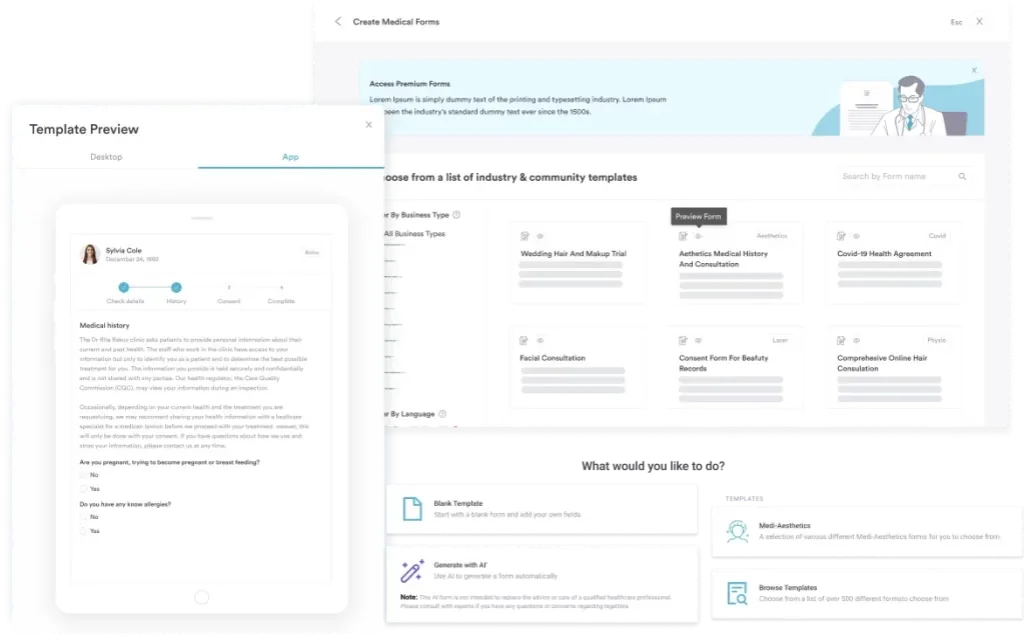
Pabau builds the template straight into the client record as a digital form. Your SOAP, DAP, BIRP, or GIRP sections become fields the clinician has to complete, so nothing gets skipped. Pabau Scribe, drafts the note from what you dictate, and you review and sign it before it saves.
Every entry is timestamped against the appointment and searchable across the practice. When an auditor asks for six months of notes for one payer, you filter and export instead of digging through folders. Clinicians finish the day’s documentation before they leave.

Pabau builds your note template into the client record, with an AI scribe to draft from dictation. Notes stay complete, timestamped, and ready for an audit.

The note you write in 10 minutes today is the document that answers for your clinical judgment two years from now. That deserves a system, not the odd spare moment between clients.
Pick one format and use it for every client. Fill the template in the same day, in language another clinician could act on. When a payer or a board asks, the answer is already written down.
Practices that move this into one system stop writing every note twice. Book a demo to see how Pabau keeps clinical progress notes complete, timestamped, and ready for review.

Need a general-purpose clinical note format? Medical notes template covers the structure for consultations, exams, and follow-ups across specialties.
Need a care plan for pancreatitis patients? Pancreatitis nursing care plan It offers a NANDA-I formatted plan with five diagnoses, goals, interventions, and evaluation criteria for acute and chronic cases.
Preparing paperwork for patient discharge? Patient discharge form It covers the free template’s 7 required sections and where discharge records commonly fail HIPAA.
Need a general-purpose progress note format? Progress note template It offers a free, ready-to-use form covering observations, interventions, and the treatment plan across specialties.
Clearing a patient to return to work? Return to work doctors note template It provides a standardized template confirming an employee’s fitness to resume duties after illness or injury.
A clinical progress note is an official medical record. It documents a patient’s status during a healthcare visit, the interventions provided, and the response to treatment. Therapy notes stay private, while progress notes form part of the medical record. Insurers, other providers, and regulatory bodies can request them for continuity of care, billing, and legal compliance.
Therapy notes are private clinical records kept by the treating clinician. HIPAA’s psychotherapy notes exemption protects them from mandatory disclosure, and they usually hold the clinician’s impressions and clinical reasoning. Progress notes are part of the medical record and go to insurers and other providers. They stay with objective observations, clinical findings, and treatment planning. Many practices keep both.
SOAP (Subjective, Objective, Assessment, Plan) is the standard in medical settings. It records what the patient reports, what you observe, your assessment, and the plan. DAP (Data, Assessment, Plan) is common in mental health and merges the subjective and objective into one Data section. BIRP (Behavior, Intervention, Response, Plan) leads with observable behavior and the client’s response to each intervention. GIRP (Goal, Intervention, Response, Plan) ties every entry to a treatment goal, which suits rehabilitation settings. All four are equally valid, and your payer or practice may mandate one.
A progress note should be concise but complete, typically 200 to 400 words. Session complexity and your specialty move that range. Longer is not better, because excessive detail buries the clinical information auditors look for. A good test: another clinician should be able to read it and know the concerns, what you did, and what happens next. Use your practice’s template for consistency.
Complete the note within 30 minutes of the session, while details are fresh. Use a template with standard sections so you fill in blanks rather than decide what to write. Keep a library of clinical phrases you reuse, such as “Client endorsed a reduction in…”. Many practices capture notes in real time with digital forms or voice dictation. Practices using automated note-generation tools, like Pabau’s AI scribe, reduce documentation time by 40% while staying compliant.
Yes. HIPAA requires US healthcare practices to keep progress notes as part of the medical record. State licensing boards for mental health professions set documentation standards in their ethical codes. Medicare and most insurance plans require progress notes as a condition of reimbursement. Medical practices also document clinical reasoning to satisfy malpractice insurers and legal defensibility.
Yes. AI-powered documentation tools can draft progress notes from clinician dictation, reducing writing time by 30% to 40%. The clinician still owns accuracy, completeness, and compliance. AI-generated notes need clinician review and approval before they enter the medical record. Pabau Scribe, our AI scribe, generates note drafts from voice input. You review for clinical accuracy, edit as needed, then sign and save the final note.