Normal vital signs chart
A normal vital signs chart lists the expected resting ranges for blood pressure,...

1
Last Updated: Oct 19, 2026
A nursing skin assessment is a head-to-toe exam of the skin, hair, and nails that checks for breakdown, infection, pressure injury risk, and abnormal lesions. Nurses perform it on admission, at regular intervals during an inpatient stay, and whenever a patient’s condition changes.
A structured assessment catches pressure injuries early and gives you the documentation that CMS, the Joint Commission, and accreditation bodies expect. Validated risk tools such as the Braden and Norton Scales mean every nurse scores the same patient the same way.
This guide covers the parameters to check, how to score pressure ulcer risk, a step-by-step head-to-toe method, and how to chart what you find. It comes with a free downloadable checklist you can use at the bedside.
A printable head-to-toe skin exam checklist, with body diagrams for marking lesions and pressure areas. It includes Braden and Norton scoring guides, ABCDE melanoma screening criteria, charting prompts, and space for photos and referral notes.
Download template
A nursing skin assessment is a systematic head-to-toe examination of the integumentary system, performed on admission and at regular intervals afterward.
Nurses check seven parameters: Color, temperature, moisture, turgor, texture, lesions, and edema. Standardized terms make each finding readable to the next clinician.
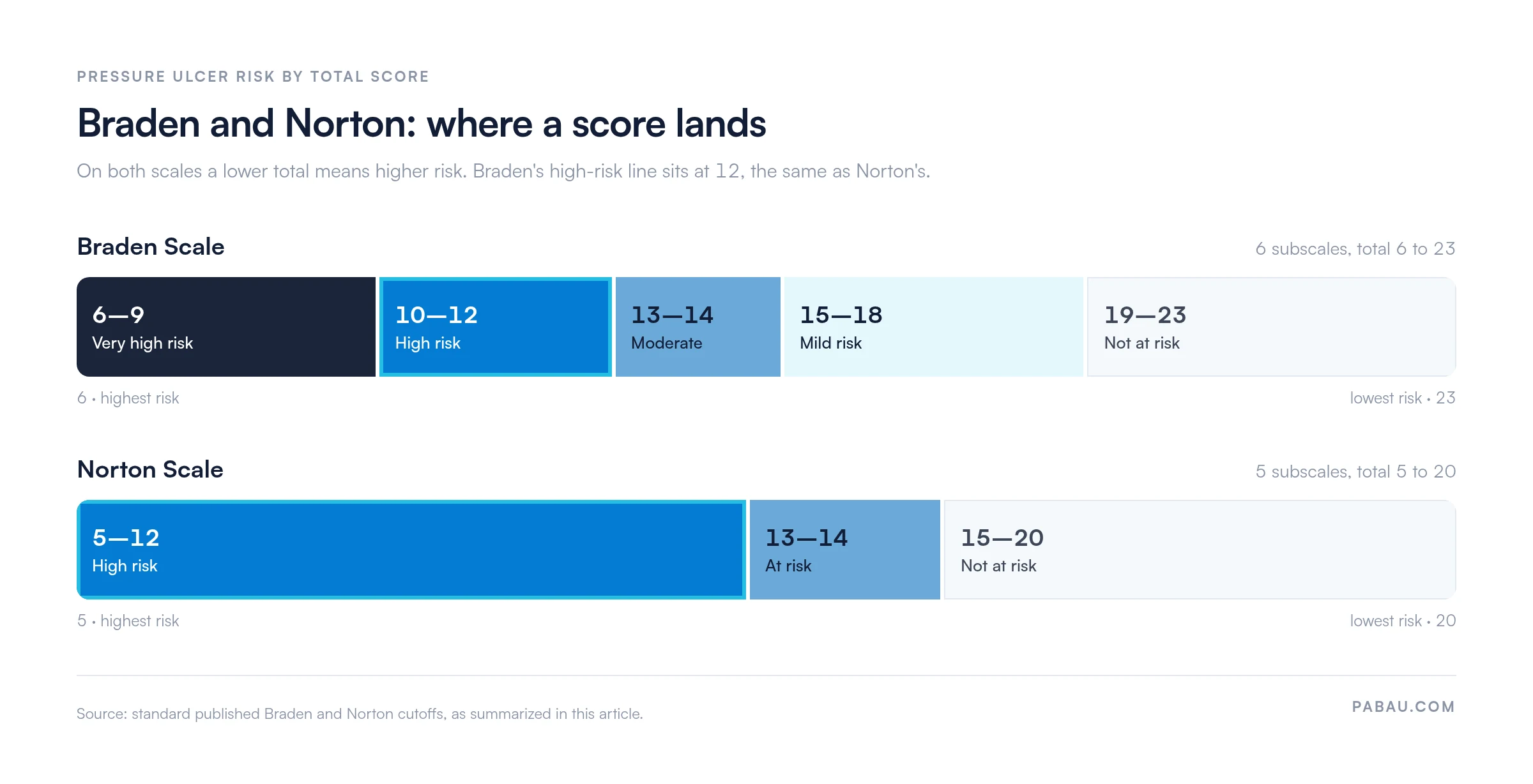
The Braden Scale marks high pressure ulcer risk at a total of 12 or below. On the Norton Scale, any total of 14 or below means the patient is at risk.
Practice management software like Pabau turns the checklist into a digital form, so findings, photos, and risk scores land in one patient record.
A nursing skin assessment is a full examination of the skin, hair, and nails to judge the condition of the integumentary system. The nurse works from head to toe, checking color, texture, temperature, moisture, lesions, and signs of breakdown or infection. It records a baseline on admission, picks up changes that signal deterioration, and identifies patients at risk of pressure injuries or infection.
Clinical purpose: Early detection prevents serious complications. Pressure injuries develop in stages, and spotting erythema at Stage 1 lets you intervene before tissue damage becomes irreversible. Catching infection, dehydration, poor perfusion, allergic reactions, and rashes early all depends on a thorough, documented assessment.
Regulatory requirement: CMS Conditions of Participation mandate documented skin assessment on admission for inpatient facilities. Joint Commission standards require assessment and reassessment protocols. The baseline usually lives in the admission nursing note, so later findings have a starting point to compare against. Without it, a pressure injury that develops later leaves the organization exposed to compliance findings and liability.
Skin assessment has direct consequences for patient safety and compliance. It guides clinical decisions, prevents adverse events, and creates the record showing that the standard of care was met.
Every nursing skin assessment examines the same seven observable parameters: Color, temperature, moisture, turgor, texture, lesions, and edema. Any finding that needs a closer look or a specialist referral gets recorded alongside them.
Cyanosis noted during the color check calls for a respiratory follow-up, because central and peripheral cyanosis point to different causes.
Recording findings in standardized terms keeps the assessment accurate and readable for every clinician who picks it up. Structured documentation prompts consistent language and stops vague or incomplete entries from causing confusion at follow-up.
When you find a lesion, classify it as primary (an initial lesion on normal skin) or secondary (caused by trauma or a progressing primary lesion). The distinction guides clinical decisions and specialist referral.
Identifying at-risk patients is the foundation of pressure injury prevention. Two validated tools dominate clinical practice: The Braden Scale and the Norton Scale. Both add subscale scores into a total, and on both a lower total means higher risk.
Braden totals run from 6 to 23 and Norton totals from 5 to 20. An identical total can fall in a different risk band on each scale. The bands below show where a score lands on each scale.
Both tools need regular reassessment, because risk changes as the patient’s condition evolves. Keeping the score current means prevention protocols match the patient in front of you, not the one admitted last week. AHRQ guidelines recommend reassessment at every significant change in condition.
A structured approach means no area is missed and findings are charted consistently. These seven steps take you through a complete integumentary assessment.
Time requirement: A thorough head-to-toe assessment typically takes 10 to 15 minutes on first presentation and 5 to 10 minutes at follow-up. Rushing compromises accuracy, so give it the time it needs, especially when you’re setting the admission baseline.
Documentation matters as much as the assessment itself. Vague or incomplete entries create liability and fail to tell other clinicians what you found. The rules below apply the wider standards of nursing documentation to skin findings.
Legal importance: Detailed, contemporaneous documentation shows that the standard of care was met. If a complication develops later, the record proves the baseline was known, risk was identified or ruled out, and monitoring took place. Vague or missing documentation creates liability exposure even when the care itself was appropriate.
Workflow automation can lighten the charting load by prompting required fields, pre-filling standard language, and flagging any section left blank.
Use the template as-is or customize it to match your organization’s protocols. Many teams rebuild it as a digital form in their electronic health record. Nurses can then complete it on a tablet or computer at the bedside.
Paper skin assessments are easy to lose and hard to read, and the next shift can’t see them until someone finds the folder. A handwritten Braden score also sits on the page without prompting anyone to act on it.
Practice management software like Pabau lets you rebuild this checklist as one of its customizable digital forms. With the assessment in Pabau, your nursing team can:
Each patient ends up with one legible record, ready for an auditor or the next nurse on shift. Book a demo of Pabau’s clinical documentation tools to see customizable assessment forms and integrated clinical notes in action.

Pabau’s digital forms put skin findings, risk scores, and wound photos in the patient record your whole care team already uses. Nurses chart once at the bedside, and no one retypes notes later.

A skin assessment protects the patient and the practice only when it’s repeated and recorded the same way every time. Set the baseline on admission, rescore Braden or Norton whenever the patient’s condition changes, and chart findings in terms another nurse can act on.
The trade-off is time. A full assessment takes 10 to 15 minutes on admission, and cutting it short is how pressure injuries get missed. The printable checklist works from day one. Once several nurses share the same patients, a digital form keeps every finding in one place.
Book a demo to see how Pabau keeps skin assessments, risk scores, and wound photos together in one patient record.

Want a quick reference for the rest of the chart? Nurse charting cheat sheet covers SOAP, DAR, and PIE note structures, the head-to-toe order, and approved abbreviations.
Need to record more than the skin on admission? Nursing assessments template gives you a two-page form for physical findings, diet, medications, and consultant input.
Writing up a pressure area concern after the assessment? Focus charting (F-DAR) shows how to build a nursing note around one patient concern.
A complete nursing skin assessment evaluates color, temperature, moisture, turgor, texture, lesions, and edema using a systematic head-to-toe approach. It includes observation and palpation of all visible skin and charting in standardized terms. For inpatients, it also includes a pressure ulcer risk score from the Braden or Norton Scale.
ABCDE is a melanoma screening tool. A is asymmetry (one half differs from the other), B is border irregularity, and C is color variation within one lesion. D is a diameter over 6 mm, and E is evolving, meaning the lesion changes over time. Any lesion meeting these criteria needs dermatology referral, because only a biopsy can confirm melanoma.
The Braden Scale assesses pressure ulcer risk in inpatients and long-term care residents. It scores six subscales (sensory perception, moisture, activity, mobility, nutrition, and friction/shear) for a total between 6 and 23. A score of 18 or below indicates risk, and patients scoring 12 or below are high risk. High-risk patients need intensive pressure relief, regular repositioning, and skin care protocols.
CMS Conditions of Participation and most hospital policies require documented skin assessment on admission, daily during the stay, and whenever the patient’s condition changes significantly. Patients who score as high risk on the Braden or Norton Scale need more frequent assessment. A final assessment at discharge records skin status when the patient leaves.
A skin assessment evaluates the whole integumentary system, including color, texture, lesions, breakdown, and pressure ulcer risk across the entire body. A wound assessment focuses on one area of tissue damage, such as an ulcer, surgical wound, burn, or laceration. It records dimensions, depth, drainage, odor, signs of infection, and staging. A patient with a pressure injury needs both.