Anja Dodevska

Problem solving therapy worksheet
Download your free problem solving therapy worksheet A six-section PDF that take...

2
Last Updated: Nov 6, 2026
Free PDF 2 pages, print-ready Clinician-reviewed
A self-harm worksheet is a structured form that helps a client understand their self-harm, name their triggers, and plan safer ways to cope. The free PDF here has four parts: behaviors and triggers, healthy coping strategies, self-compassion and affirmations, and a support and safety plan. Clinicians use it in CBT and DBT sessions or set it as guided homework. Because the client writes the answers in their own words, repeat copies show how triggers and coping change over time. This guide covers what each part asks, how the answers carry forward, and the reporting duties that apply when a client discloses self-harm.
A two-page worksheet in four parts, written in the client's own words. It covers behaviors and triggers, healthy coping, self-compassion and affirmations, and a support and safety plan.
Start from scratch, or upload this PDF or any form you already use, and Pabau's AI Form rebuilds it with tick boxes, text fields and a signature. Attach it to the treatment once, and every patient gets it on time.
AI Form rebuilds the consent, history and aftercare forms you already use. You review each one, then publish.
Patients complete forms on their phone before they arrive, so the front desk stops retyping paper.
Every signed form is versioned and attached to the treatment record, ready when you need it.
Set how long a consent stays valid. Returning patients skip forms they have already signed.
Supports HIPAA and GDPR compliance AES-256 encryption 4.8 on G2 4.7 on Capterra Trusted by 4,000+ practices worldwide

A self-harm worksheet helps a client name their self-harm behaviors, triggers and early warning signs, then plan safer responses.
This free PDF has four parts: triggers, healthy coping, self-compassion and affirmations, and a support and safety plan.
Part I’s early warning signs become the first step of the part IV safety plan, so the two sections work as a pair.
Reporting duties for self-harm disclosures vary by jurisdiction and by the client’s age, so check the rules where you work.
Practice software such as Pabau files each completed worksheet in the client record, so every review starts from the last answers.
Clinicians use a self-harm worksheet to structure assessment, spot triggers, and record coping options during and between sessions. The client’s written answers give the clinician a record of the behavior that doesn’t rely on memory alone.
The worksheet draws on established frameworks. Cognitive behavioral therapy (CBT) uses it to link thoughts, emotions and urges. Dialectical behavior therapy (DBT) uses similar prompts to build distress tolerance and emotion regulation skills.
The download is a two-page form in four parts. The client completes it, ideally with a clinician or another source of support close by. The form itself warns that writing about self-harm can be triggering.
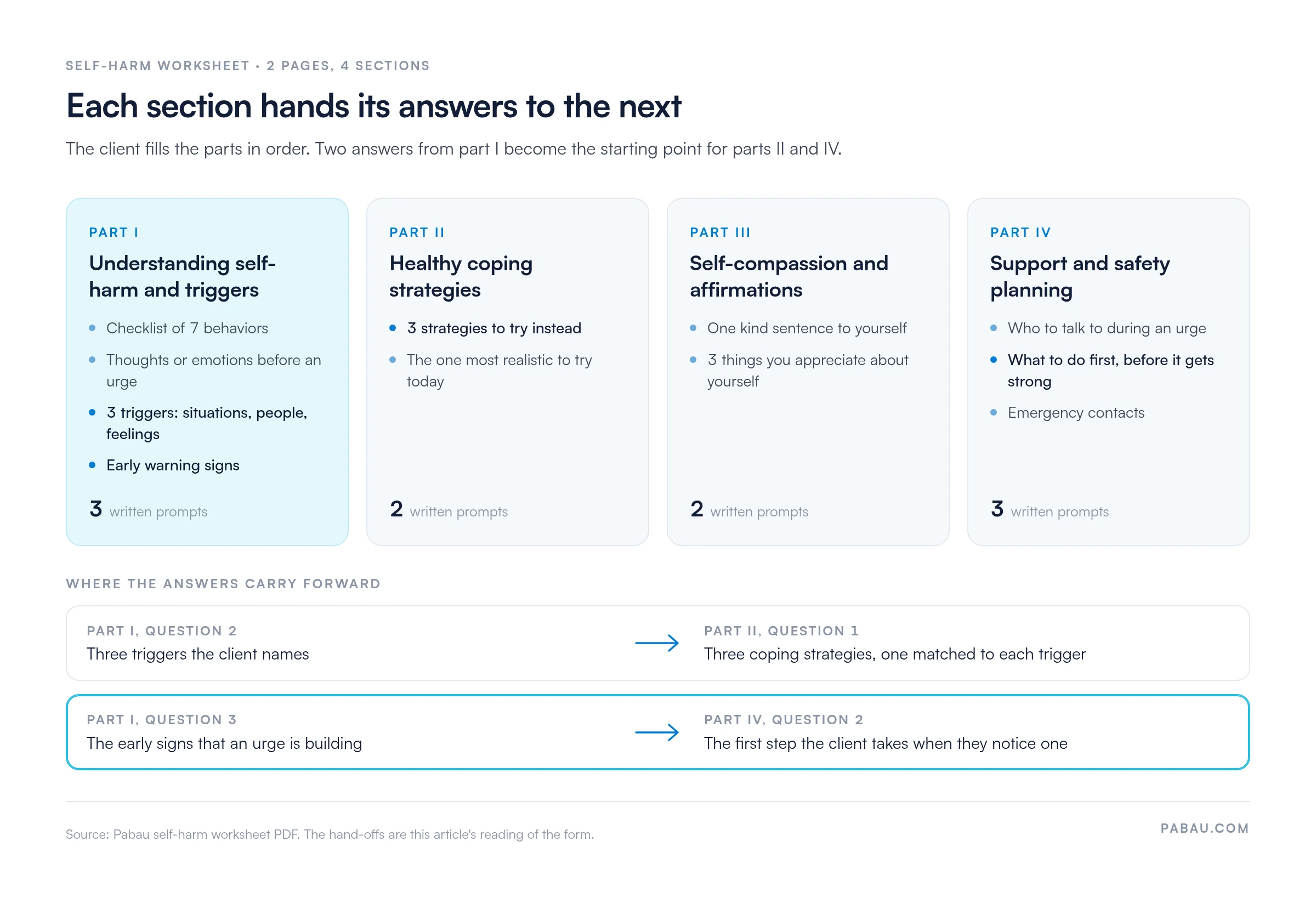
Part I opens with a checklist of seven behaviors, from cutting or scratching the skin to starving or bingeing as self-punishment. Three written prompts follow. They ask which thoughts or emotions come before an urge and which three situations, people or feelings trigger one. The last asks which early signs warn that an urge is close.
The checklist records what happens, not how often or how severe it is. For a clinical history of frequency, method and intent, pair the worksheet with a self-harm assessment template. That record also helps you separate non-suicidal self-injury from suicidal ideation, which call for different risk responses.
Part II asks for three healthy strategies the client could try instead of self-harming, then which one feels most realistic today. Typical entries include distraction, movement, creative activities, and talking to someone who listens. Clients who name urges as waves may find an urge surfing worksheet a useful addition here.
Part III asks the client to write one kind sentence to themselves and list three things they like or appreciate about themselves. It targets the harsh self-criticism that often sits behind an urge, and it gives the client words to return to when one starts.
Part IV records who the client can talk to during an urge, what they can do first before it gets strong, and their emergency contacts. The client keeps a copy, so the plan travels with them outside the session. Where risk extends beyond self-harm, a fuller Stanley-Brown safety plan adds the structured six-step format.
The four parts build on each other. The triggers listed in part I set up the three coping strategies in part II, ideally one strategy per trigger. The early warning signs in part I then become the cue for the first step in part IV. If those part I answers stay vague, the safety plan has nothing concrete to respond to.
Introduce the worksheet as a shared tool rather than a form to be marked, and pace it to the client. Most clients won’t finish all four parts in one sitting.
Adapt the wording for age and presentation. Younger clients often respond better to shorter prompts, while adults may want more space for reflection. Where a client is a minor, check consent and reporting obligations before the session. When repeat copies show a pattern, build it into a treatment plan for self-harm.
Review the worksheet at the start of each session rather than only at the end. A quick check on urge frequency since the last visit shows whether the coping plan is working. It also gives the client a chance to adjust it.
Mandatory reporting duties for self-harm disclosures depend on jurisdiction and on the client’s age. In the US they vary by state, while in the UK they sit within safeguarding frameworks. Check the rules that apply where you practice before you rely on any worksheet record.
Worksheets help here because they record what was disclosed, when, and what the plan was. That record supports a reporting decision, but it does not replace one.
The worksheet suits any practice where clients present with self-injury. Mental health and psychology practices use it most often. Psychiatry teams use it to support medication reviews, and therapy and counseling services use it in individual and group work.
A shared format makes progress visible. Clinicians can compare the first and latest copies and see whether the triggers, warning signs or chosen coping strategies are changing.
Consistent records also support audit and supervision. A reviewer can see what was discussed and what the plan was without reconstructing the session.
Self-harm often links to earlier experiences, but this worksheet does not explore trauma history. Where that link matters, a trauma timeline worksheet lets the client place key events alongside changes in urges and behavior. Move to that work only once the client has their coping strategies and safety plan in place.
Grounding exercises help interrupt an urge in the moment. Common examples include the 5-4-3-2-1 technique, a short body scan, and a safe-place visualization. They fit naturally into the part II coping list.
Clinicians often teach these in session first, then assign them as homework. The client practices when calm, which makes the technique easier to reach during an urge.
On paper, the worksheet gets printed, filled in, and filed or scanned by hand. Copies go missing between sessions, and the client’s safety plan exists only on the sheet they took home.
Pabau is therapy and counseling software that turns the worksheet into one of your digital forms. You can send it before an appointment, and the client completes it on their phone or at home.
Each answer lands in the client’s file under Client records, next to consent forms and session notes. At the next review you open the last copy in seconds, so comparing triggers and coping choices takes minutes rather than a search through folders.
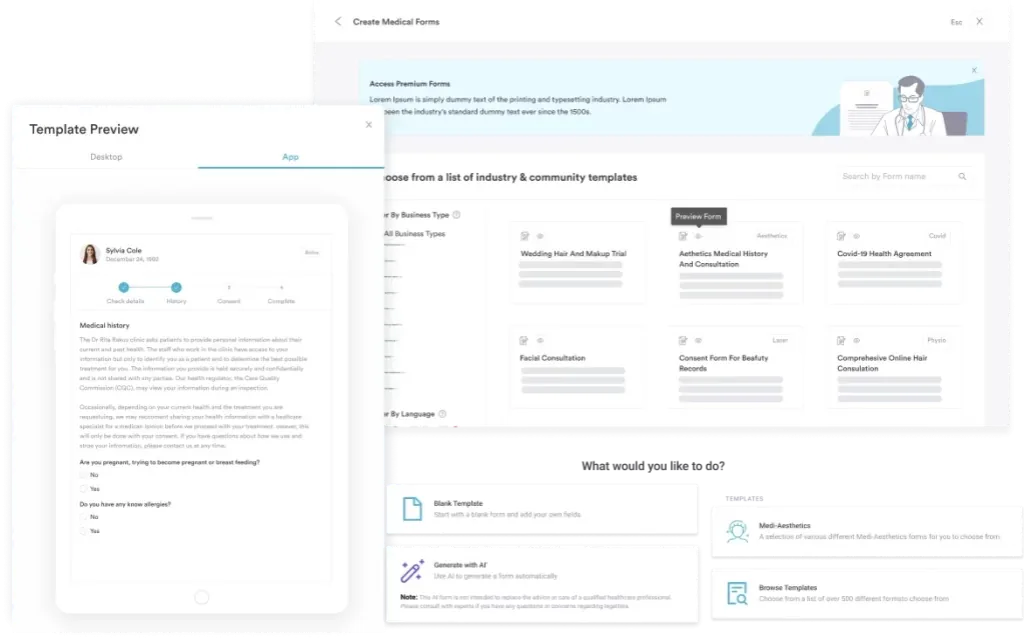

Pabau’s digital forms send the worksheet before a session and file each answer against the client, beside consent and session notes. Reviews start from the last copy, not a search through paper.

The worksheet pays off from the second session on. A single copy shows where the client is today, while repeat copies show whether the triggers and coping choices are shifting.
Start with part I in session, and spend the most time on triggers and warning signs, since parts II and IV build on them. Treat any disclosure as a cue to check your local reporting duties before anything else.
Book a demo to see how Pabau sends the worksheet before each session and keeps every completed copy in the client record.

Want more structure on the self-compassion part? Self-compassion journal gives clients a daily ACT prompt for answering their own self-criticism.
Need a quick tool for the moment an urge starts? Grounding worksheet walks the client through sensory exercises they can use anywhere.
Building out part II with the client? Coping skills checklist lists healthy strategies to choose from when filling in the three alternatives.
Working on DBT skills alongside the worksheet? Distress tolerance skills worksheet covers the skills that help a client ride out an urge without acting on it.
Is the risk higher than self-harm alone? Crisis safety plan template sets out warning signs, contacts and steps for a crisis.
A self-harm worksheet is a structured clinical tool that prompts assessment, coping skills, and safety planning. It gives clinicians a consistent record across sessions.
A worksheet is used in therapy to structure reflection and skills work. A questionnaire is a screening or assessment instrument used to gather structured responses.
Yes, a free self-harm worksheet is available from Pabau. Check that any template you use fits your service and local clinical guidance.
It should include warning signs, coping strategies, people the client can contact, and crisis line details. The client keeps a copy.