Mental health self-care checklist
A mental health self-care checklist is a structured daily tool for tracking the ...

5
Last Updated: Oct 20, 2026
A treatment plan for self-harm is the clinical document behind the care. It records your risk assessment, the patient’s goals, the interventions you chose, and the safety steps around them.
Building one takes five steps, from risk assessment through to harm reduction.
This guide covers each step, the documentation a reviewer expects, and how to adapt the plan for adolescents. The template below follows the same five-step structure, so you can fill it in as you read.
The template covers comprehensive assessment and risk factors, SMART goals, DBT and CBT interventions, safety planning, and progress monitoring. It is built for mental health practitioners working with adolescents and adults who self-harm.
Download template
A self-harm treatment plan pulls risk assessment, SMART goals, evidence-based interventions, safety planning, and harm reduction into one clinical record.
DBT has the strongest evidence base for self-harm and non-suicidal self-injury (NSSI), especially where emotion dysregulation or borderline personality disorder is present.
A safety plan handles the acute crisis moment. The treatment plan targets the longer-term drivers of the behavior.
Practice management software like Pabau links each goal to its interventions and progress notes, so the care record stays continuous.
A treatment plan for self-harm is a formal clinical document. It sets out the assessment findings, the therapeutic goals, and the evidence-based interventions. It also carries the safety protocols that support recovery from non-suicidal self-injury (NSSI) or deliberate self-harm.
The plan does three jobs:
Self-harm differs clinically from suicidal ideation. Self-harm is usually repetitive, low to moderate risk injury — cutting, scratching, burning — driven by emotion regulation or tension release. Suicidal behavior is intent-driven and carries higher risk.
A solid plan covers both, with an escalation protocol for any co-occurring suicidality. The five steps below show what the plan records at each stage.
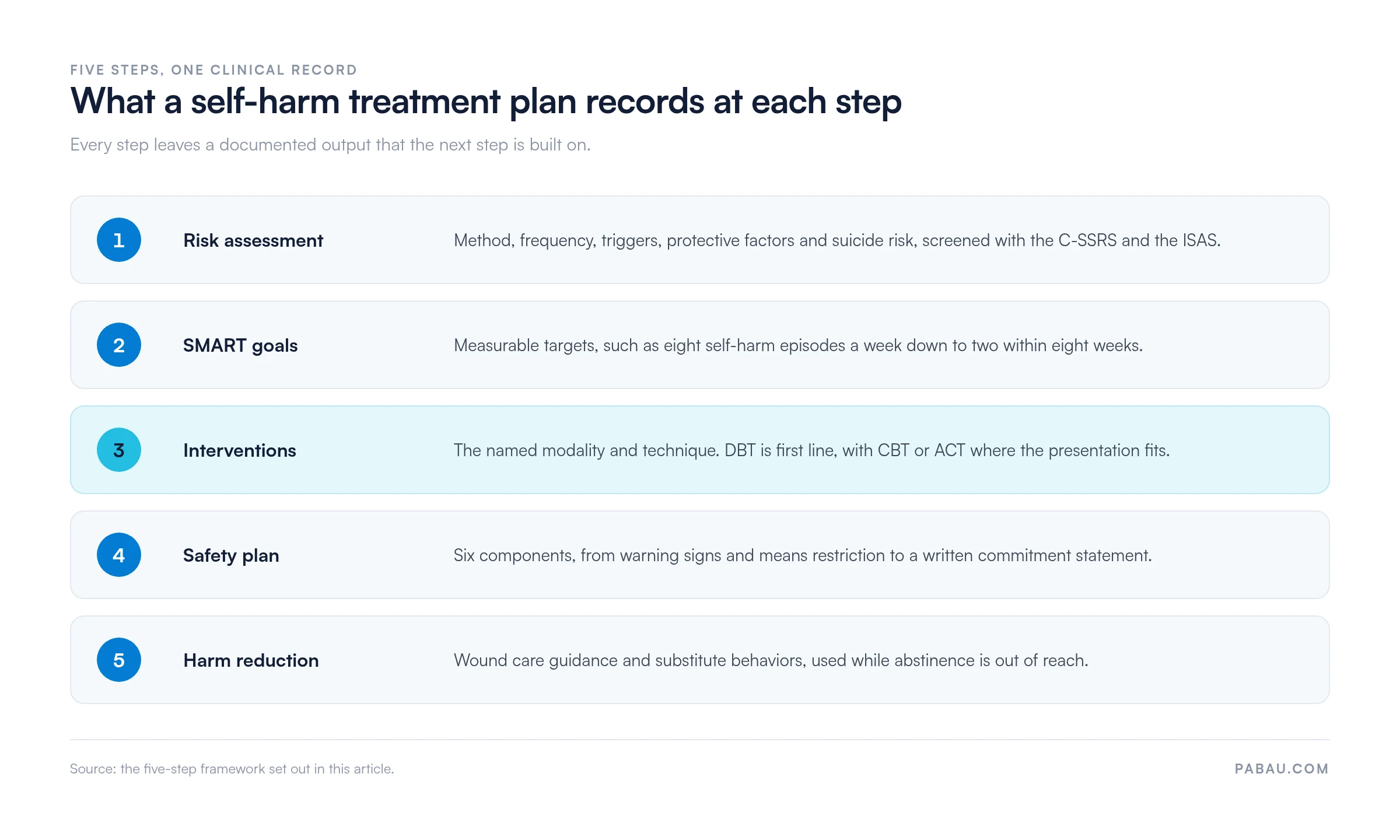
Every treatment plan for self-harm starts with a thorough risk assessment. Document the self-harm history: method, frequency, severity, age of onset, triggers, and intent. Record protective factors too, such as family support, coping skills already in place, and willingness to engage with treatment.
Screen suicide risk explicitly. Is there intent to die, or is the injury emotion-driven? Screen for co-occurring depression, anxiety, trauma, and personality pathology. Borderline personality disorder commonly co-occurs with NSSI.
Key assessment elements:
Use validated tools where you can. The Columbia Protocol (C-SSRS) screens for suicidal ideation alongside non-suicidal self-injury. The Inventory of Statements About Self-Injury (ISAS) measures both the frequency and the functions of self-harm, which points straight at your intervention choice. A psychiatric evaluation template keeps those findings in the same order for every patient.
Document what you find, so the plan targets the function driving the behavior rather than a blanket “reduce self-harm” goal.
Self-harm treatment goals must be SMART: specific, measurable, achievable, relevant, and time-bound. Tie each goal to a finding in your assessment and to the drivers the patient named.
Name the modality and the technique in the plan. A generic “provide psychotherapy” entry gives a reviewer no way to judge whether the intervention worked. The mental health practice software you use should let you link each intervention to the goal it serves.
Dialectical behavior therapy (DBT): the strongest evidence base for self-harm, especially where emotion dysregulation or BPD is present. Its core components are distress tolerance, emotion regulation, mindfulness, and chain analysis of each episode. Distress tolerance covers the TIPP skills: temperature, intense exercise, paced breathing, and paired muscle relaxation. Emotion regulation covers opposite action, check the facts, and PLEASE skills. Individual therapy, skills groups, and phone coaching are the standard structure.
Cognitive behavioral therapy (CBT): useful for identifying the thought patterns that precede self-harm and for building cognitive flexibility. Thought records, behavioral activation, and graded exposure to difficult affect are the standard techniques for NSSI.
Acceptance and commitment therapy (ACT): builds psychological flexibility, so the patient can accept difficult feelings and still act on their values. It works well where avoidance cycles are reinforcing the self-harm.
A safety plan is a separate document from the treatment plan. It covers the acute crisis moment, while the treatment plan targets long-term change. Sound crisis intervention strategies give the safety plan six components:
Harm reduction is a pragmatic clinical approach endorsed by NICE guidelines. Where abstinence-focused goals are out of reach for now, it lowers the medical consequences and keeps the therapeutic relationship intact.
Give wound care guidance: clean supplies, infection prevention, and when to seek medical attention. Discuss substitute behaviors that lower injury severity, such as holding ice. Then explore the function of the self-harm, so you can build coping that serves the same emotional purpose.
Harm reduction does not endorse self-harm. It keeps the patient safer while they build skills and while the risk of serious injury comes down.
Adolescent plans need family involvement, developmental language, and attention to school and peer contexts. Five adaptations matter most.
Your clinical record must show the assessment rationale, the diagnoses behind each goal, and how each intervention addresses a specific goal. Link progress notes back to the original plan, so the care narrative stays continuous and auditable.
Record an update at every session. Has self-harm frequency changed? Are the goals still relevant? Do you need to escalate care or swap an intervention?
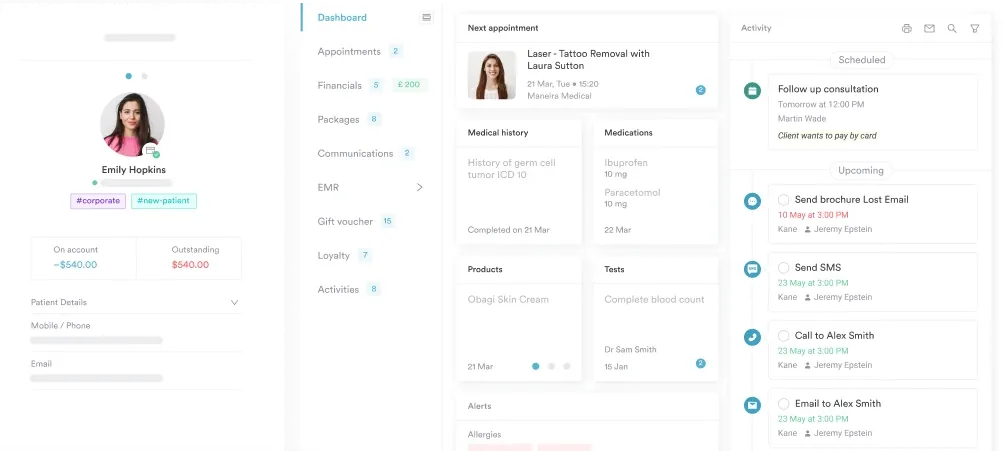
Keep the record encrypted, log every access, and back it up. HIPAA obligations bite hardest on a self-harm case, because access logs are the first item an investigator asks to see.
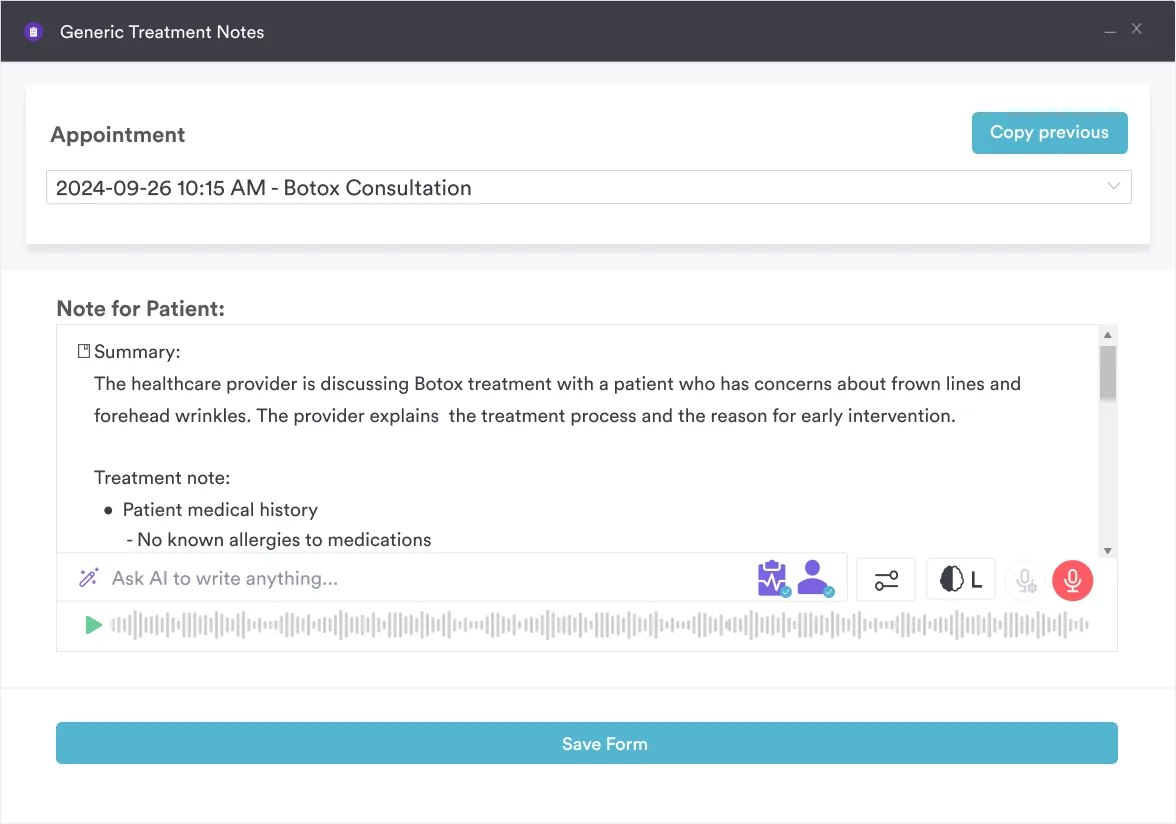
An AI medical scribe drafts the note from the consultation itself, so your goal and intervention wording stays consistent between sessions. It also takes the admin hour off the end of your day.
Outpatient treatment works for most patients who self-harm. Inpatient or day program admission is indicated when one of the following applies.
Document the escalation decision in the plan. Tell the inpatient team what has already been tried, which goals were set, and what helped.
Most adolescents with non-suicidal self-injury do not need inpatient care. Intensive outpatient DBT or a day program is usually enough, and it suits their development better.
Building a treatment plan should not add hours to your week. Pre-populate your template with the goals and interventions you use most, then adapt each one for the patient in front of you.
Therapy practice management software links a progress note back to the goal it reports on, so the whole care arc sits in one view. That saves you rebuilding the story from scratch at every review.
Track engagement as well as outcomes. Missed appointments, unfinished homework, and drop-in attendance all tell you the plan needs a change of intensity or modality.
Review monthly for acute presentations and quarterly for stable patients. Update the plan when a goal is reached, a new risk appears, or an intervention stops working.
In many practices the plan and the evidence behind it sit in different places. The risk assessment is in an intake form and the goals are in a word processor file. Session notes build up in a separate chart. A monthly review then means opening three files.
Pabau keeps them in one place. The assessment form, the goals, the safety plan, and every progress note attach to the same patient record. When you sit down to review, the history of episodes and attendance is already on screen.
Pabau Scribe, our AI scribe, drafts the session note from the consultation itself. You edit and sign it, and your goal wording stays consistent from one review to the next. Automated reminders chase the appointments that adolescent patients most often miss.
Every subscription includes every feature, so the documentation tools are part of the platform rather than a paid extra.

Pabau links each self-harm goal to its interventions and progress notes in one patient record. Pabau Scribe drafts the session note, so a plan review takes minutes rather than an evening.

A treatment plan for self-harm is only as strong as the evidence sitting behind it. Write goals you can count, name the technique rather than the modality, and keep the safety plan attached to the plan it belongs to.
The trade-off worth remembering is pace. Pushing for abstinence before the patient has the skills usually costs you the therapeutic relationship, and harm reduction buys the time to build them.
Download the template above, then decide where the completed plan is going to live. Book a demo to see how Pabau keeps the assessment, the goals, and every review note in one patient record.

Need the crisis-side document too? Mental health safety plan template gives you the six components to complete with the patient in session.
Teaching the skills behind the plan? DBT therapy worksheet covers the exercises patients practice between sessions.
Looking for distress tolerance drills? DBT distress tolerance skills explains TIPP and the skills to pair with a self-harm goal.
Writing plans for other presentations? Psychology treatment plan template follows the same goal and intervention structure for a wider caseload.
Want a fuller intake picture first? Biopsychosocial assessment shows how to gather the history your risk assessment depends on.
A safety plan addresses the acute crisis moment, and what the patient does when an urge to self-harm hits. A treatment plan is the longer-term clinical roadmap covering assessment, goals, therapy modalities, and progress monitoring. Both are necessary, and the safety plan usually sits inside the treatment plan.
Review the plan monthly during the acute phase, which is roughly the first 8 to 12 weeks. Once the patient stabilizes and episodes drop, quarterly review is standard. Update it sooner if a goal is reached or a new diagnosis appears. Do the same if the interventions have not worked after 4 to 6 weeks of consistent engagement.
Not entirely. Adolescent plans need family involvement with clear consent boundaries, school liaison, and developmental language. Adult plans lean on autonomy and on work and relationship contexts. The core structure is the same: assessment, goals, DBT or CBT, and safety planning. What changes is the language, who is involved, and the environment around the patient.
No. DBT has the strongest evidence base, especially for emotion dysregulation and borderline personality disorder. CBT, ACT, and mentalization-based therapy also show effectiveness for self-harm. The choice depends on the patient’s presentation, your training, and what they will engage with. Many plans combine modalities, such as DBT skills groups alongside individual CBT.
Document the refusal, explore the barriers behind it, and offer a modified plan. A patient with capacity is entitled to decline treatment. Where risk is high, through severe self-harm or active suicidality, consider escalation or the reporting duties that apply in your jurisdiction.