Anja Dodevska

Self-harm worksheet: Free PDF with a safety plan
Download your free self-harm worksheet A two-page worksheet in four parts, writt...

5
Last Updated: Nov 6, 2026
Free PDF 2 pages, print-ready Clinician-reviewed
A self-love meditation script is a ready-to-read guide that takes a listener through breath, body awareness, and kind self-talk. Therapists, coaches, and yoga teachers use one to add a short, structured moment of self-compassion to a session.
The free PDF holds eight guided prompts, from grounding to a gentle close, each with its own response box. A ninth box holds a concluding reflection. This guide covers how to lead the script safely, what each stage does, and a five-minute version for shorter sessions.
A ready-to-use self-love meditation script with eight guided prompts, from grounding and a body scan to affirmations, heart-centered visualization, forgiveness, and gratitude. A response box follows each prompt, ending with a closing and concluding reflection.
Start from scratch, or upload this PDF or any form you already use, and Pabau's AI Form rebuilds it with tick boxes, text fields and a signature. Attach it to the treatment once, and every patient gets it on time.
AI Form rebuilds the consent, history and aftercare forms you already use. You review each one, then publish.
Patients complete forms on their phone before they arrive, so the front desk stops retyping paper.
Every signed form is versioned and attached to the treatment record, ready when you need it.
Set how long a consent stays valid. Returning patients skip forms they have already signed.
Supports HIPAA and GDPR compliance AES-256 encryption 4.8 on G2 4.7 on Capterra Trusted by 4,000+ practices worldwide

A self-love meditation script is a skills exercise that supports therapy without replacing it.
The ten-minute version has five stages, from grounding to a gentle close.
Skip the body scan for trauma-exposed patients and use grounding instead.
Affirmations a listener does not believe can backfire, so people with low self-esteem need softer phrasing.
Collect written consent before a group session begins, ideally on a digital form.
A self-love meditation script is a timed, read-aloud session that builds self-compassion through breath, body awareness, and warm, self-directed phrases.
It belongs to the wider family of mindfulness and compassion practices, which many clinicians use alongside care. Each stage has a clear purpose, which is what separates it from a generic relaxation track.
Kristin Neff’s research on self-compassion links self-compassion practice with gains in self-esteem and wellbeing. The American Psychological Association also offers background on mindfulness for clinicians.
Clinical boundary: The script is a skills exercise, not a treatment. It does not diagnose, treat, or cure any condition, and local scope-of-practice rules still apply to any clinical use.
Start with a short screening conversation before you read anything aloud. Check for recent bereavement, acute distress, or trauma history that would make body-focused work unsafe.
Step five matters most when a session brings up strong emotion. Note the concern, follow your clinical protocol, and arrange a follow-up.
Therapists, wellness coaches, yoga teachers, and group facilitators all use this script, and each adapts it differently. The core stages stay the same across all of them.
Practices that run mental health services can book these group sessions in their mental health EMR software, next to one-to-one appointments.
The ten-minute version moves through five stages, each with a clear job. The PDF breaks the same arc into eight guided prompts and adds self-compassion, forgiveness, and gratitude reflections. It ends with a separate box for a concluding reflection.
Invite the listener to settle into a comfortable position and notice their breath. A sample line: ‘Let your breath find its own rhythm, without changing it.’
Guide attention from the feet upward, asking the listener to notice sensation rather than criticize it. Skip this stage for trauma-exposed patients and stay with grounding instead. The body scan meditation script expands this stage into a full session.
Ask the listener to imagine warmth gathering in the chest, then offer it to the younger part of themselves. Pause for a full breath between each instruction.
Offer eight to ten short phrases, each read slowly, for the listener to repeat silently. Examples include ‘I am allowed to take up space’ and ‘I can treat myself with patience.’
Return attention to the room, ask the listener to wiggle their fingers and toes, and invite them to open their eyes when ready.
A self-love meditation script focuses on kind attention to the self. Loving-kindness (metta) meditation is a classical Buddhist practice that cultivates goodwill, usually widening from the self to loved ones and then to all beings.
In a session, the two practices differ in three ways.
Some patients find it far easier to offer warmth to a friend than to themselves. For them, a few rounds of metta toward a loved one make a gentler opening. The self-compassion prompt in the PDF uses the same move, asking the listener to picture supporting a friend first.
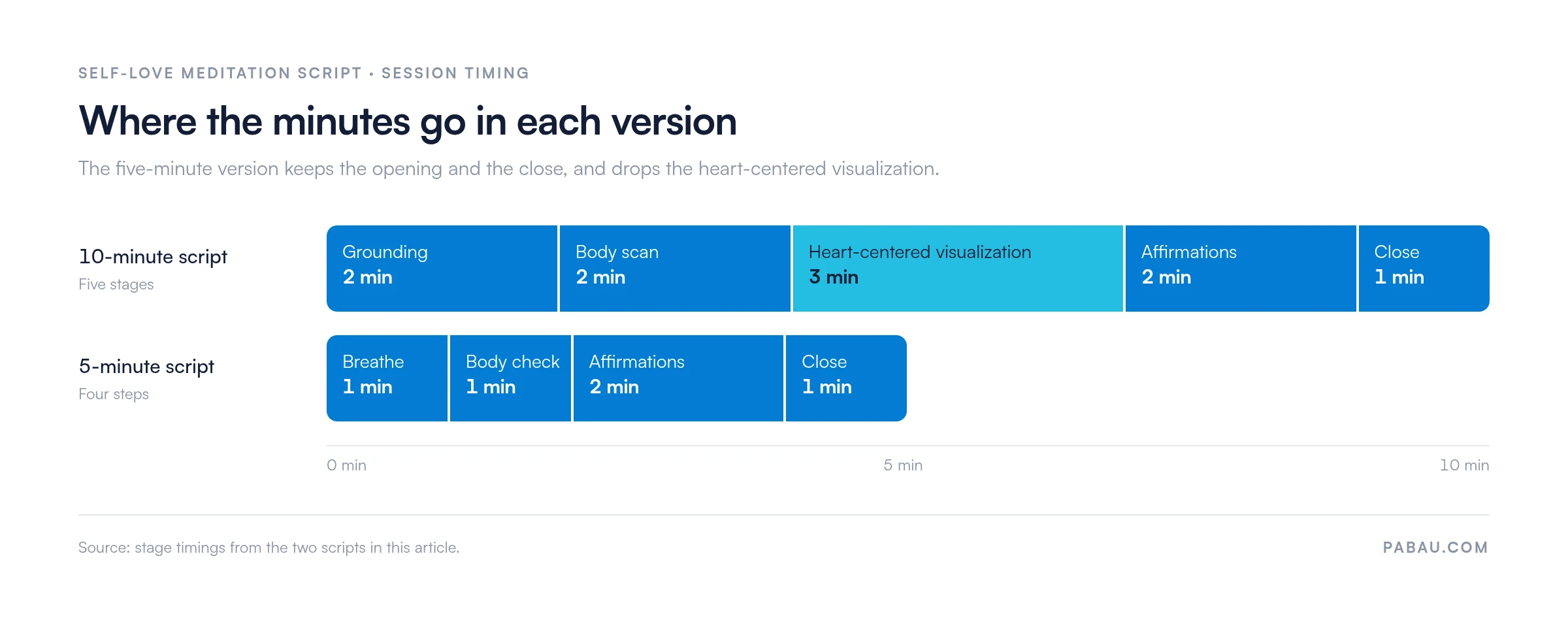
A shorter version fits the end of a yoga class, the start of a coaching call, or a patient’s home practice between sessions. It keeps the opening and closing stages and trims the middle to one body check and three affirmations. The timeline below shows how the two versions spend their minutes.
Strong affirmations can backfire. In a 2009 study in Psychological Science, people with low self-esteem repeated “I’m a lovable person” and felt worse afterward. People with high self-esteem felt slightly better.
A phrase the listener does not believe invites an inner rebuttal, and the rebuttal is what they remember. Swap absolute statements for phrases that describe progress the patient can believe in.
Ask in the debrief which phrases felt true and which felt forced. Record the answer in the patient record, so the next session starts from phrases that land. A positive affirmation worksheet lets patients draft their own believable phrases between sessions.
A meditation session leaves a small paper trail. There is a consent form before it, a debrief note after it, and often a follow-up booking. In many practices those three sit in a filing cabinet, a notebook, and a calendar that never connect.
Pabau, the therapy practice management software we build, puts all three on the patient record. Digital consent and intake forms go out before the appointment, so patients sign on their phone at home. Your debrief note, including which affirmations worked, sits on the same record for the next session.
Online booking lets patients choose their next session slot, and automated reminders go out before it. Session time goes to the meditation, and the admin runs in the background.

Pabau sends digital consent forms before each session, keeps debrief notes on the patient record, and handles online booking and reminders for follow-ups.

A self-love meditation script works when the listener believes what they hear. The stages give the session its shape, but the screening conversation and the debrief decide whether it helps. Use the full script for patients who already respond well to affirmations, and the softer phrasing for those who do not.
Start with the five-minute version if you are new to leading it, then move to the full PDF once the pacing feels natural. Book a demo to see how Pabau keeps consent forms, session notes, and follow-up bookings on one patient record.

Want a version focused on loving-kindness? Loving-kindness meditation scripts give you metta phrases that widen from the self to others.
Working with a self-critical patient? The self-compassion meditation script builds on the friend-first prompt in this template.
Looking for a shorter session? The 5-minute meditation script fits a quick reset at the start or end of an appointment.
Want affirmations patients can practice at home? The positive affirmation worksheet helps patients write phrases that feel believable to them.
A self-love meditation script is a read-aloud guide that walks a listener through breath, body awareness, and kind self-talk. Therapists, coaches, and yoga teachers use it to add a short, structured self-compassion exercise to a session.
The full script in this guide runs about ten minutes across five stages. A five-minute version keeps the breathing, one body check, three affirmations, and a short close. Both work, so pick the length that fits the session.
No. A self-love script keeps the focus on the listener throughout. Loving-kindness, or metta, meditation starts with the self and then extends the same wishes to others, ending with all beings.
No. The script is a skills exercise that supports care, and it does not diagnose or treat any condition. Screen patients before using it, and refer out when you see signs of acute distress or risk.
That can happen with patients who have low self-esteem, since a phrase they do not believe invites an inner rebuttal. Swap absolute statements for gentler ones, such as “I am learning to treat myself with more patience.”