Trauma response test: Free template for clinicians
A trauma response test is a structured screening questionnaire that helps clinic...

8
Last Updated: Oct 15, 2026
A crisis safety plan is a short, personalized written plan that a patient and clinician build together to guide action during a suicidal crisis. It follows the six steps of the Stanley-Brown Safety Planning Intervention, from spotting warning signs to making the home environment safer.
Our free crisis safety plan template walks the patient through those six steps, plus an optional seventh prompt on reasons for living. A written copy gives the patient something to hold on to at 2 AM, when recall is weakest.
The Substance Abuse and Mental Health Services Administration (SAMHSA) identifies safety planning as a recognized intervention. The plan is simple enough to complete in one session.
A three-page form that opens with a current situation field, then follows the six Stanley-Brown steps, from warning signs to a safer environment. An optional seventh prompt covers reasons for living, and step 5 is where you write in 988 and local crisis contacts.
Download template
A crisis safety plan is a written, collaborative tool built on the Stanley-Brown Safety Planning Intervention.
The plan has six numbered steps, from warning signs and internal coping strategies through to making the environment safer.
Steps 3, 4 and 5 escalate in order: people who distract, then people who help, then professionals and crisis lines like 988.
Reasons for living is not one of the six steps, so our form carries it as an optional seventh prompt.
Store completed plans in the patient record so every update is dated and easy to retrieve.
A crisis safety plan is a written document for the moment suicidal thoughts escalate. It lists the warning signs, coping steps, people, and professional contacts a patient can turn to. It is a structured alternative to a general instruction to “call if you feel worse.”
The format most clinicians use comes from the Stanley-Brown Safety Planning Intervention, developed by Barbara Stanley and Gregory K. Brown. Their official form uses six numbered steps in a fixed sequence, which keeps the plan short and usable under stress.
Professional guidance now favors the safety plan over the older no-suicide contract. A contract asks the patient for a promise, while the plan gives them steps to follow.
A template gives every clinician the same structure, so plans are consistent across the team and quicker to complete. It also creates a dated record of what was discussed, which supports continuity of care when a different clinician sees the patient.
Patients keep a copy they can read on their phone or print. A plan they can reach during a crisis is one they are more likely to use.
Documentation requirements vary by state and by setting. Check your own licensing board and payer rules, and treat the template as a clinical tool rather than a substitute for your professional judgment.
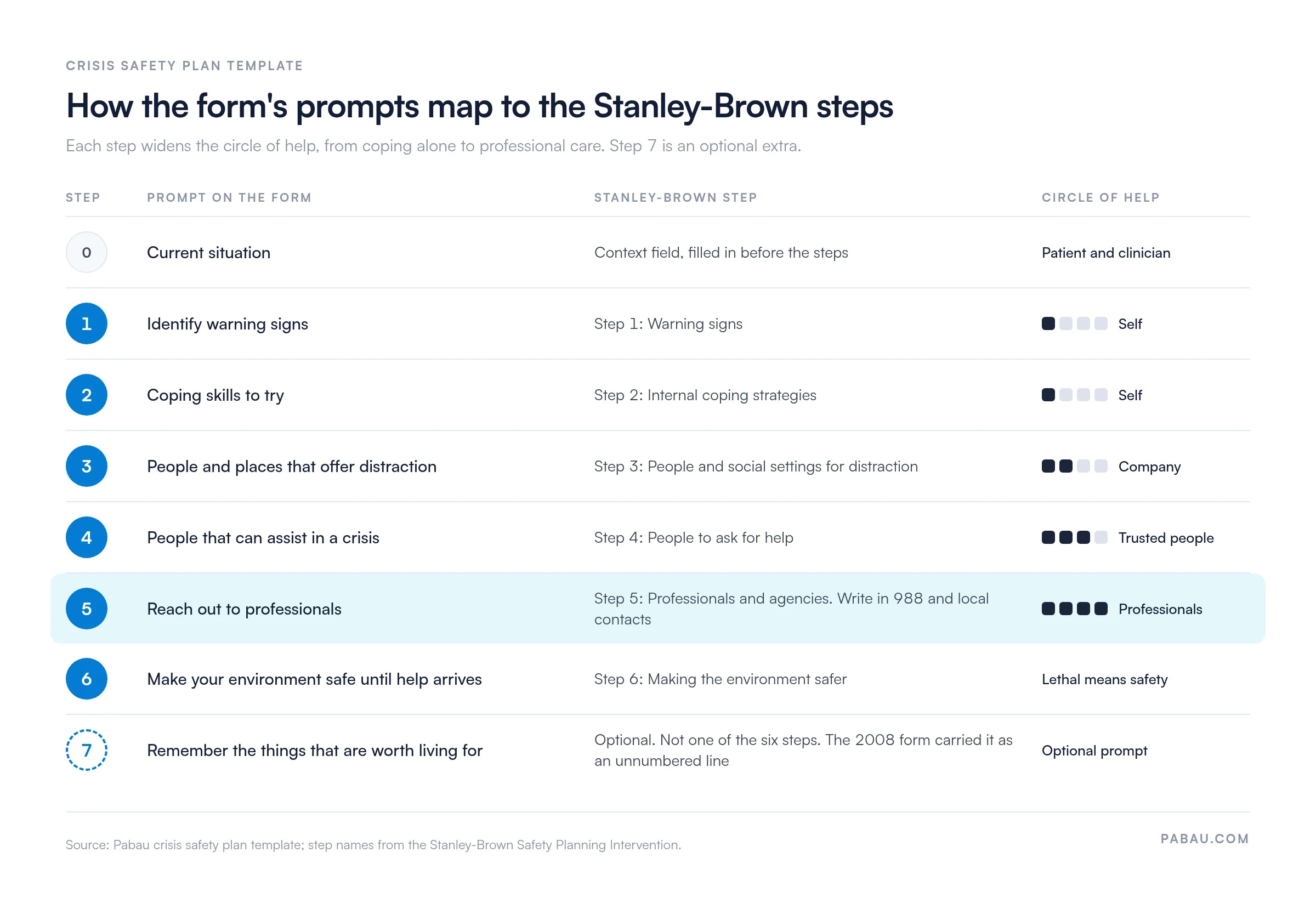
Steps 1 to 6 of the template follow the six numbered steps of the official Stanley-Brown Safety Plan. The form words some of them differently. It opens with a current situation field, where you note what is happening for the patient right now.
Complete the steps in order, and let the patient write in their own words wherever possible. The table below shows how each prompt on the form lines up with the official step.
Warning signs are personal. Ask the patient what they notice in the hours or days before a crisis, and record their words exactly. Generic lists copied from a handout rarely help.
This step lists activities the patient can start alone, without contacting anyone. Walking, a cold shower, or a specific playlist are common examples. Ask the patient to test each one in session where possible.
If coping alone does not help, the patient moves on to company. List people they can contact and places they can go, such as a coffee shop, a gym, or a friend’s home.
The aim here is distraction, so the patient does not need to talk about the crisis. Record a name and phone number for each person.
This step names people the patient trusts enough to tell that they are in crisis. Ask who they would feel able to call, and record names and phone numbers.
Keep this list separate from step 3. Someone who is good company is not always someone the patient can ask for help.
Record the names and numbers of the patient’s clinicians, plus the nearest urgent care or emergency department. Add the 988 Suicide and Crisis Lifeline, the national number in the United States, reachable by call or text at 988.
Our form prints no hotline numbers, so write 988 and any local crisis line into this step yourself. Confirm every number with the patient in session. A contact that turns out to be wrong at 2 AM undermines the whole plan.
Lethal means counseling is a core part of safety planning. Work with the patient to identify which means are accessible to them. Then agree specific steps to increase distance or time, such as storing medication or firearms with a trusted person. Tailor this step to the patient’s state and home situation.
Reasons for living is not one of the six steps. The 2008 version of the form carried a single unnumbered line outside the steps. It asked what is most important to the patient and worth living for. The 2021 version drops it.
Our template keeps it as an optional seventh prompt, “Remember the things that are worth living for.” Use it only if it helps the patient, and let them answer in their own words. Never treat it as a substitute for any of the six steps.
Use the Stanley-Brown intervention when a patient presents with suicidal ideation, after a crisis episode, or at discharge from a higher level of care. It works best as a single collaborative session followed by review at each visit.
Safety planning starts once the immediate crisis has settled. For the acute stage itself, these crisis intervention techniques cover each step of the conversation.
Save each revision as a new dated entry rather than overwriting the old plan. When a patient returns after a crisis, comparing versions shows what has changed in their warning signs and contacts.
Teen safety plans need plainer language. They also need contacts a young person can reach without a parent present, such as a school counselor or a peer. Confidentiality and parental notification rules vary by state, so confirm them before the session.
Ask the teen which digital tools they use, and include crisis text options in steps 4 and 5. Review the plan with the family only with the teen’s agreement where the law allows.
If most of your caseload is under 18, the safety plan for teenagers template adapts the format for adolescents and their families.
The SAMHSA website publishes resources on suicide prevention and safety planning for clinicians and the public. Patients can also use materials from the 988 Suicide and Crisis Lifeline, which are useful to hand out alongside your plan.
Give these out with the template. The clinician completes the plan with the patient, and the external materials give the patient somewhere to turn between sessions.
Psychiatry practices, psychology and therapy practices, and community mental health providers use crisis safety plans most often. Emergency departments and primary care teams also use the format when they discharge patients with suicidal ideation.
Any clinician who sees patients with suicidal thoughts can use the template. They need the clinical training to assess risk and respond to a crisis.
Many practices still store safety plans as scanned PDFs on a shared drive, or as paper copies in a folder. When the patient calls in crisis, nobody can find the current version quickly.
Pabau, the therapy practice management software we build, stores each safety plan as a dated document in the patient record. It sits next to the session notes and risk assessment. With digital forms, the patient and clinician complete and sign the plan in session, and each update sits alongside earlier versions.
The result is one place to check before every appointment. Any clinician on the team can see the latest warning signs, contacts, and means safety steps within a few clicks.

See how Pabau keeps clinical notes, patient records, and signed digital forms together, so your team can find the current safety plan in seconds.

Download the form, then spend most of the session on steps 4 and 5. The plan helps only if the names and numbers in it still work when the patient reaches for them.
Keep the six Stanley-Brown steps fixed and step 7 optional, so the plan stays short enough to use under stress. The trade-off is that the plan is never finished. Revisit it after every crisis and at each review, because warning signs and contacts change.
Book a demo to see how Pabau keeps every dated version of a patient’s safety plan in one secure record.

Tracking how severe the thoughts are? Suicidal ideation scale helps you rate suicidal thoughts so you can see change between reviews.
A crisis safety plan is a written, collaborative document listing a patient’s warning signs, coping strategies, support contacts, and crisis resources. It is designed to be used during a suicidal crisis.
Evidence and professional guidance favor safety plans over no-suicide contracts. A safety plan gives the patient concrete steps, whereas a contract relies on a promise.
No. The six steps end with making the environment safer. The 2008 form added an unnumbered line about what is worth living for, and the 2021 form drops it. Our template keeps it as an optional seventh prompt.
The structure can be the same, but language, contacts, and family involvement should be adapted. Confirm confidentiality rules for minors in your state.
No. The form prints no hotline numbers, so write 988 and any local crisis contacts into step 5 with the patient. Confirm each number works before the session ends.