Anja Dodevska

Rejection sensitivity test: Scoring guide and PDF
Download your free rejection sensitivity test A ready-to-use self-report questio...

4
Last Updated: Nov 11, 2026
Free PDF 3 pages, print-ready Clinician-reviewed
A mental health maintenance plan is a written plan that helps a patient keep their mental health stable once active treatment has eased off. It records known triggers, early warning signs, self-care habits, coping strategies and support contacts in one place. The patient and clinician then both know what to do next. Many patients finish therapy with good insight but no written plan for the months ahead. A maintenance plan gives that insight a practical shape and can be reviewed at each session. This guide covers what to include, how to build the plan with a patient, and what the free printable holds.
A three-page worksheet with prompts for four triggers, four warning signs, three self-care activities and three coping strategies. It closes with a question on how the patient will know when to return to therapy.
Start from scratch, or upload this PDF or any form you already use, and Pabau's AI Form rebuilds it with tick boxes, text fields and a signature. Attach it to the treatment once, and every patient gets it on time.
AI Form rebuilds the consent, history and aftercare forms you already use. You review each one, then publish.
Patients complete forms on their phone before they arrive, so the front desk stops retyping paper.
Every signed form is versioned and attached to the treatment record, ready when you need it.
Set how long a consent stays valid. Returning patients skip forms they have already signed.
Supports HIPAA and GDPR compliance AES-256 encryption 4.8 on G2 4.7 on Capterra Trusted by 4,000+ practices worldwide

A mental health maintenance plan records triggers, warning signs, coping strategies and support contacts for use after active treatment.
The free printable covers five sections, so support contacts, crisis steps and review dates are added in session.
Plans work best when they are reviewed at regular sessions rather than filed once and forgotten.
Clinicians should frame the criteria for returning to therapy as clinical judgment, never as a fixed rule.
Store completed plans in your practice software with HIPAA or GDPR safeguards in place.
A mental health maintenance plan is a written document that sets out how a patient will stay well between sessions and after therapy ends. NICE’s depression guideline describes the same building blocks for relapse prevention. It recommends concrete plans to maintain progress, a list of triggers and warning signs, and a plan for what to do if each one returns.
It differs from a treatment plan, which targets a diagnosis and active symptom reduction. A maintenance plan focuses on prevention and continuity. Clinicians use it with patients leaving acute care, finishing a course of therapy, or wanting a structured way to stay well.
It also overlaps with a relapse prevention plan worksheet, which is usually built around one condition or substance. The maintenance plan is broader and covers day-to-day well-being as well.
Continuity of care is the main clinical reason. Early warning signs often go unnoticed between sessions, and a written plan keeps the patient’s own knowledge of them in view.
The plan does not guarantee that a relapse will be prevented. Its realistic goal is an earlier conversation, before a difficult period takes hold.
A useful template captures the same core sections every time, so the patient and clinician can compare versions over months. A complete plan has seven sections.
Triggers and warning signs come first, because the patient needs to recognize them before any coping step will help. Coping strategies and support contacts follow, and both only work if they are specific. Crisis steps sit at the end, where they are easy to find under pressure.
A support system worksheet helps the patient name the people they would really call. If the patient has a history of suicidal thoughts, build the crisis steps as a full mental health safety plan and attach it.
Daily habits give the plan its everyday texture. Ask the patient to choose a small number of habits they can realistically keep.
Triggers are easiest to manage when they are written down before they arrive. Work through them with the patient in session, using an identifying triggers worksheet if they struggle to name them.
The plan is most useful during transitions, such as discharge from inpatient care or the end of an intensive program. Recovery involves setbacks, and a plan gives the patient a clear first step when one occurs.
Support networks matter here. Include the people the patient trusts and the professional services available, and confirm consent before sharing the plan with anyone outside the practice.
Cognitive behavioral therapy (CBT) techniques fit naturally into a maintenance plan because they are practical and skills-based. Clinicians often draw on them for the coping section, and a CBT triangle handout is a quick way to revisit the model first. The plan does not replace formal CBT delivery.
Introduce the template as a shared document rather than an assessment. Complete it together in session so the patient leads on their own content.
Store plans only in systems that meet your data protection duties, including HIPAA in the US and GDPR in the UK and EU.
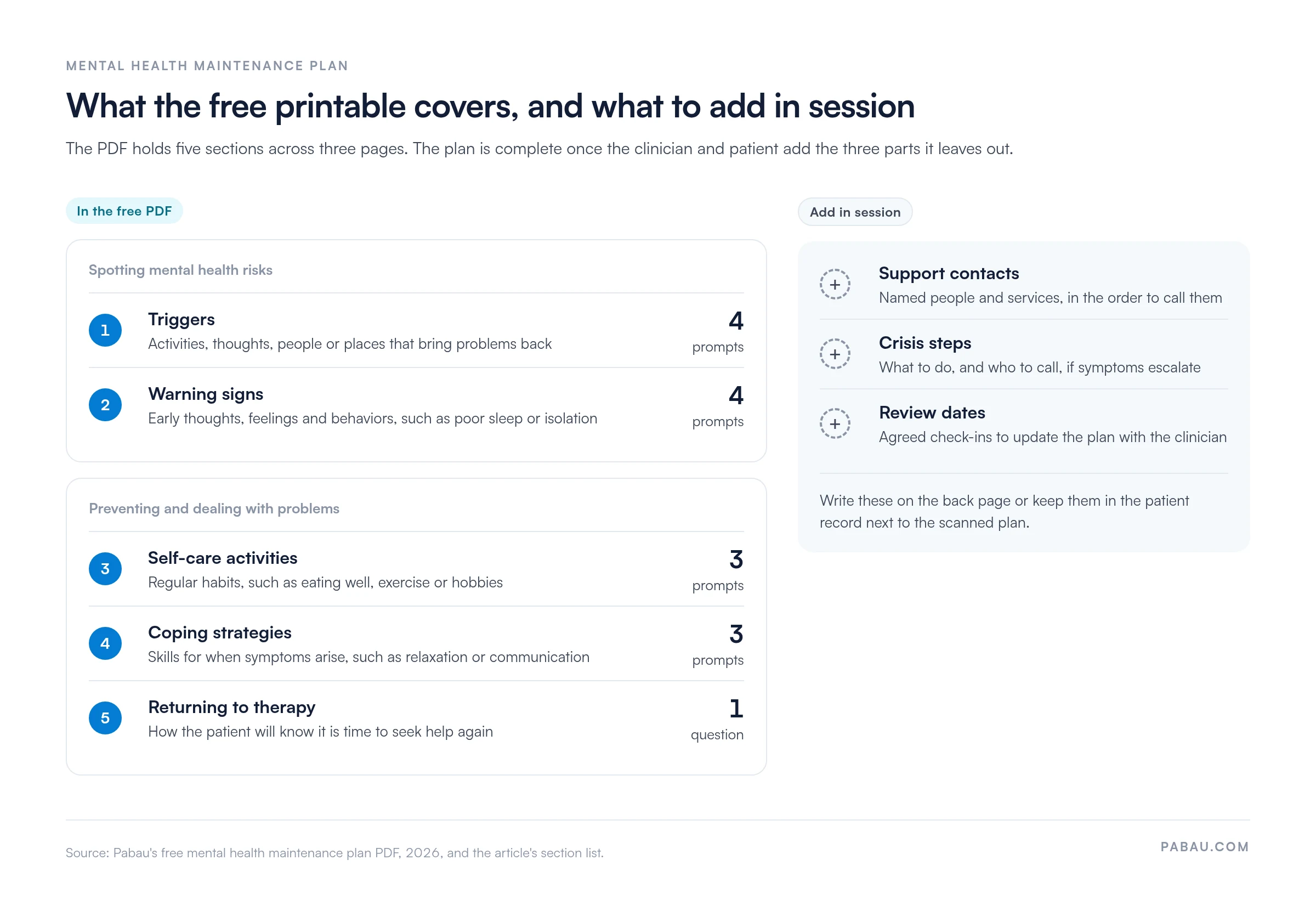
The free printable has five sections over three pages. It asks for four triggers, four warning signs, three self-care activities and three coping strategies. It closes with one open question on how the patient will know it is time to return to therapy.
It has no space for support contacts, crisis steps or review dates, so the clinician adds those in session. The diagram below shows the split, and the prompts can be adapted to your patient group and treatment model.
Most practices hand the plan over on paper. The agreed version ends up in a drawer or a scanned file, and the review date lives in someone’s diary.
Pabau, the therapy practice management platform we build, lets you rebuild the plan as a digital form. The patient fills it in through the Client Portal, and the completed version is saved to their record next to session notes.
With medical records software holding each completed form, you can compare a new version with the last one at review. Recall workflows send the patient an SMS, email or WhatsApp reminder before the review is due.
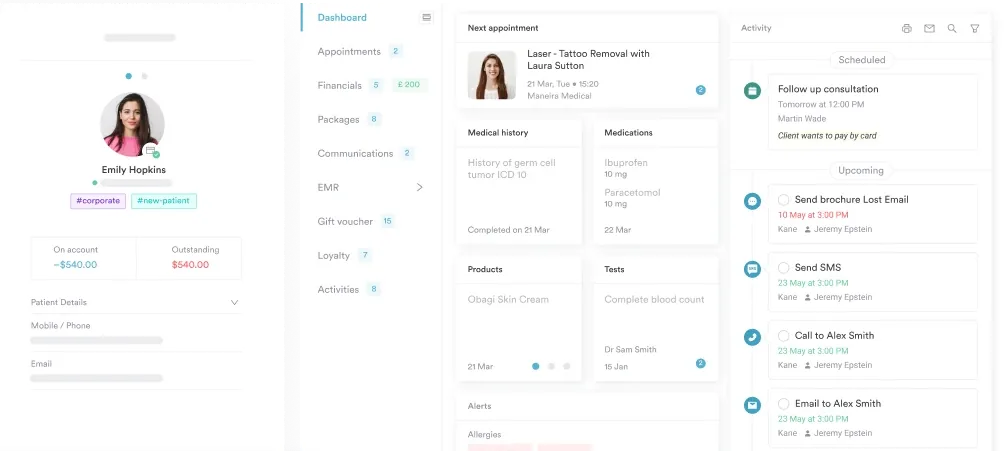

Pabau turns your maintenance plan into a digital form that patients complete through the Client Portal. Completed plans sit in the patient record, and recall workflows remind patients before each review.

Treat the printable as the first draft of the plan. Its five sections cover what the patient notices and does day to day. Support contacts, crisis steps and review dates still need adding in session.
A plan earns its place when it gets reviewed. Set the first review date before the patient leaves the room, and bring the plan to every session after that.
To see how Pabau keeps maintenance plans, review reminders and session notes in one patient record, book a demo.

Want a recovery plan the patient drives? Wellness recovery action plan worksheet covers a wellness toolbox, daily maintenance, triggers and early warning signs.
Need to show how a lapse builds? Stages of relapse worksheet tracks the warning signs a patient shows as a relapse builds, weeks before it happens.
Building the self-care section? Self-care plan template sets out the habits that protect well-being across seven areas of life.
Short on coping strategies to suggest? Coping skills worksheet sorts current strategies into healthy and unhealthy ones and builds a personal toolbox.
Tracking mood between reviews? Mood tracker template gives the patient a daily record to bring to each maintenance plan review.
A mental health maintenance plan is a written document that records triggers, coping strategies, support contacts and daily habits for use after active treatment. It focuses on continuity and early action rather than symptom treatment.
Most plans include triggers, warning signs, coping strategies, support contacts, daily habits, crisis steps and therapy check-in dates. Pabau’s free printable covers triggers, warning signs, self-care activities, coping strategies and when to return to therapy, so the rest is added in session.
It may help patients recognize early warning signs and act sooner during recovery. It does not prevent relapse on its own and works alongside professional care.
A self-care plan lists general well-being activities. A maintenance plan is clinician-informed and adds triggers, warning signs and crisis steps.