Mental health self-care checklist
A mental health self-care checklist is a structured daily tool for tracking the ...

6
Last Updated: Oct 20, 2026

The Stanley-Brown safety plan is a six-step written plan that a clinician and patient build together to reduce suicide risk.
The steps escalate in order, from what the patient can do alone to who they call and how the home is made safer.
Most sessions take 20 to 30 minutes, and the patient keeps a copy they can read during a crisis.
Review the plan every 6 to 12 months, and straight after an attempt, a hospitalization, or a major life change.
Practice management software like Pabau keeps every version in the client record, so staff can open the plan during a crisis.
A printable six-step form with space for warning signs, internal coping strategies, distraction contacts, and support people. Step 5 holds professional and crisis contacts, and step 6 records the means restriction you agree in session.
Download templateThe Stanley-Brown safety plan is a six-step written plan you build with a patient who is at risk of suicide. It records their warning signs, then what to do and who to call as those signs get worse.
During a crisis, thinking clearly is hard, so the patient follows their own instructions instead of deciding. A vague plan, or one nobody can find after hours, does not help at that moment.
The six steps below run in that order. You also get a filled-in example, the mistakes that make plans useless, and where to keep the finished form.
Stanley-Brown safety plan gives a patient a written sequence to follow when suicidal thoughts escalate. Barbara Stanley and Gregory K. Brown designed it as a brief intervention. It fits inside one appointment rather than a course of therapy. Clinician and patient write it together, and the patient keeps a copy.
The format comes out of cognitive behavioral practice. Patients learn to spot their own early signs, then act on them before the crisis peaks. A generic crisis plan usually lists services and phone numbers. This one lists the patient’s own moves, in the order they will need them.
Warning-sign work sits inside a wider risk conversation, and the plan is only as good as the interview around it. Our guide to crisis intervention strategies covers how to open that conversation and what to ask next.
Each step adds a layer of support. The patient moves down the list only when the step above it does not settle the crisis. Steps 1 and 2 keep the patient in charge, then every later step widens the circle of help.
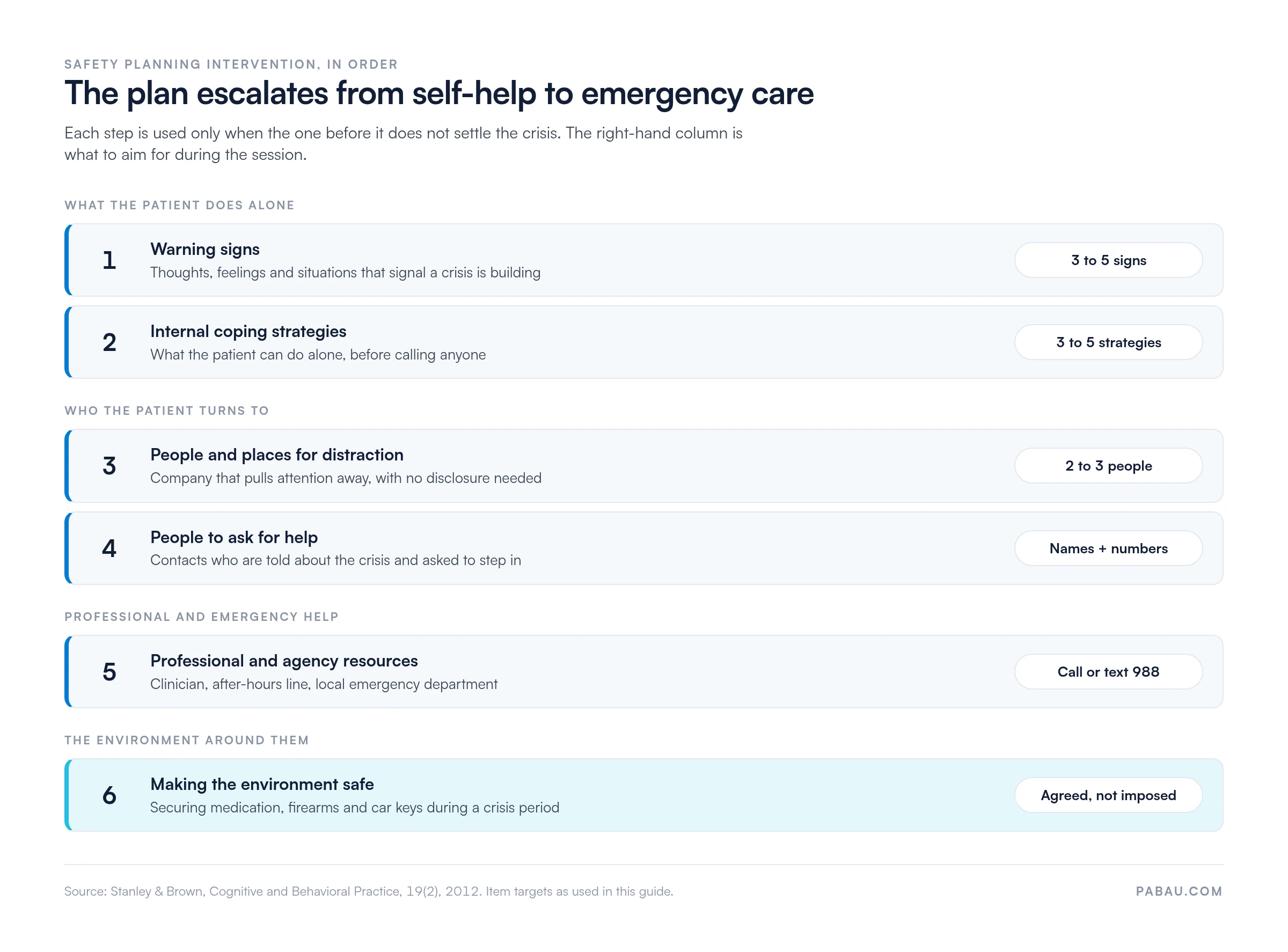
Warning signs are the thoughts, feelings, and situations that show a crisis is building. They are not risk factors. Chronic depression is a risk factor, while three sleepless nights after a breakup is a warning sign. Aim for 3 to 5 signs the patient will recognize in the moment. “I stop answering texts” works better than “I feel bad”.
These are the moves a patient makes without calling anyone. Breathing exercises, a shower, a run, journaling, or a favorite playlist all count. Ask what has helped before, then write down 3 to 5 of those. A strategy the patient has never tried usually stays untried.
Step 3 is about company, not disclosure. The patient plays basketball with a friend or sits in a busy cafe, and the crisis never comes up. Name 2 to 3 people or places, then write the activity next to each name. Entries such as “see friends” are the ones that fail at 11pm.
These contacts are told about the crisis and asked to help, so they are usually family, a partner, or a close friend. Write their numbers on the form. Then check whether the patient agrees to you contacting them. Record that consent in the note as well as on the plan.
Step 5 holds your direct line, the after-hours number, and the local emergency department. Add the 988 Suicide & Crisis Lifeline, which takes both calls and texts on 988.
The Crisis Text Line also answers texts sent to 741741. Some printed forms still carry the older 1-800-273-8255 number. Write 988 beside it, because patients dial what is in front of them.
Reducing access to lethal means is one of the strongest steps on the page. Talk through locking up medication, storing firearms with someone else, or handing car keys to a family member for a few days.
Suicidal impulses often peak for minutes rather than hours, so distance buys time. Frame the step as temporary and agreed, never imposed.
Treat it as a conversation, not a form you hand over. Plan on 20 to 30 minutes inside an intake, a risk assessment, or a session that follows a disclosure.
Set it up. Say what you are about to do and why. “We are going to write a plan together that you can use if you are ever in crisis. It is yours to keep.” That framing turns the exercise into joint problem-solving rather than a set of conditions.
Work down the steps. Start with warning signs and prompt for detail. What does it feel like in your body? What time of day is it? What happened just before? Then move through the steps in sequence, and write the patient’s own words rather than your summary of them.
Handle pushback. Step 6 draws the most resistance, so explore the worry instead of pressing. Ask what makes securing the medication feel difficult, then problem-solve from there. A short explanation of how quickly an impulse passes often does more than persuasion.
Hand over a copy. Print it, photograph it on the patient’s phone, or send it through patient portal software. They can then read it again between sessions. Keep a copy in the chart too, because the version in your record is the one your colleagues will work from.
The form is simple, so the failures are rarely about the format. Run through this list before you file a completed plan:
Seeing a finished plan helps before you try one with a patient. The example below is anonymized. It shows how a 28-year-old with depression and relationship conflict might fill in each step.
Patient: “Alex”
A safety plan earns its keep at the worst possible hour, usually when the clinician who wrote it is off duty. So storage is part of the intervention. Paper copies go missing, while a digital record can be searched, dated, and locked down.
Documentation and access. The plan is part of the clinical record, so it needs the same protection as a psychiatric note. A mental health EMR gives you encryption, access logs, and permissions that limit the file to the treating clinician and their supervisor.
Reviews and versions. Revisit the plan every 6 to 12 months, and sooner after an attempt, a hospitalization, or a big life change. Medical records management software lets you flag a plan for review and keep the earlier versions. It also shows who signed off on each one.
Crisis access. If a patient calls the emergency line or turns up at the ER, whoever answers should reach the current plan in seconds. That only works when plans sit in one system, rather than split between paper files and email attachments.
Audits. The Joint Commission standard NPSG 15.01.01 expects documented suicide risk assessment and reduction in mental health settings. A completed plan, reviewed on a set cadence, is straightforward evidence during a chart audit.
Barbara Stanley and Gregory K. Brown published the Safety Planning Intervention in Cognitive and Behavioral Practice in 2012. The paper sits in volume 19, issue 2, pages 256 to 264. Randomized controlled trials since then show fewer suicide attempts among patients with a recent attempt, compared with treatment as usual.
The Suicide Prevention Resource Center and SAMHSA both list it as an evidence-based practice for outpatient, inpatient, and crisis settings. The authors also publish the original form and manual on the Stanley-Brown safety plan site.
One limit is worth stating plainly. The plan does not replace emergency care. A patient reporting immediate intent and a method still needs an emergency department assessment, and possibly admission. What the plan does is strengthen the net around everyone in ongoing outpatient care.
On paper, a completed plan lives in a folder in a locked cabinet. Finding it after hours means calling whoever has the key, and the version you reach may not be the current one. Scanned copies in a shared drive have the same problem, because nobody can tell which file is the latest.
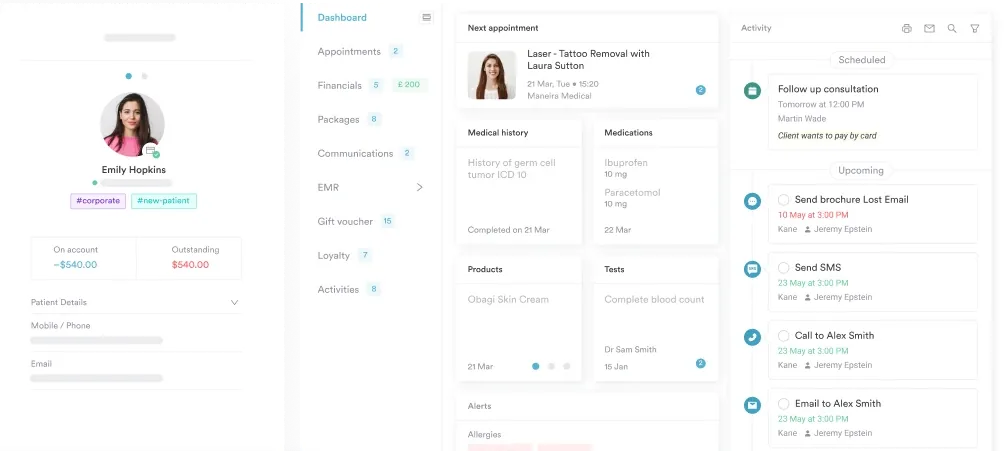
Pabau is therapy practice management software, so the plan sits with the appointment, the notes, and the client’s contact details. You build the six steps as a digital form and complete it on screen during the session. It saves straight to the client record. Permissions decide who can open it, and the audit trail records who did.
Because each version stays on file with its date, the review cadence becomes visible instead of remembered. Staff taking a crisis call open the record and read the plan the patient agreed to. Nobody hunts for the newest copy.

Complete the six-step plan as a digital form and store every version with the client’s file. Staff on call open the current plan in seconds, and each review is logged.

Safety planning is one of the few suicide prevention steps a single clinician can finish inside one appointment. The work is all in the detail. Specific names, numbers, and an agreed means restriction get used during a crisis. A general plan gets forgotten in a drawer.
So write the plan in the patient’s words, then make it easy to find again. Book a demo to see how Pabau keeps every version of a safety plan where the clinician on call can find it.

Need a lighter exercise before a full plan? Suicide prevention worksheet gives you a shorter risk-reduction task to work through in session.
Working with a teenager? Safety plan for teenagers template adapts the same six steps for adolescents and their caregivers.
Want the interview skills behind the plan? Crisis intervention strategies for clinicians covers how to open and steer a high-risk conversation.
Need the wider assessment first? Psychiatric evaluation template structures the history, mental status, and risk sections that lead into safety planning.
Setting up a new client? Mental health intake form collects the history and screening answers you need before the first session.
No. A contract asks the patient to promise not to act, and that promise has little evidence behind it. A safety plan gives them steps to follow instead, written in their own words.
Any trained clinician. Social workers, nurses, case managers, and emergency department staff all use the format. Prescribing rights are not required, but training in the six steps is.
Yes, with a caregiver involved. Adults control the means restriction step, so a parent usually agrees to secure medication and firearms. Keep the wording age-appropriate, and let the teenager choose their own coping strategies.
Document the refusal and what you offered. Then start smaller, because many patients will name warning signs even when they decline the rest. Reassess risk before they leave the room.