Despina Petrushevska

Piercing consent form
A piercing consent form is a signed record that a client understood a piercing&#...

13
Last Updated: Oct 2, 2026
Free PDF 2 pages, print-ready Clinician-reviewed
A rejection sensitivity test is a self-report questionnaire that measures anxious expectation of rejection when a person makes a request or approach. This free version is the nine-item Adult Rejection Sensitivity Questionnaire (A-RSQ), adapted from the RSQ that Downey and Feldman published in 1996. Patients rate each scenario for concern and for expected acceptance, and each scenario scores concern × (7 − expectation), averaged across all nine. The result flags a pattern worth exploring in patients assessed for ADHD, anxiety or mood concerns. It does not diagnose rejection sensitive dysphoria (RSD), which is not a DSM-5-TR diagnosis.
A ready-to-use self-report questionnaire of nine scenarios, each rated for concern and expectation of acceptance, with a total score line. It follows the nine-item Adult Rejection Sensitivity Questionnaire (A-RSQ).
Start from scratch, or upload this PDF or any form you already use, and Pabau's AI Form rebuilds it with tick boxes, text fields and a signature. Attach it to the treatment once, and every patient gets it on time.
AI Form rebuilds the consent, history and aftercare forms you already use. You review each one, then publish.
Patients complete forms on their phone before they arrive, so the front desk stops retyping paper.
Every signed form is versioned and attached to the treatment record, ready when you need it.
Set how long a consent stays valid. Returning patients skip forms they have already signed.
Supports HIPAA and GDPR compliance AES-256 encryption 4.8 on G2 4.7 on Capterra Trusted by 4,000+ practices worldwide

A rejection sensitivity test is a screening questionnaire, not a diagnostic instrument.
Rejection sensitive dysphoria is linked to ADHD in the research literature, but the link is correlational.
This PDF is the nine-item adult Rejection Sensitivity Questionnaire, scored as concern × (7 − expectation) and averaged across the nine scenarios.
Use scores to guide a clinical conversation, then confirm findings through a structured interview.
Pabau digital forms let teams send the questionnaire before the visit and store the completed form on the patient record.
The nine-item form in this PDF is the Adult Rejection Sensitivity Questionnaire (A-RSQ). Berenson and colleagues published it in 2009, adapting the Rejection Sensitivity Questionnaire (RSQ) that Downey and Feldman developed in 1996. Both measure the tendency to anxiously expect rejection, readily perceive it and react strongly to it.
Every scenario puts the patient in the position of asking someone for something. The questionnaire captures how they feel before the other person answers. It does not measure how they cope with criticism they have already received.
| Scenario | Who the patient approaches | What they ask for |
|---|---|---|
| 1 | Parents or other family members | A loan through a difficult financial time |
| 2 | A close friend they upset | A chance to talk and work things out |
| 3 | A partner | A conversation about sexual protection |
| 4 | A supervisor | Help with a problem at work |
| 5 | A partner after a bitter argument | To make up |
| 6 | Parents or other family members | To come to an occasion that matters to them |
| 7 | Someone at a party | To start a conversation |
| 8 | A partner who seems distant | Whether something is wrong in the relationship |
| 9 | A friend | To listen to something on their mind |
The spread is deliberate. Family, friends, partners, a supervisor and a stranger each appear. A high score can then show whether the worry is broad or tied to one kind of relationship.
The form is self-report and fits on two pages. The patient fills in their name, age, gender and date of completion, then answers each scenario twice:
The instructions ask patients to answer for how they think and feel most of the time, not on their best or worst day. Sending the form before the appointment gives you time to score it before the conversation starts.
Several scenarios assume a partner, a supervisor or nearby family. Ask which ones the patient found hard to picture, because a guessed answer weighs as much as a lived one.
The PDF ends with a total score line but no scoring key, so use the A-RSQ method. For each scenario, subtract the expectation rating from 7 to turn expected acceptance into expected rejection. Multiply that by the concern rating, then average the nine results.
Each scenario can score from 1 to 36, and so can the average. The grid shows every possible combination of the two ratings.
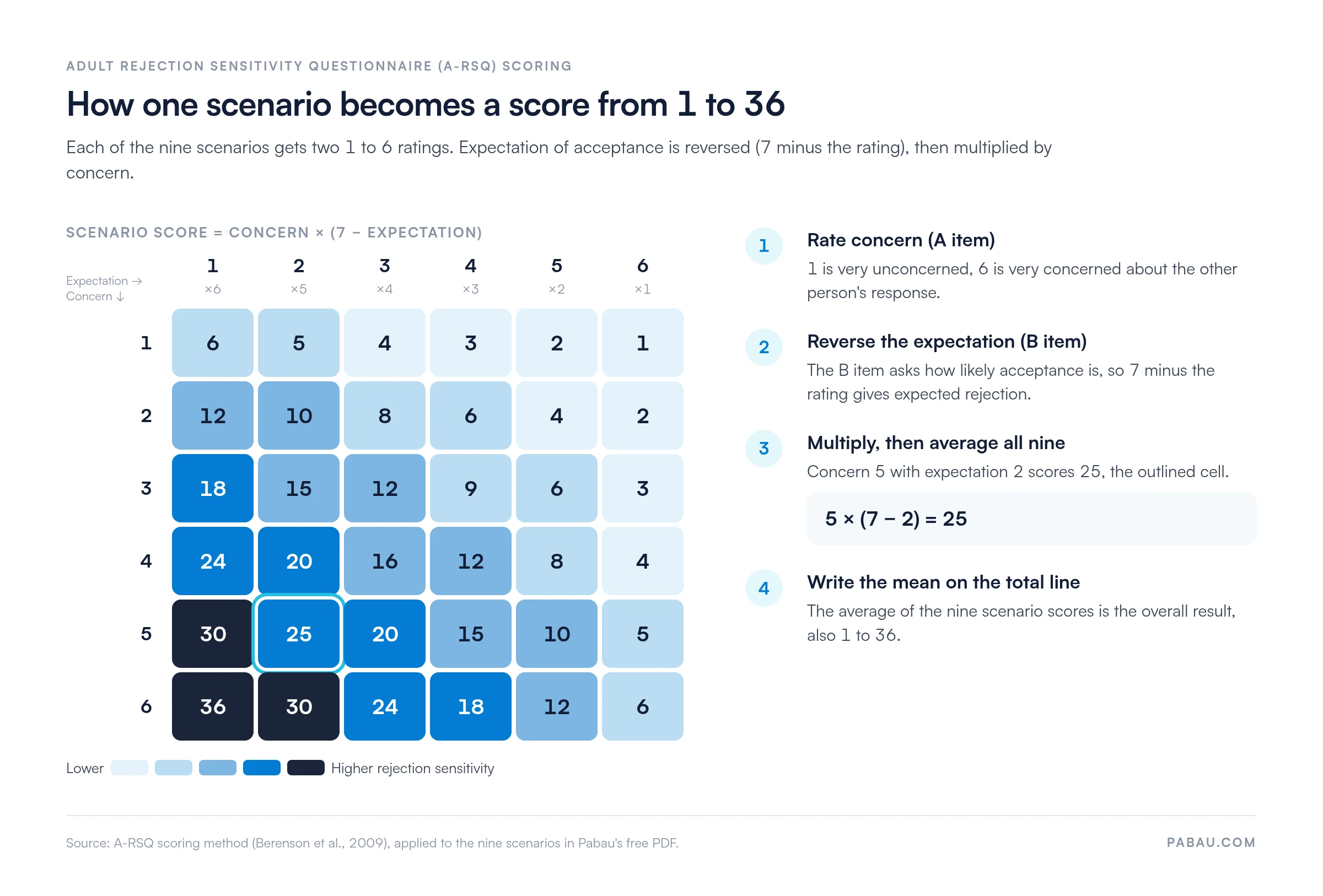
Take a patient who rates concern 5 and expectation 2 on the supervisor scenario. That scenario scores 5 × (7 − 2) = 25. If their nine scenario scores add up to 117, the total written on the form is 13.
Higher totals mean stronger anxious expectation of rejection. The A-RSQ has no validated clinical cutoff, and the bands quoted on template sites disagree with each other. Use the first score as a baseline and compare later scores against it.
Read the two ratings separately as well. An Italian validation study found that concern and expectation behave as distinct factors, so the same total can come from very different answers.
Rejection sensitivity is a research construct with validated questionnaires behind it. Rejection sensitive dysphoria (RSD) is a clinical term for sudden, intense emotional pain after perceived rejection, used mostly in ADHD practice. Neither is a DSM-5-TR diagnosis.
Research has reported an association between rejection sensitivity and ADHD, but the evidence is correlational. A high A-RSQ score is a reason to ask more questions, never evidence of ADHD on its own. Where attention symptoms are part of the referral, pair it with the adult ADHD self-report scale.
The A-RSQ screens. It does not diagnose, and it cannot tell you why a patient expects rejection or how that expectation affects their week. A structured interview covering triggers, avoidance and functional impact does that work.
It is also an adult form. For children and adolescents, the Children’s Rejection Sensitivity Questionnaire (CRSQ) uses scenarios written for school and peer settings.
Rejection sensitivity overlaps with other constructs you may already measure. The emotion reactivity scale covers how quickly emotions rise and how long they last. The social interaction anxiety scale covers fear of social situations themselves.
Attachment anxiety is the closest neighbor, since both describe worry about whether others will stay available. The adult attachment scale helps separate a relationship pattern from a broader fear of asking.
Many practices still print the PDF, hand it over in the waiting room and file the paper copy after scoring it by hand. In Pabau’s therapy practice management software, the questionnaire goes out as one of your digital forms before the appointment.
Patients complete it on their phone or through the patient portal, and the answers land on the patient record. The clinician still applies the scoring rule and records the result in the treatment note. A repeat send at review sits on the same record, so you can compare scores without hunting through folders.
Practices that run adult ADHD assessments can keep the A-RSQ alongside their other intake forms in Pabau’s ADHD clinic software.

Pabau’s digital forms send the rejection sensitivity test ahead of the appointment and file the completed answers on the patient record. You score it and start the session with the result in hand.

Treat the rejection sensitivity test as the opening of a conversation about the requests a patient avoids making. Score it with the A-RSQ rule, look at concern and expectation separately, and keep the first result as a baseline.
The form is quick and free, but it carries no clinical cutoff and no diagnostic weight. A score earns its place in the record only when the interview explains it.
Book a demo to see how Pabau sends the questionnaire before the visit and keeps every completed copy on the patient record.

Screening for attention symptoms too? ADHD screening test template gives you a structured first pass before a full assessment.
Is the patient sensitive in general, not just to rejection? Highly sensitive person scale measures sensory and emotional sensitivity as a separate trait.
Want a quick read on self-worth? Rosenberg self-esteem scale scores global self-esteem in ten items.
Exploring how the patient relates to partners? Relationship scales questionnaire maps attachment style across close relationships.
Is fear of social situations part of the picture? Social interaction anxiety scale measures anxiety about meeting and talking with people.
A rejection sensitivity test is a self-report questionnaire that measures how anxiously a person expects rejection when they ask others for something. It supports a clinical conversation but does not diagnose rejection sensitive dysphoria.
No. Rejection sensitivity describes a general tendency to react strongly to rejection. Rejection sensitive dysphoria describes an intense, sudden emotional response that disrupts daily functioning.
Research has reported an association between rejection sensitive dysphoria and ADHD. The evidence is correlational, so clinicians should not assume ADHD causes rejection sensitivity.
Follow up with a structured interview covering triggers, avoidance, and functional impact. Then decide whether referral, psychoeducation, or routine monitoring fits.
Free online quizzes exist, but most are not clinically validated. Use them, if at all, as conversation prompts rather than assessment results.