Montgomery-Åsberg Depression Rating Scale (MADRS)
The Montgomery-Åsberg Depression Rating Scale (MADRS) is a clinician-administer...

Last Updated: Oct 6, 2026
A self-compassion journal is a worksheet that walks you through one difficult moment and helps you answer it with warmth instead of blame. The free template below follows Kristin Neff’s three pillars of self-compassion: self-kindness, common humanity, and mindful awareness. You describe the situation, name the emotions and the self-talk that came with it, then write the response you would offer a close friend.
Each entry closes with a self-compassion plan for the next time the same pressure shows up. One entry takes roughly 10 to 15 minutes. You can work through it on your own, or a therapist can assign it as homework between sessions and review it with you afterward.
A two-page printable journal with seven guided prompts: situation, emotions, self-talk, self-kindness, common humanity, a self-compassionate gesture, and a self-compassion plan. The second page leaves open space for notes and reflection.
Download template
A self-compassion journal is a structured worksheet built around Kristin Neff’s three pillars: self-kindness, common humanity, and mindful awareness.
This free template carries seven prompts, running from a description of the situation through to a self-compassion plan for next time.
Writing the compassionate response down turns a vague intention into language you can reread, which is what makes the habit hold.
Therapists, counselors, and coaches can assign the worksheet as between-session homework and discuss completed entries at the next appointment.
Practices running practice management software like Pabau can share the worksheet digitally and file completed entries against the client record.
A self-compassion journal is a structured writing tool that helps you meet setbacks, mistakes, and self-criticism with understanding rather than harsh judgment. It draws on researcher Kristin Neff’s framework, which describes self-compassion as three linked elements. Self-kindness means treating yourself as you would a close friend. Common humanity means reading your struggle as part of shared human experience. Mindful awareness means noticing painful feelings without being swallowed by them.
A general diary records what happened. This journal asks a fixed sequence of questions about one moment. Each entry moves from the event to a kinder response, then to a plan. That structure is what separates a compassion practice from rumination, where the same worry circles without resolution.
The worksheet runs to two pages. The first page holds a short header and seven prompts. The second page is open space for notes and reflection, which gives you room when one entry needs more than the lines allow.
The seven prompts work as one sequence. Each belongs to a pillar of Neff’s framework, and the order does work of its own. You notice the moment first, answer it second, then plan for the next one.
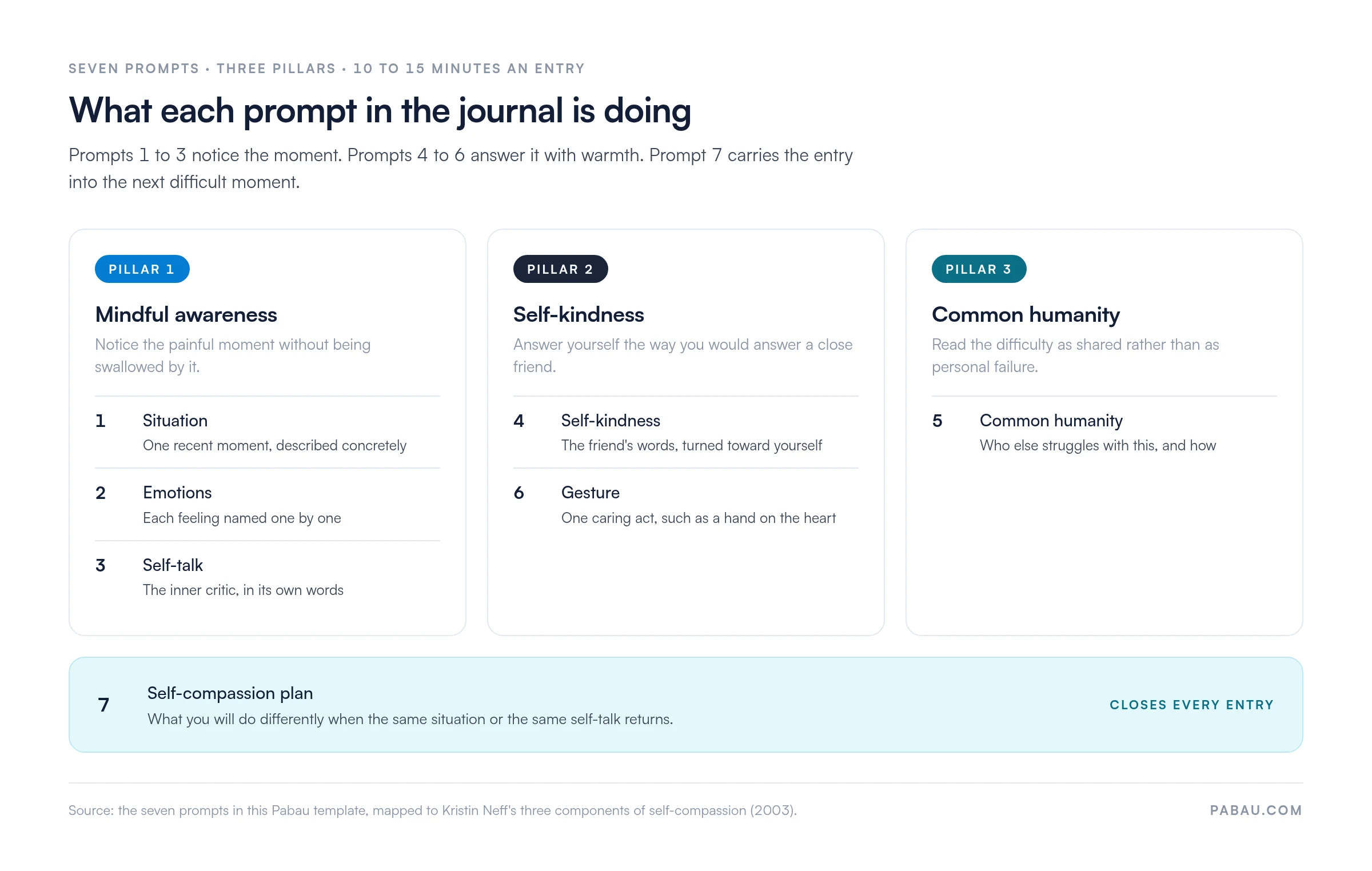
Writing converts diffuse distress into concrete language. Choosing the words slows you down and makes you decide what you are feeling. It also lets you look at the moment from more than one angle. Over repeated entries, a kinder response to pain becomes the practiced one.
Prompted journaling tends to work better than free writing here. Left without guidance, people often circle the same worry rather than answer it. The seven prompts give the reflection somewhere to land.
Download the template and either print it or complete it on screen. Work through the prompts in order, since each one sets up the next. Structured clinical assessment templates follow the same logic: establish the concern, examine it from several angles, then build a response.
Aim for three to five entries a week at a consistent time. Store completed pages somewhere private. Practices using Pabau can attach them to the client record, which keeps them in HIPAA-compliant storage.
The worksheet serves three audiences. It suits people practicing on their own, therapy clients working with a licensed clinician, and practitioners who want a repeatable homework task.
Research on Neff’s framework points to several changes that come with regular self-compassion practice. A structured worksheet makes that practice repeatable rather than occasional.
Use the entry number field deliberately. After four to six entries, read them back in order and mark which self-critical phrases keep reappearing. Those repeats show you where the criticism concentrates, so your self-compassion plan can answer the specific line rather than the general feeling.
The journal works on its own. These companion practices sit outside the worksheet and give the habit a second route in, through the body and through spoken practice.
None of these replaces therapy or crisis support. They are practices that build resilience over time, and they work best alongside professional care when someone needs it.
For therapists, counselors, psychiatrists, and coaches, the worksheet slots into structured treatment as a between-session task. It is modality-agnostic, so it fits alongside cognitive behavioral work, psychodynamic therapy, and coaching. Software built for therapists can send the worksheet out and hold the returned entry with the rest of the client’s notes.
Kristin Neff’s 2003 papers defined self-compassion as a distinct construct with three components: self-kindness, common humanity, and mindfulness. Hundreds of peer-reviewed studies have since examined self-compassion interventions in anxiety, depression, perfectionism, and disordered eating.
Neff and Christopher Germer later developed Mindful Self-Compassion, an eight-week training program delivered by certified teachers. This worksheet is not that program, and it does not substitute for it. It takes the same three components and gives you a short, repeatable way to apply them to one moment at a time.
Most practices hand a worksheet over on paper at the end of a session. The completed page then comes back weeks later, gets scanned if someone remembers, and sits in a folder that nobody opens before the next appointment. The clinical value of the exercise depends on that page being read again, and paper makes that unreliable.
Pabau handles the same job digitally. You can send the journal to a client as a digital form, through the client portal they already use for appointments. A reminder makes sure it arrives before the next session. The completed entry files itself against the client record, so no one has to scan the page or leave it on a front desk.
Because entries land in the record, you can open the last three before an appointment and see how the self-kindness responses have changed. Every Pabau subscription includes the full feature set, so digital forms, the client portal, and record storage all come as standard.
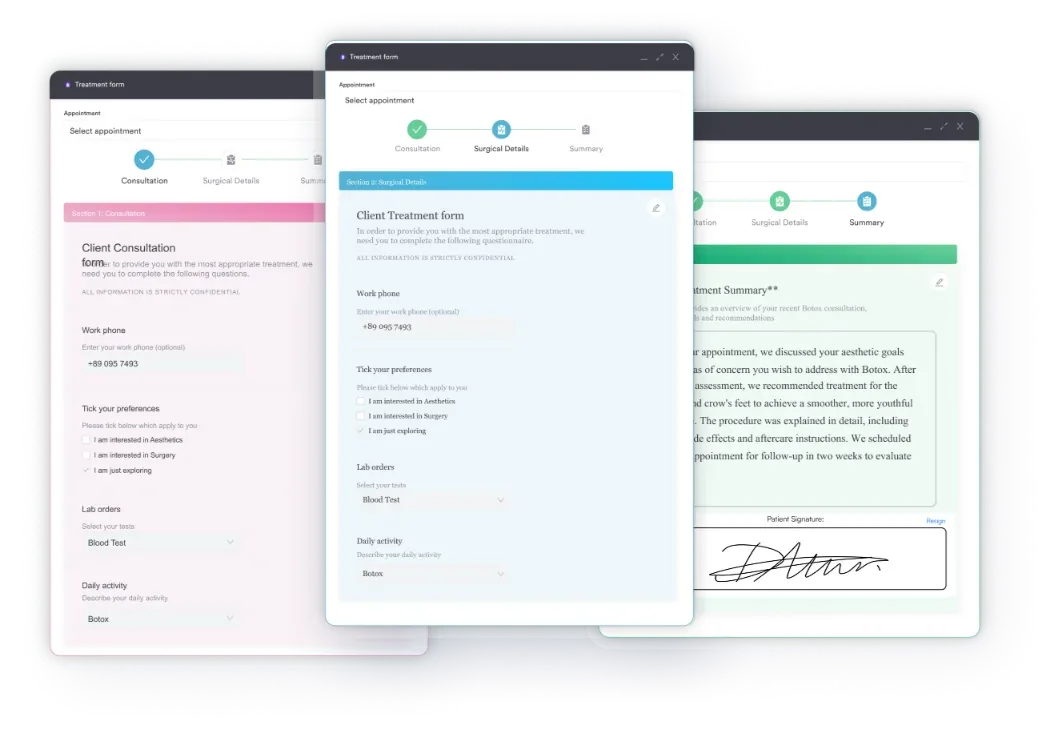

Share the self-compassion journal through the client portal, see who completed it, and store returned entries against the client record in one HIPAA-compliant system.

Self-compassion is easy to agree with and hard to practice under pressure. A worksheet helps because it asks the same questions every time, so the kinder response is already drafted when you need it. Print the template, commit to three entries a week, and read them back after a month.
The trade-off worth remembering is that structure only carries you so far. Seven prompts will not resolve trauma, acute crisis, or a condition that needs treatment, and this worksheet is not designed to. For clinicians, the value sits in what happens after the entry comes back and gets discussed. Book a demo to see how Pabau shares worksheets with clients and keeps completed entries with the rest of the record.

Want a guided script to read aloud? Self-compassion meditation script gives you spoken practice that pairs directly with the written journal.
Need a structured intake for new therapy clients? Psychiatric evaluation template covers the clinical picture before you introduce self-compassion work.
What happens when distress escalates? Crisis intervention strategies for clinicians sets out how to respond when self-soothing is no longer enough.
Running this worksheet in a group? Group therapy informed consent covers the paperwork that group-based work needs first.
Self-esteem is conditional, based on achievement and social approval. Self-compassion is unconditional warmth you offer yourself regardless of performance or outcome. Self-compassion builds psychological resilience because your sense of worth does not depend on being perfect or better than others.
Quality matters more than length. Most entries take 10 to 15 minutes and run to a few hundred words. Some days you may write one paragraph, other days a full page. Follow the prompts rather than a word count.
Yes. The template is designed for both independent practice and clinician-guided use. If you are using it on your own and experience a mental health crisis, contact a crisis line immediately. That includes suicidal thoughts, acute panic, or urges to use substances. The template is a wellness tool, not a substitute for professional care.
Begin with one entry a week at a consistent time, such as Sunday evening. Pick a quiet space and set a 15-minute timer. Choose a difficult moment from the past week and work through the prompts. After four weeks, build up to three entries a week if the practice feels useful.
Self-compassion practices can support trauma recovery, especially when paired with trauma-informed therapy such as EMDR, CPT, prolonged exposure, or somatic approaches. The mindfulness prompts may trigger responses in newly traumatized clients, so use the worksheet under clinical guidance. It is not a trauma treatment on its own.
MSC is an eight-week program created by Kristin Neff and Christopher Germer, combining meditation, psychoeducation, and self-compassion exercises. It is more intensive than this template and is delivered by certified trainers. This worksheet aligns with MSC principles and can complement or prepare you for formal training.