







Focus charting (F-DAR): How to write nursing notes that hold up
Focus charting organizes each nursing note around one patient concern. What goes...

Last Updated: Sep 16, 2026

An offer letter for employee is a formal written document that extends a job offer to a candidate. It sets out the terms they would be employed under: role, pay, start date, employment type, and any conditions attached to the offer. For practice managers and owners, it is the first written record of what was promised. Both sides fall back on it if the details are later disputed.
This guide gives you a free downloadable letter template to write yours on. It also covers the points every healthcare offer letter should include, and the compliance conditions clinical hires have to meet before their first day.

An offer letter for employee sets out the role, pay, start date, and employment terms. It is narrower than a full employment contract, and usually easier to withdraw before it is signed.
The free download is a blank letter shell on practice letterhead, not a pre-filled offer form. You write the offer terms into it yourself.
Use the checklist in this article for the wording: job title, start date, pay, benefits, employment type, reporting line, contingencies, and an acceptance deadline.
Clinical hires need conditional terms covering background checks, professional registration verification, and indemnity cover before the start date.
Practice management software like Pabau stores the signed letter on the employee’s staff profile, alongside their licenses and permissions.
An offer letter for employee is a formal letter from an employer confirming the details of a job offer to a chosen candidate. It covers the position title, start date, compensation, benefits eligibility, and employment type, whether that is full-time, part-time, temporary, or contract. It also states any conditions the candidate has to meet before employment can begin.
An employment contract goes further. It is legally binding and carries detailed terms on confidentiality, restrictive covenants, and ongoing obligations. The offer letter is the shorter document that records the initial offer and the candidate’s acceptance of it.
For practice managers and owners, the offer letter is your first legal touchpoint with a new employee. It sets the tone, manages expectations, and documents what was offered and agreed. A hiring process that ends in a clear offer letter cuts down on later arguments about pay or role scope.
The template above is a one-page letter shell rather than a completed offer letter. It gives you the layout, the letterhead structure, and prompts for the body copy, and you supply the offer terms. Here is what is printed on the page:
What the file does not give you is a pre-built form. There are no labeled boxes for salary, benefits, employment type, reporting line, contingencies, at-will wording, or an offer expiration date. Those belong in the three paragraph areas, and the checklist in the next section tells you what to write there.
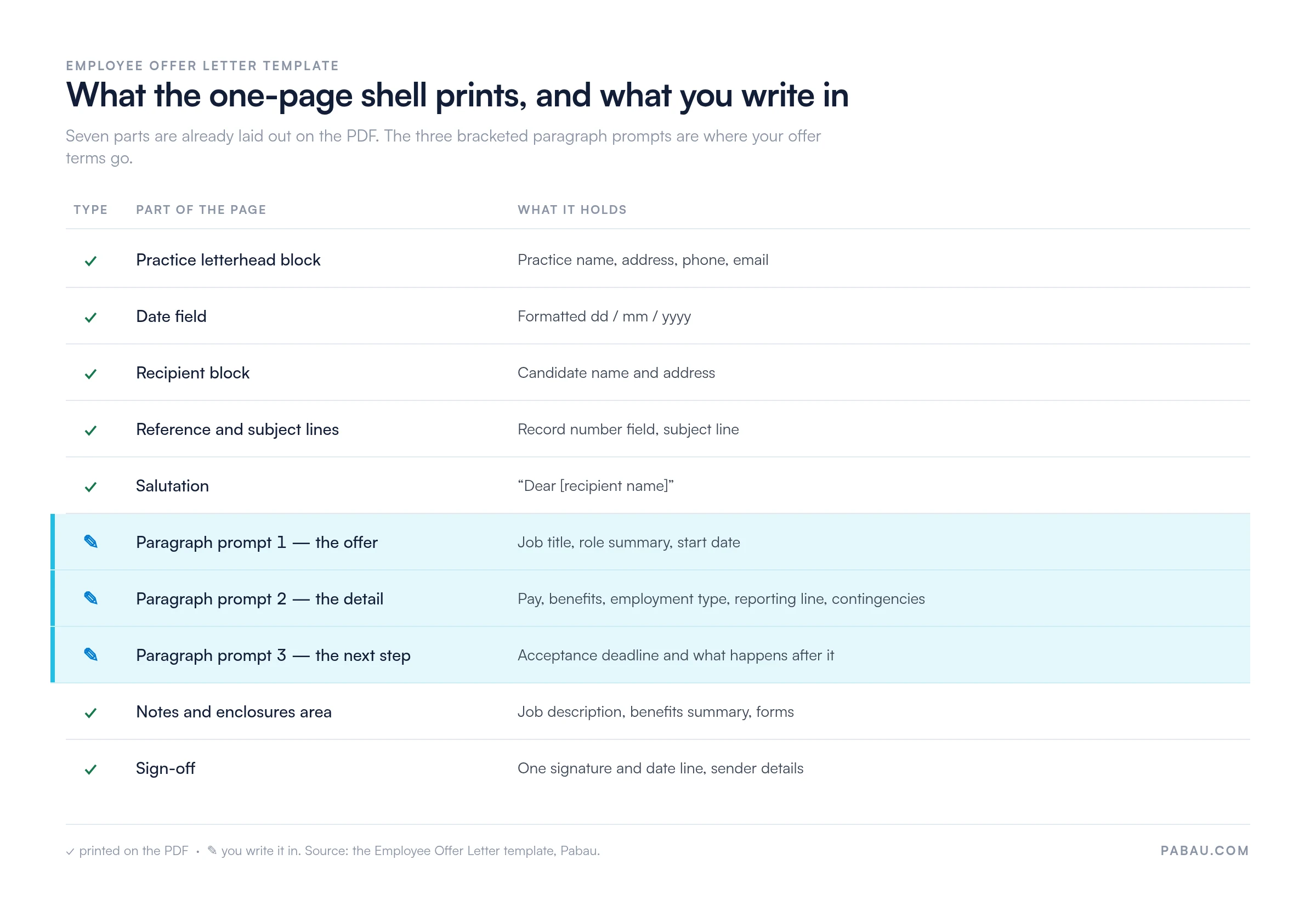
The page also carries a single signature and date line for the sender. If you want the candidate to countersign, add a second signature and date block below it before you send the letter out.
A complete offer letter for employee should cover these points:
The template gives you three paragraph areas. This is how to map the offer onto them, with wording you can adapt.
Proofread before sending. A typo in a salary figure or a start date reflects badly on the practice and confuses the new hire. Have a second manager read the letter through.
Practices rarely hire only one employment type. The same letter shell covers all of them, but the terms you write into it change.
For full-time clinical and administrative staff, state the annual salary, full benefits eligibility, and the probationary period, which usually runs three to six months. Add the at-will statement in the US, plus any health and safety requirements specific to your practice. Say what happens at the end of probation too. An annual review template gives you the format for that first formal conversation.
Part-time roles need clarity on hours. Specify the hourly rate, the expected hours per week, the benefits threshold, how paid leave accrues, and whether the schedule shifts seasonally. Say how schedule changes will be communicated, since part-time staff plan other work around them. Cover the same ground at interview. Our list of LPN interview questions includes the availability questions worth asking before an offer goes out.
Temporary and locum cover needs a stated end date or duration. Give the hourly rate, the exact period of engagement, and whether any benefits apply, since many temporary roles carry none. Add a line on how an extension would be agreed if the cover is still needed.
A general-purpose offer letter leaves out the conditions a healthcare hire turns on. Add these:
Acas publishes free guidance on UK employment offer letters and contracts. Check your wording against it, or against your own counsel’s advice, before you send anything out.
The two documents are often confused, but they do different jobs. An offer letter for employee is the formal invitation to employment, carrying the role, pay, start date, and basic conditions. An employment contract is the fuller, legally binding agreement, covering duties, intellectual property, restrictive covenants, termination procedures, and dispute resolution.
An offer letter is often the first step toward that contract. Where both parties sign it and treat it as the complete terms, the letter can itself become the contract. In the UK, employers must give a written statement of employment particulars on or before the first day of work. That statement does the contract’s job.
Restrictive covenants are the clauses most often challenged. Enforceability of a physician non-compete varies by state, so check yours before either document goes out. Have your HR advisor or legal counsel confirm that the letter and the contract line up with employment law where you operate.
The letter records what was promised. The work starts once the candidate accepts, and that is the point where a practice management app takes over from the paperwork. Practice management software like Pabau gives every employee their own staff profile, so the signed letter sits with their licenses and certifications.
From that profile you set what a new hire can see and do, and Pabau’s team management tools cover permissions, scheduling and time off. Certificates, registration numbers and background-check results go in the same documents area, so renewal dates stay visible to the practice.
Multi-location groups can run hiring centrally and still let each site manage its own schedule. That keeps the handoffs from stalling a new hire’s first week.
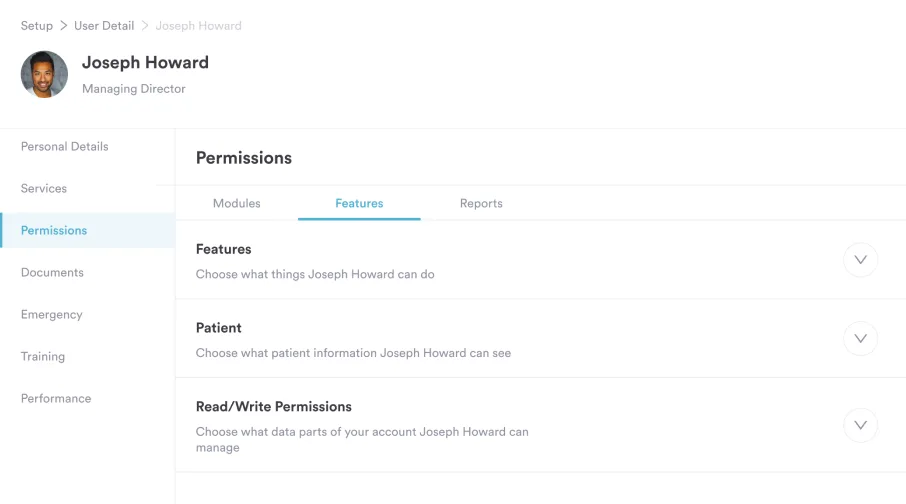

Pabau’s team management tools hold staff profiles, documents, permissions and schedules, so a new hire is set up in one place.

The letter is worth more than the ten minutes it takes to write. It is the only record of what was offered, and both sides fall back on it when a question comes up later.
Write one version, have it reviewed by your HR advisor or counsel, then reuse it. The template holds the format, so each new hire only costs you the terms and the conditions you attach.
After the offer is accepted, the onboarding steps are easier to run from the staff record than from a thread of emails. Book a demo to see how Pabau handles staff profiles, documents, and renewal dates in one place.

Need the wider picture on running the practice? Practice management software covers the scheduling, records and reporting a practice manager handles day to day.
Need to document a performance conversation? Employee counseling form gives you a structured record for the conversations that follow a hire.
Working out how to pay a new hire? Best healthcare payroll software compares the systems that run payroll for practice teams.
Building out the rest of your hiring paperwork? Cover letter template is the companion document candidates send you before the offer stage.
The download is a one-page letter shell rather than a pre-filled offer form. It gives you a practice letterhead block, a date and recipient block, and a reference and subject line. Below that sit a salutation, three bracketed paragraph prompts, a notes area, and one signature and date line. You write the pay, benefits, employment type and start date into those paragraphs, using the checklist in this guide. Add a second signature line if you want the candidate to countersign.
In most jurisdictions, an offer letter is less binding than an employment contract. It can still become a binding agreement, where both parties sign it and treat it as the complete terms of employment. Consult your legal advisor to clarify the enforceability of your offer letters in your location. Once signed by both employer and candidate, it creates a record of what was offered and accepted, which is important for dispute resolution.
An offer letter for employee typically covers the key terms: job title, start date, salary, benefits, and employment type. An employment contract is a more detailed, legally binding agreement that includes duties, confidentiality, non-compete, intellectual property, termination procedures, and dispute resolution. Many modern offers incorporate both into a single signed document. In the UK, employers must give a written statement of employment particulars on or before the first day of work. That statement does the contract’s job.
A typical response deadline is 7-14 days. This timeframe gives the candidate time to consider while protecting your practice by allowing you to move on to other candidates if no response arrives. You can set a shorter deadline for urgent or competitive roles, 48 hours for example. Still, 7-14 days is standard and shows good faith on the employer’s part.
An employer can withdraw an offer letter before the candidate has formally accepted it (e.g., before signing). Once both parties have signed, rescinding the offer may expose your practice to legal action for breach of contract. The risk is higher if the candidate has already resigned from a prior job or made relocation plans. Always ensure you have legitimate business reasons for rescinding (e.g., background check failure that meets the contingency terms) and consult legal counsel before proceeding.
At-will employment is a US legal principle stating that either employer or employee can terminate employment at any time without cause or notice. If your practice operates in the US, including an at-will statement protects your practice. This clause does not apply in most other jurisdictions, including the UK, Canada, and Australia. UK employment is governed by the Employment Rights Act 1996 and statutory notice periods instead. Check your local employment laws before including this language.
In the UK, clinical staff must hold current registration with their regulatory body. That is the GMC for doctors, the NMC for nurses and midwives, or the HCPC for allied health professionals. Government employment guidance requires you to verify registration before employment starts. Make the offer conditional on this verification passing. You should also arrange a DBS (Disclosure and Barring Service) check at Enhanced level for healthcare roles. In the US, verify state licensure and any relevant certifications through the appropriate state board.