Panama shift schedule: Free 2-2-3 template
The Panama shift schedule is a 2-2-3 rotation that keeps a practice staffed arou...

1
Last Updated: Oct 6, 2026
A contract template for partnership is a legal document that sets out how two or more business partners share ownership. It fixes their rights, responsibilities, profit split, and the procedure for settling disputes or leaving the business.
A written agreement protects everyone who signs it, whether you are forming a healthcare partnership, opening a medical spa, or starting a small business. Partnerships rarely come apart over the business idea. They come apart over salaries, decision rights, profit splits, and what happens when one partner wants out.
This guide gives you a free template to download and adapt, plus an explanation of every section it contains. You will find guidance on partner details, capital contributions, profit distribution, roles, dispute resolution, and dissolution.
A four-page agreement with fields for the party details, the purpose of the partnership, each partner’s obligations, and the signature clauses. Fill it in, then have an attorney review it before anyone signs.
Download template
A partnership contract defines each partner’s contribution, profit share, role, and exit terms. A 50/50 split needs one just as much as an uneven split.
Every partnership contract needs seven sections, from partner details and capital contributions through to dispute resolution and dissolution.
Without a written agreement, state law decides for you, and the Revised Uniform Partnership Act usually splits profits equally.
Healthcare partners need extra clauses on clinical authority, licensing, HIPAA duties, and malpractice coverage.
Pabau, an all-in-one practice management system, assigns permissions by role so daily operations match the signed agreement.
A partnership contract is a binding document that sets out how two or more partners run a business together. It is also called a partnership agreement or articles of partnership. The document names each partner’s financial contribution, the profit and loss split, who holds decision-making authority, and what happens when a partner leaves.
Compared with an LLC operating agreement or corporate bylaws, a partnership contract is more flexible and simpler to draft. Most states do not require one, and a general partnership can form on a handshake. Operating that way is still risky.
When a dispute reaches court, state default rules under the Revised Uniform Partnership Act take over. Those defaults often contradict what the partners intended.
In a healthcare setting, the contract also clarifies who sees patients, who manages staff, and who handles billing. It records how clinical decisions get made and which HIPAA duties each partner carries.
Before you customize anything, settle which partnership structure fits the business. Each type carries different liability, tax, and management consequences. If you are still weighing a group practice against practicing alone, decide that first.
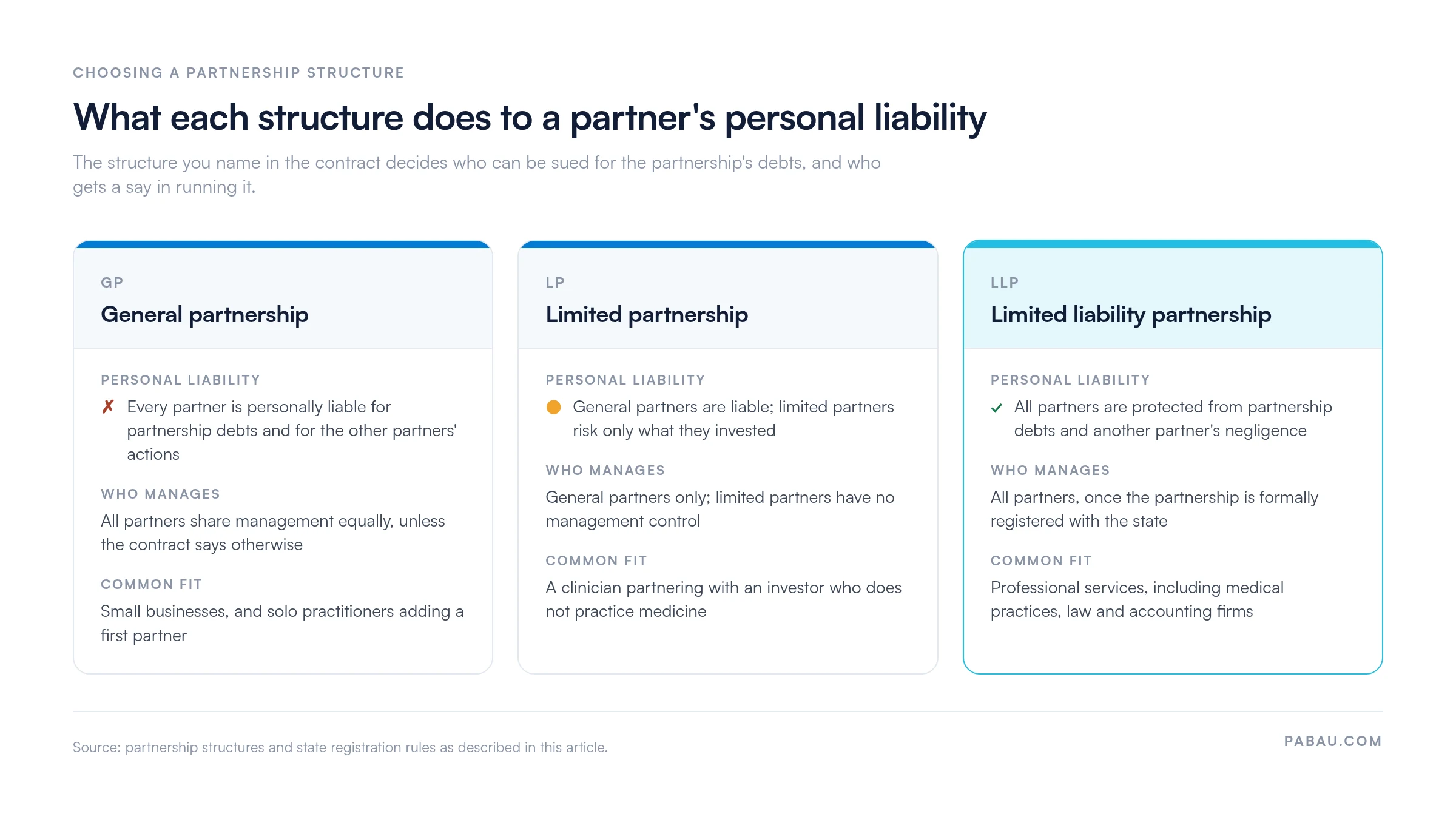
Most healthcare partnerships end up as a GP or an LLP, depending on how much personal liability protection the partners want. Name the structure in the contract and keep it consistent with your state registration.
A complete agreement covers seven areas. The template gives you language for each one, and every field needs customizing to your own business.
Name each partner, their role, the registered business address, and the purpose of the partnership. Include the legal name, the state of formation, and the effective date.
For a healthcare partnership, say whether the practice is general medicine, aesthetics, therapy, or a mix, because regulatory duties vary by specialty. If the purpose is still vague, a business plan template is a faster place to work it out.
Document how much money, equipment, property, or intellectual property each partner puts in at formation. State whether a contribution is a loan to be repaid or permanent equity. Partners who never wrote this down tend to remember the numbers differently a few years later.
Define the profit-sharing ratio. It can be equal, or weighted by contribution, seniority, or role. State how often distributions are made, and whether partners take a fixed salary plus a share of net profit or profit alone.
Say how losses are allocated too. They can follow the same ratio as profits, or a different one. Tiered splits tied to performance are common, so leave room for that if the partners want it.
Set out each partner’s title, main responsibilities, and decision-making authority. Who signs contracts? Which partner handles hiring and firing? And how much can one partner commit without the others’ sign-off?
Separate the day-to-day calls one partner can make from the major decisions that need everyone’s agreement. Once the roles are agreed, team management software keeps them visible, so the permissions in the system match the ones in the contract.
Spell out the order of escalation, starting with informal negotiation and moving to mediation, then arbitration or litigation. Name the venue and the governing law. A clause like this can save a partnership tens of thousands in legal fees by keeping the argument out of court.
Cover what happens when a partner leaves, retires, becomes disabled, or dies. Can the remaining partners buy out the departing one? At what price, and over what timeline? If a partner dies, do the heirs inherit the stake, or must the partnership buy it back?
Agreeing on a practice valuation method now saves a long argument later. Exit terms are easy to postpone while the partnership is new, and expensive to agree once it is failing.
State whether a departing partner can compete with the partnership or approach its clients and staff. Define what counts as confidential, such as patient lists, protocols, and financial data. Set how long those obligations last after a partner exits.
The two documents do similar work for different business structures. Here is how they differ.
For most healthcare partnerships, a partnership agreement is simpler and cheaper than forming an LLC. Partners who want full personal liability protection should look at an LLP or an LLC instead. A business attorney can tell you which one fits your state and your specialty.
Either way, the partnership files an information return each year on IRS Form 1065. Each partner then reports their share of the profit on a personal return.
Eight steps take the template from a blank form to a signed agreement.
Track the obligations the contract creates, the distribution dates, and the annual review dates in one shared system. A practice management app keeps them out of a spreadsheet that only one partner remembers to open.
A healthcare partnership carries obligations a standard business contract never mentions. Medical spas, therapy practices, dental offices, and primary care partnerships all need these five clauses.
Now that you know what belongs in the agreement, download the template and work through it with your partner. It adapts to general partnerships, professional partnerships, healthcare partnerships, and small businesses.
Plenty of new partnerships skip the written agreement because the partners trust each other. Trust does not settle what a profit split was supposed to be three years ago.
Without a written agreement, state default partnership laws apply. Most states assume equal profit splits, equal management authority, and equal liability, even where one partner put in 80% of the capital.
Any partner can then bind the business to a contract without the others’ consent. If a partner dies, the heirs may become partners by default. Dissolving the partnership can require a court.
With a written agreement, your terms override the state defaults. The partners control the profit split, the decision rights, and the exit terms.
A partnership contract is one of the cheapest protections a business can buy. Spending $1,000 on a lawyer’s review now is small against the cost of a dispute or a forced liquidation later.
A signed partnership contract only works if the daily operation matches it. Who can issue a refund, who sees the revenue figures, and who approves a discount are all decided in the agreement. Some system then has to enforce those decisions.
Pabau is an all-in-one practice management system. It assigns permissions by role, so each partner and staff member sees only what their role allows. Reporting gives every partner the same revenue and treatment numbers, which is what a profit split is calculated from.
Client records, treatment notes, invoices, and consent forms live in one system rather than across several. No partner ends up holding a piece of the picture on a personal device or in a private spreadsheet.
Every subscription includes every feature, so a two-partner practice gets the same reporting, permissions, and audit history as a ten-location group. Structured onboarding sets the roles up once, at the start.

Pabau assigns permissions by role and reports the same revenue figures to every partner, so the terms you signed hold up in daily operations.

A partnership contract earns its keep on the day the partners stop agreeing. Until then it is paperwork. After that, it is the only record of what you decided.
Download the template, fill it in with your partner, and have a business attorney read it before anyone signs. The hour you spend on decision thresholds and buyout terms is the hour that decides how the partnership ends.
If the partnership is a healthcare practice, the contract is only half the job. Book a demo to see how Pabau enforces the roles, permissions, and reporting your agreement sets out.

Deciding between a group practice and going solo? Group practice vs private practice weighs the income, the autonomy, and the risk on each side.
Need the business case before the contract? Medical practice business plan walks through the financials partners have to agree on first.
Running the practice once the ink dries? Private practice management covers the day-to-day systems a new partnership needs.
Choosing the software both partners will use? Clinic management software explains what to look for and what to avoid.
Tightening up how the practice runs? Medical practice operations shows where a practice loses time and money.
A partnership agreement needs partner names and roles, capital contributions, profit and loss ratios, and decision-making authority. It also needs dispute resolution procedures, dissolution and buyout terms, non-compete and confidentiality clauses, and an effective date. A healthcare partnership adds HIPAA responsibilities and clinical decision-making protocols.
For a straightforward partnership, a template is usually enough. A business attorney ($500-2,000) is worth it for partnerships with several partners, unequal capital contributions, significant assets, or a regulated healthcare business. An attorney checks the agreement against state law and finds the disputes before they happen.
Profit splits can be equal, or weighted by capital contribution, seniority, role, or performance. The agreement states each partner’s percentage, how often distributions are made, and whether partners draw a salary before sharing the remainder. It should also say how losses are allocated.
Yes. A written partnership agreement binds every partner from the moment they sign, and a court will enforce its terms. A court may refuse a clause that conflicts with state law or public policy. A lawyer’s review is what keeps the agreement enforceable.
Yes, as long as every partner consents in writing. Partners usually amend an agreement to admit a new partner, change the profit split, redefine roles, or adjust the exit terms. Sign each amendment and store it with the original.