Maja Popovska
Nursing care plan for aggressive behavior
A nursing care plan for aggressive behavior is a structured clinical document fo...

2
Last Updated: Oct 26, 2026
Free PDF 3 pages, print-ready Clinician-reviewed
A 7-day nutrition plan is a week-long eating template that sets breakfast, lunch, dinner, and snacks for every day. Each day carries calorie and macronutrient targets tied to one health goal.
For dietitians, nutritionists, and wellness practitioners, a ready-made template saves hours of planning. It also gives patients a concrete starting point they can hold for a full week.
This guide covers what the plan contains and how to fit it to one patient in five steps. It then adapts the week for four goals: weight loss, muscle building, heart health, and Stage 2-3a kidney disease.
A ready-to-use week of breakfasts, lunches, dinners, and snacks with macronutrient targets. It includes goal variations for weight loss, muscle building, heart health, and kidney disease, plus meal prep and grocery guidance.
Upload this PDF, or any form you already use, and Pabau's AI Form rebuilds it with tick boxes, text fields and a signature. Attach it to the treatment once, and every patient gets it on time.
AI Form rebuilds the consent, history and aftercare forms you already use. You review each one, then publish.
Patients complete forms on their phone before they arrive, so the front desk stops retyping paper.
Every signed form is versioned and attached to the treatment record, ready when you need it.
Set how long a consent stays valid. Returning patients skip forms they have already signed.
Supports HIPAA and GDPR compliance AES-256 encryption 4.8 on G2 4.7 on Capterra Trusted by 4,000+ practices worldwide

A 7-day nutrition plan maps breakfast, lunch, dinner, and snack options across a week against set calorie and macronutrient targets.
The template works best when it is fitted to the patient’s energy needs, restrictions, preferences, and health goal. A registered dietitian makes the individual adjustments.
Meal prepping in advance and shopping from a list improve adherence and cut the daily decision load.
Pabau’s patient portal lets you share the template digitally, track adherence over time, and adjust goals without printing or email clutter.
A 7-day nutrition plan is a week-long eating schedule that names the meals and snacks for each day. It is built around daily calorie and macronutrient targets. Generic dietary advice leaves the patient to decide what goes on the plate. The template answers that question for them, which removes decision fatigue and supports behavior change.
The plan typically includes:
For metabolic health practices, weight loss programs, and functional medicine providers, the template is a core patient education tool. It shows the patient you have thought about achievable meals rather than handing over another instruction to eat more vegetables. Pair it with a general nutrition handout that covers portions, hydration, and macronutrients.
Fitting the template to one patient takes five steps: assessment, personalization, education, tracking, and adjustment.
Adjustment eventually means a longer runway. Once a patient holds the week comfortably, a 30-day meal plan extends the same structure without restarting the assessment.
Clinical disclaimer: A 7-day nutrition plan is educational guidance, not medical treatment. Patients with eating disorders, severe food restrictions, or complex conditions such as diabetes and renal disease need one-on-one dietitian supervision. Always assess for contraindications before issuing a standard template.
Macronutrient targets move with the goal. The ranges below follow current guidance from the Academy of Nutrition and Dietetics.
Individual needs vary with metabolism, training intensity, age, and medical history. Treat these ranges as a starting point and revisit them every two to three weeks. A slightly higher calorie target the patient follows beats a perfect deficit they abandon on day three.
Nutrition plans work better when they lead with what to add rather than what to cut. Frame the week around nutrient density and whole foods.
Weight loss needs a steady deficit of roughly 300-500 kcal below maintenance, with protein held high enough to protect muscle. The template pre-calculates meals at the target, so the patient is not doing arithmetic at every meal.
Review progress every two weeks. If the loss stalls, check adherence first, then training load, then metabolic adaptation. Practices running this at volume lean on weight loss practice software to hold the targets, the check-ins, and the revisions in one record.
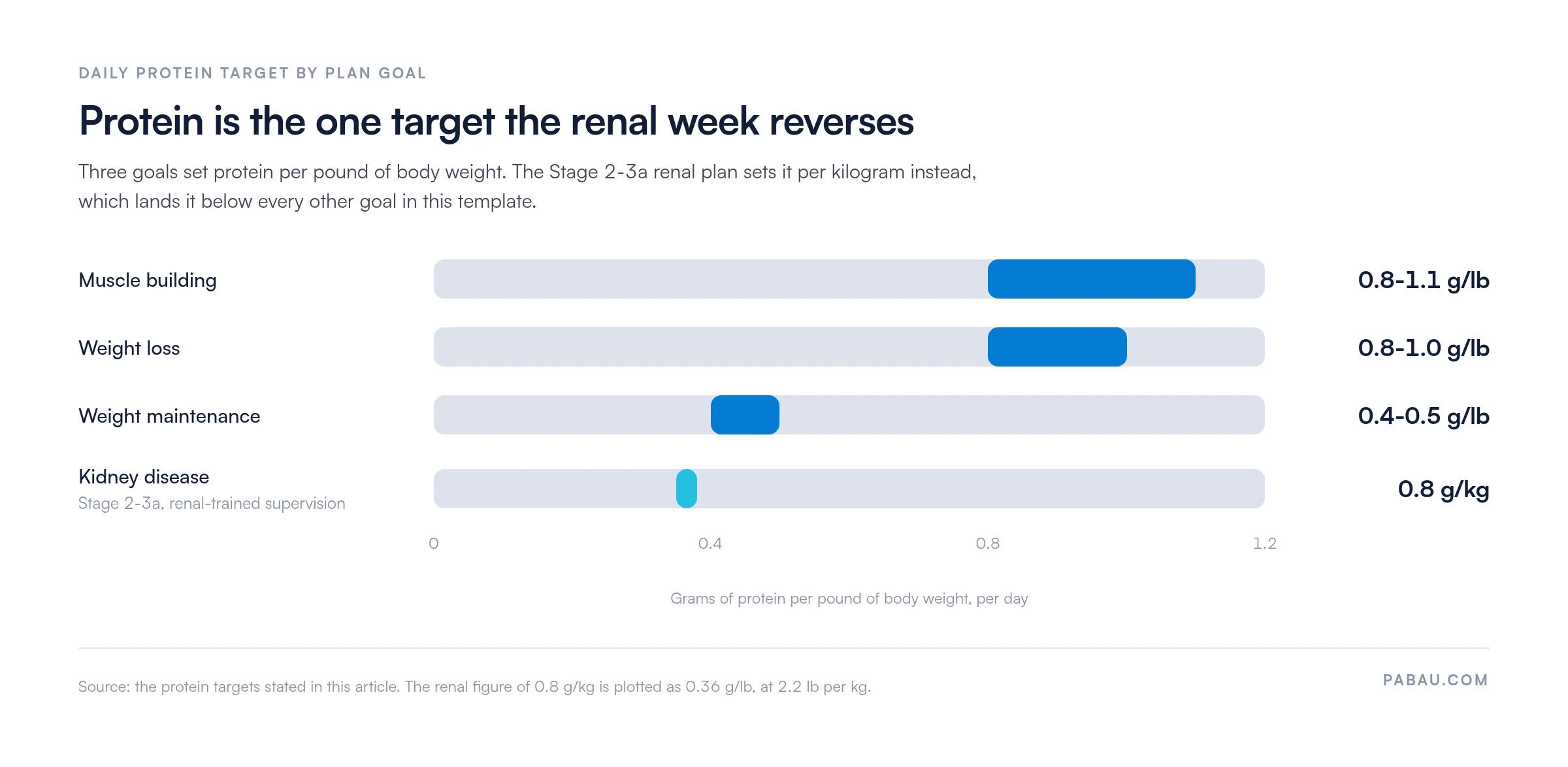
Muscle gain needs a 200-500 kcal surplus, 0.8-1.1g of protein per pound of body weight, and enough carbohydrate to fuel training. The template scales portions up and adds calorie-dense foods such as nuts, oils, and whole grains. Patients who want a whole-food week built around that surplus, with a grocery list, can follow a clean bulk nutrition plan.
Cardiovascular nutrition leans plant-forward, holds saturated fat and sodium down, and builds in omega-3 sources. Swap language works better than restriction language here. Butter becomes olive oil, and the patient keeps the meal.
Clinical disclaimer: Kidney disease nutrition needs stage-specific personalization by a renal-trained dietitian. The template below applies to Stage 2-3a. Stage 3b-5 requires supervised adjustment.
Protein is where the renal week runs against every other goal in this template, and the difference is larger than the units suggest.
Consistent monitoring and patient education slow progression and reduce hospitalization risk. Use the week as a teaching tool, so the patient sees which foods preserve kidney function rather than only which ones disappear. A full kidney disease meal plan works better once the stage and labs are known.
Meal prepping is the strongest single predictor of adherence. Patients who spend two to three hours batch cooking on Sunday often move from 40% adherence to 75% by week two.
A list tied to the plan cuts impulse buying and keeps the shop under 45 minutes. Order it by store section rather than by meal.
Record shopping and prep barriers in the patient record alongside the plan. A patient who reports no time to shop twice in a row is telling you to simplify the week, not to repeat it.
A 7-day nutrition plan is straightforward on paper and inconsistent in practice. Practice management software like Pabau closes that distance by carrying the plan, the check-ins, and the revisions in one patient record.
Digital intake forms collect dietary history, preferences, and restrictions at the first appointment. Allergies and conditions that need renal management are flagged before anyone hands over a template.
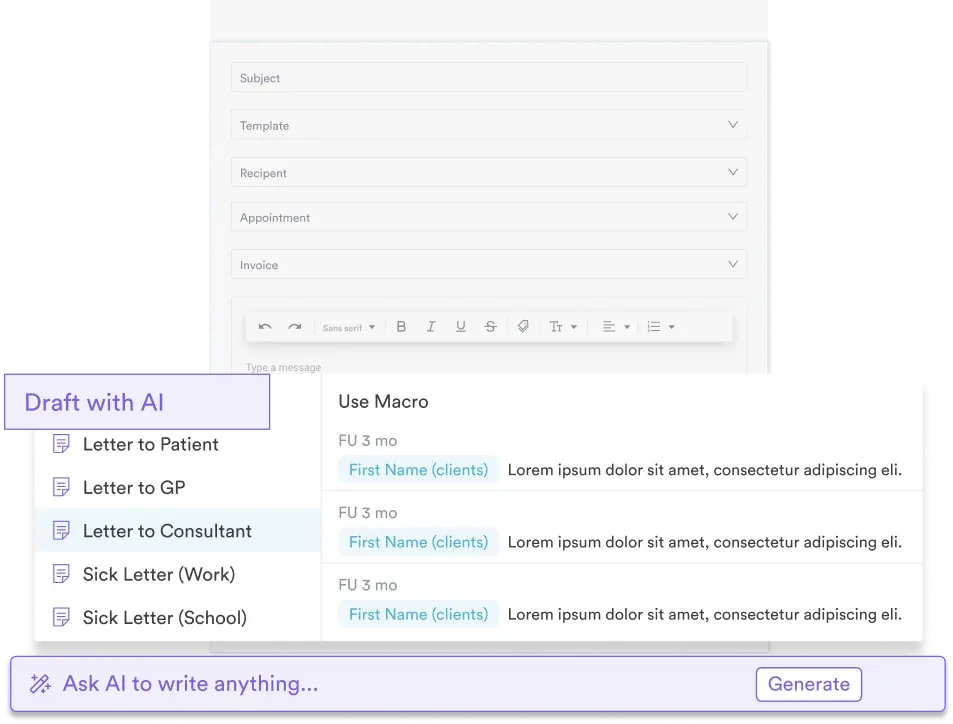
Adherence then lives where the rest of the record does. Weekly notes on which meals worked and which were skipped sit next to weights, labs, and appointments, so the next revision starts from evidence.

Pabau’s digital forms, patient portal and charting keep every 7-day nutrition plan, adherence check-in and revision on the patient’s record. Your team stops rebuilding the plan from memory at each visit.

Hand the template over as soon as the assessment is done. Waiting for a perfect plan costs more adherence than an imperfect week ever will.
The trade-off worth holding onto is precision against adherence. Tighter targets are easy to write and hard to keep. A patient who quits on day three never reaches the part of the plan that was supposed to work.
Revisit the numbers every two to three weeks and let the patient’s feedback move them. Book a demo to see how Pabau keeps every plan, check-in and revision on one patient record.

Need a template for a specific dietary restriction instead? Gluten-free nutrition plan template adapts the same 7-day structure for celiac and gluten-sensitive patients.
Running a weight-loss-focused practice rather than general nutrition counselling? Weight loss clinic software covers what a program built around this goal needs from your practice management system.
Want to see how adherence and outcomes track across your patient base? Reporting and analytics surfaces the practice-level data behind which plans patients are actually sticking to.
Delivering nutrition coaching remotely? Telehealth software covers running check-ins and follow-ups over video without losing the record trail.
Need a plan that runs longer than one week? Nutrition care plan template extends the same approach into an ongoing care plan.
A 7-day nutrition plan specifies breakfast, lunch, dinner, and snacks tailored to your calorie and macronutrient targets. Meals prioritize whole foods such as lean proteins, whole grains, vegetables, and healthy fats. Work with your dietitian to adapt portions and swap meals.
Yes. The template is a structure and a set of examples, not a rigid rule. As long as you hit your daily calorie and macro targets, moving Tuesday’s lunch to Monday is fine. Swapping every day costs you the consistency that makes the plan work.
Calorie targets depend on your goal, body weight, and activity level. Weight loss typically uses 1,200-1,500 kcal for women or 1,500-1,800 for men. Maintenance uses 1,800-2,200 or 2,200-2,800, and muscle building uses 2,000-2,400 or 2,400-3,000+. Your dietitian sets your specific target during consultation.
The plan emphasizes whole foods and minimizes processed, refined, and sugary items. The specifics follow your goal. Weight loss plans limit calorie-dense foods, heart-health plans reduce saturated fat and sodium, and kidney-disease plans restrict potassium, phosphorus, and sodium. Your practitioner tailors the list to you.
Yes, when it holds a consistent calorie deficit and enough protein to preserve muscle. Adherence matters more than the plan itself. Expect 0.5 to 1.5 lbs of weekly loss if you follow it and adjust for stalls every two to three weeks.
Track weight, measurements, energy levels, and hunger cues weekly. After two to three weeks, adjust calorie targets, meal timing, or macro ratios if progress stalls or hunger rises. A registered dietitian keeps those adjustments evidence-based and safe.