HIPAA compliant texting: What you can send patients & how to communicate securely
HIPAA compliant texting is possible when a text holds no protected health inform...

Last Updated: Oct 16, 2026

A physician non-compete restricts where a doctor can practice after leaving an employer, usually within a set radius for one to three years.
At least 14 states now void the physician practice restriction outright, with Arkansas, Wyoming, Montana, Utah, and Maine joining between 2025 and 2026.
Most other states apply a reasonableness standard, weighing geographic scope, duration, and the employer’s legitimate business interest.
A federal court vacated the FTC non-compete ban in August 2024, and the FTC removed the rule from federal regulations in February 2026.
Practice management software like Pabau keeps patient records and team schedules intact when a physician leaves.
Most physicians sign their first employment contract without reading the restrictive covenant closely. Years later a better offer arrives across town, and that one clause decides whether they can take it. Some end up moving to another city just to keep practicing.
At least 14 states now void the physician practice restriction outright, and most of those bans arrived in the past two years. Meanwhile, the federal ban that once looked inevitable never took effect at all.
So the honest answer to “can they enforce this?” turns on where you practice and how the clause was drafted. Both are far easier to change before you sign than after you resign.
A physician non-compete bars a doctor from practicing within a set area for a set time after leaving an employer. You will also see it called a covenant not to compete, or a physician restrictive covenant. These clauses are standard in employment agreements at hospitals, health systems, and private practices.
The two numbers that matter are the radius and the term. A typical clause covers 5 to 25 miles around the practice and runs one to three years. Some agreements go further and bar you from treating any former patient of the employer, wherever that patient now lives.
According to the American Medical Association (AMA), employers use these clauses to protect their investment in a patient panel and referral network. Critics argue they keep doctors out of the communities that need them most. AMA policy now opposes restrictive covenants for employed physicians.
Read all five together rather than one at a time. A modest radius paired with a three-year term still locks you out, so the combination matters more than any single number.
For a physician leaving a hospital system, this is the biggest contractual risk in the offer. A wide radius, a long term and no buyout can strand you in an area, or push you out of it. Anyone drafting a medical practice business plan should price that restriction in early.
It depends on your state. At least 14 states void the restriction on a physician’s right to practice outright, whatever the contract says. Everywhere else, the clause holds only if it passes what courts call the reasonableness standard.
The 14 are Arkansas, California, Colorado, Delaware, Maine, Massachusetts, Minnesota, Montana, New Hampshire, North Dakota, Oklahoma, Rhode Island, Utah, and Wyoming. Oregon sits just outside that group, since its 2025 law voids non-competes for medical licensees but carves out ordinary employment.
Those Oregon exclusions cover owner-physicians, non-clinical roles, and employers who document a recruitment investment worth 20% of salary. That last one is broad enough to swallow a lot of hospital hiring.
Take a family physician in a metro area of 400,000 people. Her employer runs one office and draws patients from roughly eight miles around it. A 10-mile, one-year restriction tracks that draw area, and most courts would enforce it.
Now change the terms. A 40-mile, three-year restriction covering all of medicine protects far more than the practice ever built. In a reasonableness state, that is the clause a judge trims or throws out.
Courts weigh the employer’s interest in protecting patient relationships against your interest in practicing your profession. Public access to care is the third factor. Where a restriction is broad enough to leave a community short of physicians, some courts refuse to enforce it at all.
Blue penciling is the other variable. In some states a judge rewrites an overbroad clause into a reasonable one instead of voiding it. In others the whole clause falls. That difference changes the employer’s risk in drafting, so it changes your leverage in negotiation.
The same principles reach beyond physicians. Nurse practitioners and physician assistants face the same enforceability test in most jurisdictions, and several of the newer state bans name them directly.
At least 14 states void the physician practice restriction by statute, and five of those bans took effect between July 2025 and July 2026. A second group restricts one specific arrangement, such as a hospital-physician contract. The rest apply a general reasonableness standard.
Most ban states keep a narrow carve-out, usually for the sale of a practice or the dissolution of a partnership. A carve-out of that kind does not turn a ban into a limit, because the underlying employment restriction is void either way.
If you own a share of the group, though, the sale price and the restriction get negotiated together. That puts practice valuation in the same conversation as the covenant you are asked to accept.
Oregon is the exception worth reading closely, since its carve-outs reach ordinary employment rather than just a practice sale. The table below gives the controlling statute for each key jurisdiction.
Effective dates matter more than headlines. Several of these statutes only reach agreements signed or renewed on or after a set date. Wyoming’s ban, for example, applies to contracts signed on or after July 1, 2025. An older agreement can still bind you in a state that now bans the practice for everyone else.
Two things are worth confirming with counsel. The first is the date on your signature page. The second is whether any renewal, raise letter or amendment since then quietly restarted the clock.
This article is for informational purposes only and is not legal advice. State law changes often, so confirm the current rule with a healthcare employment attorney in your state before signing or challenging anything.
The FTC ban is not in force, and you cannot use it to void an existing agreement. The rule died in court, and the agency has since taken it off the books entirely.
The agency has not walked away from the issue, though. It now challenges individual agreements case by case under Section 5 of the FTC Act. For current status, check the FTC’s non-compete rule page.
The rulemaking did leave a mark. Several states introduced or passed physician restrictions in 2023 and 2024, expecting a federal rule that never survived. That state wave is the lasting result, and it is still building.
A non-compete rarely stops you from telling patients where you are going. Several state statutes carve that right out explicitly, and the AMA’s Code of Medical Ethics backs it up.
Your duty to the patient does not disappear because of a contract clause. Patients are entitled to know who is taking over their care, and how to reach you if they choose to follow.
Practices that handle this well send a short, dated letter naming the transfer date and the covering clinician. A therapy termination letter follows the same structure and works as a model. Strong patient care management cuts the risk on both sides, since documented continuity protects the departing physician and the employer.
In a state with no statutory carve-out, negotiate the notification right into the contract. Asking for it in your last week is a much harder conversation.
Ask for the restrictive covenant as a separate document during the interview stage, before an offer letter exists. Recruiters share it more freely then, and you get to price the restriction into your salary ask.
The non-compete is usually the most negotiable clause in a physician contract. Employers know a court may refuse to enforce an unreasonable one, so they have room to move and they expect to be asked.
Most employed physicians never ask. That is the cheapest mistake in the whole process, because the benefits of private practice only arrive if you can get there.
A buyout is usually priced as a multiple of annual compensation, so check how your physician pay model calculates that figure before you counter.
Run through this list before the signature page. Anything you cannot answer is a question for counsel.
Get every agreed change into a formal amendment rather than a side letter. A verbal assurance from a recruiter who leaves next year carries no weight.
Some provisions survive negotiation because employers present them as standard boilerplate. These five are worth pushing back on every time.
One grey area comes up often. Physicians weighing a move out of clinical work, sometimes driven by burnout in healthcare, assume the clause no longer applies. Courts have split on that. Some hold that a physician turned administrator is not competing, while others enforce the covenant broadly.
The first move is almost always an injunction, not a damages claim. Courts grant preliminary injunctions quickly in these cases, so a new practice can be halted within weeks of a filing.
Beyond the injunction itself, the exposure falls into four categories.
Courts do sometimes refuse an injunction where enforcement would leave a rural or underserved community without care. It is not a reliable defense, but it is worth raising where the facts support it.
For the practice, a departure is an operational problem running alongside the legal one. Charts have to stay accessible. Booked appointments need a new owner. The rest of the team needs to know who picks up each patient.
Practice type changes the shape of that handover. A primary care practice may redistribute hundreds of routine follow-ups in a single week. A psychiatry practice moves fewer patients, but each transfer carries more clinical weight and more paperwork.
Practice management software like Pabau centralizes that work. Pabau’s patient records hold clinical notes, treatment history and consent forms in one record that stays with the practice. Team management lets an administrator reassign appointments and redistribute care without rebuilding the schedule by hand.
The outcome is a handover measured in hours rather than weeks, with no patient slipping between clinicians. That also protects the practice from continuity-of-care complaints while any contract dispute plays out.
Sound private practice management includes a plan for the day a clinician resigns. If your records live somewhere only one person can navigate, that plan starts with switching EHR systems well before anyone gives notice.
Esteem Life Medical Group runs its longevity practice this way, with records and reporting in one system instead of spread across tools. Practices starting a medical practice have the easiest job here, because the transition protocol can be built in from day one.
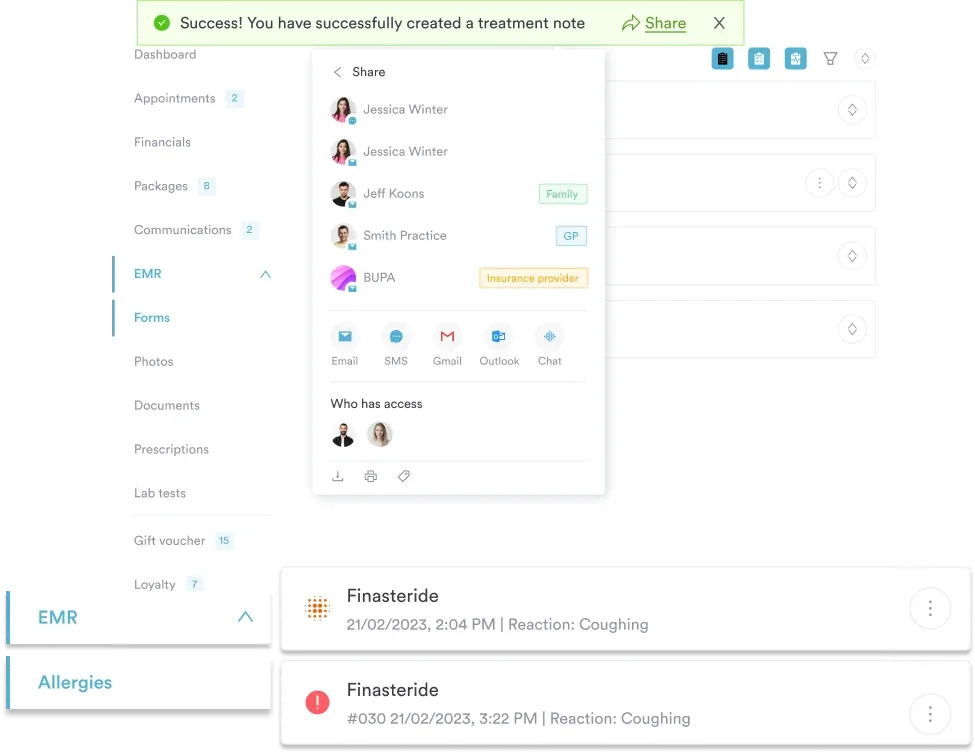

Pabau keeps patient records accessible, appointments reassigned, and your team coordinated through every staffing change. A resignation stops being a scramble at the front desk.

The clause you sign at 32 is the one that decides your options at 38. Price it, negotiate it, and paper it like any other part of the offer. Signing day is the only moment you hold any leverage.
If you are already bound, start with two facts. Find your state’s current statute, then check the date on your signature page. Those answers settle most of the question before an attorney bills an hour.
On the practice side, the fix is simpler. Keep records, schedules and team assignments in one system, so a resignation never becomes a scramble. Book a demo to see how Pabau keeps patient care continuous when a physician moves on.

Want to address the issue before it escalates? Performance improvement plan template sets SMART goals and a manager check-in schedule.
Deciding what your own practice stands for? Personal mission statement worksheet walks through five steps for hiring and pricing decisions.
Planning your own practice once the restriction expires? Best EMR for small practice compares the systems that suit a one or two provider setup.
Worried burnout is behind the departure? Burnout in healthcare covers the causes, warning signs, and fixes for a strained team.
Weighing remote work during a restricted period? Telemedicine software walks through what a compliant virtual service needs before you offer it.
Often yes. Most agreements bite on any separation, including a termination without cause. Some contracts carve out a no-cause firing or a non-renewal, so check the trigger language closely. If it is silent, ask for that carve-out before you sign.
Training contracts rarely include one. The first attending offer from the same system often does, and it usually lands early in your final year. Read the restrictive covenant then, not at graduation.
A non-compete limits where you can practice. A non-solicitation limits who you can approach, usually former patients and staff. Non-solicitation clauses survive in several states that void non-competes outright, so read both before you sign.
Usually. Most agreements include an assignment clause that hands the restriction to the buyer. A few states require your consent first. Ask for language that voids the covenant if ownership changes hands.
They can. Courts generally look at where the patient sits, not where you sit. Treating someone inside the restricted radius by video can count as practicing there, even from another state.