Copenhagen Burnout Inventory
The Copenhagen Burnout Inventory (CBI) is a free, 19-item questionnaire that mea...

19
Last Updated: Oct 14, 2026

An employee counseling form documents performance issues, conduct problems, and corrective actions in a formal written record that protects both the practice and the employee.
The form should include employee and incident information, the reason for counseling, a specific description of the issue, a corrective action plan, and signatures from both supervisor and employee.
Proper documentation supports progressive discipline, reduces legal risk, and creates accountability for workplace conduct standards in healthcare settings.
Practice management software like Pabau can document performance issues, track improvement timelines, and maintain staff records all in one centralized platform.
A verbal warning doesn’t hold up well if an employee’s performance problem ends up in front of an employment attorney six months later. A signed employee counseling form does: a dated record of what happened, what you asked the employee to change, and what they said in response.
For a healthcare practice, where a missed consent form or a HIPAA slip carries more weight than a scheduling mix-up, that paper trail matters even more.
Here’s the free template, what belongs in each section, and where these forms typically fall apart if a dispute ever reaches HR or a lawyer.
A ready-to-use counseling documentation form covering employee and incident details, the reason for counseling, a description of the workplace issue, a corrective action plan, an employee statement, and signature lines for the employee, manager, witness, and HR.
Download templateAn employee counseling form is a structured documentation tool used to record a formal discussion between a supervisor and an employee about performance, conduct, or a policy violation. Unlike an informal chat, it creates a written record that becomes part of the employee’s personnel file.
A scheduled review is a different document. A staff evaluation form rates performance against set criteria, while the counseling form records one incident. A professional development log covers different ground, tracking the training and CPD hours a staff member builds up ahead of an appraisal.
The form serves a few purposes at once. It:
For healthcare clinics, documentation carries more weight than it does elsewhere: patient care standards, HIPAA-related conduct, and clinical safety turn a write-up into a liability question, not just an HR one.
Reach for the form whenever you need to formally address a performance or conduct issue that requires documented follow-up. That covers attendance problems, missed clinical protocols, patient complaints, attitude or communication issues, missed performance standards, and policy violations.
The form is part of a progressive discipline approach, meaning it typically follows an initial verbal warning. It tells the employee the issue is serious and that improvement is expected within a set timeframe.
If the employee improves, the session becomes a positive record of growth. If the problem continues, the documentation supports whatever comes next, up to and including termination.
To hold up later, the form needs specific information, not general impressions. Here’s what each section should cover.
Lead with clear identification fields: employee name, job title, department, supervisor name, and the date of the counseling session itself. Include the date of the incident too, since the conversation doesn’t always happen the same day the issue occurred, plus who else was present.
Write an objective, specific description of the problem. Skip vague language like “attitude problem” and describe what actually happened: “Arrived 15 minutes late on three occasions in the past two weeks” or “Failed to follow pre-treatment consent procedure with two patients on July 20th.” Reference specific dates, incidents, and observable behaviors, so nobody can dispute what the session addressed.
The template doesn’t have a dedicated field for prior warnings, but that history still matters if this employee has been spoken to informally before. Note it inside the description of the workplace issue instead: the date of the earlier conversation, what was said, and who was there.
That’s what turns a single write-up into evidence of a pattern, which is what protects the practice if a case goes further. It also tells the employee this isn’t coming out of nowhere.
The corrective action plan is the heart of the form. It spells out exactly what the employee must do to improve. Instead of “improve punctuality,” write “arrive on time for all shifts, with tardiness defined as clocking in after the scheduled start time.”
That standard only holds if the shift times were set out in writing first. A free work schedule template gives you the start time to measure against.
Add a deadline, whether that’s 30 days or a specific date, and say how progress will be checked: weekly check-ins, peer feedback, or supervisor observation.
Both supervisor and employee should sign. The employee’s signature confirms they received the form and understand what was discussed. It does NOT necessarily mean they agree with the content.
If the employee refuses to sign, note it (“Employee declined to sign on [date]”) and have a witness present if you can. That protects the practice from later claims the employee wasn’t informed.
Resources like this pair well with telehealth software, letting remote clients complete them during virtual sessions.
Follow this process to complete the form correctly and fairly:
Patient safety, HIPAA compliance, and clinical protocol create a higher bar for conduct than most industries set. When you’re documenting an issue for clinical staff, nurses, medical assistants, aesthetic practitioners, include the patient safety angle directly.
“Failed to obtain informed consent before the procedure” is a different category of problem than a scheduling error, and the form should reflect that difference in tone and consequence.
Administrative staff counseling tends to sit in a different lane: patient confidentiality, scheduling accuracy, billing compliance, and professional communication. A confidentiality breach or a pattern of billing errors hits clinic revenue and regulatory standing directly.
Counseling forms end up as evidence if a dispute or legal claim follows. A few principles keep the form defensible:
According to SHRM guidance on disciplinary documentation, HR records should be retained according to federal and state law, typically a minimum of one year from the date of the action, though some states require longer. Check with your employment attorney or HR advisor for retention periods specific to your state.
These are the mistakes that come up again and again once a counseling form gets challenged:
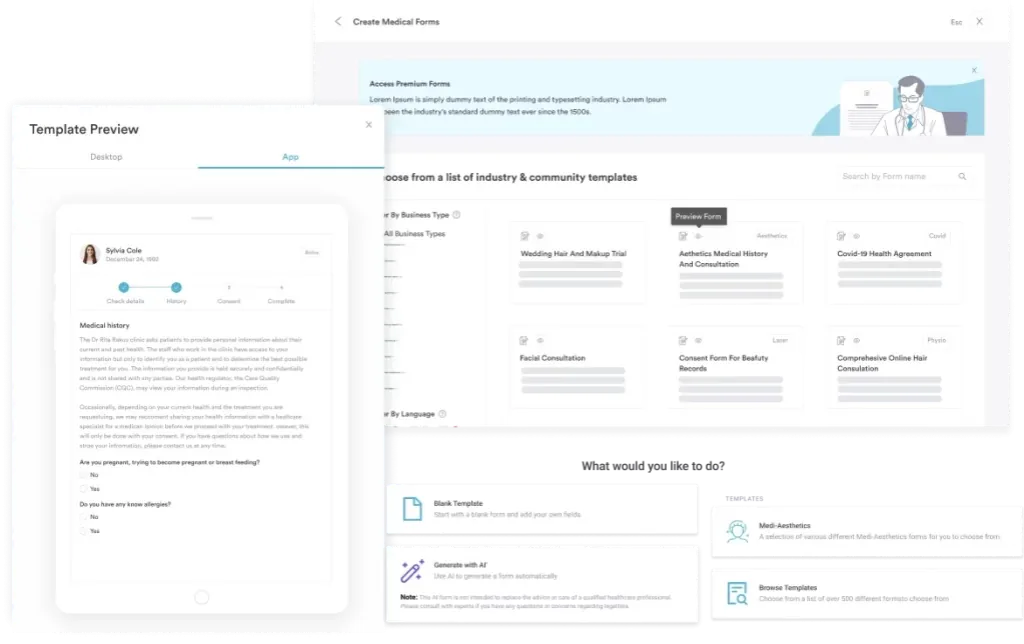
Most practices still run counseling sessions on whatever’s on hand: a Word document, a printed template from a generic form site, or a note typed up after the fact that nobody expects to need again. Clinic management software replaces that ad hoc paperwork with one searchable, permanent staff record.
None of that holds up well if a case ends up in front of an employment attorney, and none of it makes an improvement plan easy to track. A practice management system built for healthcare keeps that follow-up plan next to clinical and billing records.
Practice management software like Pabau keeps the whole process in one place. A supervisor can fill out and store the counseling form directly in the employee’s staff record, set the follow-up date as a task so the check-in doesn’t slip, and keep the file accessible only to the people who need it, not sitting in someone’s personal inbox. For teams still comparing options, an explainer on what practice management software does covers the core features to expect.
The same logic applies before a form is ever needed. Hiring carefully in the first place.
Practices that set expectations clearly from day one and follow up consistently find employees treat a counseling session as fair, not as a surprise.

Pabau’s digital forms and team management features let you document performance issues, track improvement timelines, and maintain secure staff records — all integrated into your practice management platform.

An employee counseling form is only useful if it gets filled out before you’re ready to let someone go, not after. Wait too long, and you end up defending a termination with nothing on paper. Use it at the first documented issue, and you give the employee a genuine chance to improve, plus a paper trail if they don’t.
That paper trail is worth the few minutes it takes to fill out the form properly: dates, specifics, a corrective plan the employee has seen and understood. Skip the specifics, and the form protects no one, whatever it says on the signature line.
If you’re tracking this across a growing team, a shared spreadsheet or a drawer of printed forms stops scaling fast. Book a demo to see how Pabau keeps counseling records, improvement plans, and the rest of your staff files in one secure system.

Heading into a difficult conversation? negotiation worksheet template walks through your goals, the other party’s perspective, your strategy, and likely responses before you sit down.
Hiring a social worker next? social worker interview questions covers clinical skills, ethical considerations, cultural competence, and professional experience for interview prep.
Struggling to track variable pay and hours? best healthcare payroll software compares platforms that track variable hours, commission pay, and FLSA overtime compliance.
They can decline to sit down, but that doesn’t stop the process. Document the date you asked, note the refusal, and proceed with a written notice instead of a meeting. Most employee handbooks treat a refusal to attend as a separate policy violation.
Not necessarily for a first, informal conversation, but any form going into an employee’s permanent file should route through HR so it gets tracked consistently. Most templates include a separate HR-received line for exactly this reason.
They’re often used interchangeably, but a counseling form usually documents an earlier, more improvement-focused stage, while a write-up or disciplinary form tends to accompany a more serious consequence like suspension. Check your own policy for which term triggers which process.
Yes, and that cuts both ways. A specific, factual form protects the practice in a dispute, but a vague or inconsistently applied one can just as easily support an employee’s discrimination or wrongful-termination claim. Objectivity and consistency matter more than paperwork volume.