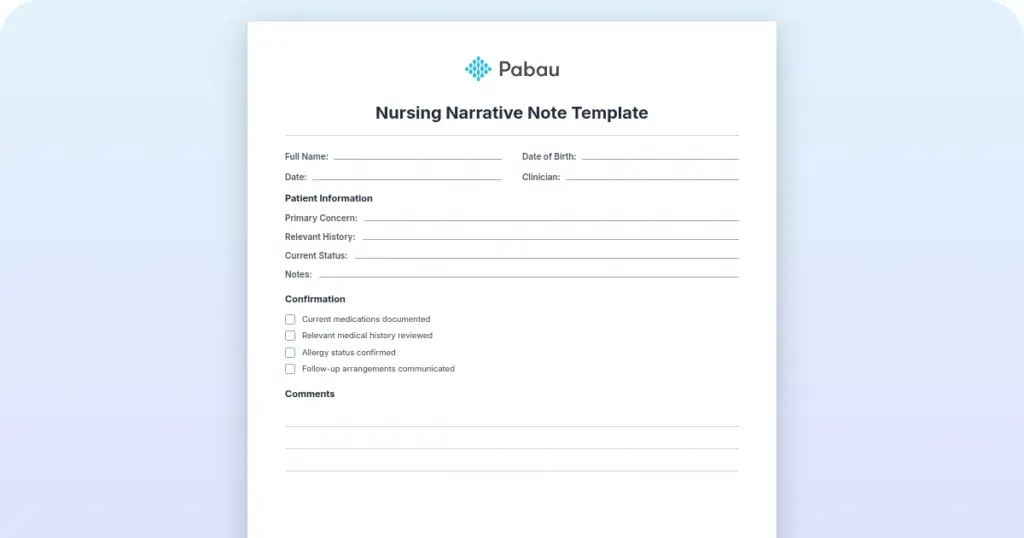
Nursing narrative note template
A nursing narrative note template is a structured PDF that guides you through re...

3
Last Updated: Oct 21, 2026

A fever nursing care plan is a structured ADPIE document that guides nurses through assessing, diagnosing, planning, and evaluating care for elevated temperature.
NANDA-I nursing diagnoses for fever include Hyperthermia (00007), Risk for Deficient Fluid Volume, Acute Pain, and Risk for Injury, each with its own related factors.
Evidence-based interventions span five categories: temperature monitoring, antipyretic administration, cooling measures, fluid management, and patient education, each grounded in clinical rationale.
Current guidance advises against routine tepid sponging for infection-driven fever, a change many older care plans still miss.
Practice management software like Pabau turns this into a digital form that syncs to the record and keeps your whole team on the same plan.
A ready-to-use template covering patient assessment, NANDA diagnosis statements, goals, evidence-based interventions with clinical rationale, and evaluation, all structured for real-world nursing workflows.
Download templateA fever nursing care plan walks you through the ADPIE nursing process, assessment, diagnosis, planning, implementation, and evaluation, so every fever case gets the same systematic, evidence-based response. ADPIE also structures a CVA nursing care plan for stroke recovery patients, from assessment through evaluation.
Standardizing this workflow across your team cuts down on variation between shifts. It also keeps your patient care documentation aligned with the standards regulators like the Joint Commission and professional nursing bodies expect to see. Neurological events call for standardized, shift-independent documentation in a seizures nursing care plan.
Fever and hyperthermia are clinically distinct, even though people use the words interchangeably. Getting this right early shapes everything else in the plan, from the diagnosis you write to the interventions you choose.
Most bedside presentations are fever, not hyperthermia, since infection is far more common than a breakdown in thermoregulation. NANDA-I still files both under the single diagnosis Hyperthermia (00007), so identifying the true cause is what actually changes your intervention choices.
A strong care plan starts with knowing why the temperature is up. Related factors split into two broad categories:
Documenting the related factor isn’t paperwork for its own sake. It directs the diagnostic workup and changes which interventions take priority. Fever from infection calls for antimicrobial therapy. Fever from heat exposure calls for immediate cooling instead.
A fever that starts after travel abroad often points to a different differential than routine, community-acquired infection. Think dengue, malaria, or typhoid before common seasonal viruses. Teams supporting returning travelers lean on dedicated travel clinic software to flag the right screening pathway early.
The care plan centers on the primary NANDA-I diagnosis Hyperthermia (00007), though secondary diagnoses often cluster alongside it. Here are the diagnoses you’ll use most:
Most complete plans address all four diagnoses, though how much weight each gets depends on the patient’s age, acuity, and underlying cause. Cognitive impairment cases follow the same multi-diagnosis approach in a nursing care plan for impaired memory.
The assessment phase establishes the baseline and informs everything that happens afterward. Collect both subjective and objective data:
Log the temperature in a HIPAA-compliant system: the route (oral, axillary, tympanic, or temporal), the time, and how the reading trends hour to hour. That trend is what actually tells you whether treatment is working.
Good fever care breaks down into five intervention categories, and each one carries its own clinical rationale:
Check every 2 to 4 hours during active fever, more often if the patient is acutely unwell. Stick to the same measurement route each time so the trend actually means something. Log when antipyretics were given and what the temperature did afterward.
Give acetaminophen or ibuprofen per your institution’s protocol and the patient’s specific guidelines. Never write exact doses into the care plan itself. Point to prescribing information and institutional policy instead. Dosing on a schedule works better than waiting for a spike, so build that into the plan, and keep watching for side effects or allergies.
Start with the basics: remove excess bedding and clothing, and keep the room comfortably cool with steady air circulation. Skip tepid sponging as a routine step. NICE guideline NG143 advises against it for fever in children. It can trigger shivering and discomfort, and may raise core temperature instead of lowering it. The same caution applies to ice packs or cold water pressed directly on the skin. Vasoconstriction can kick in and paradoxically push the core temperature higher instead. Save tepid sponging for heat-related hyperthermia rather than infection-driven fever, and always pair any cooling measure with the patient’s comfort.
Keep oral intake going with frequent small sips of water, clear fluids, or electrolyte solutions. Start IV fluids if oral intake falls short. Track intake and output hourly during acute fever, since sweating and a higher metabolic rate drain fluids faster than most patients realize.
Before the patient leaves your care, make sure they understand a few key things:
Written discharge instructions back up whatever you cover verbally, especially for caregivers managing a feverish child overnight.
Write goals using the SMART framework: specific, measurable, achievable, relevant, and time-bound. A few examples:
The template above follows five steps, from the first assessment to the final evaluation:
Paper-based fever care plans work, but they invite delays and version confusion between shifts. Pabau’s digital care plan forms embed this template directly into patient record management. Nurses complete assessments, diagnoses, and interventions in the same chart they already use for everything else.
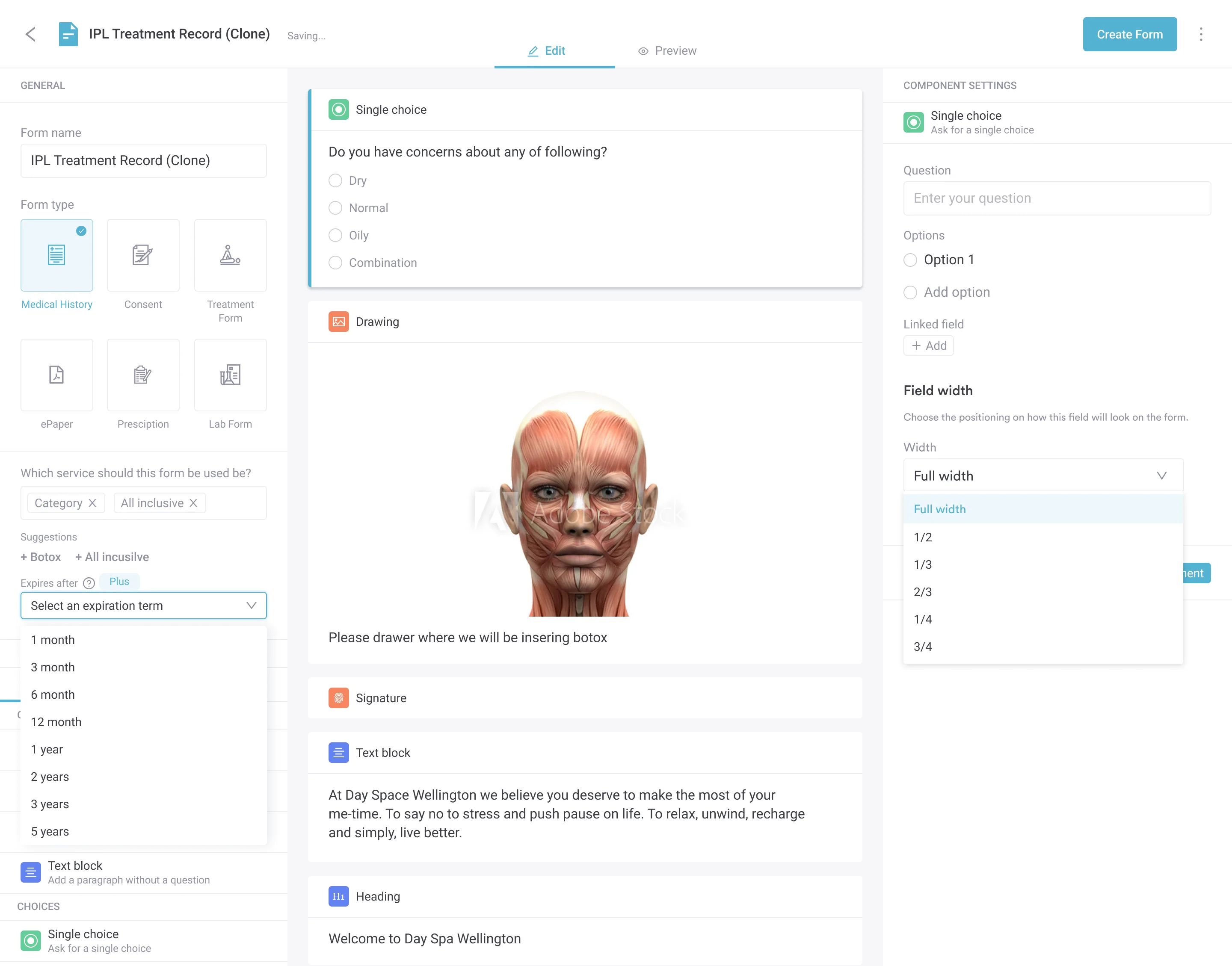
Every entry saves in real time. The whole team, day shift, night shift, physician on call, sees the same current plan instead of chasing down a paper chart.
Intervention checklists trigger standardized medical forms for medication administration and fluid tracking. The result is faster documentation, fewer transcription errors, and one current care plan instead of three different versions floating around the unit.
Scaling this across multiple locations just needs standardization, not new software for every site. Version the care plan once, and Pabau pushes the update to every location.
A multi-site GP practice then works from one identical form instead of a dozen local variants. Task and reminder automations, not vital-sign triggers, are what prompt staff to reassess on schedule, so a recheck never quietly slips through a busy shift.

Pabau’s digital forms keep every fever care plan, from assessment to evaluation, in one auditable record your whole team can see in real time.

A fever nursing care plan only works if it’s used the same way every shift, not just filed away as a formality. The real payoff shows up at handoff. The incoming nurse sees what’s been tried, what worked, and what needs watching, with no call to the previous shift required.
Download the template above, adapt it to your first few fever patients, and refine it from there as you learn what your unit actually needs.
Book a demo to see how Pabau keeps that same care plan live and current across every practice location, not just on today’s printed chart.

Need a template for pre-procedure sign-off too? Dental clearance form walks through the same structured documentation approach for medical clearance before a dental procedure.
Caring for a patient with reduced cardiac output? Decreased cardiac output nursing care plan gives the framework nurses need to assess, diagnose, plan, and evaluate cardiac care.
Need a form for new patient details? Demographic information form covers personal details, contact information, and optional social and health factors, with signature blocks.
Planning a patient’s discharge? Discharge planning worksheet is a 4-day, printable checklist covering assessment, medication reconciliation, education, and follow-up.
Documenting a vascular ultrasound? Doppler ultrasound report template gives structured fields for spectral, color, and power Doppler findings across every vascular region.
No, not as a routine step. NICE guideline NG143 advises against tepid sponging for fever, since it can trigger shivering and discomfort and may raise core temperature instead of lowering it. Reserve it for heat-related hyperthermia, and rely on antipyretics plus simple environmental cooling for infection-driven fever instead.
Immunocompromised patients need sepsis screening at a single 38.3°C (101°F) reading, or 38.0°C sustained for an hour, rather than routine fever care. Older adults often blunt their febrile response, so a rise of 1.1°C above their baseline warrants the same workup as a standard fever.
A medical diagnosis, like urinary tract infection, names the disease. A nursing diagnosis such as Hyperthermia describes how the patient is responding to it. That response is what the goals and interventions actually target.
Yes, with adjustments. Add febrile seizure precautions for children under five, and escalate sooner for immunocompromised patients. Shift toward comfort-focused care rather than aggressive cooling in chronic or palliative cases.
A temperature log only records numbers. This care plan adds the diagnosis, goals, interventions, and evaluation around those numbers, so anyone reading the chart understands what action was taken and why.