Sulcus Test: Shoulder Instability Assessment
The sulcus test is an orthopedic special test that checks for inferior glenohume...

3
Last Updated: Oct 22, 2026
An ARB medication list is a clinical reference to the eight FDA-approved angiotensin II receptor blockers, with their doses, indications, and monitoring needs. The eight are losartan, valsartan, irbesartan, olmesartan, telmisartan, candesartan, azilsartan, and eprosartan. All of them treat hypertension, and some carry extra labeled uses in heart failure, post-MI care, stroke risk reduction, or diabetic nephropathy.
The reference table below gives each drug’s brand name, labeled indications, and starting, target, and maximum doses. Contraindications, interactions, and a lab monitoring schedule follow it. There is also a free blank checklist you can print for paper records.
A blank, printable one-page checklist with fields for patient name, date of birth, record number, and preparer, plus tick-box sections and a notes area. It lists no ARB drugs or doses, so use the reference table on this page for those.
Download template
ARBs (sartans) block angiotensin II type 1 receptors, which lowers blood pressure and cardiac workload without the dry cough ACE inhibitors cause.
There are eight FDA-approved ARBs, and all treat hypertension. Some add labeled uses in heart failure, post-MI LV dysfunction, stroke risk reduction, or diabetic nephropathy.
FDA labeling gives pregnancy a boxed fetal-toxicity warning. Labeled contraindications are ARB hypersensitivity and aliskiren use in patients with diabetes, and dual RAAS blockade with an ACE inhibitor is warned against.
Check potassium and creatinine at baseline, 1 to 2 weeks after starting, and every 6 to 12 months after that.
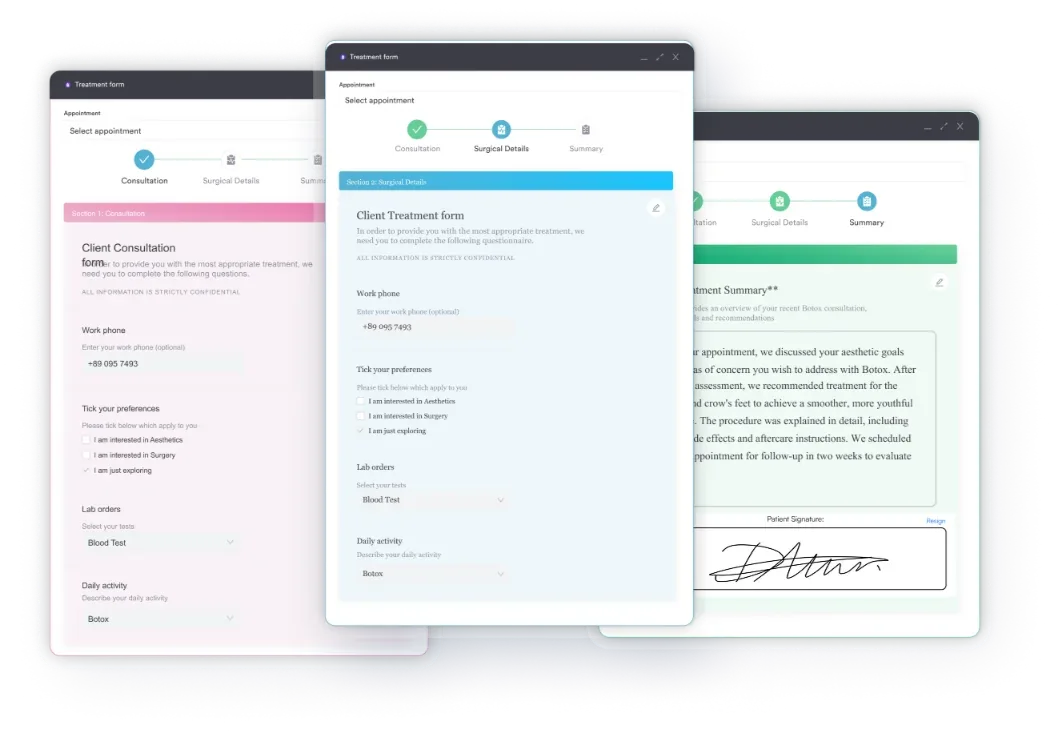
Pabau, the practice management platform we build, keeps digital intake forms, consent, and medication history in one patient record. Pabau Scribe, our AI scribe, drafts the consultation notes.
An ARB medication list is a quick-reference tool that catalogs every approved sartan by generic name, brand name, FDA-approved indications, and standard dose range. It also covers renal dosing, contraindications, and the two labs that drive most dose changes: serum potassium and creatinine. Prescribers and practice teams use it during consultations, prescription writing, and documentation audits.
The table on this page pulls together detail otherwise spread across prescribing labels, guidelines, and practice formularies. The free download is a separate blank checklist with no drug data on it.
For practices collecting medication history through digital intake forms, one shared list keeps prescribing consistent across the team. Our cardiovascular medication list covers the other heart and blood pressure drug classes.
Angiotensin II receptor blockers selectively block type 1 (AT1) angiotensin II receptors on vascular smooth muscle and cardiac tissue. Angiotensin II is a powerful vasoconstrictor that also stimulates aldosterone release. With its receptors blocked, it can no longer drive either effect.
Systemic vascular resistance and blood pressure fall, aldosterone-driven sodium retention drops, and cardiac fibrosis and hypertrophy ease. ACE inhibitors stop angiotensin II from forming, while ARBs let it accumulate but keep it off AT1 receptors. Bradykinin does not build up, so ARBs avoid the dry cough seen in 10-20% of ACE inhibitor users.
The table below is the drug reference for this list. It covers all eight FDA-approved sartans with generic and brand names, labeled indications, and standard dose ranges. The downloadable checklist does not reproduce it, so keep this page open during prescribing decisions and clinical audits.
Notes: Azilsartan starts at 40 mg only in patients on high-dose diuretics. Eprosartan (Teveten) is no longer marketed in the US. Renal dosing adjustments apply in severe CKD (eGFR <30 mL/min/1.73m²), so check each ARB’s prescribing information for renal and hepatic adjustments.
Both ARBs and ACE inhibitors lower blood pressure and protect against heart failure progression and diabetic nephropathy. The key clinical difference is bradykinin. ARBs do not block its breakdown, so they avoid the dry cough that stops some patients taking ACE inhibitors.
Choose an ARB if the patient develops ACE inhibitor cough or cannot tolerate an ACE inhibitor for another reason. Use caution after ACE inhibitor angioedema, since some cross-reactivity occurs. In HFrEF, guidelines make an ACE inhibitor or ARNI first-line, with an ARB as the alternative when an ACE inhibitor is not tolerated. Valsartan and candesartan have HF-specific trial data.
Choose an ACE inhibitor if the patient tolerates it, cost is a barrier, or local guidelines prefer it as first-line monotherapy. Never combine the two classes, because dual RAAS blockade raises hypotension, hyperkalemia, and acute kidney injury risk. Our ACE inhibitor medication list covers the other side of this decision.
Contraindications and boxed warning: FDA labeling gives pregnancy a boxed fetal-toxicity warning, so stop the ARB as soon as pregnancy is detected. Labeled contraindications are hypersensitivity to the ARB and use with aliskiren in patients with diabetes. Avoid ARBs in anyone with a history of angioedema on an ARB.
Precautions: Use caution with bilateral renal artery stenosis, baseline serum potassium >5.5 mEq/L, baseline eGFR <30 mL/min/1.73m², and severe aortic stenosis. The same applies to concurrent potassium-sparing diuretics, NSAIDs, or lithium.
Before starting an ARB, check baseline serum creatinine, eGFR, and potassium. Recheck potassium and creatinine 1-2 weeks after initiation, then every 6-12 months. The schedule below shows the two results that should prompt a dose review at any of those checks.
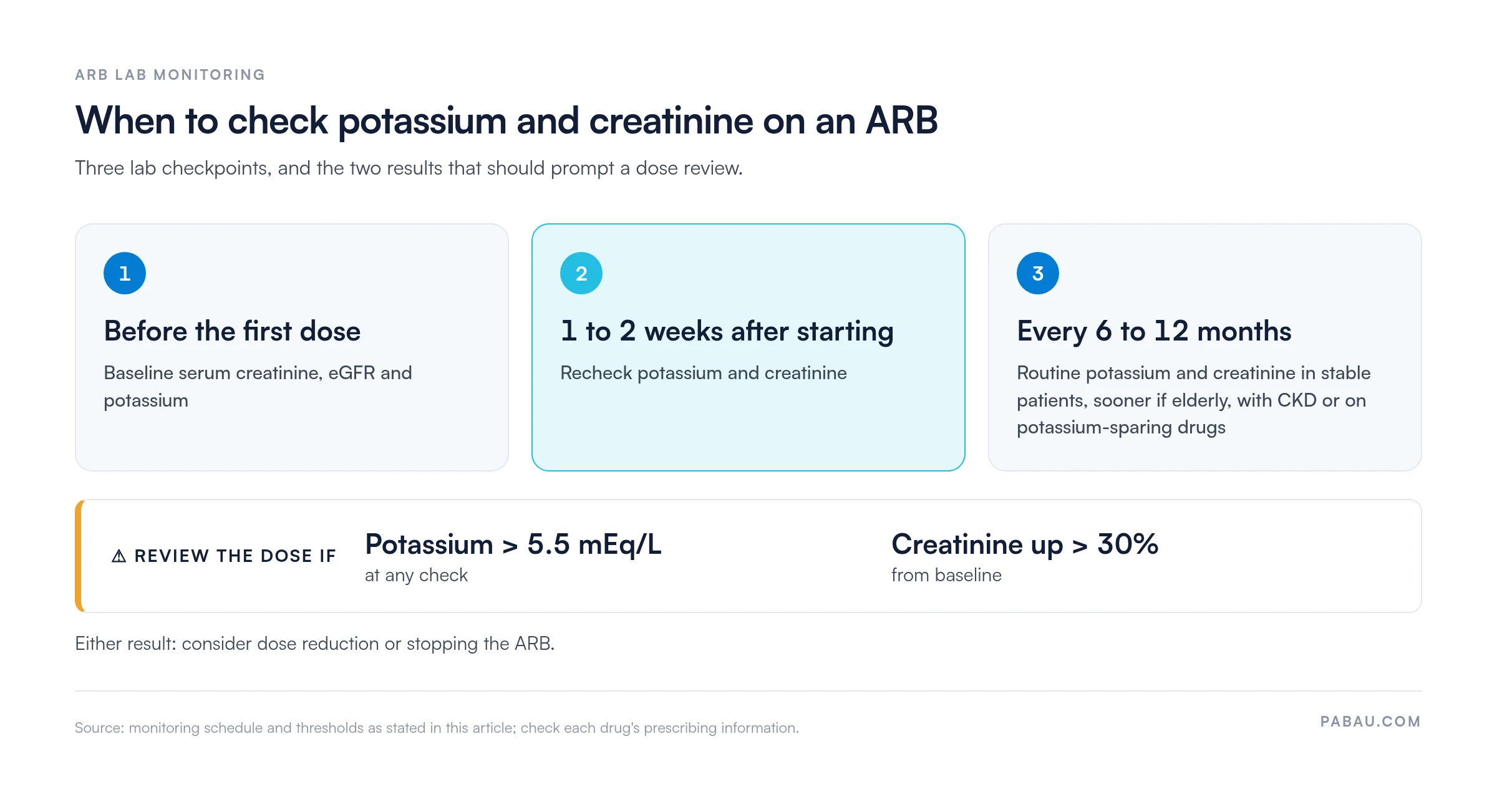
If potassium rises above 5.5 mEq/L or creatinine increases more than 30% from baseline, consider dose reduction or discontinuation.
Hypertension alone: Any approved ARB is appropriate. Cost and dosing frequency often drive the choice.
Heart failure with reduced ejection fraction: Valsartan and candesartan have trial data (Val-HeFT, CHARM-Alternative). They are the preferred sartans when an ACE inhibitor or ARNI is not tolerated.
Diabetic nephropathy (type 1 or 2 DM): Losartan and irbesartan have robust nephroprotection data (RENAAL, IDNT trials). They slow GFR decline and reduce albuminuria progression.
Chronic kidney disease (non-diabetic): Any ARB offers renal protection, with the dose adjusted for eGFR. KDIGO guidelines recommend ARBs (or ACEIs) in CKD stages 3-5 when albuminuria is present.
Post-MI with LV dysfunction or heart failure: Valsartan is FDA-approved for clinically stable patients with LV failure or dysfunction after MI. The approval rests on the VALIANT trial. Losartan carries no post-MI indication.
NSAIDs + ARBs: The pair raises hyperkalemia and acute kidney injury risk. Avoid long-term NSAID use, and use acetaminophen or selective COX-2 inhibitors (with caution) in patients on ARBs.
Potassium-sparing diuretics + ARBs: Spironolactone, amiloride, or triamterene combined with an ARB significantly raises serum potassium. Monitor closely, and consider an alternative diuretic if needed.
Lithium + ARBs: ARBs reduce lithium clearance, which risks toxicity. Monitor lithium levels and adjust the dose as needed.
ACE inhibitors + ARBs: FDA labeling warns against dual RAAS blockade. Hyperkalemia, hypotension, and renal failure risk outweigh any benefit, so use one agent only.
ARBs are generally well tolerated. Common side effects include headache, fatigue, and diarrhea (especially with candesartan). Hyperkalemia is the most clinically significant adverse effect, particularly in elderly patients, those with CKD, or those on potassium-sparing agents.
Angioedema is rare but possible. Cross-reactivity after ACE inhibitor angioedema occurs in roughly 2-10% of patients, with a published range up to about 17%. Take care if the patient has a history of ACEi-induced angioedema.
Tell patients that ARBs work best when taken consistently, and that blood pressure may take 3-6 weeks to reach target. Advise against potassium supplements or high-potassium foods (bananas, leafy greens) without clinician approval. For patients whose potassium runs high, a low potassium food list gives practical swaps to discuss.
Older patients already on nitrate therapy for angina need sitting and standing blood pressure checks. Nitrate-induced hypotension adds to the drop an ARB already produces.
Remind patients to avoid NSAIDs. Ask them to tell their clinician straight away if they become pregnant, because ARBs carry a boxed fetal-toxicity warning.
The 2025 AHA/ACC high blood pressure guideline lists ARBs among the first-line drug classes for hypertension. In HFrEF, guidelines use an ARB when an ACE inhibitor or ARNI is not tolerated. ARBs are also standard therapy in diabetic kidney disease with albuminuria. For patient-facing background, the NHLBI’s high blood pressure pages explain the condition and its treatment in plain language.
The CMS135 quality measure covers ACE inhibitor or ARB or ARNI therapy for left ventricular systolic dysfunction (LVSD). It applies to heart failure patients with an LVEF under 40%. That makes clear documentation of ARB therapy critical for quality reporting.
The drug detail lives in the reference table on this page, not in the download. The free PDF is a blank checklist, so it works as a paper record rather than a prescribing reference. Use it alongside Pabau, the practice management platform we build, in three ways:
For CMS135 reporting, document ARB therapy in the patient’s electronic record rather than on paper alone. Practices using Pabau’s compliance management tools keep signed forms and clinical notes together in one place for audits.
Hypertension often sits alongside obesity and type 2 diabetes. Practices treating all three can run the same intake, consent, and notes workflow through Pabau’s weight loss clinic software.
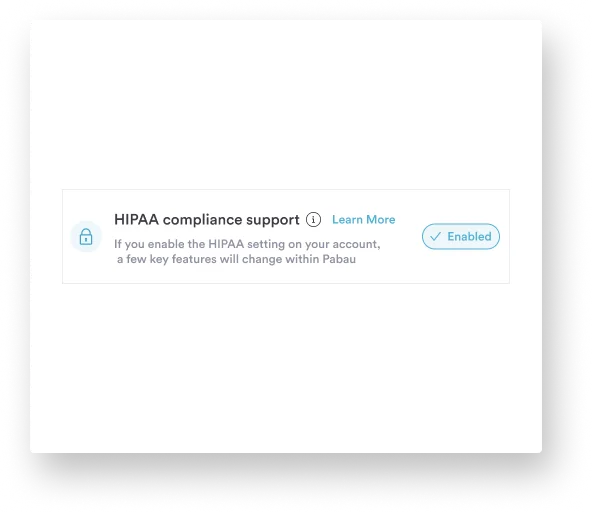

Pabau’s digital forms, Client records, and AI-drafted consultation notes keep each patient’s medication history in one place. Your team can then show ARB therapy at audit time without chasing paper.

Keep the table on this page as your prescribing reference and treat the blank checklist as a paper back-up. The riskiest calls sit outside the dose column: pregnancy, dual RAAS blockade, and a patient with past ACE inhibitor angioedema.
Potassium and creatinine results drive most ARB dose changes, so the monitoring schedule matters as much as the starting dose. Book a demo to see how Pabau keeps medication history, intake forms, and consultation notes in one patient record.

Weighing an ACE inhibitor instead? Medication list of ACE inhibitors covers the other half of the ARB-or-ACE-inhibitor decision.
Managing more than blood pressure? Cardiovascular medication list groups the wider heart and blood pressure drug classes in one reference.
Treating hypertension alongside high cholesterol? Cholesterol medication list covers the lipid-lowering classes many ARB patients also take.
Patient’s potassium creeping up? Low potassium food list gives patients practical food swaps to discuss at the next review.
The most widely prescribed ARBs are losartan, valsartan, and irbesartan. Losartan was the first approved and remains popular due to cost. Valsartan is preferred in heart failure. Irbesartan is frequently chosen for diabetic nephropathy.
FDA labeling gives pregnancy a boxed fetal-toxicity warning. Labeled contraindications are ARB hypersensitivity and aliskiren use in patients with diabetes, and ARBs should be avoided after angioedema on an ARB. Precautions include bilateral renal artery stenosis, baseline serum potassium >5.5 mEq/L, eGFR below 30 mL/min/1.73m², and concurrent potassium-sparing diuretics, NSAIDs, or lithium.
No. FDA labeling warns against dual RAAS blockade (combining ARBs and ACE inhibitors). The combination increases hyperkalemia, hypotension, and acute kidney injury risk without additional clinical benefit. Use one agent only.
Check baseline potassium before starting an ARB, then recheck 1-2 weeks after initiation. Thereafter, monitor every 6-12 months in stable patients. Check sooner if the patient is elderly, has CKD, or is on concurrent potassium-sparing diuretics or NSAIDs.