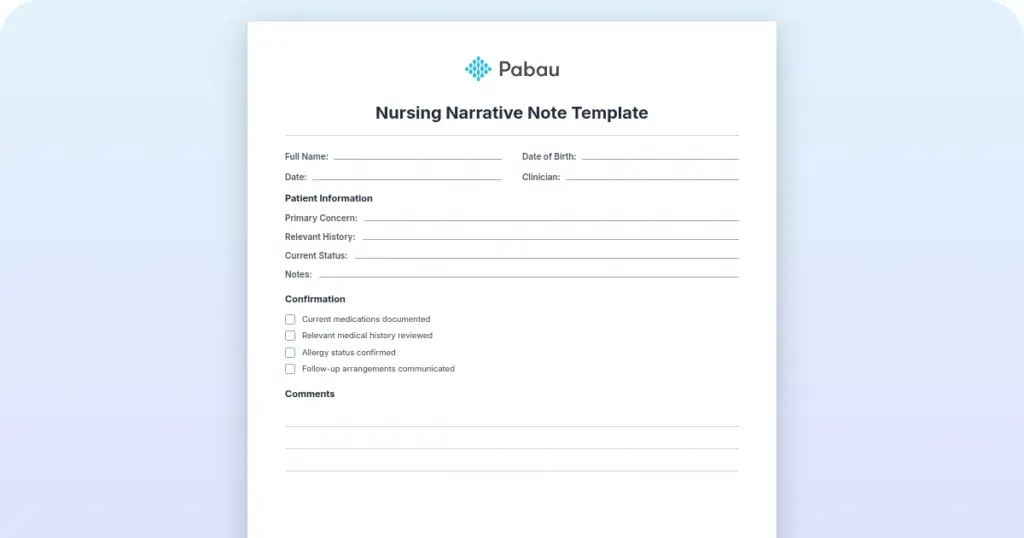
Nursing narrative note template
A nursing narrative note template is a structured PDF that guides you through re...

3
Last Updated: Oct 21, 2026

A CVA nursing care plan is a structured document guiding assessment, diagnosis, intervention, and discharge planning for stroke patients.
NANDA nursing diagnoses prioritize ineffective cerebral tissue perfusion, impaired physical mobility, and aspiration risk.
Evidence-based interventions include neurological monitoring, rehabilitation support, swallowing assessment, and secondary prevention education.
Practice management software like Pabau streamlines care plan completion and team communication throughout the recovery journey.
A comprehensive, ready-to-use template covering patient assessment, NANDA diagnoses, nursing goals, evidence-based interventions with rationale, expected outcomes, and discharge planning for cerebrovascular accident patients.
Download templateA CVA nursing care plan is the foundation of coordinated, evidence-based stroke recovery. Stroke affects over 795,000 Americans annually according to the CDC, and the first 72 hours of nursing care directly influence long-term functional outcomes. This guide walks you through implementing a comprehensive CVA nursing care plan template in your clinical setting.
A CVA (cerebrovascular accident) nursing care plan is a dynamic document. It structures patient care across five integrated phases: Initial assessment, diagnosis, goal-setting, intervention delivery, and discharge planning. Unlike generic protocols, a CVA care plan personalizes nursing actions to each stroke survivor’s neurological deficits, comorbidities, and rehabilitation potential.
The plan uses NANDA International (NANDA-I) nursing diagnoses to classify patient problems in clinical language every healthcare discipline recognizes. This shared taxonomy means a nurse’s documentation in an intensive care unit matches the language a rehabilitation therapist reads weeks later, without translation or rework. NANDA-I provides the structure. Clinical expertise drives the prioritization.
Legal and regulatory frameworks — The Joint Commission, CQC (UK), and professional nursing standards — expect care plans to document evidence for every intervention. A CVA nursing care plan bridges that requirement. Each intervention statement includes a rationale tied to stroke pathophysiology or rehabilitation science, creating a defensible clinical record should outcomes be questioned or care audited.
Implementing a CVA nursing care plan template follows a structured five-step workflow:
Most facilities integrate the CVA care plan into the electronic health record using digital intake forms and structured templates. This ensures every clinician accessing the record sees the unified care plan without flipping between paper documents or separate systems.
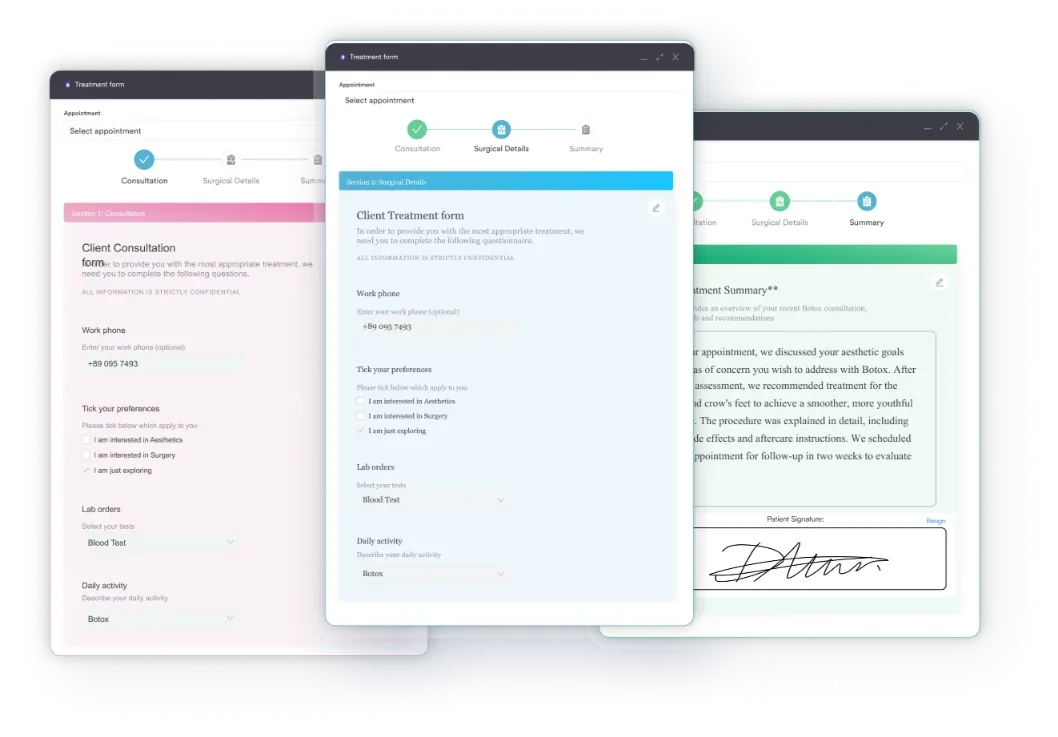
This template serves multiple clinical roles and settings:
GP practices often build forms like this into GP clinic software so records stay complete and auditable.
A structured CVA care plan delivers measurable operational and clinical benefits. It reduces variability. Every nurse follows the same assessment-to-discharge workflow, so critical monitoring isn’t missed or discontinued prematurely. This consistency improves patient safety. Swallowing precautions don’t lapse because a new shift wasn’t briefed, and fall-prevention protocols stay in place until the patient demonstrates safe mobility.
Compliance becomes auditable. When The Joint Commission or a state regulatory body reviews stroke care quality, they expect documented evidence that:
A CVA care plan with dated entries and clinician signatures documents all three. This protects the facility from deficiency citations and supports accreditation renewal.
Multidisciplinary coordination sharpens. When PT/OT/SLP reference a shared care plan rather than siloed progress notes, they adjust their own interventions to match nursing goals.
A patient’s Impaired Verbal Communication diagnosis prompts the SLP to prioritize aphasia assessment. The nursing care plan signals this priority across disciplines. Outcome data also consolidates, since all clinicians document against the same goals, which makes it easy to extract metrics for quality reporting.
Flag patient risk factors on day 1: Prior stroke, atrial fibrillation, diabetes, smoking history. These directly influence intervention intensity and discharge planning. High-risk patients need earlier social work involvement and more intensive family education on secondary prevention.
Secondary prevention begins in the acute hospital, not after discharge. Include a nursing diagnosis of Deficient Knowledge related to stroke risk reduction, with interventions documenting education on:
Nurses must explain why these actions matter, not just list them. Example: “Educate patient that maintaining blood pressure below 130/80 mmHg lowers the risk of another stroke, per current AHA/ASA guidance.” This specificity motivates patients and families to sustain behavior change post-discharge.
Record barriers to compliance such as cognitive impairment, language deficit, or limited social support, and tailor teaching methods accordingly. Link educational content to patient portals or secure messaging so families reinforce education at home.
Effective discharge planning starts on admission, not the day before discharge. Use the care plan template to document:
Document these elements in the care plan so the discharge nurse (or you, if managing post-acute care) has a single source of truth. Track each required element with a discharge planning checklist before the patient leaves your service.
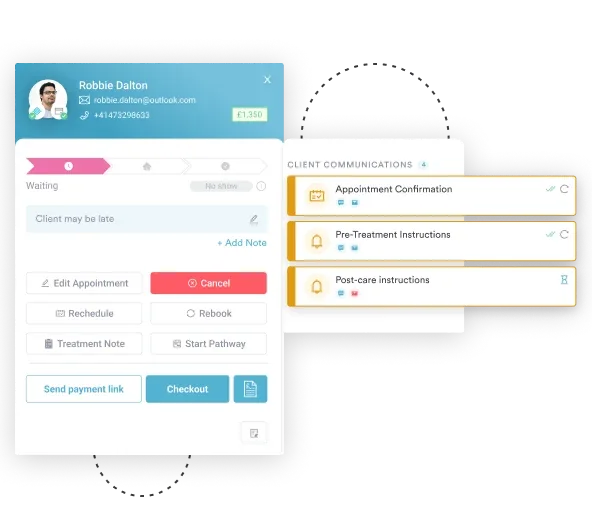
Most acute and rehab units still lean on paper care plans, faxed referrals, and verbal handoffs between shifts. A change in a patient’s swallowing status or a new mobility goal has to pass through several people before every clinician sees it. That delay is where safety protocols slip.
Pabau’s digital forms replace the paper care plan with one record every discipline can open. The outpatient team.
Built-in team communication tools let a nurse flag a new NANDA diagnosis or a change in NIHSS score. The rest of the care team sees it immediately, not at the next shift huddle.
The result is fewer dropped handoffs and faster discharge coordination, since nursing, PT, OT, and social work are all reading and updating the same plan.

Pabau’s structured digital forms and team messaging eliminate paper handoffs and ensure every stroke patient’s care plan is current and accessible to all clinicians. Automate secondary prevention reminders and discharge checklist prompts.

A CVA nursing care plan turns clinical knowledge into consistent daily practice. It gives every nurse, therapist, and physician a shared language through NANDA diagnoses, so interventions and goals stay aligned across shifts and disciplines. Stroke recovery is a race against time in the first 72 hours and a marathon after that. A structured plan keeps the whole team moving together through both stages.
Download the template above and adapt it to your facility’s patient population and documentation system. The specifics change from unit to unit, but the discipline behind them doesn’t.
Assess before you diagnose. Tie every intervention to a rationale. Start discharge planning on day one, not day five. Skip that structure, and the shortfalls tend to surface later, as a missed secondary-prevention teaching moment or a delayed rehab referral.
Book a demo to see how Pabau keeps care plans current and visible to every clinician on a stroke patient’s team.

Need a fast neurological baseline for a stroke patient? Neuro exam cheat sheet lays out the assessment findings to document at admission.
Clearing a patient to return to work? Doctor’s note for work documents fitness for work, restrictions, and a return-to-work date.
Looking for a template to standardize shift handoffs? End-of-shift report keeps neurological status and care-plan updates from getting lost between nurses.
Want a structured way to document ongoing symptoms? Nursing review of systems organizes findings by body system for faster charting.
The priority diagnoses are Ineffective Cerebral Tissue Perfusion (life threat), Impaired Physical Mobility (hemiplegia/hemiparesis), Risk for Aspiration (dysphagia), Impaired Verbal Communication (aphasia), and Self-Care Deficit. Assign based on patient assessment findings, not a preset checklist.
A full care plan for acute hospitalization typically spans 2-4 pages, covering assessment summary, 6-8 prioritized diagnoses, goals, and interventions per diagnosis. Post-acute care plans may be condensed to 1-2 pages focused on functional goals and discharge barriers.
Ischemic stroke (87% of cases) requires urgent antiplatelet/fibrinolytic therapy and reperfusion monitoring; nursing focuses on perfusion support and thrombolytic complication surveillance. Hemorrhagic stroke requires strict blood pressure control and increased intracranial pressure monitoring; nursing priorities center on bleeding prevention and neurological decline surveillance. Both use similar care-plan diagnoses but different intervention rationales.
Review and revise goals daily during acute hospitalization as patient status changes. For rehabilitation settings, update weekly or per therapy milestone. Document goal achievement or revision with dates and rationale for change.
Include the patient and family, nursing team, physician, physical/occupational/speech therapists, social work, case management, and the post-acute facility (if applicable). A multidisciplinary meeting 48 hours before discharge ensures all parties align on goals and patient/family understand the plan.