Sulcus Test: Shoulder Instability Assessment
The sulcus test is an orthopedic special test that checks for inferior glenohume...

3
Last Updated: Oct 22, 2026
A blood pressure medication recall list tracks which antihypertensive drugs the FDA has recalled, by drug name, manufacturer, lot number, recall class, and reason.
The best-known entries are three angiotensin receptor blockers (ARBs), valsartan, losartan, and irbesartan, recalled in 2018 and 2019 for nitrosamine impurities. Amlodipine/valsartan combination tablets and some metoprolol lots have been recalled too.
According to the FDA, a drug is recalled when it poses a potential health risk from manufacturing defects, contamination, mislabeling, or superpotency. Practices use the list to check whether a patient’s prescription is affected and to advise them safely.
This guide covers each recall, what clinicians need to check, and a downloadable checklist your practice can use to record each patient’s recall response.
A printable, patient-level checklist with fields for the patient’s name, date of birth, record or MRN number, who prepared it, and the date. Tick rows with space for notes let your team confirm each recall step.
Download template
A blood pressure medication recall list tracks FDA recalls by drug name, manufacturer, lot number, recall class, and reason, so your team can check prescriptions.
Nitrosamine impurities (NDMA, NDEA, and NMBA) drove the landmark 2018–2019 ARB recalls of valsartan, losartan, and irbesartan.
FDA recall classes run from Class I (serious health risk) to Class III (unlikely to cause harm). The class sets how fast you contact patients.
Verify lot numbers against FDA recall notices, contact affected patients, and document each step so your recall response holds up in an audit.
Pabau, the practice management platform we build, keeps prescriptions, patient messages, and recall notes in one record, so the response is documented as it happens.
Use this page as the reference and the downloadable checklist as the record. The page lists each recall, its reason, and its FDA class. The checklist captures one patient’s details and each step your team confirms.
Start by matching the patient’s prescription lot number to the recall notice. Then record how and when you contacted them. Finish with the alternative prescribed and who signed off, so the file holds up in an audit.
The table below summarizes the main recalls affecting blood pressure medications. Recall classes and dates follow FDA recall notices, and each notice lists the affected lot numbers.
Check the FDA recall notice for each drug’s affected lot numbers before you contact a patient. New recalls are issued regularly, so search the FDA’s recall page for anything announced after this list was compiled.
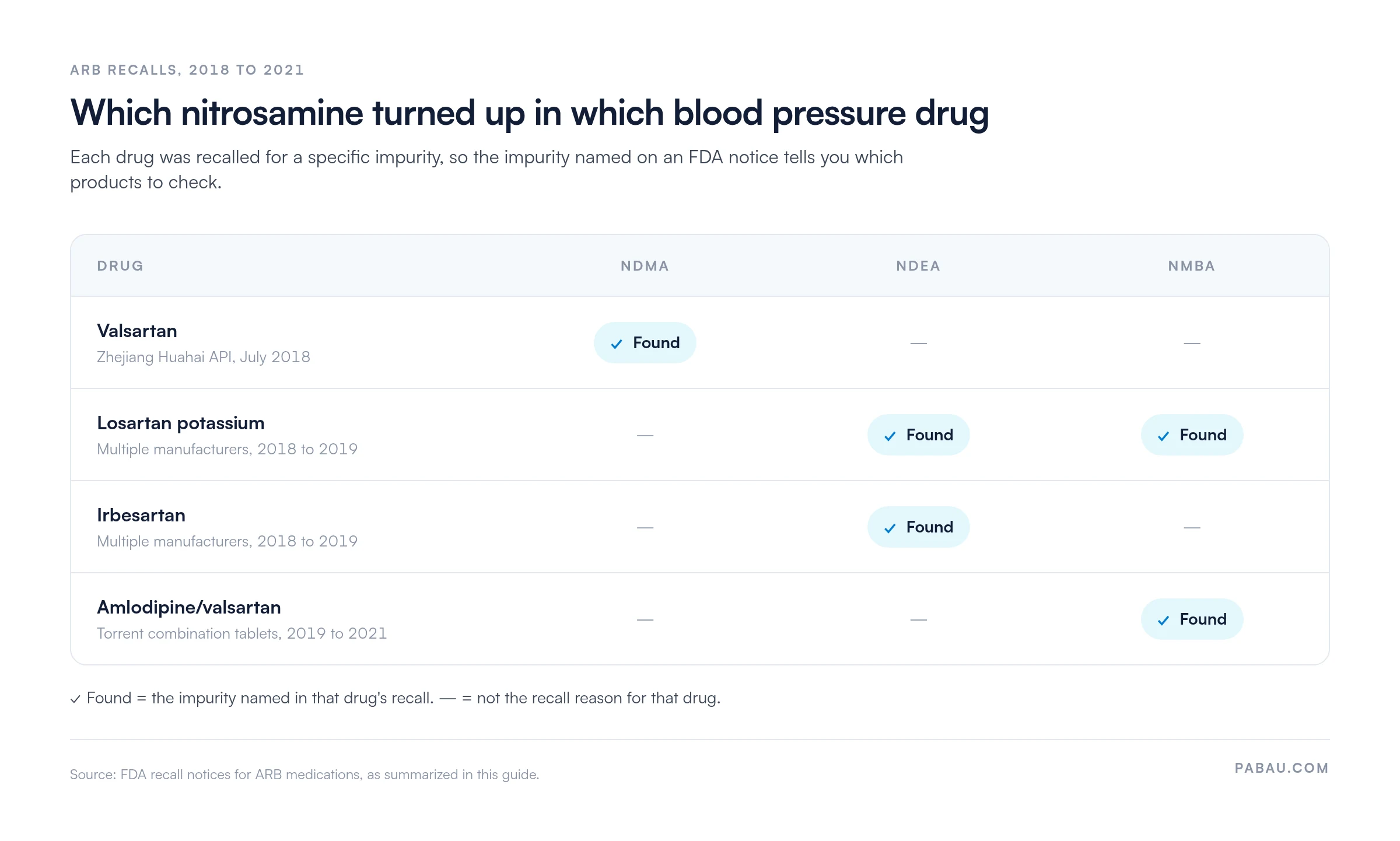
Losartan potassium recalls began in 2018, when manufacturers detected N-nitrosodiethylamine (NDEA) and N-nitroso-N-methyl-4-aminobutyric acid (NMBA) in the drug. Both are probable human carcinogens. Losartan is prescribed to millions of patients worldwide, which made this one of the most consequential medication recalls in recent years.
The impurities came from the synthesis process at certain suppliers, and not every losartan manufacturer was affected. The FDA requested a recall of affected lots. Affected patients were advised to switch to an unaffected ARB or another drug class under physician guidance. Verify the lot number on each dispensed bottle against FDA lists before assuming a supply is safe.
An ARB medication list gives the starting and target doses for each alternative ARB.
The 2018 valsartan recall was the first major nitrosamine contamination event in ARB medications. Valsartan active pharmaceutical ingredient (API) from Zhejiang Huahai Pharmaceutical contained NDMA above the FDA’s acceptable daily intake limit.
The recall triggered inspections of other manufacturers, which found similar impurities in losartan and irbesartan. The valsartan recall is largely resolved. Still, check older prescriptions against the lot lists to confirm no patient kept taking an affected supply.
The FDA sorts recalls into three classes, based on how likely harm is and how serious it would be:
Blood pressure medication recalls are usually Class II. That calls for an orderly dose review and a planned switch, not an emergency stop. Getting the class right tells your team how fast to act.
Blood pressure drug recalls come from four main causes: nitrosamine contamination, superpotency, mislabeling, and manufacturing defects.
Nitrosamine contamination: This is the most common cause of recent blood pressure recalls. Nitrosamines (NDMA, NDEA, NMBA) are probable carcinogens that can form during chemical synthesis if impurities aren’t removed. ARBs proved especially susceptible because of their chemical structure and manufacturing routes. The chart below shows which impurity turned up in which drug.
Superpotency: A batch contains more active ingredient than the label states. In blood pressure medication, that raises the risk of low blood pressure (hypotension) and fainting (syncope) in susceptible patients.
Mislabeling or packaging errors: Bottles carry the wrong drug name, strength, or directions. These can lead to wrong-drug errors or overdose.
Manufacturing defects: Visible particles, discoloration, or instability point to a quality control failure during production or storage.
Five checks tell you whether a patient’s current prescription is affected:
When a patient’s prescription matches a recalled lot, follow these six steps to protect the patient and document compliance:
A diuretic is another option at that third step. Thiazide diuretics such as hydrochlorothiazide and chlorthalidone are first-line for hypertension, so they fit a patient leaving a recalled ARB.
Two companion templates help after the switch. A repeat prescription request form records the new prescription. A blood pressure reading chart tracks readings while the patient settles on the alternative.
Patients treated after a stent or stroke often take an antiplatelet alongside their blood pressure drugs. An antiplatelet medication list covers the aspirin and P2Y12 drugs to check in the same review.
Without a connected system, a recall usually runs from a spreadsheet. Someone searches prescriptions by hand, phones patients one at a time, and types notes into separate files.
Pabau keeps the recall response inside the patient record. Its prescription management holds each patient’s medication history in the same file as their notes, so affected patients are easier to find. When a recall lands, your team can:
If a patient reports a visible reaction, such as a rash or swelling, Pabau’s clinical photo tools store dated images in the same record. That evidence supports a MedWatch report. Book a demo to see how Pabau’s clinical records and patient messaging speed up your recall response.

Pabau keeps prescriptions, alerts, patient messages, and notes in one record. Your team can find affected patients, contact them, and document each step in one place.

Work from the lot number. Two patients on the same losartan strength can hold different lots, and only one of them may be affected.
Bookmark the FDA recall page, print the checklist before you need it, and decide now who on your team owns recall outreach. Then a Class II notice becomes a few days of orderly calls instead of a scramble.
Book a demo to see how Pabau keeps each recall contact documented in the patient record.

Need to check a patient’s other medications? Blood thinning medication list covers the anticoagulants and antiplatelets that often sit alongside blood pressure prescriptions.
Want to monitor readings after a switch? Blood pressure reading chart gives patients a simple way to log readings while they settle on an alternative.
Looking for a medication management workflow? Prescription management tracks medication history and supports flagging and recall cross-referencing.
Tracking doses during a medication change? Daily medication chart records each dose, so missed or doubled doses show up quickly.
Assessing a patient’s wider cardiovascular risk? Blood pressure stroke risk chart maps readings to stroke risk for patient conversations.
Losartan, valsartan, irbesartan, amlodipine (from certain manufacturers), and metoprolol have all been subject to FDA recalls, primarily due to nitrosamine contamination or manufacturing defects. Check the table in this guide and verify your patient’s specific lot number against the FDA enforcement reports.
Losartan, valsartan, irbesartan, amlodipine/valsartan combination tablets from certain manufacturers, and metoprolol have all been subject to FDA recalls. Most were due to nitrosamine contamination or manufacturing defects. Check the table in this guide and verify your patient’s specific lot number against the FDA recall notices.
Losartan, valsartan, and irbesartan were recalled due to nitrosamine impurities (NDMA, NDEA, NMBA), which are probable carcinogens. The risk comes from taking the contaminated drug, so switching to an unaffected alternative stops further exposure.
Check your medication bottle for the drug name, manufacturer, lot number, and strength. Then search your drug and lot at FDA.gov/safety/recalls-market-withdrawals-safety-alerts. If your lot number matches a recall, contact your prescriber or pharmacist immediately to switch to an alternative.
Yes. Losartan from multiple manufacturers has been subject to recalls since 2018 due to NDMA and NDEA nitrosamine impurities. Not all losartan is recalled – only specific lot numbers from affected suppliers. Check your bottle’s lot number against the FDA list to determine if you are affected.
Yes. Losartan from multiple manufacturers has been recalled since 2018 due to NDEA and NMBA nitrosamine impurities. Only specific lot numbers from affected suppliers are recalled. Check your bottle’s lot number against the FDA list to see whether you’re affected.
Torrent Pharmaceuticals recalled its amlodipine/valsartan combination products, including amlodipine/valsartan/hydrochlorothiazide tablets, due to NMBA nitrosamine impurity. Amlodipine besylate taken on its own was not part of that recall. Only specific lot numbers are affected, so verify your lot number on FDA.gov.
A Class II recall means the product may cause temporary or medically reversible health problems, and the chance of serious harm is remote. Most blood pressure medication recalls are Class II. Switch the medication under physician guidance rather than stopping it abruptly.