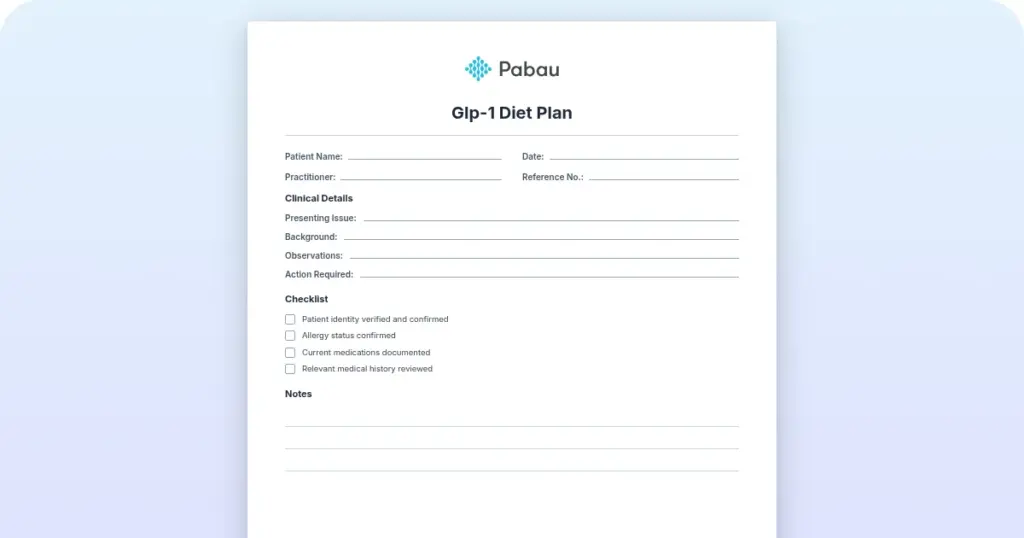
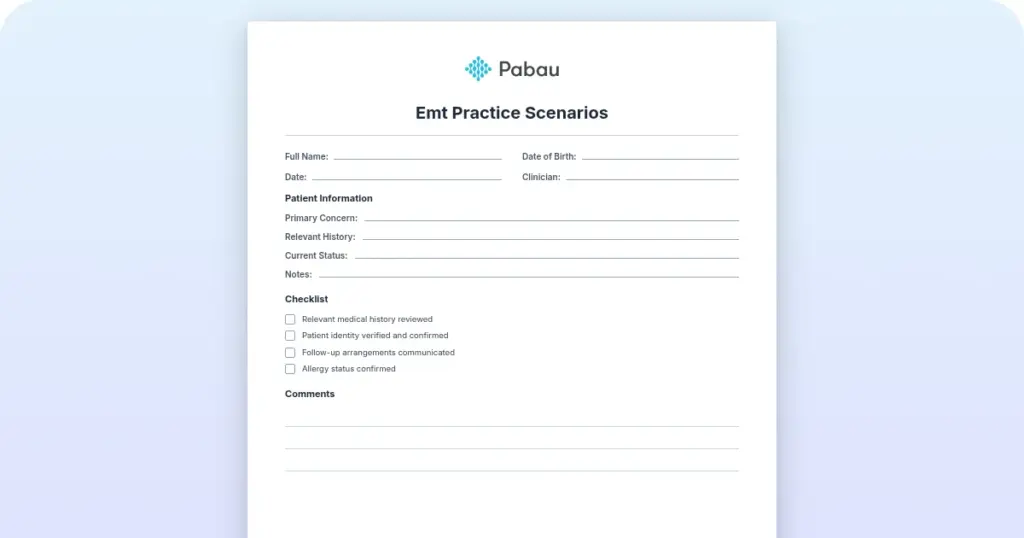
GLP-1 diet plan
A GLP-1 diet plan is a structured eating framework for patients taking semagluti...

2
Last Updated: Oct 13, 2026

A follow-up form documents patient progress after treatment, tracks outcomes, and creates a record for continuity of care — essential for both clinical quality and legal compliance.
Essential fields include symptom tracking, treatment response assessment, medication adherence, side effects or adverse reactions, patient goals progress, and clinical practitioner notes.
Post-treatment follow-ups at med spas require specific sections for visible outcomes, patient satisfaction, swelling/bruising timeline, activity restrictions, and skincare protocol compliance.
Practice management software like Pabau lets you customize follow-up templates, while automated aftercare messaging triggers delivery automatically after appointments — eliminating manual sending.
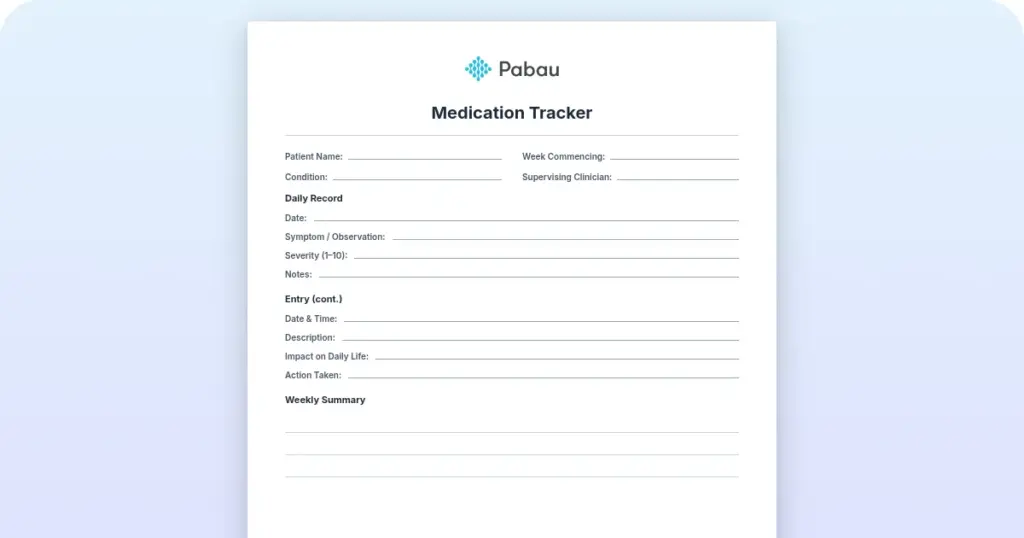
A comprehensive patient tracking document designed to monitor treatment progress, assess ongoing health status, and maintain continuity of care between appointments. Track symptoms, clinical observations, patient-reported outcomes, and next treatment steps.
Download templatePatient follow-up after treatment is the difference between a practice that documents outcomes and one that loses visibility into what happened next. A follow up form is your structured record of that critical window — the days and weeks after a patient leaves your practice.
This guide shows you what goes into an effective follow-up form, how to deploy it, and how to automate the whole workflow so follow-ups happen consistently instead of relying on staff memory. Pair it with a broader healthcare practitioner form for full-visit documentation.
A follow up form is a clinical document that captures patient status and treatment response after an initial visit, procedure, or course of treatment. It is distinct from an intake form — it does not collect baseline information, but rather documents change, progress, and any emerging concerns.
Follow-up forms serve three purposes: (1) they maintain clinical continuity — the practitioner reviewing the form knows exactly what happened since the last appointment, (2) they create a legal record of post-treatment monitoring, and (3) they signal to the patient that the practice cares about their recovery, not just the sale.
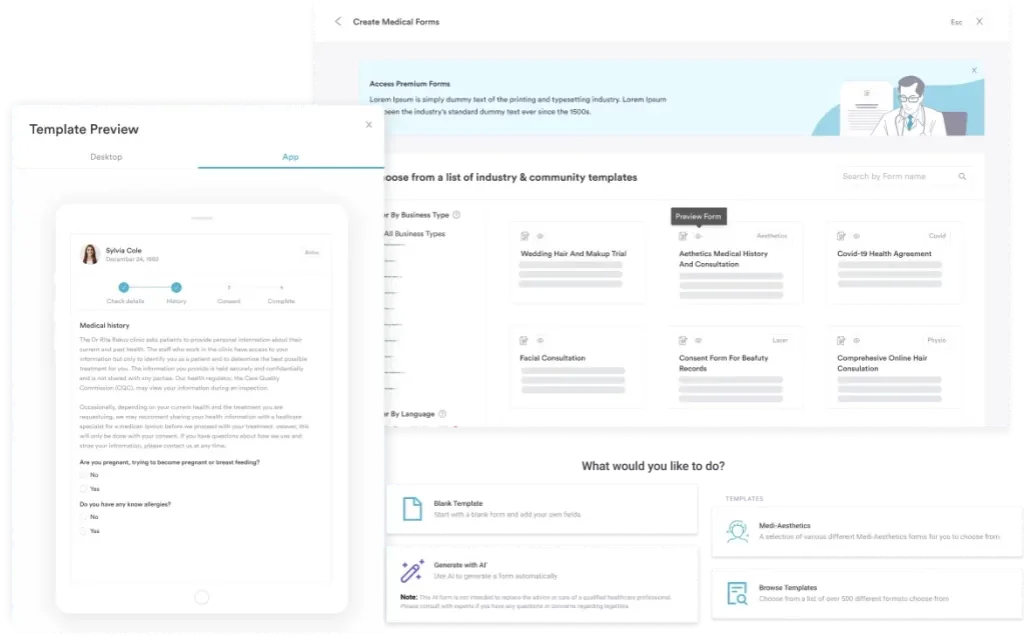
For practices using digital forms built into their practice management system, follow-up form delivery and response tracking happen automatically — no separate email platform or manual distribution needed.
The core sections of a clinical follow up form depend on your specialty, but the foundation is consistent: capture symptom status, treatment response, adherence, and safety signals. Here are the essential fields.
Each field should be clear and simple so patients can complete the form quickly on mobile or at home, yet detailed enough that your clinical team has the data they need to continue care safely.
If your practice provides aesthetic, surgical, or procedural treatments, the follow up form must track visible outcomes and the patient’s lived experience during recovery. This requires sections specific to post-procedure monitoring.
Practices using automated aftercare messaging can trigger follow-up forms at Day 1, Day 7, and Day 28 post-treatment, building a timeline of recovery data without manual staff work.
Running this form inside a GP practice system keeps clinical documentation in one place.
Download the template PDF above and follow these 5 steps to deploy it in your practice.
The template provided covers general follow-up; here’s how to tailor it to your specific practice type.
Once customized, save your practice-specific version as a template within your practice management system’s digital forms feature. This way, it auto-populates patient names and appointment details, cutting staff setup time to seconds.
What separates practices that track outcomes from those that don’t is consistency. A paper form template sits in a folder and gets forgotten. A digital follow up form that auto-triggers after every appointment consistently outperforms paper or email-attachment forms for response rates.
Pabau’s automated aftercare messaging feature ties appointment completion to follow-up form delivery. Here’s how it works: after a patient checks out, Pabau automatically sends an email containing a link to the follow-up form. No staff member has to remember to send it. The response flows directly into the patient’s record.
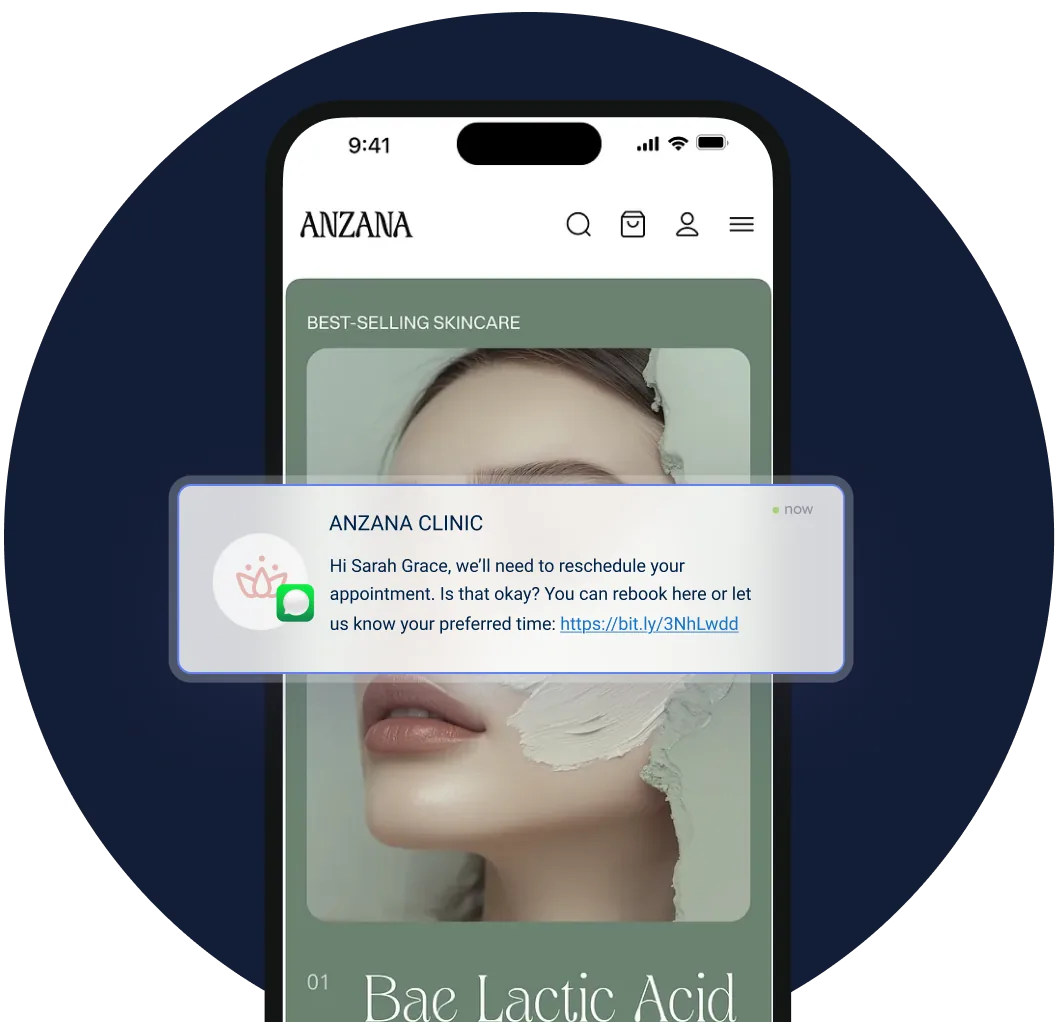
This workflow eliminates the manual steps that cause follow-up forms to fail: remembering which patients need follow-up, finding their contact info, attaching the form, and chasing non-responders.
For practices managing multiple practitioners across locations, this automation is essential.
A follow-up form template is only as powerful as your willingness to use it. The practices with the best outcome data and highest patient satisfaction are the ones that have automated the entire workflow — form goes out, responses come back, clinical team reviews, actions taken. No manual friction. No forgotten follow-ups.

Book a demo to see how digital forms, automated messaging, and patient portals work together to ensure every follow-up happens on schedule.

Follow-up forms also support compliance. Beyond data-protection obligations under HIPAA and the UK Information Commissioner’s Office (ICO), documenting patient follow-up is also a clinical and medico-legal best practice for continuity of care. A follow-up form creates that record.
For regulated treatments (aesthetics requiring informed consent, surgery, prescription-based care), the follow-up form also documents that you actively monitored for adverse events. If a patient experiences a complication and claims you didn’t follow up, your documented follow-up form is your defense.
Practices using structured follow-up processes to measure patient satisfaction also consistently score higher on review platforms and referral rates — patients feel cared for when they receive thoughtful post-appointment check-ins.
A well-designed follow up form is the bridge between treatment and outcome — it closes the loop that most practices leave open. Whether you use paper or digital, the core purpose stays the same: capture patient progress, document safety, confirm satisfaction, and inform the next clinical decision.
Download the template, customize it for your practice, and commit to using it after every treatment. Practices that track outcomes systematically outperform those that rely on chance feedback. The template is free — the only cost is making it a habit. See how Pabau’s digital forms and automation turn follow-up from friction into a frictionless system.
A follow-up form should capture patient identification, post-treatment symptoms or outcomes (pain, swelling, functional improvement), medication or aftercare adherence, any adverse reactions or safety concerns, patient satisfaction with results, and your clinical practitioner’s assessment for the next treatment step. The exact fields depend on your specialty — aesthetic practices emphasize visible outcomes; mental health emphasizes emotional wellbeing and behavioral compliance; physiotherapy emphasizes functional recovery.
Download the template provided above. Customize the section headings and field labels to match your specialty and treatment types. Then either print it for in-office use, email it to patients as a PDF, or upload it into your practice management system’s digital forms feature so responses auto-populate into patient records. Set a timeline (typically 24-48 hours post-treatment) and assign one staff member to review responses weekly.
An intake form collects baseline information before treatment (medical history, allergies, current medications, goals). A follow-up form documents what changed after treatment (symptom improvement, side effects, patient satisfaction). Intake forms are one-time; follow-up forms are repeated after each visit or course of treatment.
Yes. Follow-up forms are specifically designed for post-treatment or post-appointment check-ins. They document patient status during the recovery or integration period. Most practices send them 24-48 hours after the appointment, then again at 2 weeks and sometimes 4-12 weeks depending on the treatment.