Journal prompts for mental health
Journal prompts for mental health are guided questions that help people process ...

2
Last Updated: Oct 13, 2026

A facial expression chart is a visual reference tool mapping emotions, muscle movements, and expression patterns, grounded in Paul Ekman’s research on universal expressions and developed further to identify up to 21 distinct facial emotion signals.
The seven universal expressions (happiness, sadness, anger, fear, disgust, surprise, contempt) are recognized across cultures and are the foundation for clinical emotion recognition and patient communication assessment.
Microexpressions (fleeting facial muscle movements lasting fractions of a second) reveal genuine emotion and are critical in clinical settings for identifying patient distress, pain, or discomfort that spoken words may conceal.
Practice management software like Pabau lets clinicians log emotion and behavioral observations directly in digital clinical notes, keeping facial expression findings alongside the rest of the clinical record.
A comprehensive clinical reference guide for documenting facial expressions, emotion patterns, microexpression recognition, and patient behavioral assessment in real-time clinical settings.
Download templateClinicians recognize that nonverbal cues often carry more diagnostic weight than verbal self-report. A facial expression chart enables practitioners to systematically document these observations, creating a shared language for emotion recognition across teams and treatment settings.
Below, you’ll find Ekman’s seven universal expressions, how to spot microexpressions during a session, and how to turn what you observe into documentation that holds up in a chart audit.
A facial expression chart is a visual reference tool that maps emotions to specific muscle movements in the face. The chart serves three core functions:
The most widely used facial expression chart is based on Ekman’s foundational research identifying seven core emotions universally recognized across cultures. Modern extended charts incorporate up to 21 distinct expressions by recognizing compound emotions and microexpressions — brief muscle contractions that reveal genuine feeling states.
Ekman’s seven universal expressions form the foundation of clinical emotion assessment. Each is characterized by specific muscle movements (action units in FACS terminology) and carries diagnostic significance across mental health, pain management, and behavioral observation contexts.
Microexpressions are involuntary facial movements lasting 1/25 to 1/5 of a second. Unlike deliberate expressions, they leak genuine emotion before the brain engages social regulation. In clinical practice, spotting a microexpression of pain, fear, or disgust can prompt immediate intervention when a patient verbally minimizes symptoms.
Training to recognize microexpressions requires systematic practice. Start by observing the upper face (eyebrows, eye region) and lower face (mouth, jaw) separately. With a facial expression chart as reference, you can flag subtle asymmetries or fleeting movements that indicate concealed emotion. This skill is particularly valuable in pain assessment, autism spectrum support, and trauma-informed care.
Occupational therapists often score assessments like this directly inside occupational therapy software, keeping results attached to the treatment plan.
An emotion wheel, like Robert Plutchik’s model, organizes emotions radially by intensity and relationship, placing primary emotions at the center and compound emotions at the outer ring. A facial expression chart, by contrast, focuses on muscle movement rather than emotion relationships.
Choose a chart for rapid emotion identification during clinical observation. Choose a wheel for deeper emotional processing work with clients.
Real-world facial expression chart applications span pain assessment, neurological screening, autism spectrum support. A therapist using a chart during initial assessment gains rapid insight into genuine emotional state beneath social performance.
A cosmetic practitioner documenting pre-treatment facial movement can track post-injection symmetry changes.
In mental health clinical workflows, a facial expression chart becomes a structured observation tool that adds objectivity to clinical notes. Rather than writing “patient appeared sad,” a practitioner can note specific muscle movements and microexpression frequency, creating a measurable baseline for tracking treatment progress.
Adult-focused facial expression charts differ from child-focused versions in several ways. Adults have greater facial muscle control due to decades of social learning, so their microexpressions are subtler and require trained observation. Child-focused instruments.
Adult assessment contexts often involve pain, autonomy, informed consent, and psychological safety — each requiring nuanced emotion reading. Charts designed for adult clinical use emphasize diagnostic populations, such as anxiety disorders, autism spectrum, and trauma history, where emotion expression patterns diverge from the cultural average.
In therapy practice workflows and psychology practice assessment tools, adult charts remain the gold standard because they anchor observation in Ekman’s peer-reviewed research rather than population-specific variations.
Translating a facial expression observation into structured clinical language requires specificity and objectivity. Rather than “patient was nervous,” document: “Microexpression of fear observed during discussion of invasive procedure; eyebrow raise and eye widening lasted approximately 0.5 seconds before normalization.” This language grounds the observation in muscle movement and timing, making it reproducible and clinically meaningful.
Use your facial expression chart to translate observations into FACS action units or descriptive muscle groups. This dual-layer approach supports both clinical decision-making and legal documentation clarity.
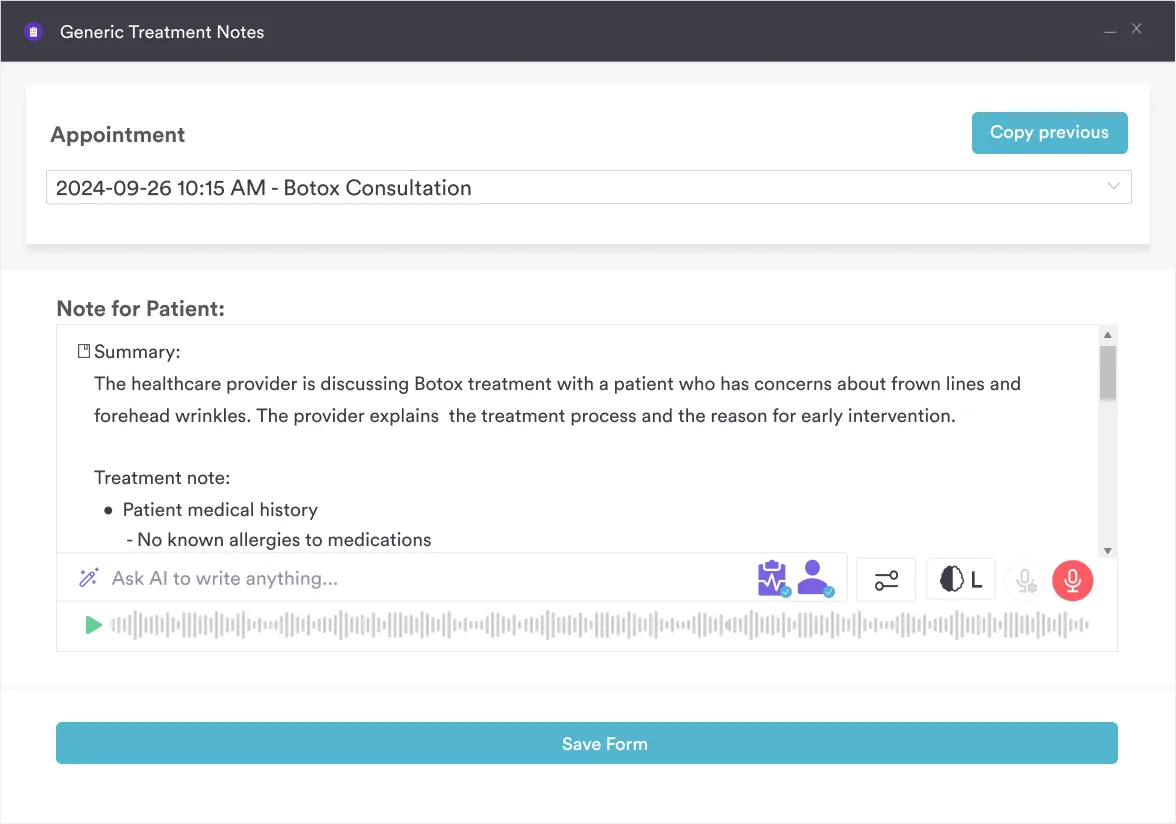

Pabau’s structured note templates and AI scribe support help you document facial expressions and behavioral observations with precision and consistency. Book a demo to see how.

Track microexpression consistency across sessions by adding a dedicated “Nonverbal Observations” field to your standard assessment form. Over time, patterns emerge that reveal emotion regulation progress or ongoing distress triggers — data that transforms qualitative intuition into measurable clinical markers.
A facial expression chart turns fleeting nonverbal cues into structured clinical documentation. Grounded in Paul Ekman’s foundational research, it gives clinicians a shared language for emotion recognition that works across cultures and populations.
Whether you use it for rapid emotion screening, microexpression training, or baseline assessment before treatment, the chart turns observation into clinical data you can act on. To capture those observations directly in your patient records, book a demo of Pabau.

Screening development alongside facial expression work? ASQ-3 documentation worksheet tracks five developmental domains across all 21 intervals from 2 to 60 months.
Screening for safety risks in these sessions? Danger Assessment template is a validated tool for evaluating intimate partner violence lethality risk and guiding safety planning.
The seven universal expressions identified by Paul Ekman are happiness, sadness, anger, fear, disgust, surprise, and contempt. These are recognized across cultures and form the foundation of most facial expression charts.
Microexpressions typically last between 1/25 and 1/5 of a second, a fraction of a second that makes them difficult to detect without training. They reveal genuine emotion before social regulation engages.
A facial expression chart maps specific muscle movements to emotion categories and is used for rapid emotion identification during observation. An emotion wheel organizes emotions by intensity and relationship and is better suited for deeper emotional processing work.
Yes, with important caveats. Autistic individuals and those with other neurodivergent profiles may display facial expressions differently or less frequently than neurotypical populations. Use the chart as a screening tool, not a diagnostic instrument, and always confirm observations with direct patient communication.
Paul Ekman and Wallace Friesen developed FACS in 1978. It systematically documents facial muscle movements (action units) and remains the gold standard for objective facial expression analysis in research and clinical settings.
No. Facial expression alone is not a reliable deception detection tool. While microexpressions can reveal concealed emotion, they do not directly indicate lying. Courts and investigative agencies do not accept facial expression analysis as evidence of deception.