Scapular assistance test: Procedure, interpretation and free template
The scapular assistance test is a manual examination in which the clinician supp...

2
Last Updated: Oct 19, 2026

The Falls Efficacy Scale measures how confident a person feels performing daily activities without falling, and the free template below uses the original 10-item version.
The original FES (10 items, 1-10 scale) differs from the FES-I (16 items, 1-4 scale) and the Modified FES (14 items, 0-10 mean score).
A total FES score above 70, or an FES-I score of 28-64, signals a high fear of falling that calls for intervention.
Practice management software like Pabau lets clinicians embed Falls Efficacy Scale assessments into client records, flag high-risk scores automatically, and track outcomes across every location.
The original 10-item Falls Efficacy Scale (Tinetti et al., 1990). Patients rate their confidence in 10 daily activities from 1 (very confident) to 10 (not confident at all). A total score above 70 indicates fear of falling. Print or hand out the PDF to standardize fall-risk screening across your practice.
Download templateA patient can be medically cleared to climb stairs and still refuse to do it. That mismatch between physical ability and confidence is exactly what the Falls Efficacy Scale (FES) measures. Developed by Tinetti, Richman, and Powell in 1990, the FES quantifies fear of falling before it hardens into activity avoidance, deconditioning, and isolation.
Below, you’ll find the free 10-item FES template, plus the FES-I and Modified FES variants. You’ll also get administration steps, scoring guidance, and what a high result should trigger in a care plan.
The Falls Efficacy Scale measures self-efficacy: how confident someone feels performing daily activities without falling. It’s a question about belief, not a test of strength or balance.
Take a 78-year-old recovering from a hip fracture. She’s medically cleared for stairs, but she believes she’ll fall on them, so she avoids them entirely. The FES catches that belief before it turns into decline: targeted balance training, environmental changes, or reassurance backed by an objective score.
The scale works across languages and clinical populations, and it correlates strongly with fall risk itself. That’s why it shows up in geriatric screening, post-operative rehab, and neurological disease management. Treatment sessions in post-operative rehab produce scores that only mean something in sequence, so the record needs to hold that sequence.
Pick the version that fits your setting. The original 10-item FES is the version in this page’s free template. The FES-I is the global research standard. The Short FES-I works best when a full assessment won’t fit the appointment.
The FES-I is the most widely used version worldwide. It’s available in 30-plus languages and has been validated in stroke, Parkinson’s disease, multiple sclerosis, and post-hip-fracture populations. The Short FES-I trades some sensitivity for speed, which suits busy practices running rapid screens.
Administering the original FES takes 5 to 10 minutes, and it needs no special equipment. Ask the patient to rate how confident they feel doing each activity below, without losing their balance. Use a scale from 1 (very confident) to 10 (not confident at all):
Patients can fill this out on paper.
No special equipment is needed. Administer it in the waiting room, over the phone, or during an initial consult. What matters is the patient’s lived experience with each activity, not the clinician’s opinion of their ability.
A few habits separate a useful FES from a wasted one:
Turning this scale into a digital form with form capture software removes double entry and keeps every score legible.
Add up the 10 item ratings (1 to 10 each) for a total between 10 and 100. A higher score means lower confidence, and a total above 70 signals a fear of falling (Tinetti et al., 1990).
Worked example: a patient rates confidence at 6, 7, 5, 8, 6, 7, 5, 6, 7, and 6 across the 10 activities. That totals 63, comfortably below the 70-point threshold, so there’s no fear-of-falling flag.
The FES-I works the same way across 16 items rated 1 to 4, for a total between 16 and 64. A higher score means more concern about falling.
These bands come from Delbaere et al. (2010), the study that validated the FES-I cut-offs.
Calculate either version by hand.
A high FES score doesn’t mean the patient will fall. It means they believe they will, and that belief alone is enough to make them stop doing things they’re still capable of.
That avoidance becomes its own fall-risk factor. It leads to deconditioning, weaker muscles, worse balance, and social isolation, all of which reinforce the original fear.
A moderate-to-high score calls for a structured response: balance exercises, removing hazards at home, and reassurance backed by an objective result.
Here’s what that sounds like in the room. A patient walks the Timed Up and Go in 9 seconds, comfortably under the 12-second at-risk threshold. You might say: “You finished that walk in 9 seconds. That’s a strong result. The risk here is your worry, not your balance.”
For patients who avoid almost everything.
The Modified FES scores the same way as the original but adds outdoor and community activities, like crossing a street or visiting a friend. It reports the result as a mean rather than a sum.
The MFES extends the original FES to 14 items. Patients rate confidence 0 to 10 on each one. The total score is the mean of all 14 ratings, so it falls between 0 and 10, not 0 and 140.
MFES interpretation: there’s no single universally accepted cut-off. The threshold cited most often in the literature is an average score below 8.0 out of 10, suggestive of increased fall risk. Always weigh that number against the patient’s overall clinical picture.
The FES-I has been validated in older adults, stroke survivors, Parkinson’s disease patients, people with multiple sclerosis, and post-hip-fracture patients. Shirley Ryan AbilityLab‘s measures database confirms its reliability across each group. That makes it a genuinely universal screening tool across geriatric, neurological, and post-operative settings.
If you treat stroke patients, a CVA care plan pairs naturally with an FES-I result. It turns a high score into a documented follow-up plan, not just a one-off note.
For Parkinson’s disease and other movement disorders.
Clinicians working with these populations should build the FES-I into routine intake. That way, fear of falling gets flagged as its own risk factor, separate from physical frailty.
The FES alone doesn’t give you the full fall-risk picture, so pair it with objective performance measures. That builds one unified risk profile instead of scattered scores across different forms.
A complete workup usually combines several tools. Start with the Timed Up and Go test to measure physical performance, where a normal result is under 12 seconds. Add the FES-I to measure confidence.
If balance concerns come up, bring in the Dynamic Gait Index. Follow with the Activities-Specific Balance Confidence (ABC) Scale for task-specific confidence.
Document every result in the same chart. A slow TUG combined with a high FES-I and a low ABC score means the patient needs intervention now, not at the next visit. Automate re-testing at 4 and 12 weeks so you can confirm whether it worked.
Most practices still track Falls Efficacy Scale results on paper or in a disconnected spreadsheet. That makes it hard to compare scores across visits, or catch a high-risk patient before their next appointment.
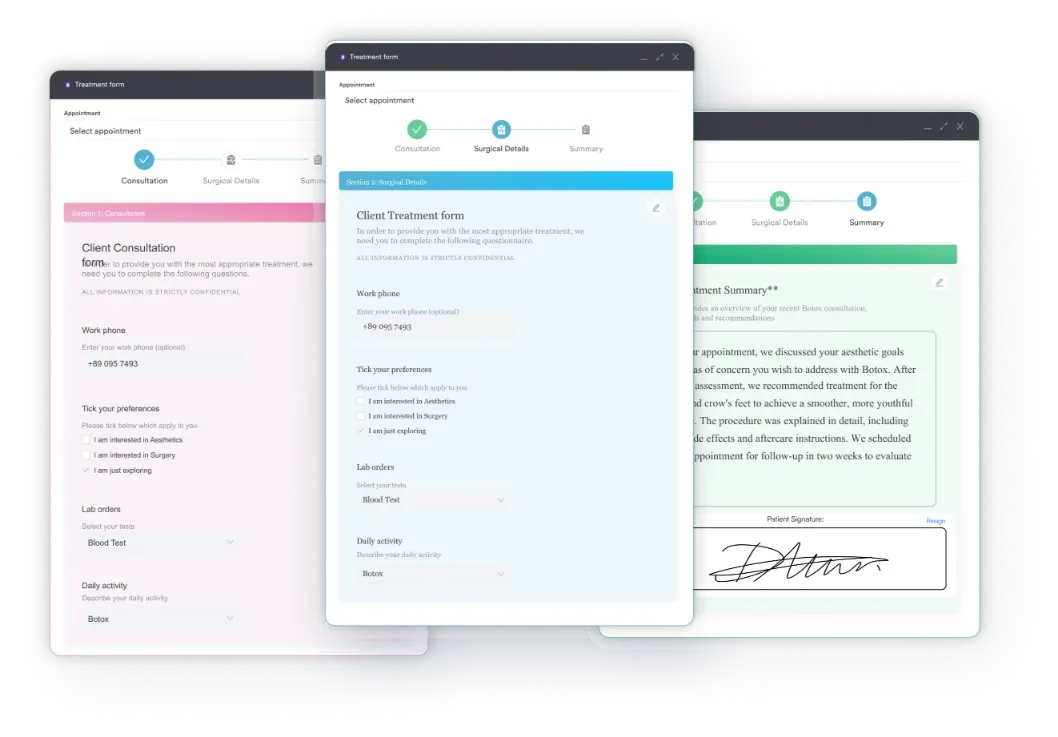
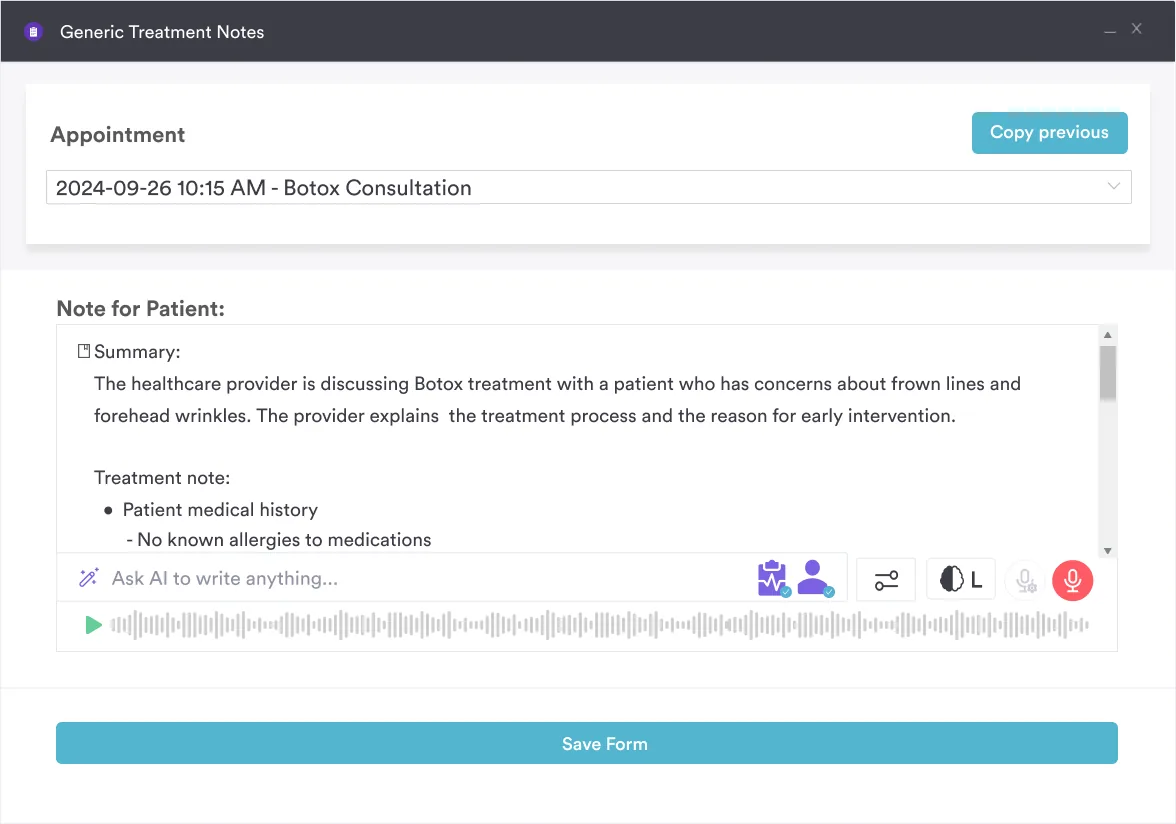
Practice management software like Pabau replaces that patchwork with a digital form clinicians build once and reuse for every patient. It can be sent ahead of the visit or completed at check-in.
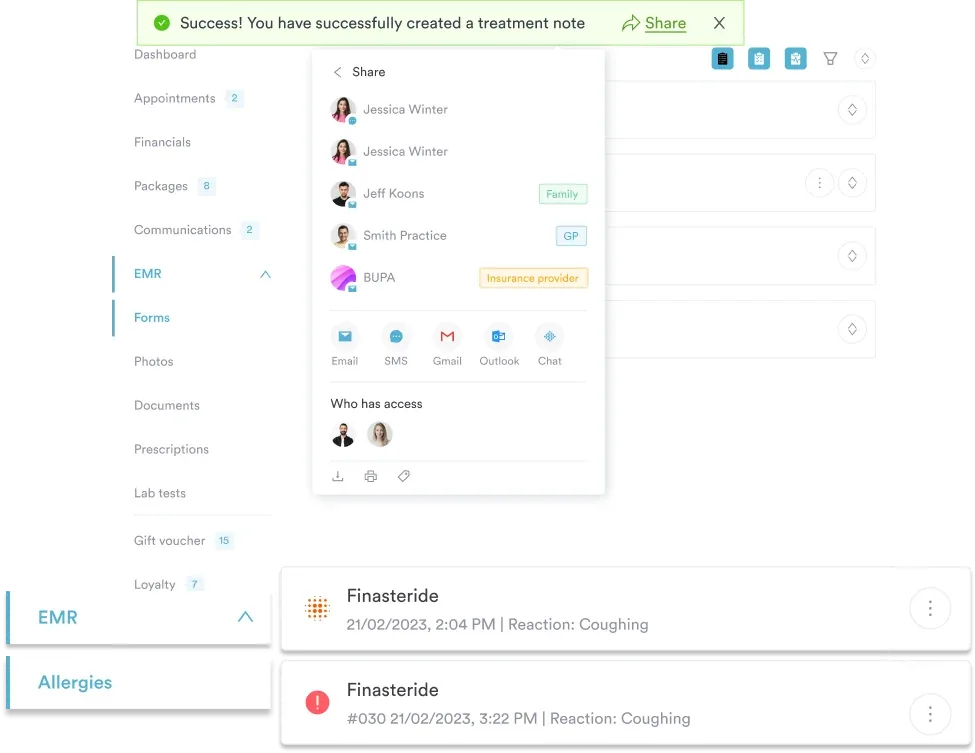
Every completed form saves directly to the patient’s record. The current FES score then sits alongside past results, Timed Up and Go times, and ABC Scale ratings, all in one place. When a score crosses your practice’s risk threshold, automated workflows can flag the chart and trigger a follow-up call right away.
The result is less paper handling, no duplicate data entry, and a fall-risk protocol every practitioner runs the same way, across every location.

Embed multiple assessment tools, the Falls Efficacy Scale, TUG, and ABC Scale, in one client record, score automatically, flag high-risk patterns, and trigger evidence-based interventions, all without paper shuffling or duplicate data entry.

Fear of falling can shorten independent living as much as a fall itself does. A patient cleared for every activity on this list can still spend years avoiding half of them, simply because nobody measured the fear itself.
Run the FES, or the FES-I if you want the global standard, at intake and again after any fall, hospital stay, or new diagnosis. A rising score is your cue to add balance work, adjust the home environment, or bring in a graded exposure plan. Act before avoidance turns into deconditioning.
Score it once and it’s a data point. Score it consistently across visits and it becomes an early warning system that catches decline before a fall does. Pabau can make that consistency automatic, from the digital form to the automated follow-up call.
Book a demo to see how it handles fall-risk scoring and follow-up for your practice.

Need a balance-specific tool alongside the FES? The Berg Balance Scale template scores functional balance across 14 tasks for a fuller fall-risk picture.
Screening for gait-related fall risk? The Dynamic Gait Index assesses how patients adapt their gait to changing task demands.
Want a structured walking assessment? The Functional Gait Assessment template scores balance during walking tasks that mirror daily obstacles.
Assessing older adults beyond falls? The Elderly Mobility Scale tracks functional mobility for discharge planning and ongoing care.
Measuring perceived exertion during exercise? The Borg RPE scale template includes the original 6-20 scale and a Modified CR10 variant for dyspnea screening.
The patient, whenever possible. Caregivers and clinicians tend to rate a patient’s fear differently than the patient rates it themselves, so a proxy answer can hide the risk you’re trying to catch.
It measures fear, not physical risk directly, but the two are closely linked. A high score flags a patient likely to restrict activity, and reduced activity is one of the strongest predictors of a future fall.
On the original FES (10-100 scale), a total above 70 indicates fear of falling. On the FES-I (16-64 scale), 20-27 suggests moderate concern and 28-64 suggests high concern. On the Modified FES, scored as a mean of 14 items on a 0-10 scale, an average below 8.0 is the threshold most often cited.
No. The FES and its variants were developed and validated for older adults and adult clinical populations such as stroke and Parkinson’s disease. Use a pediatric-specific balance tool for children instead.
Re-test at intake, after any fall, after a hospital stay, and roughly every 3 to 6 months for patients already flagged as high risk. Confidence can shift faster than physical function does.
The TUG measures physical performance: how fast someone can stand, walk, and sit. The FES-I measures confidence. A patient can pass the TUG and still score high on the FES-I out of anxiety, which calls for fear-reduction work alongside physical training.