Despina Petrushevska
Nursing care plan for aggressive behavior
A nursing care plan for aggressive behavior is a structured clinical document fo...

2
Last Updated: Oct 26, 2026
Free PDF 2 pages, print-ready Clinician-reviewed
A Down syndrome test form is essential documentation for OB/GYN and maternal-fetal medicine practices. It captures informed consent, maternal risk factors, screening test selection, and result interpretation in one structured clinical record. This ensures consistent documentation across your practice, supports informed decision-making for pregnant patients, and maintains HIPAA-compliant genetic data records.
Approximately 1 in 700 babies is born with Down syndrome, according to CDC data on birth defects. Early identification through prenatal screening allows families to prepare emotionally and medically, and providers to coordinate specialist care. A standardized form ensures nothing critical is missed during the screening conversation.
A ready-to-use prenatal screening documentation form covering maternal demographics, risk assessment, informed consent for Down syndrome screening tests (NIPT, quad screen, CVS, amniocentesis), test results recording, and clinical follow-up planning.
Upload this PDF, or any form you already use, and Pabau's AI Form rebuilds it with tick boxes, text fields and a signature. Attach it to the treatment once, and every patient gets it on time.
AI Form rebuilds the consent, history and aftercare forms you already use. You review each one, then publish.
Patients complete forms on their phone before they arrive, so the front desk stops retyping paper.
Every signed form is versioned and attached to the treatment record, ready when you need it.
Set how long a consent stays valid. Returning patients skip forms they have already signed.
Supports HIPAA and GDPR compliance AES-256 encryption 4.8 on G2 4.7 on Capterra Trusted by 4,000+ practices worldwide

A Down syndrome test form documents prenatal screening consent, maternal history, risk factors, and test results in one structured clinical record.
The form captures critical data: maternal age, family history, gestational age, screening test type (NIPT, quad screen, CVS, amniocentesis), and result interpretation.
Standardized documentation reduces diagnostic errors, ensures informed consent compliance, and supports clinical decision-making for follow-up testing.
Practice management software like Pabau streamlines prenatal screening workflows, secures genetic data under HIPAA, and automates result tracking across multi-location OB/GYN practices.
A Down syndrome test form is a clinical documentation template used by OB/GYN practices and maternal-fetal medicine specialists to record all aspects of prenatal Down syndrome screening. The form serves three core functions: capturing informed consent, documenting maternal risk factors and screening parameters, and recording test results and clinical next steps.
Down syndrome (Trisomy 21) results from an extra copy of chromosome 21. Prenatal screening tests detect the increased likelihood of Down syndrome through maternal serum markers and fetal ultrasound measurements. Diagnostic tests (chorionic villus sampling, amniocentesis) can confirm the diagnosis but carry small risks of miscarriage.
The form connects patient education with clinical record-keeping. It documents which screening test was offered, why it was recommended based on maternal age and risk factors, whether the patient consented, results received, and whether diagnostic testing is indicated. This structured approach protects both patient autonomy and clinical decision-making.
A Down syndrome test form workflow typically unfolds over 2-3 pregnancy visits. Use these five operational steps to integrate the form into your prenatal screening pathway:
Instead of paper handoffs between clinical staff and lab, electronic forms auto-populate risk calculations, trigger alerts for screen-positive results, and route documents securely to the patient record.
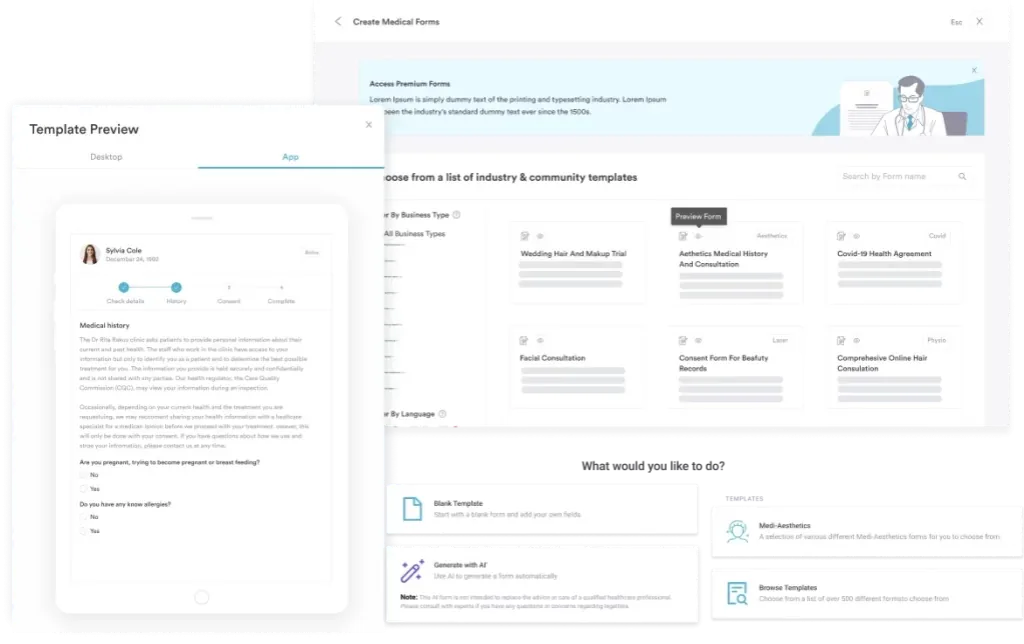
Any OB/GYN practice or maternal-fetal medicine office offering prenatal screening must use a form (paper or digital) to document informed consent and screening parameters. This includes:
Even a solo practitioner benefits from standardization. A form ensures every screening conversation covers the same ground: risk factors, test options, consent, and results interpretation. Patients see consistency, and medicolegal protection is stronger when documentation is complete.
A good patient management system files each completed scale under the right patient automatically.
Reduces diagnostic errors: A structured form prevents missed risk factors such as advanced maternal age, a prior Down syndrome pregnancy, or family history. A checklist layout keeps every risk factor in front of you, even on a busy day.
Ensures informed consent compliance: Documented discussion of screening vs. diagnostic testing, test accuracy, and risks protects both patient autonomy and clinician accountability. If a patient later questions whether they were counseled on options, the form is evidence of that conversation.
Supports clinical decision-making: When screen-positive results return, the form provides a baseline of maternal risk factors and prior history. This context shapes whether diagnostic testing is offered urgently or whether additional ultrasound is warranted first.
Streamlines multi-provider practices: In group OB practices, a standardized form ensures every clinician counsels consistently. Patients don’t hear conflicting advice about which screening test is best.
Maintains genetic data security: Prenatal screening data includes sensitive genetic information. A clinical form in a compliant EHR provides proper audit trails and access controls.
Flag any result indicating maternal serum markers inconsistent with reported gestational age – this may signal dating error or underlying fetal abnormality. Always verify gestational age via first-trimester ultrasound before ordering second-trimester serum screening, to avoid false-positive results based on incorrect timing.
A Down syndrome test form should clearly differentiate between first trimester screening options and second-trimester tests. Understanding which test to order when is critical for clinical decision-making.
First-trimester combined screening and the quad screen also estimate the risk of trisomy 18 (Edwards syndrome), so note on the form which conditions each test covers alongside Down syndrome.
A Down syndrome test form prompts clinicians to select the appropriate test based on maternal age, gestational age at presentation, and patient preference. Advanced maternal age (>35 years at delivery) alone doesn’t determine test choice anymore – March of Dimes recommends offering screening to all pregnant people regardless of age.
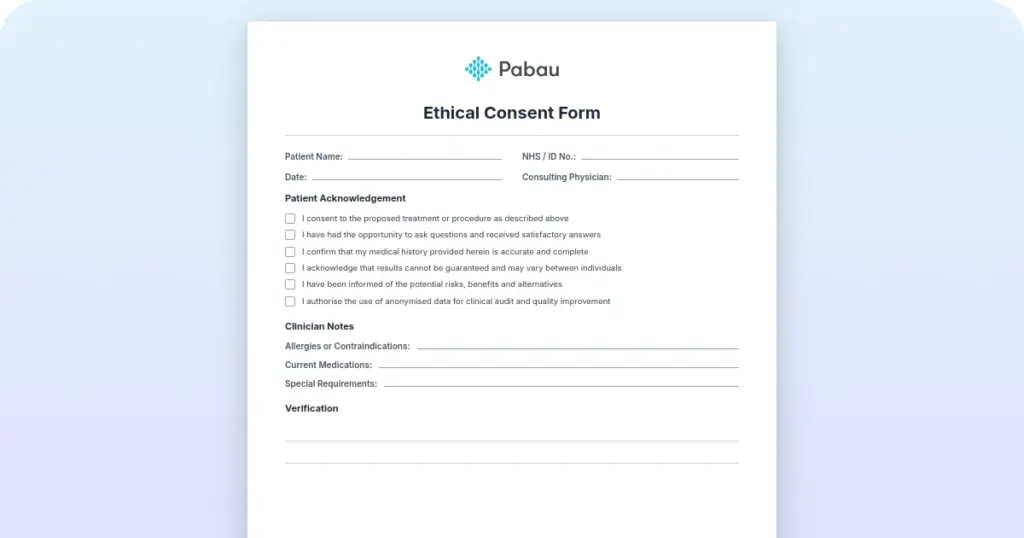
The form is as much a consent document as a clinical record. It should capture the patient’s understanding of:

Secure digital forms, automated risk stratification, and result tracking in one compliant platform.

When a screening test returns “positive” (high risk), the form becomes a critical handoff tool. Document:
Mosaic Down syndrome (1-2% of Down syndrome cases) presents special documentation challenges: some screening tests may not detect mosaic forms if the affected cells are a small percentage of the fetus. Document this when counseling patients with borderline results.
Provide written summaries, ensure understanding of next-step timelines, and follow up at the next appointment to confirm the patient’s decisions.
A Down syndrome test form transforms prenatal screening from ad-hoc counseling into a structured, documented clinical process. It protects patients through informed consent, guides clinicians through test selection and result interpretation, and creates medicolegal documentation of discussions. Whether your practice uses paper or AI-powered clinical documentation, a standardized form ensures every prenatal patient receives consistent, evidence-based screening counseling. Download the template above and adapt it to your practice protocols.

Tracking blood pressure through the rest of pregnancy? A blood pressure pregnancy chart gives trimester-specific normal ranges plus thresholds for gestational hypertension and preeclampsia.
Ready to plan the delivery itself? This birth plan template covers labor preferences, delivery wishes, postpartum care, and newborn procedures in one document.
Managing multi-location OB practices? OB/GYN clinic software ensures every location uses the same screening protocols and form templates.
A Down syndrome test form is a clinical documentation template that captures informed consent, maternal risk factors, screening test selection, results, and clinical follow-up for prenatal Down syndrome screening. It ensures consistent, evidence-based counseling and creates medicolegal documentation of patient discussions.
Use the form at the first prenatal visit (around 8-12 weeks) when discussing screening options, then again when results return. If the patient opts for sequential or integrated screening, use it at both first-trimester and second-trimester visits.
NIPT (non-invasive prenatal testing) analyzes fetal DNA in maternal blood, has >99% detection, and can be done from week 10 onward. Quad screen is a second-trimester blood test with ~80% detection and takes 1-2 weeks for results. NIPT is lower-risk but more expensive; quad screen is traditional and covered by most insurance.
Use it for all pregnant patients. Current guidelines recommend offering prenatal screening to all pregnant people regardless of age or risk factors. The form helps you document that the offer was made and document the patient’s choice.
Chorionic villus sampling (CVS) and amniocentesis carry approximately 0.1-0.3% risk of miscarriage. This must be discussed during informed consent so patients understand the trade-off between screening (non-invasive, lower accuracy) and diagnosis (invasive, definitive).
Contact the patient promptly (same day if possible). Discuss the numerical risk, explain that a positive screen does not mean the baby has Down syndrome, review diagnostic testing options (CVS or amniocentesis), and offer genetic counseling.
Accuracy depends on the test. Cell-free DNA screening (NIPT) detects about 99% of cases with a false-positive rate under 0.5%. The quad screen detects around 80%, and first-trimester combined screening about 85%. A positive result on any of these estimates risk rather than confirming it, so document that diagnostic testing is needed to be certain.
Only a diagnostic test confirms it. Chorionic villus sampling and amniocentesis collect fetal cells that are analyzed by karyotype to confirm trisomy 21; after birth, a karyotype on the baby’s blood does the same. Screening tests only estimate the likelihood, so record on the form which confirmatory test was offered and the patient’s decision.