Nursing narrative note template
A nursing narrative note template is a structured PDF that guides you through re...

3
Last Updated: Oct 21, 2026

A SOAP follow-up note records an implant review in four parts: what the patient reports, what you find, what you conclude, and the plan.
The template adds one field a general SOAP note leaves out, which is the implant information itself.
Recording the system, size, site, and torque once saves the next clinician guessing at a replacement part years later.
Interpretation belongs in Assessment, not Objective, and that mix-up is the most common fault in a follow-up note.
Practice management software like Pabau opens the note inside the appointment, so it is finished before the patient reaches the front desk.
Two printable pages that follow the visit in order: date, subjective history, objective findings, assessment, plan, and implant information. Every field carries its own prompt, so nobody faces a blank page after the appointment.
Download templateA dental implant follow-up note records one post-operative review in the SOAP order. That means what the patient reports, what you find, what you conclude, and what happens next. Done well, it still makes sense to a stranger a decade later.
The template above prompts every field, including the implant details a general SOAP note has nowhere to put. Below, you get what belongs in each section, a completed note from a three-week healing check, and the faults worth avoiding.
It records one review visit in a fixed order, so any clinician reading it later can see what changed since the last appointment. SOAP stands for subjective, objective, assessment, and plan.
Healthcare uses the format everywhere, and what SOAP notes mean does not change between specialties.
An implant review is three checks in one appointment. You look at the soft tissue around the implant, then at the fixture itself. Once the case is restored, the crown or bridge on top joins the list. Each check produces findings that only make sense next to the last set.
The note also outlives the appointment. A colleague covering recall reads it, a specialist reads it on referral, and an insurer or a lawyer may read it years from now. None of them were in the room, so the note has to stand on its own.
The template follows the visit from the date at the top to the implant details at the end. Here is what each section is for:
Start with why the patient is in the chair today. A scheduled healing check and a phone call about a bad taste are different visits, and the note should say which one this is.
Then take the history of the complaint in the patient’s own words. Useful detail includes:
Past medical history goes here too, and it needs a fresh look at every visit. New medication, a change in diabetes control, a new smoking habit, or a course of antiresorptive treatment all matter to an implant. Check the record you built with patient intake software rather than assuming last year’s form still holds.
This section holds facts a second clinician could verify. Vital signs come first. They earn their place when the patient is medically complex, was sedated, or is back after an infection.
Clinical examination findings then describe the site as it is today:
The completed investigations field is the one most often left empty. Write what you took, when, and what it showed. A radiograph is only evidence if the note says what you saw in it. A baseline dental examination form gives you the pre-surgical picture to compare it with.
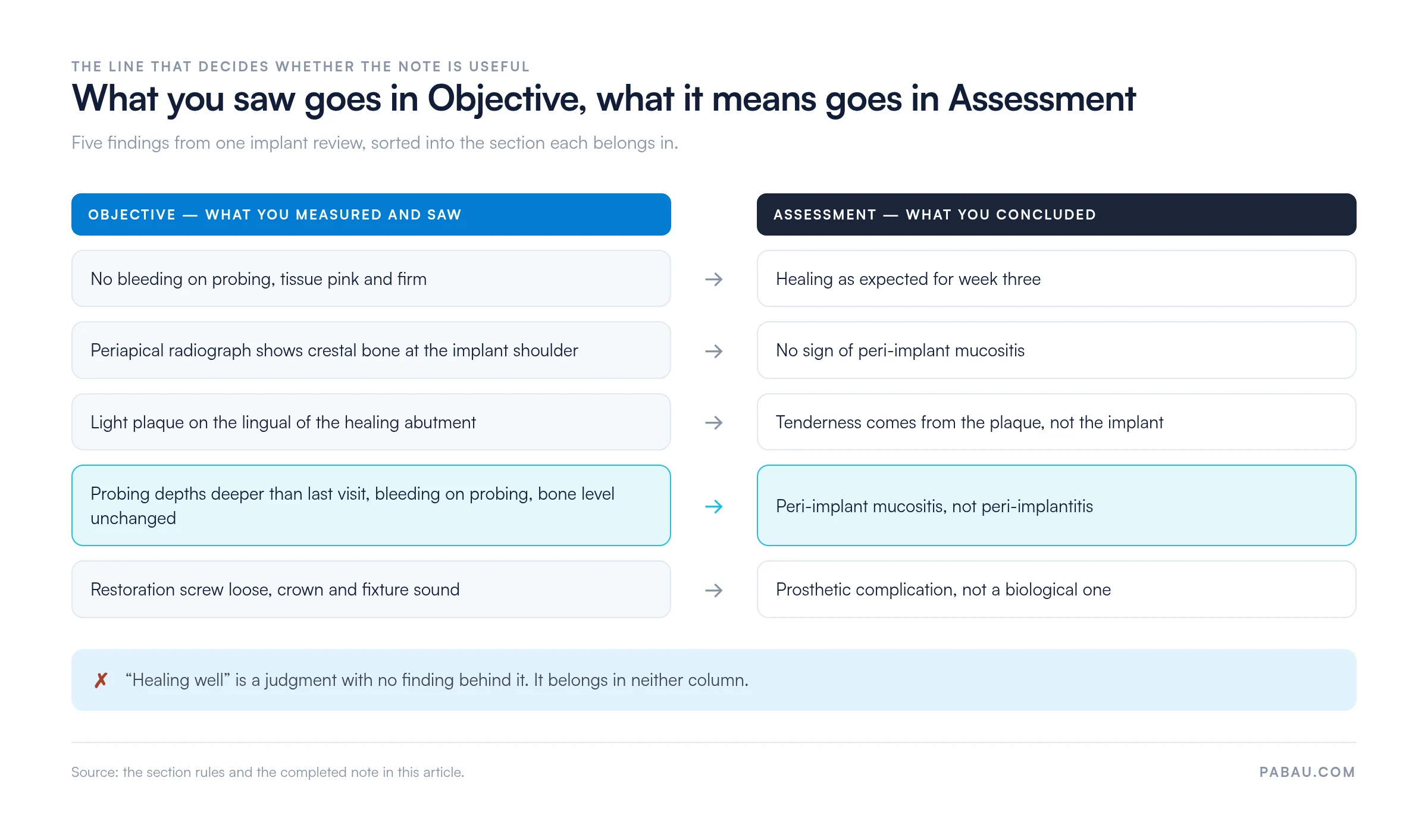
Keep your conclusions out of this section. “Healing well” is a judgment. “No bleeding on probing, tissue pink and firm” is an observation, and it belongs here.
Name the state of the implant, then say how it compares with the last review. That comparison is the whole value of the section, because a stable site and a deteriorating one can look identical in a single snapshot.
Be specific about what you are naming. Inflammation of the soft tissue with no bone loss is peri-implant mucositis. Add progressive bone loss and it becomes peri-implantitis, which is a different problem with a different plan. A loose screw, a fractured component, or a chipped crown is a prosthetic complication, not a biological one.
If you are unsure, write that you are unsure and say what would settle it. A note that records your uncertainty is stronger than one that invents confidence.
The sort below takes five findings from one review and puts each on the correct side of that line.
The plan covers what you did today and what the patient leaves with. Include:
Write the review interval your surgical protocol sets, rather than a vague “review as needed.” An interval with a purpose attached also gives your front desk something concrete to book. Hygiene visits work the same way. A dental cleaning schedule sets each patient’s next cleaning by risk level, not by a standard interval.
This is the section a general SOAP form does not have, and the one your future colleagues will thank you for. Record the implant system and manufacturer, the diameter and length, the site, the surgery date, and who placed it.
If a vacuum-formed surgical guide positioned the fixture, its production record belongs beside these figures. A dental vacuum form logs the sheet thickness, the heat settings, and the fit checks behind each appliance.
Add the prosthetic detail as the case progresses. That means the abutment type, the torque value used, the retention method, and the date the restoration was fitted.
Eight years from now, someone facing a fractured screw needs those figures. Without them, the repair starts with guesswork and an unnecessary appointment.
Scan the implant passport or the manufacturer’s sticker at handover, and file it against the patient record. Then copy the key figures into the first follow-up note. Paper passports get lost with house moves, and patients rarely remember which system is in their mouth.
Implant care runs for decades, and the team around the patient changes several times over that span. The note is what carries the case between those people.
Four jobs depend on it:
Consent and follow-up cover different ground, and one does not replace the other. A dental treatment consent form records what the patient agreed to before surgery. The follow-up note records what happened afterward.
Here is the template filled in for a routine soft-tissue review. The surgeon placed the implant three weeks earlier at a lower right first molar site.
Date: September 4, 2026, three weeks post-placement.
Subjective: Scheduled healing check. Patient reports no pain since day four and has stopped taking ibuprofen. Describes mild tenderness when brushing the area. No bad taste, no swelling noticed. Past medical history unchanged, type 2 diabetes, last HbA1c reviewed by the family physician in July, non-smoker.
Objective: Blood pressure 128/78, pulse 72. Peri-implant tissue pink, no swelling, sutures resorbed. No bleeding on probing, no suppuration. Light plaque on the lingual aspect of the healing abutment. Adjacent teeth sound, occlusion clear of the healing cap. Periapical radiograph taken today shows crestal bone at the implant shoulder, no radiolucency.
Assessment: Healing as expected for week three. No sign of peri-implant mucositis. Brushing tenderness attributed to plaque at the healing abutment rather than to the implant itself.
Plan: Cleaning around the healing abutment demonstrated with a single-tufted brush, one issued. Patient advised to call if swelling, discharge, or a bad taste appears. Review in eight weeks to assess readiness for restoration, with a further radiograph at that visit. No prescription today.
Implant information: System and manufacturer as recorded on the passport scanned to the record. 4.1 mm diameter, 10 mm length, lower right first molar site. Placed August 14, 2026 by the practice’s implant surgeon. Healing abutment in place, definitive abutment and torque value to be recorded at the restorative visit.
Notice how little of that is prose. The sections do the organizing, so the writing can be short.
A blank form is only half the job. Five decisions made once stop the same questions coming back at every visit:
The last one catches people out. A form that changed in March is still sitting in the drawer in November.
Every one of these is quick to fix at the chair and expensive to fix later:
A completed form only helps if the next person can find it. A flat scan keeps the paper safe and leaves the content unsearchable. The detail sits in the file, but nobody can pull it up during a phone call.
Storage carries its own rules. HIPAA, the US health privacy law, governs how you hold and share the note. State law sets how long you keep it.
Proper medical records management means access is controlled, changes are logged, and a scanned page never becomes the only copy.
Practice management software like Pabau keeps the note, the radiograph, and the implant details in one client record. The next clinician then does not have to hunt for a folder in the back office.
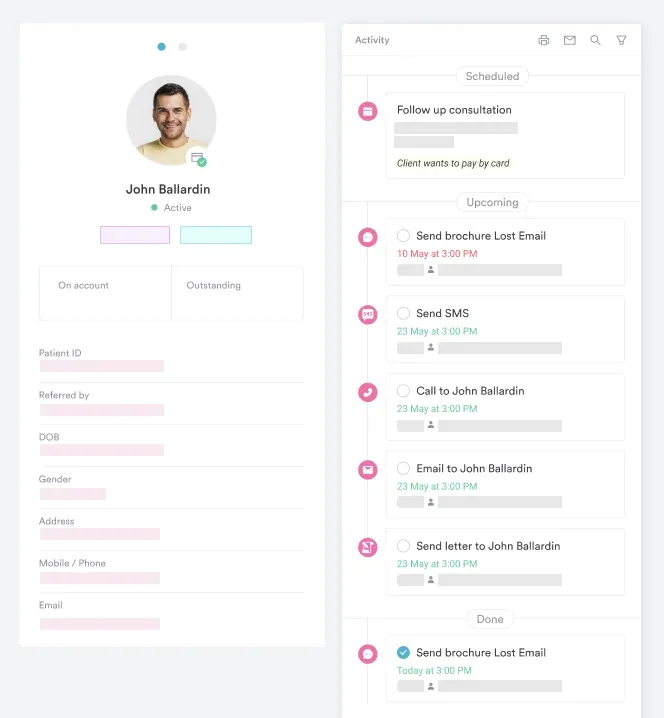
In most practices someone prints the form, fills it in by hand, then scans it to the record days later. The scan is not searchable, and the review date lives on a sticky note. Whoever chases the recall has to open the file to find out what was promised.
Pabau turns the same form into a digital note that opens inside the appointment. The clinician works through the SOAP sections on screen while the patient is still in the chair. The finished note saves straight to the client record, with the radiograph and the photos beside it.
The plan then drives the follow-up. The next review can be booked from the note, and aftercare advice goes out automatically.
The implant details stay searchable too. A colleague answering a call about a loose crown has the system and the size on screen in seconds. Pabau Scribe, our AI scribe, can draft the note from your dictation if you would rather talk than type.
Every Pabau subscription includes every feature. Digital notes, records, recalls, and patient messaging arrive together, not as a tier you upgrade into later.

Pabau opens your SOAP template inside the appointment, so the note, the radiograph, and the next review all sit in the client record. No page waits weeks to be scanned in.

An implant follow-up note is a small piece of writing with a long life. Keep the observation in Objective and the judgment in Assessment, and it will still make sense to someone reading it cold in a decade.
The implant information section is the part worth being strict about. Systems get discontinued, patients move practices, and paper passports go missing. Five lines written once protect every repair after that.
Print the template and it will keep your team consistent. Put it in your software and the note, the recall, and the record stop being three separate jobs. Book a demo to see how Pabau handles implant follow-up documentation from the chair.

Sending an implant case to a specialist? Dental referral form sets out the history and findings the receiving clinician needs first.
Taking on an implant patient from another practice? Dental new patient form collects the baseline your first follow-up note depends on.
Waiting on medical sign-off before surgery? Dental clearance form gives the physician a single page to confirm the patient is fit to proceed.
Documenting a course of treatment, visit by visit? SOAP progress notes shows how consecutive notes track change over time.
Chasing follow-ups across the whole practice? Follow-up form covers the non-surgical reviews your recall list also has to cope with.
There is no single figure. Peri-implant readings often run deeper than around a natural tooth, because the tissue attaches differently. Record a baseline once the case is restored, then judge each review against that number rather than a textbook value.
No. Radiographs follow your protocol and the clinical picture, so a settled site does not need one every visit. Take one when bleeding, deepening pockets, or pain suggest bone loss, and always write down what the image showed.
Healing checks follow the surgical protocol for that case, and later visits follow the restorative plan. Once the case is restored, the interval depends on risk factors such as diabetes, smoking, or past periodontitis. Record the interval and its purpose.
It is the card the manufacturer supplies with the fixture, listing the system, diameter, length, and batch. The patient keeps the original, and the practice should scan a copy to the record. Patients move house and cards disappear.
A hygienist can record their own examination findings and the care they gave, within the scope their state allows. The diagnosis and the treatment plan stay with the treating dentist. Sign and timestamp both entries.
Yes, whenever the soft tissue is the concern. A dated photo of the emergence profile shows change that probing depths alone miss. File it against the same visit, so the image and the written finding stay together.