HIPAA compliant texting: What you can send patients & how to communicate securely
HIPAA compliant texting is possible when a text holds no protected health inform...

Last Updated: Oct 16, 2026

A dental treatment consent form documents that a patient understood the procedure, its risks, benefits, and alternatives before treatment began.
State dental boards, the ADA’s ethical guidelines, and malpractice insurers all require informed consent. It’s the strongest evidence a practice has if a claim is disputed.
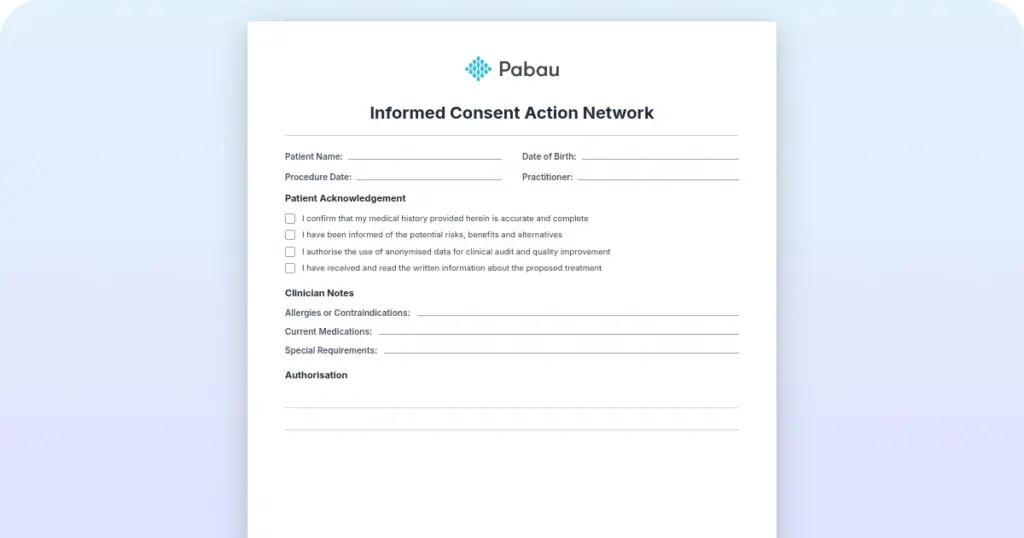
A complete form covers patient details, the treatment description, risks, alternatives, and a signature block. A patient-rights statement and a short benefits summary are worth adding too.
How long to keep a signed form depends on the state. In the UK, it depends on GDC-aligned indemnity guidance, and on whether the patient was a minor.
Practice management software like Pabau can send a consent form before the appointment and capture a legally valid e-signature. It then files the form straight into the patient’s record.
A ready-to-use consent form covering patient details, informed consent acknowledgment, treatment description, risks and complications, alternatives to treatment, and signature blocks.
Download templateA dental treatment consent form is a written record of what was said, what could go wrong, and that the patient agreed anyway. Skip it, or leave it vague, and a practice is exposed the moment a complication happens. Every state dental board, the ADA, and malpractice insurers treat documented consent as the baseline, not a nice-to-have.
Below is what a compliant form needs, and how it changes by procedure. You’ll also see how to get it signed before the patient sits down.
A dental treatment consent form is a written document. It confirms a patient understands a proposed procedure, its material risks, expected benefits, and available alternatives, and agrees to proceed. Consent isn’t a single signature, it’s a conversation, documented in writing.
The form does three jobs:
Informed consent differs from two other types. Implied consent is when a patient’s behavior suggests agreement, like opening their mouth for an exam. Expressed consent is when they simply say yes out loud. Only the informed, written version meets the legal standard.
The American Dental Association requires it before every procedure. State dental boards, patient-rights laws, and malpractice insurers all back that up.
Consent forms cut both ways. The patient portal lets patients review and sign before their appointment, at their own pace. That way, they aren’t rushed, they can ask questions, and they keep a copy for themselves. For the practice, the signed form becomes the record.
Say a complication happens, and the patient claims no one warned them. A form that reads “I acknowledge the risk of dry socket” is hard to argue with. Malpractice insurers and regulators, including the General Dental Council in the UK, treat documented consent as the baseline.
Consent also sets expectations. Patients who already know roughly how long a procedure takes, and what it costs, are less likely to cancel. They’re also less likely to complain afterward.
That isn’t unique to dentistry. A medical spa walking a client through a filler consultation runs the same play. So does a general practice signing off on a minor procedure, before anyone picks up a scalpel or a needle.
Practices offering elective cosmetic work often pair consent with a separate liability release, which records the patient accepting the disclosed risks. The two documents do different legal jobs, so most practices keep both in the treatment file. When a patient declines the treatment you recommended, an informed refusal form records that choice and the risks you explained.
A compliant dental treatment consent form needs specific elements, whichever template you start from. The table below lists what a complete form should cover and why each part matters.
Our free download above already includes patient details, the treatment description, risks and complications, alternatives to treatment, and signature blocks.
Write every section in plain language and skip the jargon. A patient should be able to understand the form without a dental degree. Digital forms make this easier. You can add helper text and organize fields clearly, instead of cramming everything into a dense PDF.

Every procedure carries its own risk profile, so a general cleaning consent won’t cover an extraction or an implant. Many practices use a general consent form for routine care, and a separate, procedure-specific form for anything more complex. Here’s how the three most common ones differ.
Extraction carries risks a cleaning doesn’t: dry socket, swelling, bleeding, and nerve damage. Say so explicitly on the form. Practices doing surgical extractions should also flag bone loss and sinus involvement for upper molars. They should note the chance the patient will need a bone graft, too.
Implant surgery is elective and expensive, so consent needs to be thorough.
Key risks include osseointegration failure, where the implant doesn’t fuse to the bone, sinus perforation, nerve injury, and infection. Spell out the multi-stage timeline too: placement, the healing period, then the crown. Patients often don’t realize an implant is a months-long commitment, not a single visit.
If you’re using sedation, get a separate or supplementary consent.
Patients need to understand the fasting requirements beforehand, and who will monitor them during the procedure. They should also know what happens if they react badly, and how long recovery takes. Anesthesia carries its own rare but serious risks, including allergic reaction and cardiac events, so disclose them explicitly.
Minors can’t legally consent to their own treatment in most states and countries. A parent or legal guardian signs instead. A pediatric consent form needs fields for the parent or guardian’s name, signature, and relationship to the patient. Ideally.
Some practices also have the child give “assent”: simple, age-appropriate agreement to participate. Legal consent still comes from the parent. It’s a small step that respects the child’s say in their own care. Age of majority for dental consent varies by state and country, so check your local rule before finalizing a form.
Custody is a separate question. If parents are divorced or share custody, a parental consent form should record which parent can authorize treatment.
Sometimes a grandparent brings the child to the appointment instead of a parent. A grandparent medical consent form, signed by the parent, gives that adult authority to approve care.
The Health Insurance Portability and Accountability Act, or HIPAA, requires a privacy notice for every patient. It has to explain how their health data is used and protected. Some practices fold that notice into the same document as the treatment consent form.
It’s convenient, but the two are legally distinct. Agreeing to treatment isn’t the same as acknowledging a privacy notice. Keeping them as two separate documents avoids confusion and makes sure both requirements are clearly met.
Printing and filing forms by hand is slow, and it’s easy for something to go missing along the way. A modern workflow starts before the patient arrives.
Two days out. The patient reviews it at home, then signs on their phone or laptop. The signed PDF lands in their clinical record automatically. By the time they’re in the chair, there’s no paper, no pen, and no delay.

Electronic signatures are legally valid in most US states under the ESIGN Act. The UK and EU recognize them too, under eIDAS. The signature captures a timestamp, the patient’s IP address, and their device, building an audit trail. If a dispute surfaces years later, you can show exactly when and how the patient signed.
Signed forms in the patient’s record are easy to pull up during an audit or a medico-legal review. Paper goes missing. Digital records don’t, and they’re searchable besides.

Send consent forms before appointments, capture legally valid e-signatures, and store signed documents automatically in the patient record.

A few principles make any consent form stronger:
Keep it short. A form longer than two pages discourages reading and isn’t automatically more protective. Focus on material risks, the ones that would change a patient’s decision.
Minor risks, like brief discomfort or temporary swelling, can be assumed. Catastrophic ones, like permanent nerve damage or death, however rare, still need to be spelled out.
Once a form is signed, it becomes a permanent clinical record. How you handle it afterward matters just as much as what’s written on it.
In a paper-based practice, a signed form gets scanned and filed in the patient’s folder. The original goes in a fire-safe cabinet.
Digitally, it skips a step. The patient signs, and the file attaches straight to their record. It’s there the next time anyone opens the chart. No scanning, no re-filing, no folder to misplace.
Retention rules depend on where you practice, so check your own jurisdiction before setting a policy.
In the UK, the GDC doesn’t set one fixed retention period. Indemnity providers and NHS guidance still recommend keeping adult records for at least 10–11 years after the last treatment. For a child patient, keep the file until they turn 25.
In the US, there’s no single national rule either. Each state dental board sets its own retention period, commonly 2–10 years after the last date of treatment. Retention runs longer for minors’ records, often tied to the age of majority. When in doubt, call your state board and ask.
Practice management software like Pabau stores every signed form directly in the patient record, with access controls and encryption. Retrieval during an audit takes seconds, not an afternoon spent digging through file cabinets.
A dental treatment consent form isn’t paperwork for its own sake. It’s proof that your patient understood the procedure, had room to ask questions, and agreed to it willingly. That’s also a big part of what protects your practice if the agreement is ever challenged.
Getting there is mostly a workflow problem. It takes a clear template delivered before the appointment, signed digitally, and filed where your team can find it fast. Pabau handles that whole loop, from sending the form to storing the signed copy in the patient’s record. Book a demo to see it in action.

Need a full-body systems review at each visit? Medical review of systems template It offers a free, fill-in template covering all 13 body systems for every patient encounter.
Building your own exam paperwork? Dental examination form template covers the clinical fields a routine exam needs.
Documenting a medical device evaluation? Clinical evaluation template It offers a free form covering device evaluation criteria, risk assessment, and EU MDR compliance signatures.
No. It proves the patient understood the risks and agreed to treatment. It won’t excuse negligent care or a procedure done incorrectly. Consent and quality of care are judged separately.
Document the refusal and the conversation that led to it. Treating without consent exposes the practice to liability, so most practices hold off until the patient signs or clearly declines.
Practices receiving federal funding are expected to provide language access. A translated form or a qualified interpreter is the safer route for non-English speakers.
There’s no federal rule requiring a witness. Many malpractice insurers recommend a staff member other than the treating dentist sign as witness.
Review it whenever treatment protocols, state law, or malpractice guidance changes. Give it a full read at least once a year anyway.