GLP-1 diet plan
A GLP-1 diet plan is a structured eating framework for patients taking semagluti...

2
Last Updated: Oct 13, 2026

SOAP stands for Subjective, Objective, Assessment, and Plan, the four-part structure behind most clinical progress notes.
A complete note keeps what the patient reports separate from what you measured, which is what payers and auditors check first.
Common errors include vague wording, mixed sections, missing dates, and opinion creeping into the Objective section.
In practice management software like Pabau, digital forms and Pabau Scribe, our AI scribe, draft each section as you work.
Download the free template below and adapt the section headers to your specialty.
A one-page PDF with patient details and blank Subjective, Objective, Assessment, and Plan fields. It closes with lines for the practitioner’s name and signature.
Download templateSOAP progress notes record a patient encounter in four fixed sections: Subjective, Objective, Assessment, and Plan. The format is used across mental health, physical therapy, nursing, and primary care. It keeps the patient’s account separate from your measurements, so the next clinician can follow the visit without guesswork.
This guide covers what belongs in each section, worked examples from three specialties, and the mistakes that trigger claim denials. The template above is free to download and edit. The related medical notes template applies that same SOAP structure to general history, exam, and treatment fields.
SOAP progress notes are a structured way to record a patient encounter, using the same four sections every time. Subjective is what the patient reports. Objective is what you measure or observe. Assessment is your clinical impression. Plan is what happens next.
Dr. Lawrence Weed introduced the format in the 1960s as part of the problem-oriented medical record. It has lasted because it travels well between disciplines, software, and payers.
Practices rely on the format for four reasons:
Narrative notes let a complaint and a finding sit in the same sentence. The four sections force them apart, which keeps assumptions out of your clinical data.
SOAP progress notes are used in mental health therapy. Every specialty uses the same four sections, though what fills them varies by discipline.
Each section answers one question. Knowing which question keeps every piece of information in the right place.
The Subjective section is what the patient tells you. Record the chief complaint, the symptoms, pain location and intensity, and how the problem affects daily life. Add a direct quote when it carries clinical weight, such as a report of waking after three hours every night. Note the goals the patient names. Your interpretation does not belong here.
The Objective section holds measurable data: vital signs, test results, exam findings, range of motion, lab values, and imaging. Be specific. Knee flexion 110 degrees bilaterally says something; limited range of motion does not. Standardized assessment scores belong here too, and opinion does not.
Your Assessment synthesizes the subjective and objective material. State your clinical impression, your working diagnosis, and progress against the treatment goals. Give the reasoning in a line or two. List differential diagnoses while they are still open. This is where clinical judgment belongs.
The Plan documents what happens next: interventions, medication changes, referrals, follow-up dates, and any education you gave. Be concrete. Increasing PT to twice weekly for four weeks tells the next clinician more than continue current treatment. Record what the patient agreed to, plus any barrier they raised. This section is what justifies the billing code.
The format is universal, the content is not. Here is how three disciplines fill the same four sections.
Subjective: Client reports ongoing anxiety and disrupted sleep over the past two weeks. Reports feeling on edge even when nothing is happening. Denies suicidal or homicidal ideation. Sleeping four to five hours a night, waking at 3 AM with racing thoughts. Work stress rose after a restructuring announcement. Attended the last two sessions and completed the mood diary. Consent forms captured at booking are easier to evidence later than ones signed at the door.
Objective: Alert and oriented, speech clear and goal-directed. Mood anxious, affect congruent. GAD-7 score 12, in the moderate range. No acute safety concerns. Session attendance and homework compliance both good.
Assessment: Generalized anxiety disorder, moderate, with secondary insomnia. Responding to the CBT skills introduced in earlier sessions, though anxiety has risen with the external stressor. Prognosis good given engagement and prior response to treatment.
Plan: Continue weekly individual therapy. Introduced a grounding technique for nighttime anxiety. Refer to PCP for a sleep medication review. Assigned a thought record for next session. Follow up in one week.
Name the intervention precisely. A note that says which grounding exercise you taught tells the next clinician what the client has already practiced.
Subjective: Patient reports 50% improvement in knee pain since starting PT four weeks ago. Pain now 4/10 during walking, down from 8/10 at the initial evaluation. Pain settles within 30 minutes of rest. Attending the gym twice a week with a modified lower-body routine. Goals are running and stair climbing without pain.
Objective: Right knee extension deficit 5 degrees against the left, improved from 10 degrees. Quad strength 4+/5 right, 5/5 left. Single-leg stance 45 seconds right, up from 20 seconds at evaluation. Pain on stair descent at peak load only. Gait improved, with a minimal antalgic pattern.
Assessment: Right patellar tendinopathy, improving. Tolerating progressive loading and functional activity. Strength and proprioception deficits resolving. Prognosis excellent given compliance and functional gains.
Plan: Progress to single-leg step-ups and light running drills. Increase gym sessions to three a week. Continue the daily home exercise program. Retest running tolerance in two weeks. Discharge planned in two to three weeks if the trajectory holds.
Numbers carry a PT note. A repeatable measure such as the Thessaly test gives you a figure to compare at the next visit.
Subjective: Post-op day two. Patient reports pain 6/10, managed with scheduled analgesics. No nausea or dizziness. Reports feeling much better today and able to get out of bed. Daughter at the bedside, and the family reports a good support network at home.
Objective: Vitals stable at BP 128/74, HR 88, RR 16, O2 saturation 98% on room air. Surgical dressing clean and dry, with no signs of infection. Ambulating 50 feet with a walker, gait steady. Urine clear with adequate output. Tolerating a soft diet.
Assessment: Post-operative recovery on schedule. Pain controlled and no complications present. Safe to continue the current care plan and start discharge planning.
Plan: Continue current pain management. Increase mobility as tolerated. Begin discharge teaching on wound care and activity restrictions. Book the discharge assessment for day four.
Nursing notes usually sit alongside a standing care plan. A cirrhosis care plan sets the problems and goals, and the daily SOAP note records what changed. A respiratory diagnosis such as ineffective airway clearance follows the same nursing care plan structure, pairing interventions with measurable goals.
Software designed for GP practices can attach this form to the consultation record automatically.
Progress note is the category, and SOAP is one format inside it. Some practices use DAP (data, assessment, plan), BIRP (behavior, intervention, response, plan), or plain narrative entries instead.
SOAP differs by forcing a split between the patient’s report and your findings, which makes a note easier to audit, bill, and hand over.
Narrative notes blend everything into paragraphs. They are quicker to write and slower to read, and they tend to omit the detail a payer asks for six months later.
A reviewer reads a SOAP note as a chain. The Objective data has to support the Assessment, and the Assessment has to justify the Plan and the code you billed. Break one link and the claim looks unsupported, however careful the rest of the note is.
So write the chain deliberately. If you billed for a complex visit, the measurements and the reasoning both need to be on the page. Undated entries, one-line assessments, and a missing Plan are the usual reasons a note fails review.
Copy-forward is the other risk. Text pasted from last week makes today’s visit look unexamined, and a reviewer spots it quickly. Write what happened today, even when little changed.
Clear notes protect you as well as the claim. If a complaint arrives two years later, a dated note shows what you knew and what you decided.
Most clinicians spend 15 to 30 minutes on a note when they write it by hand. Three changes bring that down.
Voice dictation turns spoken findings into text, which removes most of the typing.
Practice management software like Pabau adds AI-assisted documentation that drafts the note from your dictation or form data. You review, edit, and sign it. Building a short phrase library for your most common findings saves time again on every visit.
SOAP notes are standard in mental health therapy, physical therapy, occupational therapy, nursing, chiropractic, and primary care. Speech-language pathologists, psychiatrists, counselors, and aesthetic practitioners documenting injectables use them too.
If your practice bills insurance, the notes have to show the medical necessity and the complexity of what you did. Four labeled sections make that easier to demonstrate than an unstructured narrative.
Supervisors, billing staff, and new clinicians all read these notes to pick up a patient’s history. When a supervisor teaches that structure, guided notes give a trainee the same headings with blank space to fill in during the session.
Build your phrase library before your busy season, not during it. Store the lines you write most often, such as knee flexion [X] degrees, strength 4+/5, or ambulates [X] feet without stopping. Drop one in, edit the values, and you keep the specificity without the typing.
Most practices write the same note twice. The clinician scribbles on paper or types into a separate document, then someone copies it into the patient record later that day. Detail goes missing in the second step, and the note is often signed hours after the visit.
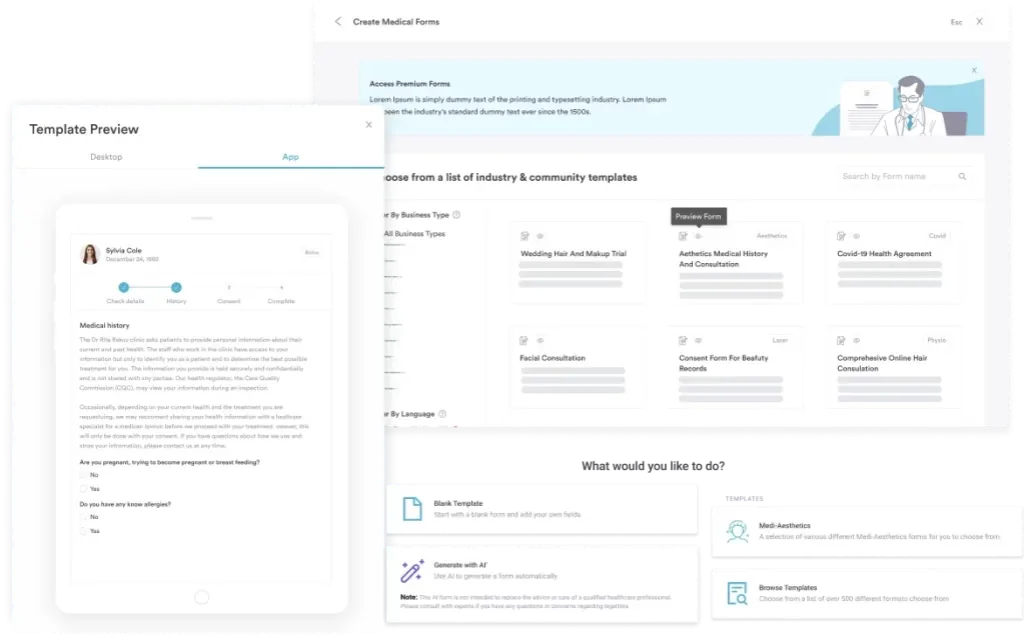
In Pabau, the note is the record. You build a SOAP form once, and every clinician documents against the same four sections on a tablet or a laptop, in the room. Pabau Scribe, our AI scribe, drafts the note from your dictation, so you review and sign rather than type.
That is how Esteem Life Medical Group writes treatment notes on the spot, with the record updated before the patient leaves. Because the note lives on the patient file, your billing team can see the reasoning behind a code without chasing anyone for it.

Pabau’s digital forms and Pabau Scribe draft your SOAP notes as you work, so the record is complete and signed before the patient leaves.

The four sections are easy to learn. The discipline is keeping them honest. Measurements stay in Objective, reasoning goes in Assessment, and the Plan is specific enough for someone else to follow.
Download the template, adapt the section headers to your specialty, and build a short phrase library for the findings you write every week. Two weeks of that habit cuts more time than any change to the format itself.
One trade-off is worth remembering. A fast note only helps if it still supports the claim you submit. Book a demo to see how Pabau drafts, files, and signs SOAP notes for your practice team.

Documenting a respiratory problem? Ineffective airway clearance nursing care plan shows how a standing plan pairs with the daily note.
Documenting a gastrointestinal complaint in SOAP notes? gastrointestinal assessment guide covers the correct assessment sequence so findings are not missed or documented out of order.
Choosing intake software for your practice? patient intake software guide compares seven intake platforms to help different practice types find the right fit.
Collecting details before the visit? Medical needs form captures the history your Subjective section would otherwise chase.
Need a drug screening form on file? 5-panel drug test form is a DOT-compliant form covering detection windows, consent, chain-of-custody, and results documentation.
SOAP stands for Subjective, Objective, Assessment, and Plan. Subjective is what the patient reports, Objective is what you measure, Assessment is your clinical impression, and Plan is what happens next.
SOAP is one format of progress note. DAP, BIRP, and plain narrative entries are progress notes too. SOAP is the most widely used because it separates the patient’s report from your findings, which makes a note easier to audit and bill.
Long enough to justify what you billed, and no longer. A routine follow-up might run five to ten sentences, while a full assessment can fill one or two pages. Brief, vague notes are the ones that draw denials.
Yes. AI documentation tools draft a note from your dictation or from structured form data, and you review and sign the result. They handle the structure and the routine phrasing. The clinical content and the sign-off stay yours.
Anything you did not measure or observe. Leave out hedges such as claims or allegedly, personal opinions, informal language, and remarks about other providers. Every line should be something you counted, measured, or saw.
The format itself is neutral, so compliance depends on how the notes are stored and accessed. Electronic records with access controls, audit logs, and encryption meet the HIPAA security rules, and paper charts need physical security. The structure helps by making clear what sits in the chart.