Intake note template
An intake note is the clinical record a therapist or counselor writes at the sta...

2
Last Updated: Oct 22, 2026
An exit interview form is a structured document you give to an employee who is leaving your practice. It records why they’re leaving, how they rated their role and manager, and what they’d change. Used for every departure, it gives you comparable answers that show which problems keep pushing trained staff out.
Staff turnover is often higher in healthcare than in other sectors, and each departure disrupts patient continuity and adds recruitment costs. The free template below covers the core sections. This guide adds sample questions, extra prompts for clinical roles, and a way to turn the answers into retention fixes.
A printable exit interview form with fields for the employee’s details, job title and department, and the reason for completing the form. It closes with a confirmation section and an office-use block for who received it and the action taken.
Download template
An exit interview form captures structured feedback from departing staff on tenure, reasons for leaving, satisfaction ratings, and management.
Healthcare turnover is often higher than in other sectors, so exit data helps you see why trained staff leave and what might keep them.
Exit interviews aren’t legally required in most places, but a documented record shows you gathered feedback professionally. Check local employment law for your obligations.
Digital forms in Pabau, the practice management platform we build, help standardize forms across your practice.
An exit interview form is a structured document that practice owners and managers use to gather feedback from departing staff. It records the same details every time, from role and tenure to reasons for leaving and views on management and culture. That consistency lets you compare departures over time and spot patterns.
The form does two jobs. It shows departing employees that their experience matters to you. It also creates a documented record that you gathered their feedback professionally. That record doesn’t amount to legal protection, so check local employment law for what applies to your practice.
Staff turnover in healthcare is often higher than in other sectors. Losing a trained nurse, esthetician, or clinician disrupts patient continuity, adds recruitment costs, and strains the rest of the team. Exit interviews show whether a departure comes down to personal circumstances or to workplace factors you can fix.
When you do recruit the replacement, a pre-interview questionnaire collects the same answers from every candidate before you book interview time. Shortlisting then rests on job-related facts instead of a first impression.
A good form gets the data you need without taking up too much of the departing employee’s time. Build it around six sections, from employee details to suggestions for improvement.
Sample questions for each section steer departing staff toward useful answers. Mix closed questions, such as Likert scales, with open prompts. You get numbers you can count and the story behind them.
Clinical teams face pressures that a generic HR form won’t ask about. Add questions on shift patterns, clinical autonomy, patient continuity, and training support.
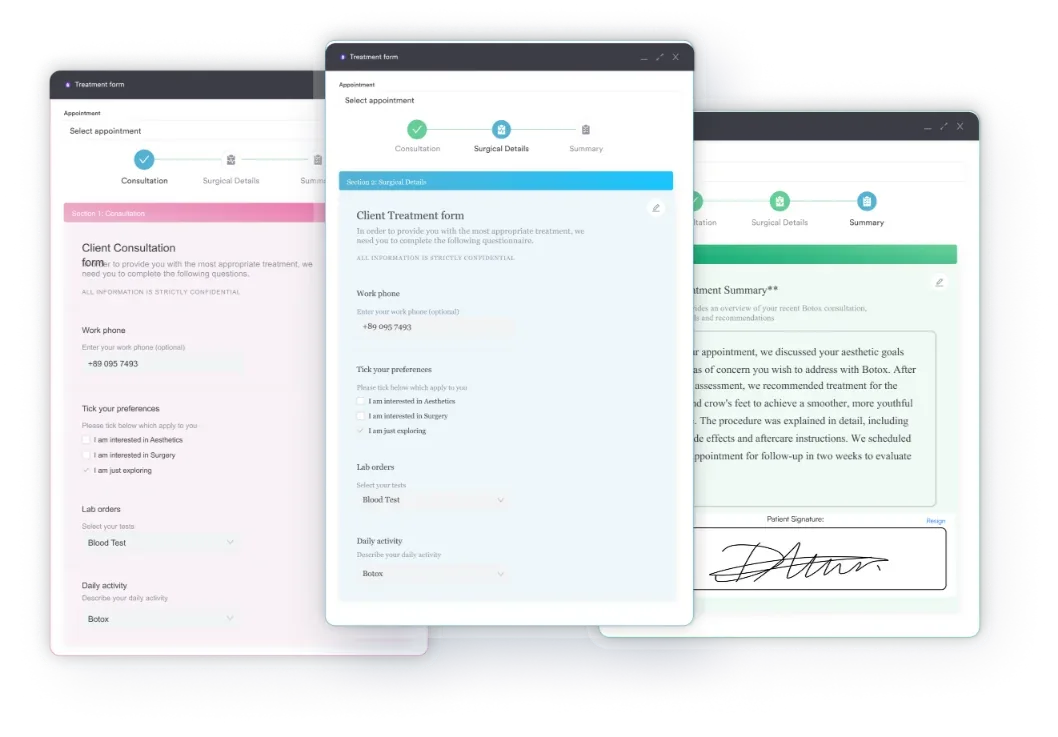
Running the form online makes it easier for departing staff to answer thoughtfully, in their own time. With digital intake forms, practice leaders can filter and compare responses without retyping paper copies.
Timing, confidentiality, and tone decide whether an exit interview gets honest feedback or defensive answers. Five steps keep the conversation productive.
Set a reminder in your calendar or HR system for the day a resignation comes in. That way no departure is missed and every exit interview happens while it’s still useful.
Exit interviews only pay off when you act on what they tell you. The five-step loop below runs from the interview itself to checking whether your fix worked.
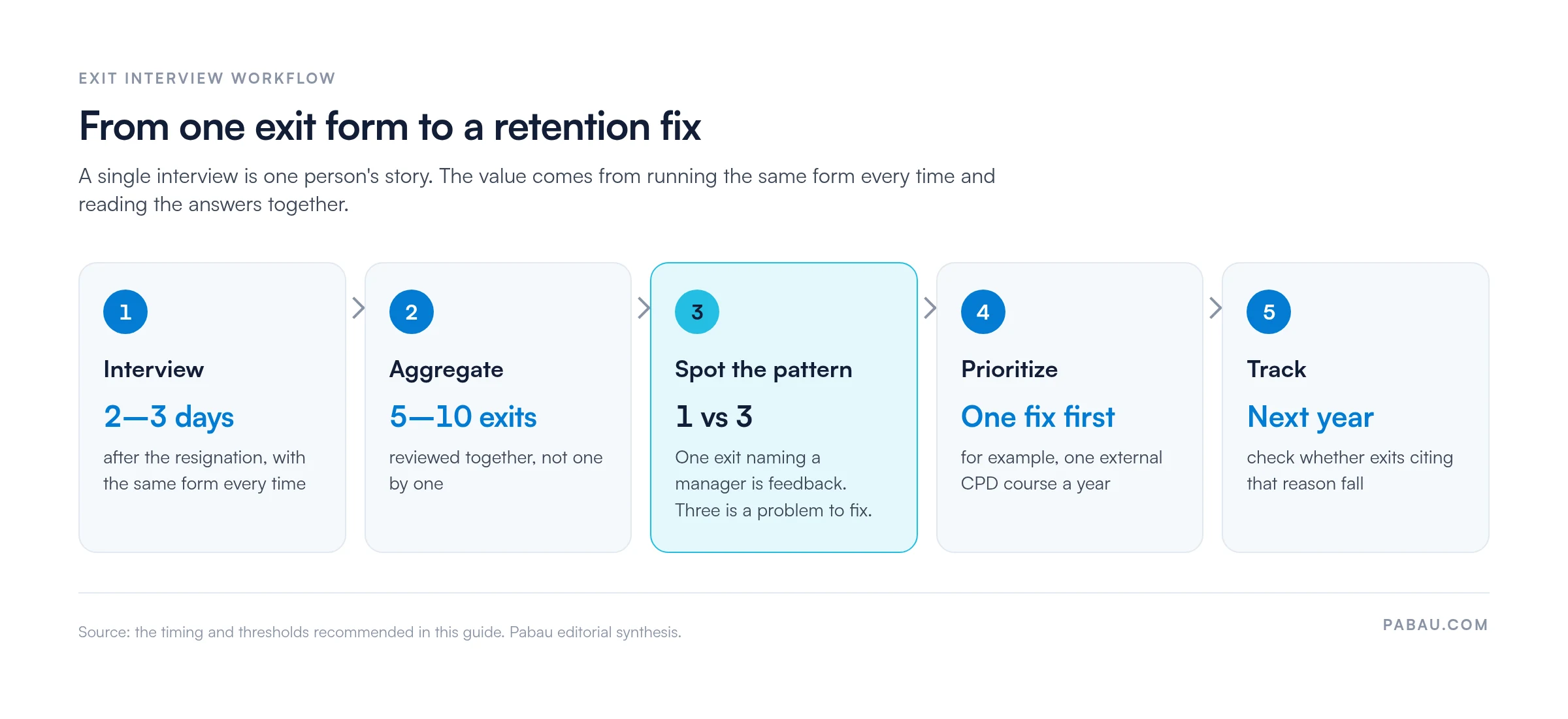
Aggregate and identify patterns. After 5–10 exits, review the responses together. Do several departures cite inflexible scheduling, pay below local competitors, or little learning support? Those patterns call for practice-wide fixes. One exit citing a clash with a manager is feedback, but three citing the same manager is a problem to address.
When workload and on-call pressure top the list, our guide to burnout in healthcare covers fixes a small team can make without an HR department.
Prioritize high-impact changes. Not every suggestion merits investment. If five departing clinicians wanted more CPD budget and you can fund one external course a year, start there. If departures cite isolation, try team huddles, mentoring pairs, or peer learning groups. Small, concrete changes show staff you listen.
Regular one-on-one meetings help you catch those frustrations with current staff before they turn into resignations.
Track retention over time. Measure whether your changes reduce future turnover. If you introduced flexible scheduling and exits citing scheduling fell by 30% the next year, the change worked. Pabau’s built-in reporting covers practice performance, while a spreadsheet or HR system tracks turnover and tenure by role.
Many practices still run exit interviews on paper or in a shared document. The questions drift from one departure to the next, and completed forms end up in a drawer where nobody compares them.
Pabau is a time-saving practice management app that brings scheduling, records, and forms into one system. Its digital forms help standardize forms across your practice, so you keep one current version instead of several edited copies.
When a team member hands in their notice, the shared calendar shows which of their appointments need a new practitioner. Patients get rebooked before the last day, so a departure doesn’t turn into missed appointments.

Pabau’s digital forms help standardize forms across your practice, and the shared calendar shows each practitioner’s appointments in one view. That means fewer loose ends when a team member moves on.

Start with the next resignation rather than waiting for a perfect process. Download the template, add the clinical questions that fit your roles, and use the same form for every departure. One exit tells you about one person. Five or ten tell you what your practice needs to change.
The trade-off is time. An exit interview is easy to skip when you’re already short-staffed. Skip it, though, and you hire the replacement without knowing what drove the last person out.
Want one consistent version of every form your team uses? Book a demo to see how Pabau’s digital forms help standardize forms across your practice.

Seeing the same reasons for leaving in every exit interview? Healthcare worker burnout solutions that work without an HR department shows how small practices can tackle the workload pressures that drive staff out.
Want to catch problems before they turn into resignations? One-on-one employee meeting template gives managers a regular structure for spotting frustration while there is still time to act.
Need a fair way to address performance before a departure? Performance improvement plan template for healthcare staff sets clear goals, support, and timelines so improvement has a documented path.
Documenting a conduct or attendance conversation? Employee counseling form records the issue, the agreed actions, and both signatures in one place.
Planning yearly reviews that keep good staff engaged? Annual review template for healthcare practices helps you recognize progress and agree on growth goals with each team member.
No. Exit interviews aren’t legally required in most jurisdictions. They’re still good practice, because a documented record shows you gathered feedback professionally. Check local employment law for any obligations that apply to you. In regulated UK healthcare, CQC inspectors view evidence of staff feedback processes positively.
It depends on the size of your team. In small teams, where anonymity is hard to guarantee, confidentiality encourages honesty. Keep responses with leadership and away from the departing employee’s manager. Larger practices can run fully anonymous online forms. Either way, explain how responses will be handled so staff trust the process.
Store responses in one place, such as a digital form, spreadsheet, or HR system. Review them quarterly or after each departure, and flag patterns. Share anonymized themes with leadership and the relevant managers. When you change something based on exit feedback, say so: “Three staff mentioned needing more flexibility. We now offer compressed weeks.” That closes the loop and shows you listen.
An exit interview is usually a conversation with a manager or HR lead at the time of departure. It happens in person or through a structured form. An exit survey is a broader questionnaire, often sent online weeks or months later, that captures longer-term reflections. Using both gives you immediate data and hindsight. Send a quick form on the last day, then a detailed survey 30 days later.
Exit feedback shows why people leave and what they valued about the role. If departures keep citing scheduling, flexible scheduling becomes a competitive advantage. If they mention a lack of learning, CPD investment becomes a retention tool. Practices that act on exit insights and communicate changes can reduce avoidable turnover over time.