Sulcus Test: Shoulder Instability Assessment
The sulcus test is an orthopedic special test that checks for inferior glenohume...

2
Last Updated: Oct 22, 2026
A dental cleaning schedule template gives your practice one place to record each patient’s cleaning type, risk level, and next recall date. Low-risk patients with healthy gums come back every six months for a routine prophylaxis. Patients with diagnosed gum disease return every three to four months for periodontal maintenance instead.
This guide covers what belongs in the schedule, how the two cleaning types differ, and where insurance coverage runs out. Download the free template below and adapt the fields to your own protocols. Feed it into your automated recall scheduling so reminders go out on time.
A ready-to-use recall tracker with fields for the last cleaning date, the cleaning type (D1110 or D4910), and patient risk level. It also covers the next due date, the insurance allowance, and reminder status. Adapt the intervals to your own clinical protocols before you hand it to the hygiene team.
Download template
A dental cleaning schedule template sorts patients by risk level, so recall intervals range from six months down to three.
Low-risk patients with healthy gums do well on a six-month prophylaxis, which is the interval ADA guidance supports.
Patients with diagnosed gum disease need periodontal maintenance every three to four months instead.
Recording D1110 prophylaxis separately from D4910 periodontal maintenance keeps your billing and your intervals straight.
Most plans cover two cleanings a year and cap D4910 at a set number, commonly two to four.
A structured recall schedule takes the guesswork out of when each patient comes back. Without one, patients book cleanings whenever they happen to remember. Plaque and tartar build up between visits, and gum disease progresses without anyone noticing.
The schedule does four jobs at once. It records the cleaning each patient received, the date they were last seen, their risk profile, and the date they are next due. Your team can then prioritize the patients who need close follow-up, and your documentation holds up when an auditor asks.
Most adults with healthy gums need a routine prophylaxis (D1110) every six months. That is the interval the American Dental Association (ADA) supports for low-risk patients. Two visits a year clear the plaque and tartar that brushing cannot reach, and they give your hygienist a chance to catch decay early.
Not everyone fits that pattern. Patients with diagnosed gum disease, smokers, diabetics, and patients with dry mouth usually need cleanings every three to four months. The shorter interval keeps active periodontal disease in check and reduces the risk of tooth loss. Your schedule needs room for both patterns.
The most important distinction in the schedule is between prophylaxis (D1110) and periodontal maintenance (D4910). Prophylaxis is a routine cleaning for patients with healthy gums. The hygienist scales and polishes the tooth surfaces above the gum line.
Periodontal maintenance is therapeutic. It follows active treatment for gum disease, happens more often, and involves scaling below the gum line. Pocket depths and bleeding points decide which cleaning a patient gets, so a perio chart template usually sits alongside the recall schedule.
The distinction drives billing as much as clinical care. Most plans cover two prophylaxis cleanings a year. Periodontal maintenance is handled under separate rules, and most plans cap D4910 at a set number of visits a year, commonly two to four. Coverage is plan-dependent, so record which cleaning each patient received and check their allowance before you book.
The template captures the fields your team needs to set a recall date without digging through the chart. Include patient identifiers, clinical status flags, and enough scheduling logic that anyone on the team can work out the next due date.
Most of these fields already exist somewhere in your records. Risk factors come off the medical history the patient fills in. Practices running patient intake software can carry them straight onto the recall schedule instead of asking again at the chair.
Download the template and shape it around your own protocols. The structure is fixed. The field labels and the intervals are yours to change.
ADA guidance supports a risk-based approach, so not every patient belongs on a six-month cycle. The findings below are what move someone onto a three to four month interval. A structured oral health assessment at each visit turns those observations into a risk level the whole team reads the same way.
Most dental plans cover two prophylaxis cleanings (D1110) per calendar year. That matches the six-month interval for low-risk patients. A patient on a quarterly cycle will run past the allowance, so the schedule should show which visits the plan covers before anyone books them.
Periodontal maintenance is handled under its own rules, and plans do not cover D4910 without limit. Most cap it at a set number of visits a year, commonly two to four, and some count it against the prophylaxis allowance instead. Check the patient’s plan, then record the diagnosis so your billing team can submit the claim correctly.
The arithmetic is worth seeing laid out. A risk-based recall schedule regularly asks for more visits a year than a standard benefit pays for.
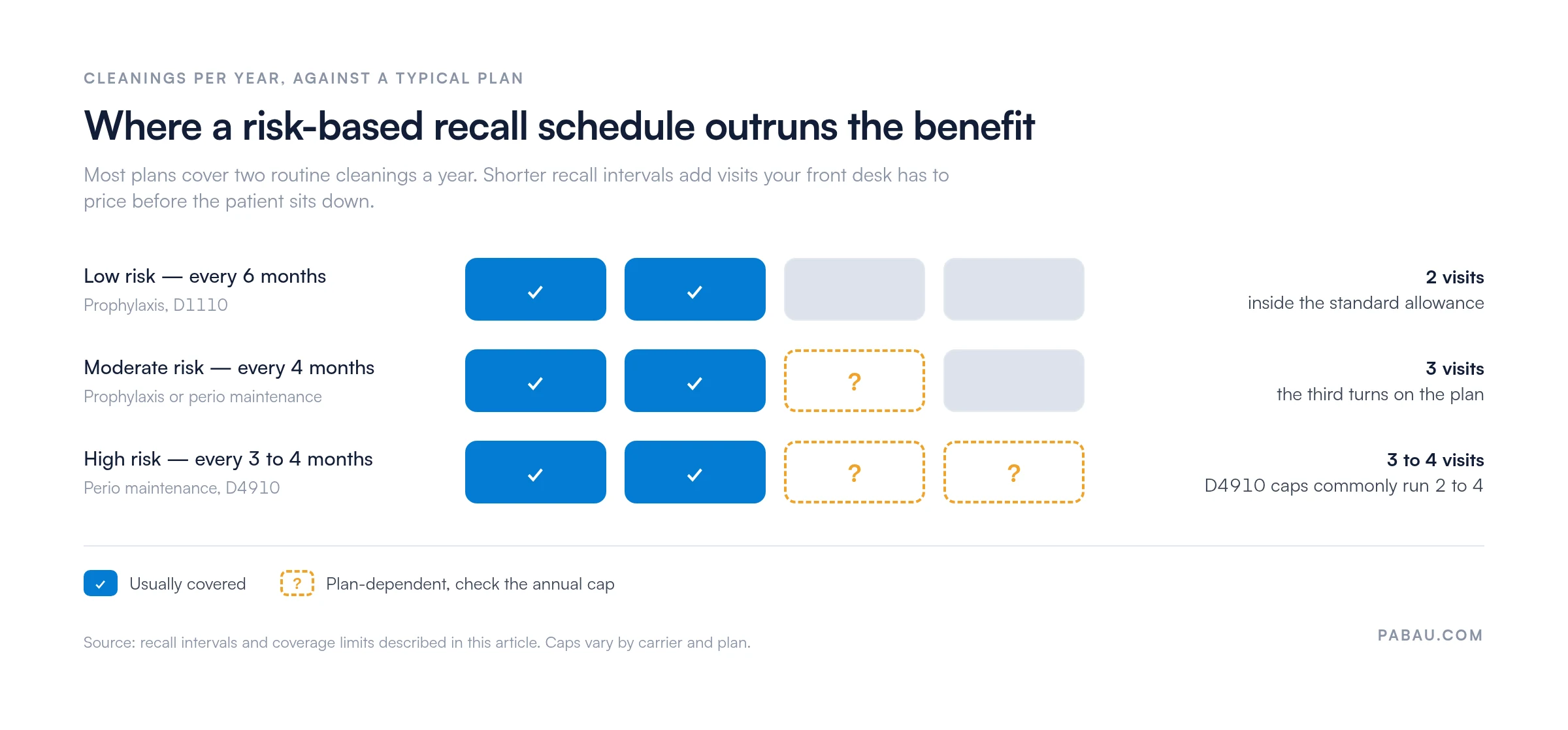
Getting the claim right matters as much as getting the interval right. The ADA dental claim form is where the cleaning type and the diagnosis have to match what your schedule says happened.
A recall schedule only works if the whole team uses it. Hygienists have to assess risk and record it at every visit. Front desk staff have to send reminders on time and log who responded. Dentists should review the protocol once a year against current ADA guidance.
Train everyone on the same criteria: what counts as high risk, how prophylaxis differs from periodontal maintenance, and how the next date gets set. Then audit your recall completion rate each quarter. Patients who miss repeatedly usually have a reason worth asking about.
Tracking recall by hand does not scale. A spreadsheet has no memory of who was due last Tuesday, and no way to tell you which patient groups keep slipping through.
Practice management software like Pabau stores the risk level on the patient record and works out the next recall date from it. The SMS or email reminder then goes out without anyone opening a list. Your downloaded template becomes the blueprint for how those automated workflows get set up.
Once recall runs digitally, you can see overdue patients in real time rather than at the end of the month. Insights Plus, our reporting add-on, breaks recall completion down further, so managers can see which patient groups skip appointments most often.

Store each patient’s risk level once, let Pabau work out the next recall date, and send the reminder automatically. Your hygiene schedule fills itself instead of your front desk chasing it.

Six months is a starting point, not a rule. The patients who most need a dental cleaning schedule are the ones who do not fit it. Think of the smoker, the diabetic, and the patient two years out of periodontal therapy. Moving them onto a three to four month cycle is what the template is for.
The trade-off worth remembering is the benefit year. A clinically correct interval will often outrun what the plan pays, so have that conversation before the patient is in the chair rather than after.
Download the template, fit it to your protocols, and put it in front of your hygiene team this week. Book a demo to see how Pabau turns it into automated recall reminders your front desk never has to chase.

Need to capture risk factors before the first cleaning? Dental new patient form collects the medical history, smoking status and medications that set a patient’s recall interval.
Looking to tighten up your hygiene notes? Dental note template covers what each visit note should contain, from chief complaint through to the recall decision.
Running a full exam before you set the interval? Dental examination form structures the findings your risk assessment depends on.
Low-risk patients with healthy gums need a prophylaxis cleaning every six months, which is the interval ADA guidance supports. Patients with diagnosed gum disease, smokers and diabetics usually need periodontal maintenance every three to four months, based on clinical judgment.
Prophylaxis (D1110) is a routine cleaning for patients with healthy gums. The hygienist scales and polishes above the gum line. Periodontal maintenance (D4910) is therapeutic, follows treatment for diagnosed gum disease, and involves scaling and root planing below the gum line at shorter intervals.
A routine prophylaxis cleaning usually takes 30 to 60 minutes. Periodontal maintenance takes longer, often 60 to 90 minutes, depending on how much scaling and root planing the patient needs.
Most dental plans cover two prophylaxis cleanings per calendar year. Periodontal maintenance is handled separately and is not unlimited. Plans commonly cap D4910 at two to four visits a year, and some count it against the prophylaxis allowance, so check the patient’s plan.
Patients diagnosed with periodontitis, smokers and diabetics usually benefit from a three to four month interval. So do patients with weak home care and those who form tartar rapidly. The shorter cycle keeps active disease in check.