Collagen stimulating injections trigger the body’s own collagen production via biostimulation, offering gradual, natural-looking results that improve over months.
Professional consent forms must document patient medical history, treatment explanation, potential risks such as injection-site reactions and granulomas, benefits, and aftercare protocols. This documentation is non-negotiable for regulatory compliance and patient safety.
Treatment typically requires 2-3 sessions spaced 4-6 weeks apart, with results peaking at 3-6 months and longevity lasting 12-24+ months depending on the product (Sculptra, Radiesse, Ellanse).
Digital consent forms, like those in practice management software such as Pabau, reduce paperwork burden, ensure consistent documentation, enable audit trails for compliance, and improve patient engagement through structured pre-treatment education.
Download your free collagen stimulating injections consent form
A ready-to-use consent form covering patient details, contraindication screening, treatment explanation, risk disclosures, benefits acknowledgement, aftercare instructions, and signature blocks.
Collagen stimulating injections are an aesthetic treatment category that works differently from traditional fillers. Rather than adding volume directly, products like Sculptra, Radiesse, and Ellanse act as biostimulators. They trigger the body’s own collagen production to gradually restore volume, improve skin texture, and reduce signs of aging. Each biostimulator session needs its own injection chart, so check how the platforms in our guide to software for med spas handle that record.
For aesthetic practices offering these treatments, a professional consent form is essential. Standard filler forms don’t cover what makes collagen stimulating injections different, so digital consent forms built for this treatment category need to address:
The gradual onset of results
The longer treatment timeline, with multiple sessions spaced weeks apart
A distinct risk profile compared to hyaluronic acid fillers
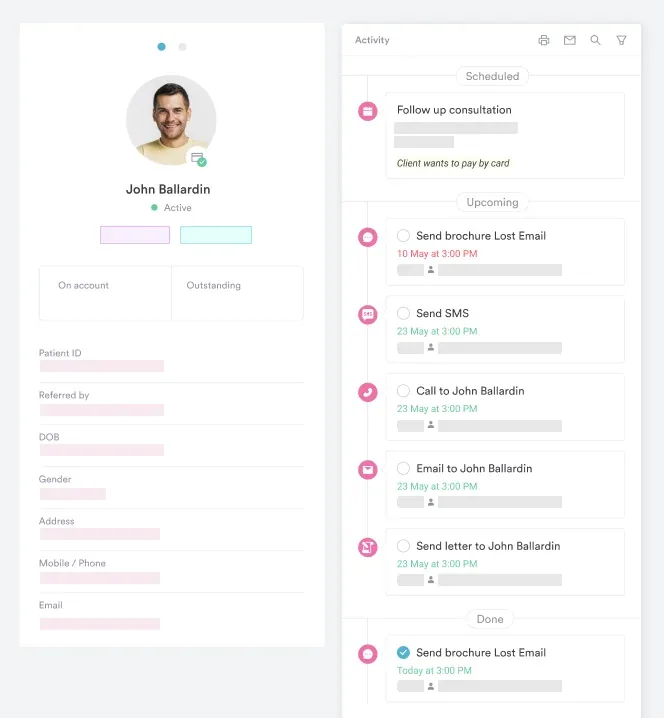
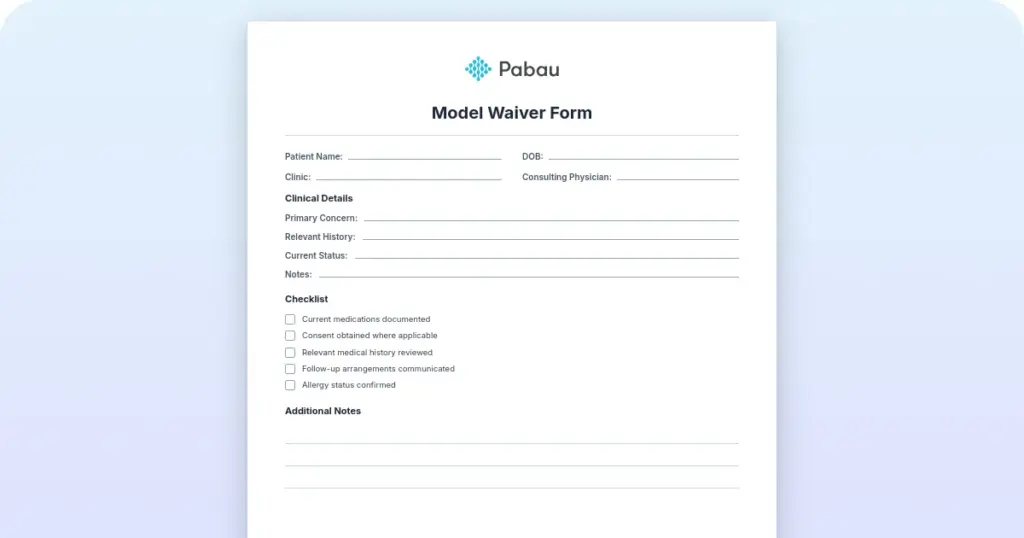
Customizable consent and intake forms
This guide explains what a professional collagen stimulating injections consent form should contain, why it matters for regulatory compliance and patient safety.
Found our content helpful?
What is a collagen stimulating injections consent form?
A collagen stimulating injections consent form is a structured medical document that captures informed patient consent before treatment. It documents that the patient understands what the procedure is, how it works, what to expect during and after treatment, potential risks, realistic benefits, and aftercare responsibilities.
This form serves three critical functions:
Legal protection. It establishes that the patient was fully informed and voluntarily consented, reducing liability exposure.
Clinical safety. It forces a structured discussion of contraindications, allergies, and medical history before treatment proceeds.
Regulatory compliance. In the UK, CQC expects documented informed consent. In the US and Australia, HIPAA and state licensing boards require evidence that patient education occurred before aesthetic procedures.
Captures baseline patient expectations (what results they hope for, timeline understanding)
Documents medical history and contraindication screening
Explains the biostimulation mechanism and why results take time
Details the multi-session protocol and spacing requirements
Outlines mandatory aftercare (Sculptra massage, sun avoidance, activity restrictions)
Obtains patient signature as evidence of informed consent
Unlike a booking confirmation or intake form, a consent form is a legal document. It must be thorough, use plain language, address the specific treatment’s risks and benefits, and be signed and dated. Professional practices store signed consent forms with patient records for audit trails and regulatory documentation. Nurses charting other conditions face the same time drain, and a nursing care plan template can speed similar documentation work.
Using the consent form in your practice
A professional consent form should follow a structured workflow that integrates into your practice’s patient journey. Here are the five key operational steps:
Pre-consultation review. Send the form to the patient before their appointment, via your practice’s portal or email. This primes them with treatment information and flags any contraindications early. Many patients will note medical history, previous reactions to injectables, or allergies they might forget to mention verbally. Digital forms like Pabau’s AI-powered documentation can auto-populate from existing patient records, saving time during checkout.
In-consultation discussion. During the consultation, walk through the form section by section with the patient. Explain the biostimulation mechanism, how Sculptra or Radiesse differs from hyaluronic acid, the realistic results timeline (first visible results at weeks 4-8, peak at 3-6 months), and specific aftercare requirements. Address their concerns directly. This conversation is where informed consent happens. The signature just documents it.
Contraindication and allergy screening. Cross-check the patient’s reported medical history against the form’s contraindication checklist. Absolute contraindications, such as current pregnancy, active autoimmune disease, or keloid tendency, require treatment postponement. Relative contraindications, such as recent isotretinoin use, immunosuppression, or a history of granulomas, require clinician judgment and may require medical director approval. Document the decision in the patient’s record.
Risk and benefit acknowledgement. Review the specific risks with the patient: injection-site reactions such as redness, swelling, or bruising, delayed-onset nodules that are rare but possible with PLLA, and very rare granuloma formation that typically responds well to treatment. Confirm they understand that results are gradual and require patience. Many patients expect Botox-like results within days, so explaining the multi-month timeline upfront prevents unrealistic expectations. For patients whose expectations still seem out of step with what the treatment can achieve, a short screening conversation, or a structured body dysmorphia questionnaire, can help identify when a referral is more appropriate than proceeding.
Aftercare protocol acceptance. For Sculptra specifically, emphasize the “5-5-5” massage protocol: 5 minutes of massage, 5 times a day, for 5 days post-treatment. Poor massage compliance leads to nodule risk. For Radiesse and Ellanse, aftercare is less strict but still requires sun avoidance, activity restrictions, and avoiding pressure on treated areas. Have the patient sign off on the aftercare section. This isn’t optional, and documented agreement protects the practice if the patient ignores advice.
The entire process should take 10-15 minutes. Digital consent forms streamline this.
Comprehensive patient records
Who needs this consent form
Any aesthetic practice, medical spa, dermatology practice, or cosmetic surgery practice offering collagen stimulating injections (Sculptra, Radiesse, Ellanse, or similar biostimulators) must use a professional consent form. This applies across several specialties:
Aesthetic practices and medical spas offering Sculptra or Radiesse for facial volumization, jawline definition, or body contouring.
Dermatology practices using biostimulators for anti-aging treatments or skin quality improvement.
Cosmetic surgery practices combining injectables with surgical procedures, such as pairing Radiesse with a facelift.
Plastic surgery practices offering non-surgical body contouring with Sculptra for the buttocks, hips, or breasts.
Regenerative medicine practices using collagen stimulators as part of broader rejuvenation protocols.
The form should be adapted slightly per specialty. An aesthetic practice’s version may emphasize anti-aging and cosmetic results, while a regenerative medicine practice’s version might frame the treatment around tissue quality and long-term structural restoration.
Knowing how practice management software works helps you decide which forms to digitize first.
Key benefits of a professional consent form
A well-designed consent form protects both the patient and the practice. Here are the core operational and legal benefits:
Regulatory compliance. CQC (UK), TGA (Australia), and state licensing boards (US) expect documented informed consent. A signed form is audit-ready evidence that your practice meets this standard.
Liability reduction. If a patient experiences post-treatment complications and later claims they weren’t informed of risks, a signed, comprehensive consent form is your primary legal defense.
Consistent patient education. A standardized form ensures every patient receives the same key information, regardless of which practitioner is on duty.
Reduced no-show and dissatisfaction. When patients understand the multi-session protocol and gradual timeline upfront, they’re more likely to complete the full treatment course and feel satisfied with outcomes.
Contraindication safety gate. Structured screening catches medical histories that might otherwise be missed, including pregnancy, immunosuppression, and keloid tendency, before treatment starts.
Documentation clarity. A signed form becomes a permanent part of the patient’s medical record, supporting clinical decision-making and follow-up care.
Digital consent forms add efficiency in several ways:
Automated reminders ensure patients complete forms before appointments.
Digital signatures provide tamper-proof audit trails.
Integrated automated workflows attach the signed form directly to the patient’s chart for instant access during follow-up visits.
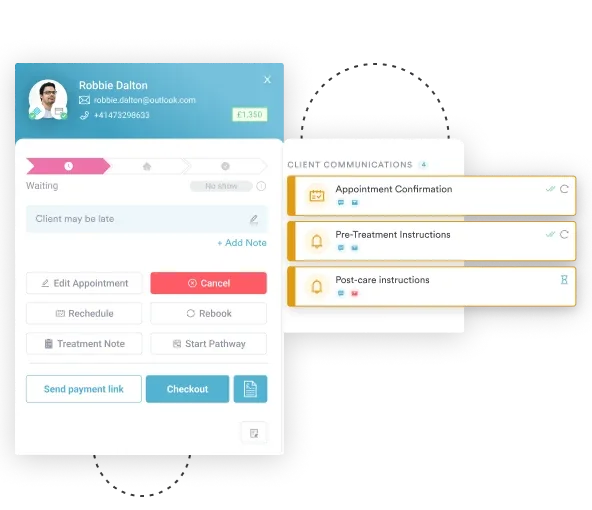
Automated communication in Pabau
What to include in the consent form
A professional consent form should include these core sections:
Patient details and date. Name, date of birth, contact information, appointment date, practitioner name.
Medical history and contraindication screening. Pregnancy, autoimmune disease, immunosuppression, previous granulomas, keloid tendency, allergies to treatment components, recent isotretinoin use, bleeding disorders.
Treatment explanation. Plain-language description of how the treatment works (biostimulation mechanism), which product will be used (Sculptra, Radiesse, or Ellanse), treatment areas, expected onset timeline (first results weeks 4-8, peak at 3-6 months), and longevity (Sculptra 2+ years, Radiesse 12-18 months).
Session protocol. Number of sessions required (typically 2-3), spacing between sessions (4-6 weeks), total treatment timeline (2-3 months for the full series).
Benefits. Natural-looking gradual results, skin quality improvement, longevity advantage versus HA fillers, and volumization without the “overfilled” appearance.
Risks and adverse events. Injection-site reactions such as redness, bruising, swelling, or tenderness that usually resolve within 1-2 weeks, delayed-onset nodules that are rare and typically manageable, granulomas that are very rare but require monitoring, infection that is extremely rare with proper technique, and vascular complications that are rare but require immediate management.
Specific aftercare protocols. For Sculptra: the 5-5-5 massage rule with clear instructions. For all products: sun avoidance, activity restrictions, avoiding pressure on treated areas, timing of follow-up sessions.
Realistic expectation statement. Results are gradual and improve over months, not days. Multiple sessions may be required. Individual results vary based on age, skin condition, lifestyle, and metabolism.
Patient declaration. “I have read and understood the information above. I have had the opportunity to ask questions. I consent to treatment on [date] with [practitioner name].”
Signatures. Patient signature, date, practitioner signature (or medical director if delegation applies), date.
Many practices also add a section on before-and-after photography consent, which is separate consent for using photos in marketing or staff training. This must be explicit and independent of treatment consent. According to guidance from the American Society of Plastic Surgeons (ASPS), photography consent should specify where images may be used and require explicit patient approval.
Regulatory and compliance considerations
Consent forms are subject to regional regulations:
UK (CQC, GDPR). Signed consent forms must be retained as part of the patient record for at least 3 years. GDPR requires explicit consent for processing patient data (medical history, contact details). Digital consent systems must be GDPR-compliant-data encryption, secure storage, patient access rights. CQC expects documented evidence that practitioners explained risks before treatment.
US (State licensing, HIPAA). Consent requirements vary by state; some states specify that certain injections require physician oversight (scope of practice). HIPAA requires patient data security and confidentiality. Signed forms must be retained per state requirements (typically 5-7 years).
Australia (TGA, State legislation). Therapeutic Goods Administration (TGA) classifies aesthetic injectables as devices. Practitioners must hold appropriate qualifications (nurse, doctor, or registered practitioner per state). Consent forms must document the TGA-approved use and any off-label use (which requires additional patient consent and clinical justification).
Before-and-after photo regulations (the CAP Code in the UK, the TGA in Australia, and the ASA in the US). Any consent form collecting permission for before-and-after photography must disclose that images may be used in marketing, testimonials, or staff training. The UK’s CAP Code prohibits misleading claims in photos, and Australia’s TGA requires images to be unretouched or to clearly note any retouching. Your consent form should explicitly state photo usage restrictions.
If your practice operates across multiple countries, such as the UK and Australia or the US and Canada, your consent form template should include region-specific language. Many practices use digital consent capture systems that branch by location, ensuring each region receives compliant forms.
Common mistakes to avoid when using consent forms
These mistakes undermine consent documentation and create compliance risk:
Generic filler forms. Using a standard dermal filler consent for collagen stimulators is inadequate. Collagen stimulators have unique timelines, aftercare protocols (Sculptra massage), and risk profiles that must be explicitly covered.
Unsigned or partially signed forms. A consent form without a patient signature has zero legal value. Make sure the patient signs and dates the document, and that the practitioner countersigns. Digital systems should flag unsigned forms before checkout.
Skipping the verbal discussion. A signature alone is just documentation, not informed consent. The practice needs a practitioner-led conversation that explains the treatment, risks, timeline, and aftercare. Take notes in the patient record documenting what was discussed.
Ignoring red-flag contraindications. If a patient discloses pregnancy, recent isotretinoin, or autoimmune disease, proceeding with treatment despite these contraindications is negligent. The form should require medical director review or treatment postponement for these scenarios.
Poor aftercare documentation. Many practices fail to document whether the patient completes aftercare, such as the Sculptra massage protocol. Keep a follow-up checklist: confirm the patient massaged as instructed, check for nodules or delayed reactions at week 2, and record findings in the patient chart. If a granuloma does develop, many practitioners manage it with an intralesional corticosteroid injection billed under J3300 before considering more invasive treatment.
Not updating forms for new products or guidelines. Sculptra’s FDA approval, Radiesse formulation changes, or new regulatory guidance should trigger consent form updates. Outdated forms put your practice out of compliance.
Related templates
Diarrhea Nursing Care Plan Template
Communication styles worksheet
Couple Communication Worksheet
Community health improvement plan template
Simplify your consent workflows
Pabau’s digital consent forms auto-populate from patient records, flag unsigned documents before appointments, and create audit-ready compliance trails, so your practice can focus on providing outstanding treatment rather than managing paperwork.
Grounding consent conversations in patient education
A consent form is most effective when it’s part of a broader patient education strategy. Many practices pair the consent form with additional resources:
Before-and-after photo galleries. Show realistic results from your own practice, with patient permission. Include timelines showing progression from session 1 to session 2 to session 3 to the 3-month peak. Pairing these galleries with filler face mapping helps patients see exactly where product will be placed relative to their own anatomy, reinforcing the treatment-area language already covered in the consent form.
Video or infographic explanations. A 2-minute video showing the biostimulation mechanism or the Sculptra massage protocol can be more engaging than written paragraphs. Many patients are visual learners.
Written aftercare instructions. Beyond the consent form’s aftercare section, provide a take-home sheet with day-by-day guidance: Day 1-5 massage protocol, week 1 activity restrictions, week 2-4 sun avoidance, when to return for session 2.
Post-treatment follow-up messaging. Automated SMS or email reminders (“Reminder: time for your Sculptra massage protocol”) keep aftercare compliance high and catch complications early.
Practices using structured email and SMS campaigns can automate these educational touchpoints, ensuring every patient receives consistent, timely guidance before and after treatment.
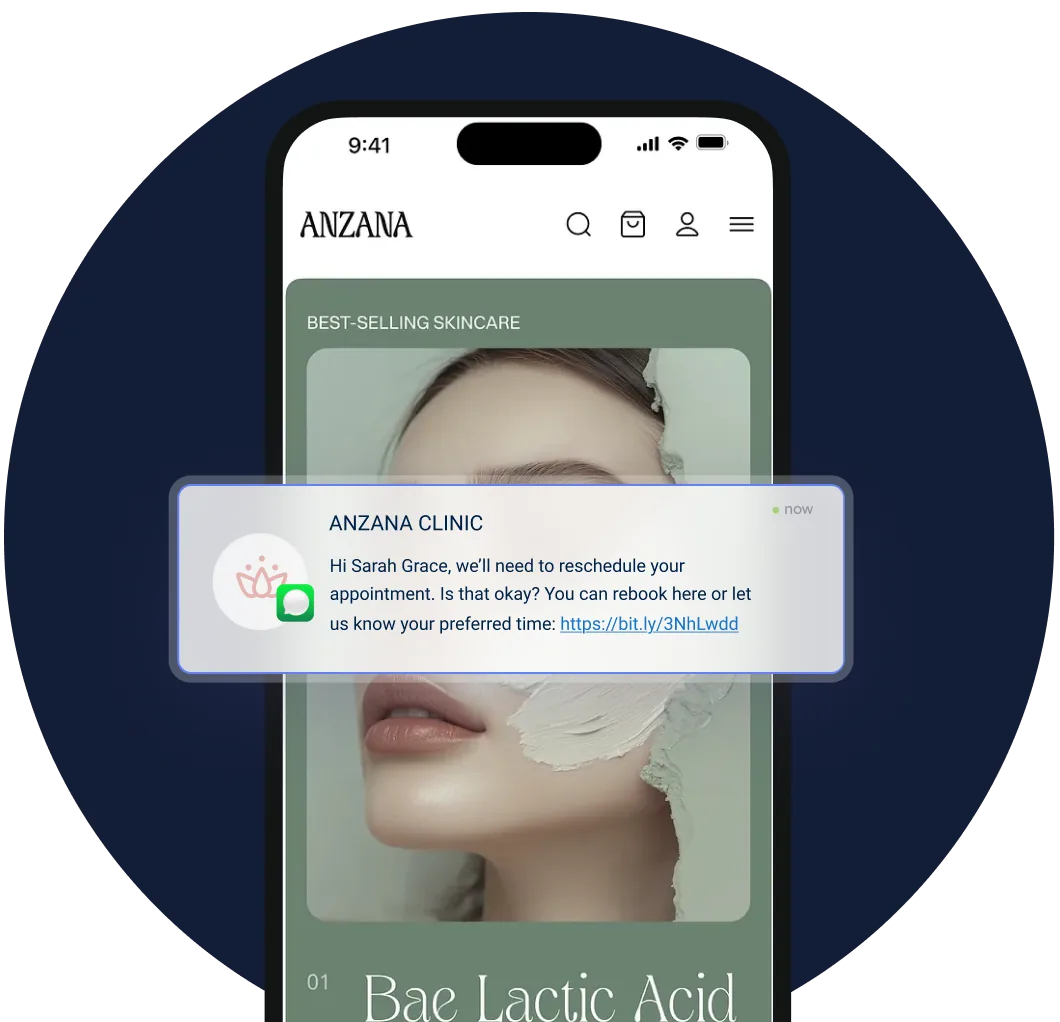
SMS Broadcast
Conclusion
A professional collagen stimulating injections consent form is non-negotiable for any practice offering these treatments. It documents informed patient consent, protects the practice legally, ensures regulatory compliance, and creates a structured conversation that manages patient expectations and improves treatment outcomes.
The template above covers all the essential elements: patient information, medical screening, treatment explanation, risk disclosure, aftercare protocols, and signature blocks. Customize it for your practice’s specific products, practitioners, and regional regulations. Most importantly, use it as a conversation tool during consultation, not just a paperwork checkbox.
For aesthetic practices managing multiple practitioners and high patient volumes, digital consent forms integrated with your practice management system reduce friction, eliminate missed signatures, and create audit-ready compliance documentation. Book a demo with Pabau to see how digital consent workflows streamline your practice’s operations.
Continue your research
Also offering Baby Botox treatments?Baby Botox consent form covers contraindication screening, pre-treatment checks, aftercare instructions, and safety protocols for neuromodulators.
Also performing chemical peel treatments?Chemical peel treatment record covers Fitzpatrick skin type, peel depth, product details, and post-care follow-up scheduling.
Offering cryolipolysis body contouring too?Cryolipolysis consent form covers contraindication screening, body area mapping, treatment planning, and post-treatment care instructions.
Frequently asked questions
What is a consent form for collagen stimulating injections?
A consent form is a legal document that documents a patient’s informed agreement to collagen stimulating injection treatment. It captures their medical history, confirms they understand the treatment mechanism (biostimulation), expected timeline (results peak at 3-6 months), risks (injection-site reactions, rare nodules or granulomas), aftercare requirements (especially Sculptra’s massage protocol), and realistic expectations. The patient signs to confirm they were fully informed before treatment.
How long should the consent process take?
The full process, including reviewing the form with the patient, answering questions, discussing contraindications, and obtaining a signature, should take 10-15 minutes. Digital forms that auto-populate from existing patient records and guide practitioners through the conversation can reduce this to 8-10 minutes without sacrificing thoroughness.
What are the main differences between collagen stimulating injection consent and standard dermal filler consent?
Collagen stimulating injections need more detail than a standard filler consent. Cover the gradual onset timeline, since results build over weeks or months rather than days. Explain the multi-session protocol, typically 2-3 sessions spaced 4-6 weeks apart. Note product-specific aftercare, since Sculptra’s 5-5-5 massage rule is mandatory while HA fillers need minimal aftercare. Flag delayed-onset risks, since nodules can appear weeks after injection rather than immediately. And compare longevity: Sculptra lasts 2+ years, while HA fillers typically last 6-12 months. Standard filler forms don’t adequately cover any of this.
Can I use the same consent form for Sculptra, Radiesse, and Ellanse?
A single form can cover all three products if it acknowledges their differences in your consent language. Sculptra requires the 5-5-5 massage protocol, but Radiesse and Ellanse do not. Longevity also differs: Sculptra lasts 2+ years and Radiesse lasts 12-18 months, while Ellanse’s duration depends on the formulation, ranging from about 1 year with Ellanse-S up to 4 years with Ellanse-E (roughly 2 years for Ellanse-M and 3 years for Ellanse-L). Many practices use a master form that branches based on which product and formulation is being used, so product-specific details are always included.
What happens if a patient doesn’t sign the consent form?
You must not proceed with treatment. An unsigned consent form has no legal value and leaves your practice exposed to liability claims. If a patient refuses to sign after you’ve explained the treatment, document their refusal in the patient record (“Patient declined treatment after informed discussion on [date]”), reschedule, or discuss their concerns with the medical director. Some patients just need extra reassurance before committing.
How long should I keep signed consent forms?
UK (CQC/GDPR): minimum 3 years. US: state-dependent, typically 5-7 years. Australia (TGA): typically 5 years minimum. Best practice is to retain them for the life of the patient record (often 7-10 years). Digital systems should store signed forms electronically with backup, making retention and retrieval straightforward.
What if a patient has a contraindication but really wants the treatment?
Absolute contraindications, such as pregnancy, active autoimmune disease, or current isotretinoin use, require postponement. There are no exceptions here, for patient safety. Relative contraindications (previous keloids, immunosuppression) require medical director assessment and documentation of the risk/benefit discussion. The medical director (or delegated senior practitioner) must sign off on the decision. Never proceed based solely on patient demand.
Can I collect consent digitally, or must it be handwritten and printed?
Digital consent with electronic signature is fully legal in the UK (GDPR), US (E-SIGN Act), and Australia (UECA) as long as the system creates an audit trail (timestamp, IP address, signature record). Digital is preferable because it’s tamper-proof, reduces lost paperwork, and integrates with your patient record system. Just ensure your software is GDPR/HIPAA-compliant and has proper data security.