EHR ROI: How to calculate and maximize your return
EHR ROI is the financial return a practice earns on its electronic health record...

Last Updated: Oct 15, 2026

A cancellation policy enterprise template is a compliance document that sets notice periods, fees, no-show consequences, and deposit forfeitures for multi-location practices.
Enterprise practices lose 5 to 30% of weekly revenue to no-shows and late cancellations. A written policy backed by automated reminders recovers 15 to 25% of it.
Late cancellations happen inside the notice window, typically 24 to 48 hours. No-shows carry zero notice. Fair enforcement depends on separating the two.
CMS permits a missed-appointment fee for Medicare and Medicaid patients, provided every patient pays the same fee and Medicare is never billed for it.
Practice management software like Pabau tracks cancellations, sends reminders, collects deposits at booking, and flags repeat offenders automatically.
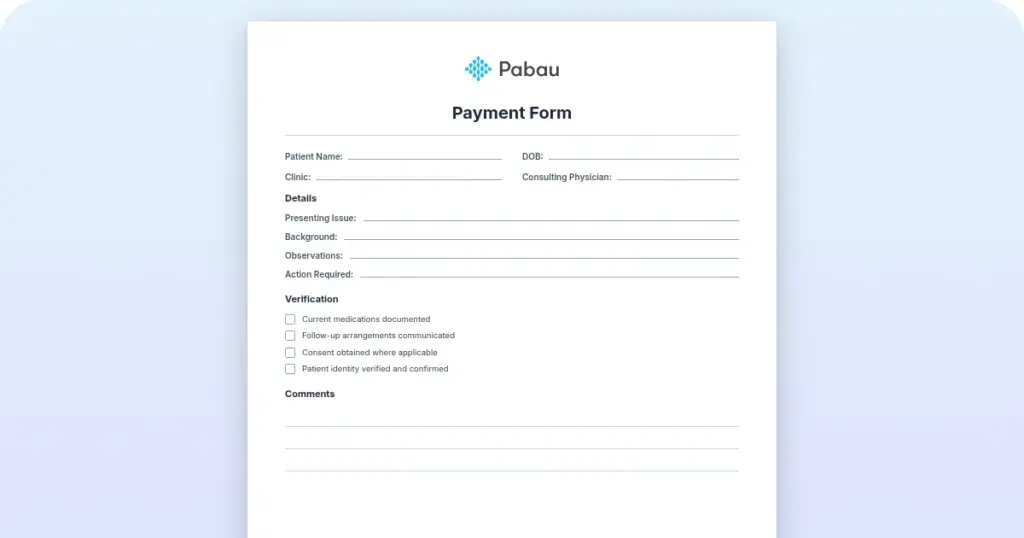
Eight editable clauses covering notice windows by service type, fee and deposit tables, no-show definitions, the insured-patient carve-out, repeat-offender steps, and a dispute process. Fill in your own thresholds and it is ready for patient intake packets.
Download templateA cancellation policy enterprise template is one written agreement that sets notice windows, fees, no-show consequences, and deposit rules for every location you run.
Download it below and set your own thresholds by service category. The rest of this guide explains the reasoning behind each of its eight clauses.
Enterprise practices have a different problem from solo ones. Their policy is usually written well and applied unevenly, and patients notice when one site charges $50 while another waives the fee. Two clauses cause most of the trouble: the insured-patient carve-out and the repeat-offender rule.
A cancellation policy enterprise template is a formal, compliance-aligned document. It defines how a multi-location practice handles cancellations, late cancellations, no-shows, and the money attached to each.
It goes further than a 48-hour notice line in a booking email. An enterprise policy is a signed agreement that appears in intake packets, booking confirmations, and automated reminders.
For a multi-location practice, the formal version earns its keep three ways. It protects appointment slots from revenue loss. It gets the same rules applied at every site.
It also gives auditors and insurers a documented position to read. A written policy is only as good as its enforcement. That is why enterprises run it through no-show policy software rather than a shared spreadsheet.
Regulation shapes two of the clauses. CMS permits a missed-appointment fee for Medicare and Medicaid patients. The conditions are that every patient pays the same fee, and that Medicare is never billed for it.
What CMS bars is billing Medicare for the service the patient missed. HIPAA governs how you store cancellation and booking data, and state medical boards publish ethics guidance on what counts as a reasonable fee.
The math is stark. A mid-size aesthetic practice with 8 to 12 practitioners runs 200 to 300 appointments a week. At a 10 to 15% no-show rate and $150 to $300 per appointment, that is $3,000 to $6,750 of unrecovered revenue every week. One location loses $156,000 to $351,000 a year, and a five-site group loses multiples of that.
A documented, enforced policy recovers 15 to 25% of that loss. Practices that measurably improve patient no-show rates tend to do it three ways:
For enterprises, consistency matters more than strictness. Patients accept a firm policy when all five locations apply it the same way. Uneven enforcement breeds resentment, poor reviews, and a fee nobody takes seriously. A written template gets every front desk, practitioner, and automated reminder working from one set of numbers.
An enterprise cancellation policy contains eight core clauses. Each one covers a distinct workflow state and a distinct slice of your patient population.
The notice period is the cornerstone. Twelve hours is too short to refill the slot. Seven days feels punitive to a patient with a genuine emergency. Most enterprises tier the window by appointment complexity and cost:
The NCL cancellation policy tiers its fees the same way, putting suites on a stricter clock than standard cabins.
Keep the windows identical across locations unless a site serves a different population. An urgent care clinic and an elective aesthetic practice can justify different numbers. Everywhere else, matching windows reduce confusion and disputes.
Patients mix these two up, and a clear definition prevents most disputes:
Written as a ladder, the four states are far easier to explain to a patient standing at the front desk.

Many no-shows are not deliberate. Patients forget, lose transportation, or have a medical event. Logging the reason on a follow-up call lets you separate a habitual canceler from someone who had a bad week. That distinction drives the enforcement approach described below.
Fees and deposits are what give the notice period teeth. Three structures are common:
Most enterprises land on a hybrid. They take deposits on procedures over $500, charge percentage fees on mid-range appointments, and flat fees on quick consultations. Collecting the deposit is far simpler when payment processing sits inside the booking flow. The template lets you set each threshold per service category.
A policy exists only where patients have seen it. Four touchpoints carry it:
Keep the paper trail. Signed intake forms, email confirmations, and SMS delivery receipts all prove the patient was told. That evidence settles a disputed charge in a single email.
Manual enforcement is uneven and eats front-desk hours. Holding the thresholds inside a practice management app takes the judgment call away from the desk. Automation covers four jobs.

A firm policy breeds resentment when it is applied without context. The practices that keep both the revenue and the patients build three habits into the process.
Separate intent from outcome. A patient who cancels after an injury is a different case from a serial canceler. Follow up on every logged cancellation with a short call or email. Where the reason is a genuine emergency, a one-time waiver buys loyalty. Repeat offenders, defined as 2 cancellations in 12 months, get the fee enforced.
Make canceling easy. Where canceling is harder than showing up, patients simply no-show instead. Give them a button in the patient portal, an SMS reply option, and a phone line that gets answered. Easy cancellation raises compliance, because a patient who feels respected comes back and rebooks.
Frame it as fairness. Tell patients why the window exists. “Your slot is held for you, and we turn other patients away to hold it. Let us know in time and we can offer it to someone on the waitlist.” A fee explained that way reads as fair rather than greedy.
In most enterprise practices the policy is enforced by hand. Someone on the front desk checks the booking time, decides whether the cancellation counted as late, and either charges the card or lets it go. Five locations produce five interpretations of the same document.
Pabau moves that decision into the booking record. You set the notice window and the fee per service category once, and every site inherits it. Deposits are taken at booking, reminders go out on schedule, and each no-show is logged against the patient without anyone typing it in.
The repeat-offender clause then runs itself. Once a patient reaches 2 cancellations in 12 months, their next booking asks for payment in full. Managers get cancellation and no-show rates broken down by location, so a conversation about an outlier site starts with numbers rather than impressions.

Pabau collects deposits at booking, sends reminders on schedule, and flags repeat offenders at every location. Your front desks stop deciding cases one at a time.

Writing the policy is the easy part. Applying it identically at every location is what protects the revenue, and that is where most enterprise groups lose the argument with their own patients.
So download the template, set your thresholds by service category, and put the numbers somewhere every front desk reads from. Then decide in advance which exceptions you will honor. Deciding case by case at the desk is exactly how the inconsistency starts.
Automating the enforcement is what makes the policy hold. Book a demo to see how Pabau collects deposits, sends reminders, and tracks no-shows across every location you run.

Running a single site rather than a group? Appointment cancellation policy is the shorter template, without the multi-location and carve-out clauses.
Want the reminders doing the work? Appointment reminder software compares how reminder timing and channel change attendance.
Need the confirmation email to carry the policy? Appointment confirmation email gives you wording you can paste into your booking flow.
Wondering where enforcement sits in the wider stack? Practice management software explains how scheduling, billing, and patient communication connect.
A cancellation policy enterprise is a formal, written agreement that defines notice periods, cancellation fees, no-show consequences, and deposit rules for multi-location practices. Practices need one because no-shows and late cancellations cost 5 to 30% of weekly revenue. A documented policy backed by reminders and deposits recovers 15 to 25% of that loss.
A comprehensive enterprise policy has eight components. They start with the advance notice period of 24 to 72 hours and the late cancellation window and fee. Next come the no-show definition and consequence, plus the prepaid deposit policy. Then come the repeat-offender protocol, refund eligibility, and the insurance and CMS carve-out. Dispute resolution closes the list. The download lets you customize each one per service category and location.
Standard fees run from a $50 flat charge to 50% of the appointment cost for a late cancellation, and 100% forfeiture for a no-show. High-value procedures usually use a deposit instead, at 25 to 50% collected at booking and non-refundable inside the notice window. Fees must be disclosed in advance and follow state medical board ethics guidance.
Most practices require 24 hours’ notice for standard appointments and consultations, and 48 to 72 hours for high-value procedures such as surgery. Longer windows of 5 to 7 days feel punitive, and a 6-hour window is too permissive to protect the slot. Enterprise groups tier the notice by appointment cost and complexity.
A late cancellation happens when a patient cancels by phone, email, or app inside the notice window, so the practice hears from them. A no-show happens when a patient never appears and never cancels. A late cancellation typically costs 50% of the appointment fee. A no-show costs 100% and flags the patient for repeat-offender tracking.
Yes, in most US states and UK settings. The fee has to be reasonable, usually 25 to 75% of the appointment cost, and disclosed in writing upfront. CMS permits a missed-appointment fee for Medicare and Medicaid patients. Two conditions apply. The same fee must be charged to every patient, and it goes to the patient rather than to Medicare. What CMS bars is billing Medicare for the missed service itself. Check your state medical board’s guidance or ask a healthcare attorney before you set fees.
Record the charge on their account as an outstanding balance. You can then make future appointments conditional on settling it. Escalate a persistent dispute to a practice manager. Small claims court is available for larger sums above $500, though pursuing it usually ends the patient relationship for good.
Waive the fee once and document the reason in the patient’s chart. If the same patient claims an emergency repeatedly, ask for medical records or other proof before waiving again. Recording the reason each time is what lets you tell the two situations apart six months later.
Enforce it with context. Waive a one-time fee for a genuine emergency and enforce the charge on repeat offenders, defined here as 2 cancellations in 12 months. Make canceling easy through online, SMS, and phone options, so patients cancel rather than no-show. Explain the window as fairness to the patients on your waitlist.
A 24-hour cancellation policy asks patients to cancel at least 24 hours before the appointment to avoid a fee. It suits most consultations, injectable treatments, and routine procedures. Canceling inside 24 hours typically costs 50% of the appointment fee. The window gives the patient nearly a full day to call while leaving the practice time to refill the slot.