CRM for chiropractors: how to manage patients, bookings and marketing
A CRM for chiropractors is a patient relationship management system built around...

Last Updated: Oct 13, 2026
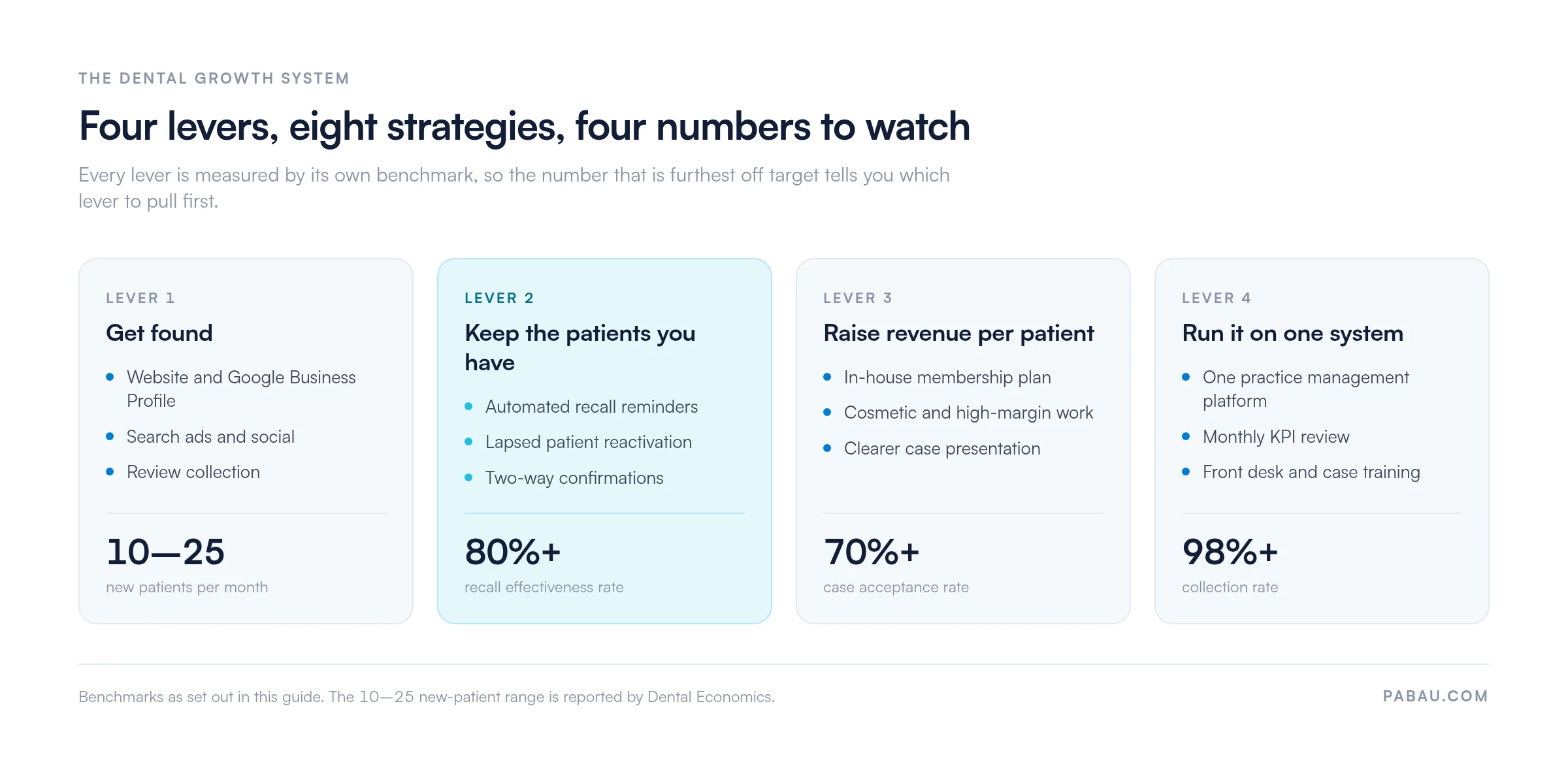
How to grow dental practice revenue comes down to eight strategies across four levers. You need to get found, keep the patients you have, raise revenue per patient, and run all three on one system. Pull one lever on its own and growth stalls, however good that single tactic is.
This guide covers all eight, the benchmark each one is measured against, and how to tell which lever to pull first. Start with your new patient count. A general practice should be booking 10 to 25 a month.

Growing a dental practice means working four levers at once — acquisition, retention, revenue per patient, and the operations behind them.
Dental Economics benchmarks put a healthy general practice at 10 to 25 new patients per month.
Keeping an existing patient costs far less than winning a new one, so recall systems deserve a bigger share of the budget.
An in-house membership plan converts uninsured patients into regular attenders on a predictable monthly fee.
Pabau brings scheduling, automated recalls, marketing campaigns, membership plans, and multi-location dashboards into one platform.
Every growth strategy starts with knowing where you stand today. Spend a marketing budget before you have baseline data and you cannot tell which channels brought patients in.
Pull four numbers before you commit to any new initiative. According to Dental Economics, a healthy general practice should target 10 to 25 new patients per month. The right figure varies by practice size and local market, so check where you sit now.
These four numbers reveal which lever to pull first. A practice with strong new patient flow but a 60% case acceptance rate should work on conversion before it spends more on marketing. A practice with 90% case acceptance but 20 new patients a month needs awareness instead. Diagnose before prescribing.
The reporting and analytics dashboard in practice management software like Pabau surfaces all four metrics live, across one location or several. The audit then takes minutes instead of a spreadsheet session. The four levers and their benchmarks sit together below, so you can see which number is furthest off target.
“Dentist near me” generates approximately 1.83 million monthly searches in the US. If your practice does not appear in the top three Google local results, most of those searches never reach you.
Three pillars drive local patient discovery online. Each reinforces the others.
Ask for the review at checkout, while the visit is still fresh, then send one follow-up by SMS a day later. Automating that second ask keeps it off your front desk’s task list.
Getting more dental patients does not require a large ad budget. It requires choosing the right channels for your practice type and running them consistently.
Google Search Ads targeting “emergency dentist [city]” or “dental implants [city]” capture patients already ready to book. These convert at a higher rate than brand-awareness campaigns because the intent is explicit. Set a modest daily budget, track calls and form fills separately, and pause campaigns for services where your schedule is already full.
Instagram and TikTok work particularly well for cosmetic dental services. Before-and-after content (with patient consent) for whitening, veneers, and Invisalign cases generates organic reach and positions the practice as a cosmetic destination. Facebook remains effective for family and community content targeting households with children.
Short video outperforms static posts on every platform. A 30-second myth-busting clip about teeth whitening safety will usually reach more people than a static infographic.
Word-of-mouth is the lowest-cost acquisition channel a dental practice has, and it works better with a structure around it. Pair a clear incentive, such as teeth whitening or a gift card, with a simple ask at the end of a good appointment.
Track referral sources in your practice management software so you can see who refers most and thank them properly. Pabau’s referral marketing tools run the whole program, including reward tracking and ROI reporting, so nobody has to keep a spreadsheet.
Acquiring a new dental patient costs five to seven times more than keeping an existing one, according to widely cited retention benchmarks. Acquisition still takes the larger share of most marketing budgets. Plugging the leaks is usually the cheaper route to the same revenue.
Patient retention in dentistry comes down to three operational systems. Get these working and you keep revenue that currently walks out the door.
Pabau handles all three sequences in one place, so you do not need a separate marketing platform. Set them up once and they run without further input.

Audit your lapsed patient list quarterly. Any patient with no appointment in 15 months and no cancellation in the system is a reactivation opportunity. A personalized SMS that names their last treatment converts far better than a generic reminder.
There is revenue sitting inside your existing patient base that no amount of new patient marketing will reach. Three approaches lift revenue per patient without adding a single appointment.
Roughly 72 million Americans have no dental insurance, according to the ADA Health Policy Institute. That is about one in five adults aged 19 to 64. Unpredictable out-of-pocket costs keep many of them away from the dentist.
An in-house membership plan charges a flat annual or monthly fee for preventive care, plus a discount on restorative treatment. It turns an uninsured patient into someone with a reason to book.
Members visit more consistently than uninsured patients paying per visit, so the plan pays for itself quickly. Pabau handles enrollments, payment collection, and benefit tracking, so the plan does not add admin to the front desk.
Teeth whitening, Invisalign, composite bonding, and dental implants carry margins well above routine preventive care. Practices that add or actively promote one cosmetic service to their existing patient base typically see a lift in average patient value within 90 days.
Promote these to existing patients first, through email campaigns and post-appointment conversation, before you spend on external advertising. They already know you, so the conversation starts from trust rather than from a cold ad.
If your case acceptance rate sits below 70%, the fastest revenue gain comes from how treatment plans are presented. Intraoral camera images shown chairside, a clear cost breakdown, and flexible payment options all lift acceptance. Hesitant patients usually need to see the problem before they agree to fix it.
Total monthly revenue and appointment count are lag indicators. They tell you what already happened. Lead indicators tell you what is coming, and those are the ones worth reviewing every month.
Review these monthly, not quarterly. A dip in recall effectiveness rate in month one signals a retention problem that will show up as revenue decline in month three. Catching it early means fixing the reminder sequence before those patients lapse for good.
A growth plan on paper falls over if the person answering the phone loses the patient in the first 30 seconds. Your front desk touches every new patient inquiry, which makes it the highest-leverage team in the practice.
Team training is usually the last investment a practice makes and the one with the fastest payback. Staff scheduling, performance tracking, and commission management all live in the same system as the appointment book, which keeps the admin down.
Run a mystery shopper call on your own practice every quarter. Call in as a new patient asking about a popular service. Time how long you are on hold, evaluate the script, and note whether you were offered a booking before the call ended. The recording is usually more instructive than any training deck.
Every strategy in this guide depends on data and automation working together. Run them from spreadsheets and disconnected apps and you get activity without compounding results.
Pabau is built as one platform for the whole practice. Online booking, automated recall sequences, membership management, marketing campaigns, and multi-location dashboards live in the same system. A patient’s record and the campaign that reached them are never two separate tools, so there is no reconciling at month end.
For a dental practice, that means scheduling, automated recalls, two-way SMS, marketing campaigns, online booking, and reporting in one place. Pabau builds software for busy practices, and every subscription includes the full feature set, whatever your size.
If you are still comparing options, the clinic management software buyer’s guide gives you a checklist that works for a practice of any size.

Automated recalls, marketing campaigns, referral tracking, and live dashboards in one platform. See what a difference the right tool makes.

Growth comes from the four levers running together. Visibility fills the schedule, recall automation keeps it full, revenue work raises what each visit is worth, and one system keeps all three measurable.
Pick the lever whose number sits furthest from its benchmark and fix that one first. Then come back and check the other three next month, because they move each other.
The practices that compound are the ones that treat this as a monthly routine rather than a campaign. Book a demo to see how Pabau runs recalls, campaigns, and KPI reporting for a dental practice.

Want the same playbook outside dentistry? How to grow a medical practice applies the same four levers, with more detail on staffing and capacity.
Planning the numbers before you grow? Medical practice business plan covers the financial and operational planning framework behind sustainable growth.
Not sure what to look for in a platform? Practice management software features sets out which capabilities change the working day and which are noise.
Struggling to keep the schedule full? Patient scheduling and appointment management covers waitlists, reminders, and filling cancellations fast.
The most effective approach runs acquisition and retention at the same time. A consistent online presence and a review system bring new patients in, while automated recall and reactivation campaigns keep existing patients returning. Practices that improve both levers at once grow faster than those that focus only on new patient marketing.
According to Dental Economics benchmarks, a general dental practice should target 10 to 25 new patients per month. The right number depends on practice size, chair capacity, and local market. Tracking it monthly alongside recall effectiveness rate gives a clearer picture than new patient volume alone.
Online reviews influence both Google local ranking and the click-through rate from the map pack to your website. Practices with a steady flow of recent four and five-star reviews outrank competitors with older review profiles. That holds even when the competitor has more reviews in total. Automating the review request via post-appointment SMS is the fastest way to build a current review profile.
Yes. In-house membership plans convert uninsured patients, who often avoid the dentist because costs are unpredictable, into regular attenders on a set monthly or annual fee. Members typically visit more consistently than uninsured patients paying per visit. That raises preventive care revenue and the likelihood of accepting restorative treatment when it is needed.
The five most predictive KPIs are new patients per month, recall effectiveness rate, case acceptance rate, production per hour, and collection rate. Review them monthly, not quarterly. A drop in recall effectiveness rate this month predicts a revenue dip two to three months out. That gives you time to fix the sequence before it shows up in the numbers.