EHR ROI: How to calculate and maximize your return
EHR ROI is the financial return a practice earns on its electronic health record...

Last Updated: Oct 15, 2026
An employee handbook is a written document that sets out your practice’s policies, procedures, workplace expectations, and employee rights.
It gives every member of staff one place to check how the practice runs and what is expected of them.
For medical, aesthetic, and allied health practices, a written handbook does three jobs at once. It settles the questions staff would otherwise ask one manager at a time. It records the compliance obligations you already carry under HIPAA, OSHA, and equal employment law. And it gives you something to point at when a dispute or a regulatory review lands.
This guide includes a healthcare-specific template to download and a breakdown of the seven core sections it contains. It also sets out the five steps that take it from blank document to signed acknowledgment. It works the same way for a solo practitioner and for a multi-location group.
A ready-to-use handbook for healthcare practices, covering employment basics, conduct, leave, HIPAA confidentiality, workplace safety, discipline, and a sign-off page. Replace the bracketed fields with your own details and hand it to every new hire on day one.
Download template
An employee handbook sets out your practice’s policies, conduct standards, and procedures in one written document that staff sign for.
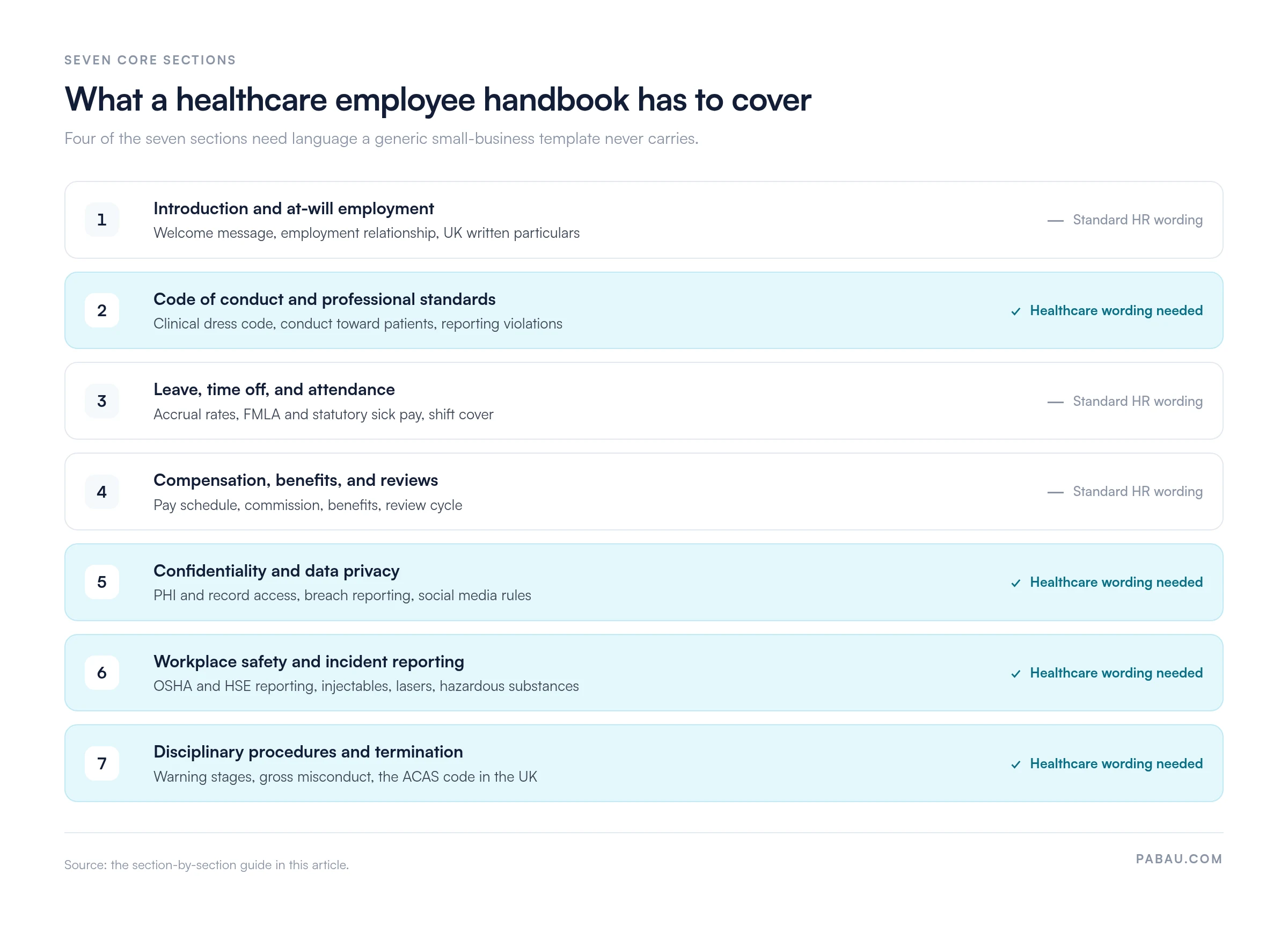
Four of the seven core sections need healthcare-specific wording, which is why a generic small-business template leaves a practice exposed.
HIPAA confidentiality, record access rules, and breach reporting belong inside the handbook rather than in a separate file nobody opens.
US and UK handbooks differ: US employers cite FMLA, OSHA, and EEO, while UK employers issue written particulars and follow the ACAS code.
Storing each signed acknowledgment in the staff record is what proves who received which version of the handbook.
A handbook states the rules, records your compliance obligations, and gives you evidence when a dispute or an inspection arrives. In healthcare, the second and third of those carry far more weight than they do in most small businesses.
Practices answer to regulators a retail business never meets. CQC inspects in the UK, state medical boards license in the US, and HIPAA and GDPR both govern what staff may do with patient data. A documented handbook shows an inspector that your policies are deliberate and applied the same way to everyone.
Healthcare staff handle sensitive records, work under regulatory oversight, and often cover more than one role. Writing those roles and responsibilities down creates accountability, and it is easier to keep current when staff records already sit in one practice management system.
A healthcare employee handbook runs to seven core sections. Start from the template above, then rewrite each one for your practice’s size, location, and specialty. Four of the seven need wording no generic template carries.
Open with a short welcome from the practice owner, then state the employment relationship. In the US, say plainly that employment is at-will, so either side can end it at any time, with or without cause. Local law or an individual contract can override that, so note the exception.
UK practices issue the written statement of particulars instead, covering job title, hours, pay, and reporting line. That statement is a legal requirement under the Employment Rights Act 1996.
Set out what you expect of behavior: professionalism with patients and colleagues, punctuality, dress code, confidentiality, and how disagreements get resolved. Dress code carries more weight in clinical roles than owners expect, so be specific about scrubs, jewelry, and nails.
Add your anti-harassment and anti-discrimination policy, citing EEOC protected classes in the US or Equality Act 2010 characteristics in the UK. Name the person who receives a report, and say what happens after one is made.
Cover paid time off, statutory entitlements, and what you expect when someone cannot work a shift. FMLA applies to US employers with 50 or more employees, and UK staff receive statutory sick pay. Set out accrual rates, carryover limits, and who approves a request.
For a practice, also say how a booked-out diary gets covered and whether any dates are closed to leave. A table keeps this readable:
Document the pay schedule, how commission or productivity bonuses are calculated, which benefits you offer, and when reviews happen. Aesthetic practices should be explicit about commission, because treatment-based pay is where most payroll disputes start.
Name who gives performance feedback, how goals are agreed, and which employee evaluation form records the ratings. If you have no review format yet, the annual review template gives you a structure this section can point to.
If feedback also runs through regular one-on-one meetings, say how often they happen and who leads them. That tells a new hire when to expect a conversation rather than waiting for the annual review.
A generic business template will not carry this section, and it is the one an inspector reads first. HIPAA compliance requires documented training on protected health information, so your handbook has to spell out the rules in writing.
State that staff never disclose patient information, that a breach carries disciplinary action up to termination, and that violations can create personal legal liability. UK practices reference GDPR and the role of the Information Commissioner’s Office. Cover:
Reference OSHA requirements for injury reporting, first aid, and hazardous substances. Hazardous substances matter most in an aesthetic practice, where injectables, lasers, and topical medicines each need their own handling rules.
Document how staff report an unsafe condition or a near miss, and who reviews the report. UK practices reference HSE requirements for clinical safety instead.
Set out your progressive discipline steps: first written warning, second warning, final warning, then termination. List what counts as gross misconduct and ends employment immediately, such as violence, theft, or a deliberate HIPAA breach.
US at-will employers can terminate without cause, but a documented process still reduces litigation risk. UK practices must follow the ACAS Code of Practice to defend an unfair-dismissal claim.
Say how a warning is recorded and where it is filed, because an undocumented warning is impossible to rely on later. A performance improvement plan gives the earlier, corrective stage of that process a consistent format.
Starting from the template turns a week of evenings into an afternoon. These five steps take it from download to signed acknowledgment.
Day one is also when the rest of the starter pack gets signed. An employee info form records contact, payroll, and registration details alongside the handbook acknowledgment.
Employment law diverges enough between the two countries that a handbook written for one is unusable in the other. Here is the side-by-side comparison:
Do not run a US handbook in a UK practice, or the reverse. The jurisdiction-specific wording is what protects you, and staff need it to work out which rights apply to them. A group operating in both countries keeps two versions and reviews them separately.
A handbook that sits in a drawer changes no one’s behavior. What makes it work is evidence that each person received it, read it, and was trained on the parts carrying legal weight. Practice management software like Pabau keeps that evidence inside the staff record itself.
Handbook acknowledgment. Upload the final PDF to Pabau’s onboarding module. A new hire signs the acknowledgment on day one through digital forms, and the signed copy files itself against their staff record. Nothing goes missing between reception and the filing cabinet.
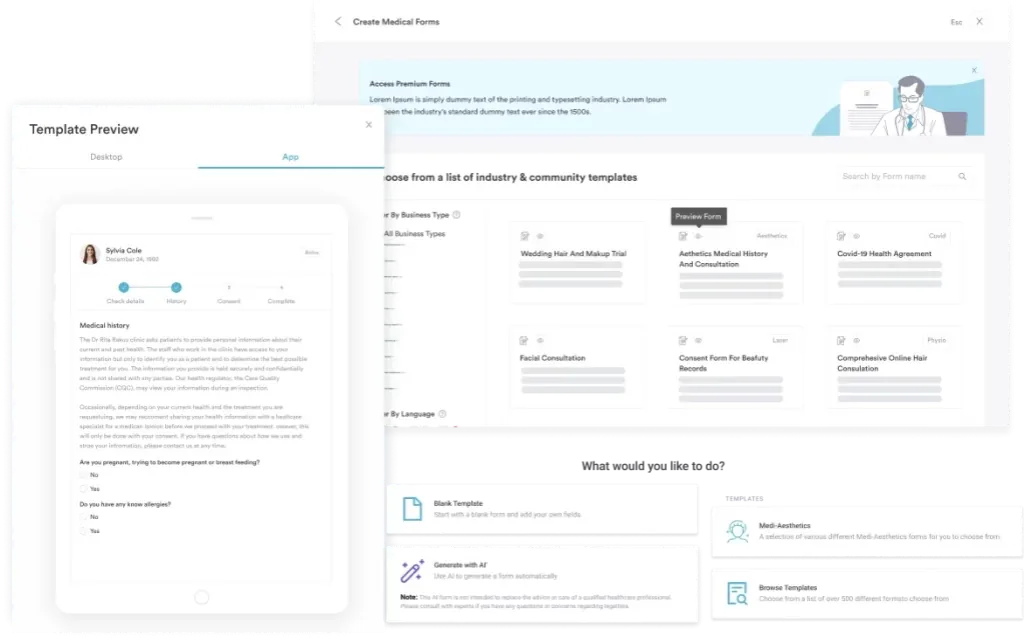
Training documentation. HIPAA training and workplace safety training both have to be evidenced. Set recurring tasks in team management tools so each person completes their modules and confidentiality agreement, then mark the completion in their record.
Discipline and performance. When you issue a warning or a corrective action, record it against the staff member and cite the handbook section it rests on. That trail shows you followed your own stated procedure, which is the first thing a tribunal or an employment attorney asks to see.

Collect handbook acknowledgments through digital forms, track who has completed HIPAA and safety training, and file warnings against the staff member they belong to. Your compliance evidence stays where an inspector can find it.

A handbook does not manage your people for you. It settles the questions that would otherwise get answered differently by each manager. And it gives you a documented position when someone challenges a decision you made.
Download the template, spend an afternoon replacing the bracketed fields, and have an employment attorney or HR adviser read it before it goes out. The cost of that review is small next to one mishandled dismissal.
Then keep it current. Review it every year, reissue it when the law moves, and store each signed acknowledgment somewhere you can retrieve it in a minute. Book a demo to see how Pabau keeps handbook sign-off and staff training records in one place.

Need to document the conversation before a formal warning? Employee counseling form gives you a record of the informal stage your disciplinary section describes.
Still writing rotas by hand? Employee work schedule template gives the attendance section of your handbook something concrete to point at.
Adding restrictive covenants to an employment contract? Physician non-compete agreements explains what those clauses can and cannot restrict in a medical practice.
Working out how to pay the team accurately? Best healthcare payroll software compares the systems that handle the pay schedule your compensation section commits to.
No single US federal law mandates a handbook, but several of the policies inside it must legally be communicated, including FMLA, OSHA, and EEO. The UK mandates no handbook either. A written statement of employment particulars is a legal requirement there from day one, under the Employment Rights Act 1996. Every employer should have one regardless.
A complete handbook covers seven core sections. The first four are the introduction and employment statement, the code of conduct, leave and attendance, and compensation and benefits. The remaining three are confidentiality and data privacy, workplace safety, and disciplinary procedures and termination. Healthcare practices add clinical governance policies and patient data handling procedures on top of those.
Review it annually, and again whenever employment law changes, such as new HIPAA guidance, a change to state leave entitlements, or a wage increase. Update within 30 days of any policy change and tell all staff. Keep a version history so you know which version each employee received and acknowledged.
No. A signed acknowledgment proves the employee received and understood the handbook. It does not turn the handbook into a binding employment contract unless you explicitly state otherwise. In at-will US jurisdictions you can still change policies or end employment. In the UK, the handbook can form part of the contract, so changes require agreement or proper notice.
Document HIPAA training and confidentiality obligations under 45 CFR 164.530, and reference OSHA injury reporting for medical offices. Include an EEO statement listing protected classes per EEOC guidance. State that employment is at-will, with any state-law caveats, and give FMLA notice if you employ 50 or more staff. Have an employment attorney licensed in your state review the result.
Provide a written statement of employment particulars covering job, hours, pay, reporting line, and notice periods. Follow the ACAS Code of Practice for discipline and grievance, since failing to do so raises unfair-dismissal awards. Comply with the Equality Act 2010 and GDPR, and reference CQC if your practice is regulated. Have a UK employment solicitor review it.
It is not advisable. Generic templates miss the healthcare-specific requirements: HIPAA confidentiality, clinical conduct standards, patient-safety protocols, and infection control. They also skip regulated-activity oversight from CQC in the UK or medical boards in the US. A healthcare-specific template covers the compliance risks that come with treating patients.