OSHA respirator medical evaluation questionnaire
The OSHA respirator medical evaluation questionnaire is the mandatory health for...

3
Last Updated: Oct 15, 2026
Clinical communication and collaboration is the structured exchange of information between healthcare professionals that keeps care teams aligned, patients safe, and treatment moving.
According to The Joint Commission, communication failures are the leading root cause of sentinel events in US healthcare. Its published sentinel event reviews have attributed roughly two-thirds of serious adverse outcomes to a communication breakdown.
For practice owners and managers, that finding lands close to home. It shows up as the missed handover note, the unanswered page, and the intake form that never reached the treating clinician.
This guide covers what clinical communication and collaboration means day to day, and which platforms and tools support it. It also shows how a private practice can fix its weakest handoffs without enterprise-scale infrastructure.

Clinical communication and collaboration covers the full range of information exchange between care team members, not just messaging apps.
Joint Commission sentinel event reviews attribute roughly two-thirds of serious adverse outcomes to communication failures.
CC&C platforms add HIPAA-compliant secure messaging, on-call scheduling, and EHR integration on top of existing clinical systems.
Private practices benefit most from practice management tools that embed communication in the same workflow as patient records and scheduling.
Pabau’s built-in team notes, task assignment, and automated workflows replace fragmented communication for practices of up to 50 practitioners.
Clinical communication and collaboration, often shortened to CC&C, is the end-to-end system by which physicians, nurses, allied health professionals, and support staff share patient information.
It also covers how they coordinate decisions and escalate concerns across a care episode. A group chat does not cover it. The term takes in verbal handovers, electronic messaging, alert systems, task assignment, and the documentation trails that make clinical decisions auditable.
The distinction matters because most healthcare teams already communicate constantly. Messages get sent all day. What decides patient safety is whether each one arrives quickly, reaches the right person, and carries enough context to act on.
A nurse pages a physician and waits 40 minutes for a callback. A physician sends a referral letter by fax with no confirmation it arrived. A coordinator writes a treatment note in a paper file that the next practitioner never opens. All three are communication failures, even though communication technically happened.
Communication that is timely, documented, and routed to the right person is what clinical teams and software vendors mean when they talk about CC&C.
AHRQ’s TeamSTEPPS research identifies poor interprofessional communication as a primary contributor to medication errors, delayed diagnoses, and preventable readmissions. The Joint Commission’s sentinel event data points the same way. Communication breakdowns turn up in the root cause analysis of most reported adverse events, year after year.
Three consequences bring the stakes home for practice operators.
For private practices, the financial side adds pressure. A single patient complaint traced to a communication failure can trigger a regulatory review, a refund, and lasting reputational damage. Money spent on better communication infrastructure comes back as reduced risk, not just as better care.
Most clinicians can name the obstacles without prompting, because they live with them every shift. Understanding the structural causes helps practice managers fix them at the system level. The alternative is blaming individual practitioners for problems the system creates.
One pattern links most communication failures. There are too many channels, too many alerts, and no single authoritative source for a patient’s status. That load is a documented driver of burnout in healthcare, and tired staff drop more information at handover.
A clinical communication and collaboration platform is a software system built for healthcare team communication. It combines secure messaging, on-call scheduling, alert routing, and EHR integration in one HIPAA-compliant environment.
Three things separate it from a consumer messaging app. Messages are encrypted and auditable. Protected health information (PHI) is handled under regulatory standards. Routing follows clinical role and patient context rather than personal contact lists.
Knowing where staff messaging already sits in your systems makes it easier to see where a dedicated platform would fit. Enterprise platforms like TigerConnect and PerfectServe run on top of existing hospital EHRs such as Epic and Cerner.
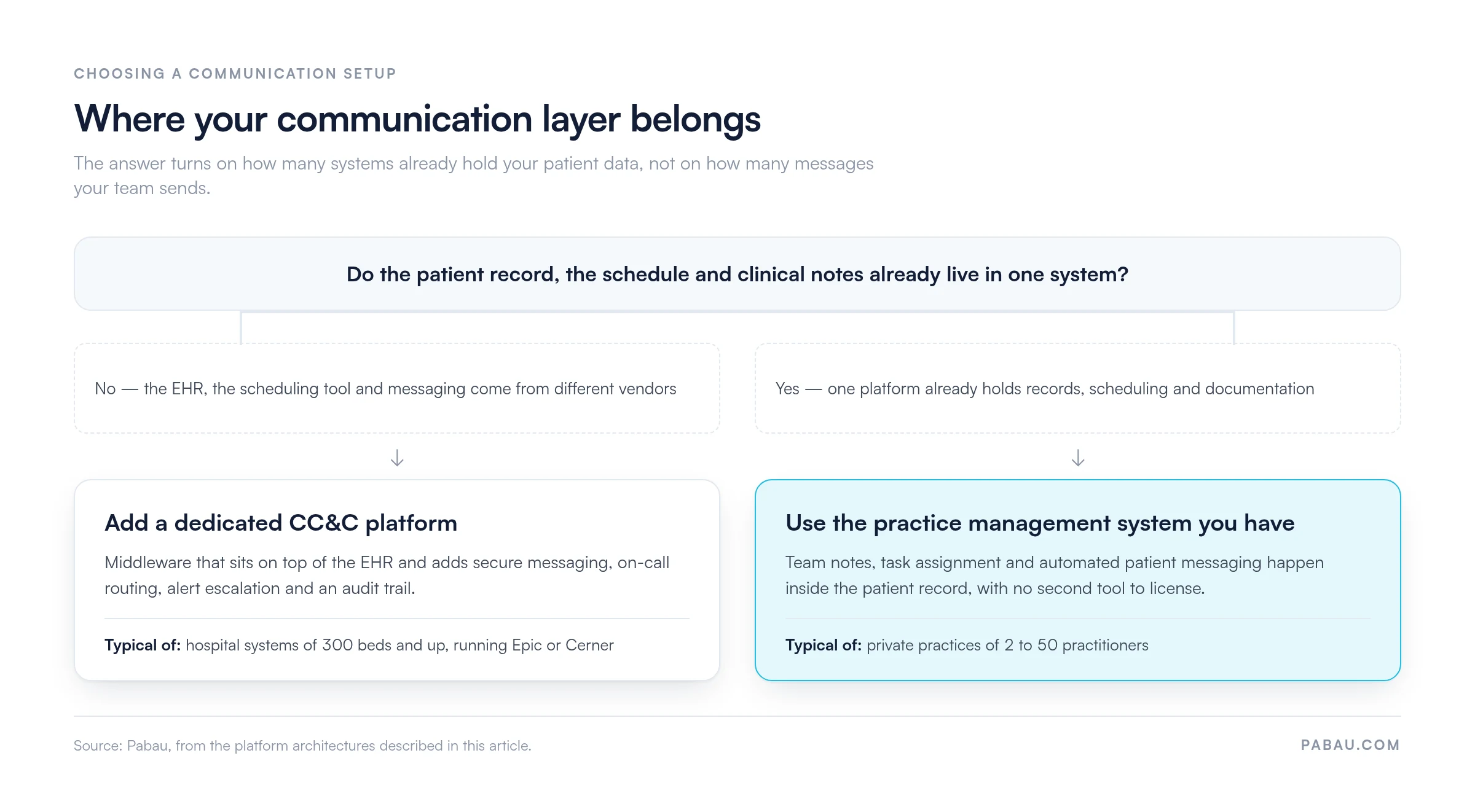
They add a communication layer the EHR does not provide. They are middleware. A 300-bed hospital running Epic still needs a separate tool for a nurse’s urgent query. That tool routes it to the right on-call physician, confirms delivery, and logs the exchange.
For a private practice with two to 20 practitioners, the architecture looks different. The communication problem is smaller, and solving it rarely calls for an enterprise platform. What these practices need is a practice management system where communication is native to the clinical workflow.
The choice comes down to one question about the systems you already run.
Before evaluating CC&C software, map your current communication flows: who sends what, to whom, and through which channel. Most private practices find they are running four to six parallel channels for the same patient. Email, WhatsApp, verbal updates, paper notes, and EHR messages all count. Consolidation, rather than addition, is usually the fix.
Not every practice needs every feature on this list. Its value is in showing which capabilities your current setup lacks, and where that shortfall creates clinical or operational risk. Most of them depend on EHR integration working properly.
Nurses carry the communication burden in most clinical settings. They are the connective tissue between patient, physician, pharmacist, and allied health. When the systems are inadequate, nurses absorb the friction. They chase physicians by phone, keep paper handover sheets alongside digital ones, and work through alarm volumes high enough to cause desensitization.
Structured electronic communication tools change that pattern. A message that is delivered, confirmed read, and escalated automatically when nobody answers takes the chasing away. The nurse stays with the patient instead of working the phones.
For shift handovers, CC&C platforms hold structured digital handover notes that the incoming team can read before the outgoing shift ends. Verbal-only handovers lose information even when they follow SBAR (Situation, Background, Assessment, Recommendation). A written structured handover keeps what the spoken one drops.
Secure clinical messaging is HIPAA-compliant encrypted communication of protected health information between authorized care team members. It answers a problem that became acute once smartphones reached clinical settings. Clinicians defaulted to WhatsApp and SMS because both are fast and familiar, and neither is legally permissible for PHI.
HHS guidance on HIPAA and texting is clear: standard SMS isn’t suitable for sending PHI unless proper security measures are in place. WhatsApp’s end-to-end encryption helps protect messages, but it doesn’t cover requirements like audit trails and Business Associate Agreements.
Using either platform for patient information would require extra safeguards and proper logging, which standard accounts don’t typically provide.
The practical consequence for many practices is risk nobody has measured. Staff reach for consumer messaging apps because no compliant alternative exists in the workflow. Putting a compliant channel inside the system they already use shuts that route off. It also asks clinicians to change very little about how they work.
Artificial intelligence is entering clinical communication from two directions. Ambient documentation is one, and intelligent alert prioritization is the other. Both address problems that conventional software has not solved.
Ambient documentation uses AI to listen to clinical conversations and generate structured notes automatically. When a physician finishes an examination, the AI has already drafted the SOAP note, and the physician reviews and signs it. The note exists without the clinician stopping to write it. Practice management software like Pabau now builds this in. Pabau Scribe, our AI scribe, drafts the note inside the record the appointment already sits in.
Intelligent alert prioritization reduces alarm fatigue by managing alerts more effectively. Rather than pushing every alert to every relevant clinician at the same priority, AI-driven routing scores alerts by urgency, patient acuity, and clinician availability.
It then sends each one to the most appropriate available recipient. This is mostly a hospital-system problem today, though the underlying technology is reaching practice management platforms as it becomes affordable at smaller scale.
For a private practice reviewing its communication stack in 2026, one question matters more than any enterprise CC&C roadmap. Is the software you already run investing in documentation AI that cuts the communication overhead of clinical work? That is where the near-term value sits.
The right approach depends heavily on practice type and size. A 500-bed hospital and a five-practitioner aesthetic practice have almost no overlapping requirements. Before you compare vendor features, answer these four questions to work out which category of tool you need.
For most private practices under 50 practitioners, the shortlist should start with all-in-one practice management software that includes communication natively. Dedicated CC&C platforms come second, because they need integration work and extra licensing. The simpler option is usually the one clinical teams keep using.
Run a 30-day communication audit before you buy any CC&C platform. Track how many channels your team uses for patient-related communication, and how often information from one channel fails to reach the people who need it. Write your requirements from that data, not from a vendor’s feature list.
Enterprise CC&C platforms solve an enterprise problem. They connect communication across large hospital systems where the EHR, the scheduling tool, and the communication layer come from three different vendors.
Private practices in aesthetics, physical therapy, primary care, and wellness do not have that problem. Theirs is that communication happens outside the clinical record, in WhatsApp threads, corridor conversations, and sticky notes on a monitor.
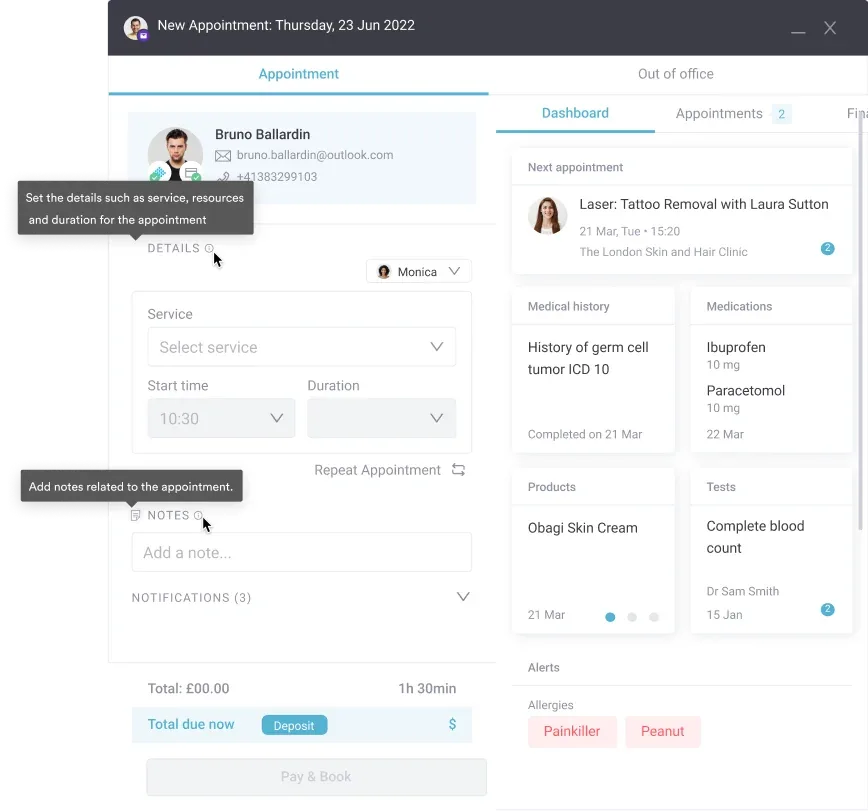
Pabau takes a different route. It already holds the patient record, the schedule, and clinical documentation, so most private practice workflows need no separate communication layer. A practitioner adds a note to the patient record, and every team member with access to that record sees it. Tasks are assigned in the same system.
Three areas make the biggest difference to how a private practice team communicates.
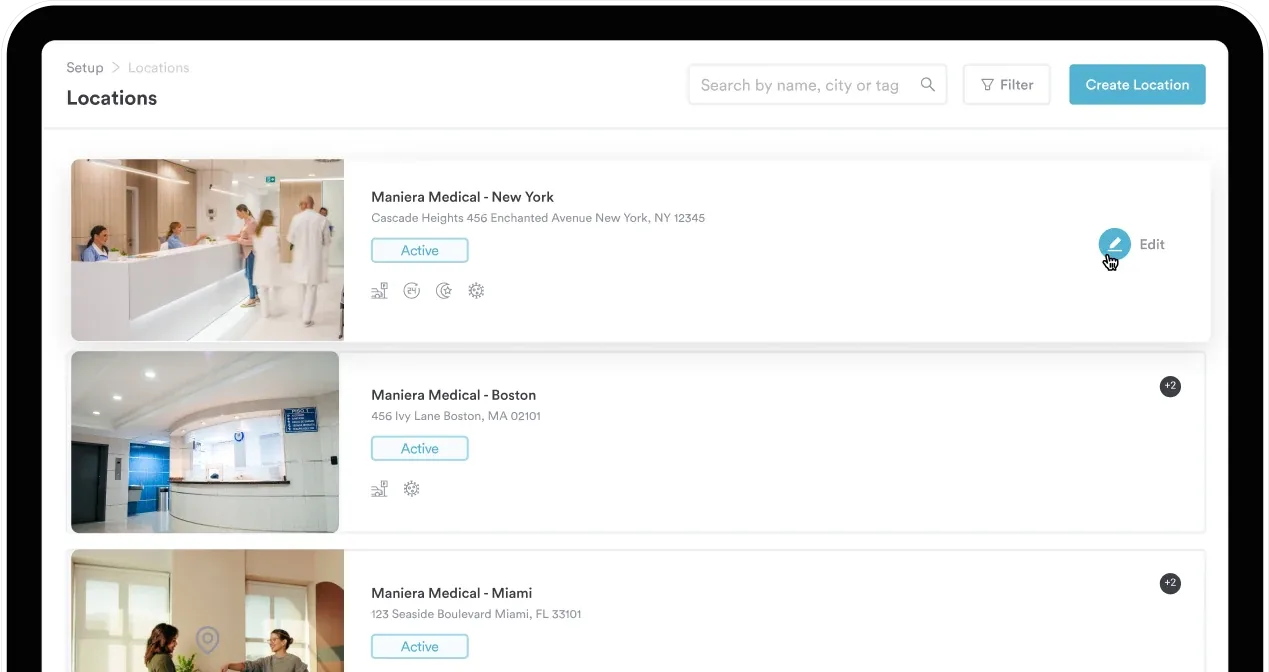
For multi-location practices, team visibility stays consistent across sites. A practitioner at one site sees a patient’s full record, the notes, and the outstanding tasks logged by the team at another. Nobody has to message between locations.
Clinicians moving between treatment rooms read and update the same notes from the practice management app on their phone. Nobody has to walk back to a desk to find out what the last practitioner wrote.
The pattern behind all of it is consolidation. Fewer channels, more context, and one record that holds the notes, the tasks, and the schedule.

Pabau brings patient records, team notes, task assignment, and automated workflows into one place. Your clinical team communicates in context instead of across parallel channels.

Communication failures remain the most preventable cause of clinical adverse events, and fixing them is a systems job rather than a training job. Most private practices get further by making documented, in-context communication the default inside the system they already run. Bolting an enterprise CC&C platform on top rarely earns its cost at that size.
Start by writing down where communication currently happens, then shut the channels that leave no record behind. The practices that see the biggest change are the ones that cut channels rather than adding one more.
Pabau’s team notes, task assignment, automated workflows, and patient records make communication part of every clinical interaction instead of a parallel activity. Book a demo to walk through the handover and task workflows with our team.

Moving consultations online as well? HIPAA-compliant telehealth platforms compares the tools that keep remote consultations inside the same compliance boundary as your messaging.
Coordinating a team across more than one site? Best clinic management software for multi-location practices looks at how each option shares records and tasks between locations.
New to this category of software? What is practice management software explains what one system covers, and where communication features sit inside it.
A clinical communication and collaboration (CC&C) platform is a HIPAA-compliant software system that combines secure messaging, on-call scheduling, alert routing, and EHR integration. It enables structured, auditable communication between healthcare team members. It differs from general business tools by encrypting PHI, enforcing role-based access, and maintaining the timestamped audit trails clinical regulators require.
Clinical communication is the exchange of patient-relevant information between healthcare professionals, including verbal handovers, electronic messages, clinical notes, alerts, and task assignments. Effective clinical communication is timely, documented, and routed to the person who needs it, which is what separates it from general workplace communication.
Nursing teamwork and collaboration directly affects patient safety, because nurses coordinate between physicians, pharmacists, allied health, and patients across every care episode. When nurses cannot communicate efficiently, response times to deteriorating patients slow, handover information is lost between shifts, and medication errors increase. Structured CC&C tools reduce these risks by making escalation and handover reliable and documented.
Secure messaging replaces one-way paging and non-compliant consumer apps with HIPAA-compliant two-way communication. It confirms delivery, logs exchanges against patient records, and routes urgent messages to the correct on-call clinician automatically. The result is faster escalation, fewer missed communications, and a complete audit trail for every patient interaction.
The category covers dedicated CC&C platforms such as TigerConnect or PerfectServe, and practice management systems with built-in communication features such as Pabau. The right choice depends on practice size and complexity. Large hospital systems typically need dedicated middleware, while private practices benefit most from one system where communication is native to the patient record.