Intake note template
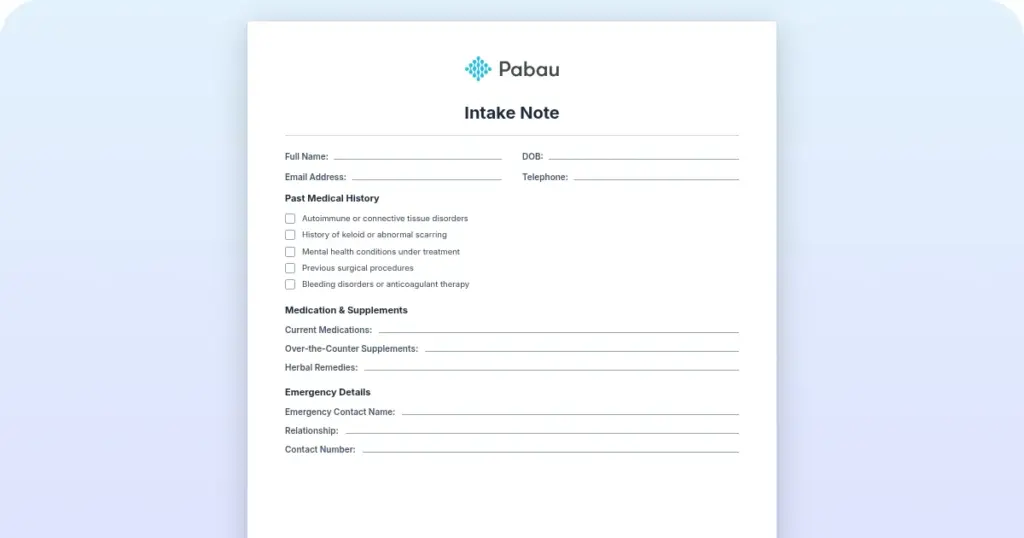
An intake note is the clinical record a therapist or counselor writes at the sta...

2
Last Updated: Oct 22, 2026
The Beck Hopelessness Scale (BHS) is a 20-item self-report questionnaire that measures negative expectations about the future in adults and adolescents.
Dr. Aaron Beck developed it in 1974 to assess hopelessness, a thinking pattern central to depression and a significant predictor of suicidal ideation. Clinicians use it in inpatient psychiatric units, outpatient therapy, crisis assessments and research to measure how pessimistic a patient is about the future.
The scale takes 5 to 10 minutes to complete. Each answer in the hopeless direction scores 1 point, for a total between 0 and 20. A score of 9 or higher warrants a formal suicide risk assessment, and higher scores track with later suicide attempts in longitudinal studies. This guide covers the scale’s structure, scoring, psychometric properties and place in your clinical workflow.
A printable questionnaire listing all 20 BHS statements with true and false response options, plus a one-week recall instruction for the patient. A hopelessness score field at the end records the clinician’s total.
Download template
The Beck Hopelessness Scale is a 20-item, true/false self-report measure of negative expectations about the future, validated for depression and suicide risk screening.
Scores range from 0 to 20, and a score of 9 or higher signals moderate-to-severe hopelessness that calls for a formal suicide risk assessment.
The BHS has three conceptual dimensions (affective, motivational and cognitive), excellent internal consistency (Cronbach’s alpha around 0.90 to 0.93) and strong predictive validity.
Pabau’s digital forms save the completed BHS to the patient record for the clinician to score. Pabau Scribe turns each session into a structured note.
The Beck Hopelessness Scale is a psychometric instrument that quantifies the thinking and emotional sides of hopelessness. Specifically, it measures negative expectations about the future and loss of motivation. Aaron Beck, a pioneering cognitive theorist, developed it in 1974 as part of his cognitive model of depression. That model holds that distorted thinking about the future is central to depressive episodes.
Broad depression screeners sample many symptoms at once. The BHS targets a single construct instead: the belief that future events will be negative and that personal effort won’t change them. That focus makes it valuable for assessing suicide risk, because hopelessness is one of the strongest cognitive predictors of suicidal behavior. Pearson Clinical Assessments publishes the BHS, and it remains one of the most widely used hopelessness measures.
The BHS consists of exactly 20 statements, each answered true or false. Respondents mark whether each statement applies to them, based on how they have felt over the past week, including today. The items cover future pessimism, loss of motivation, expectations of harm and the inability to achieve goals.
The BHS is usually scored as a single total, but research has identified three conceptual dimensions within the 20 items. Knowing them helps clinicians read which kind of hopelessness a patient is experiencing.
A patient scoring high on the affective dimension may present with depressed mood and emotional withdrawal. High motivational scores suggest learned helplessness and loss of agency. High cognitive scores point to rigid negative thinking about the future. These dimensions are useful for interpretation, but most clinicians rely on the total score for screening and risk assessment.
Scoring the BHS is simple. Each answer that matches the hopelessness key scores 1 point, and every other answer scores 0. For 11 statements the keyed answer is true. For the nine hopeful statements, such as “I have great faith in the future,” the keyed answer is false. Totals run from 0 to 20, and higher scores mean more severe hopelessness.
The most clinically important property of the BHS is its validated ability to predict suicidal behavior. Beck’s longitudinal research found that hopelessness predicted suicide attempts and deaths more strongly than depression severity alone. A score of 9 or above is linked to significantly elevated suicide risk and warrants an immediate structured risk assessment. The ruler below shows where that cutoff sits across the four severity bands.
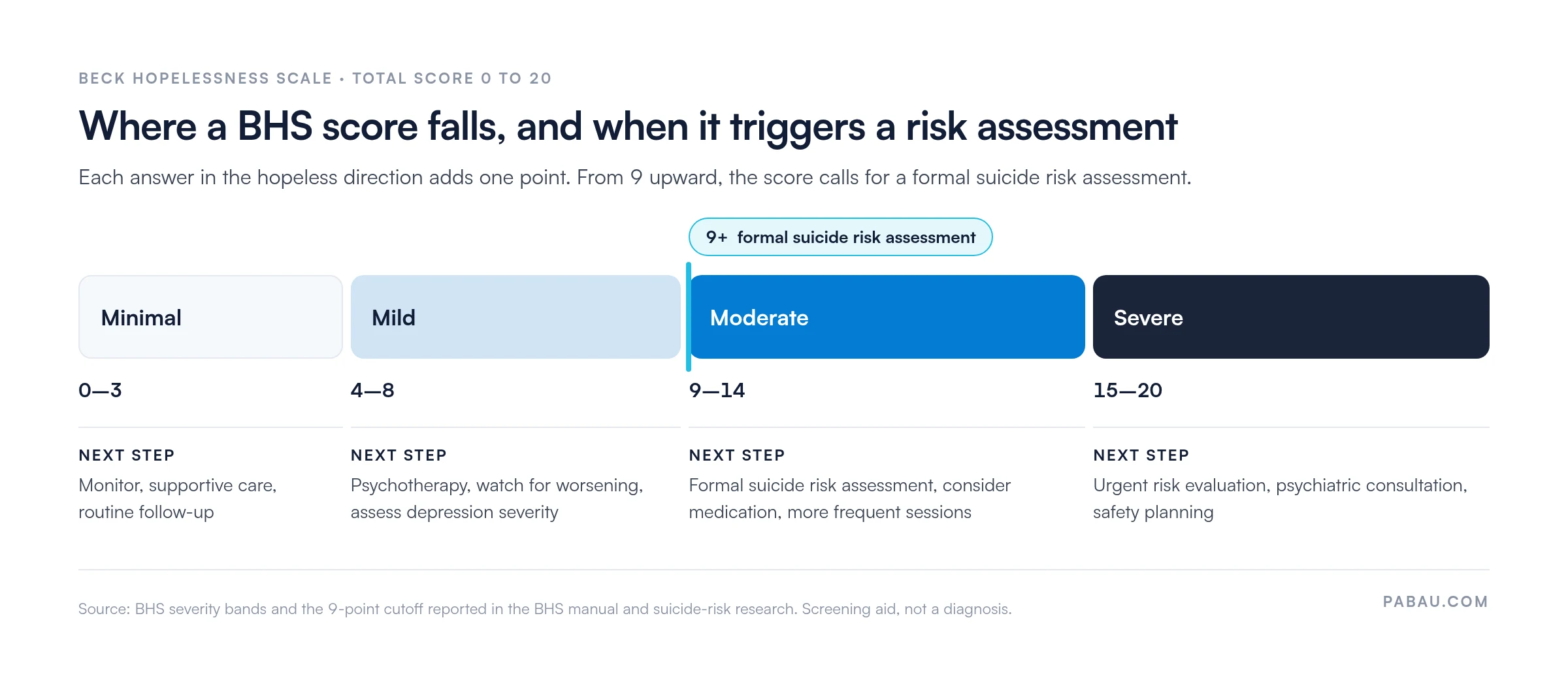
Use the BHS as one part of a full suicide risk evaluation, never as a standalone decision tool. Combine the score with a clinical interview, access to means, recent stressors and protective factors. A suicide risk assessment checklist keeps those elements consistent from one clinician to the next.
Stay alert to patients with hidden hopelessness who minimize their answers. Observable behavior and collateral information are essential here. When a score lands in the severe band, safety planning belongs in the same session. A written mental health safety plan gives the patient warning signs, coping steps and crisis contacts to use between appointments.
The BHS has extensive empirical support across diverse populations. Internal consistency is excellent, with Cronbach’s alpha typically reported between 0.90 and 0.93. That means the 20 items reliably measure a single underlying construct. Test-retest reliability is strong, so scores stay stable over time when hopelessness itself isn’t changing.
Convergent validity with the Beck Depression Inventory (BDI-II) is high, reflecting the close link between hopelessness and depression. The BHS also shows differential validity. It correlates more strongly with suicidal behavior than the BDI-II does, which supports its distinct role in suicide risk assessment.
The scale has been validated in adolescent and adult samples. It has also been tested in psychiatric hospitals, primary care and community mental health settings.
The BHS fits several points in the clinical workflow:
The BHS is most suitable for adolescents and adults, and validation data for younger children are limited. It works in individual therapy and inpatient psychiatric settings alike. Primary care clinicians screening for depression or suicide risk can add it to a routine mental health screen.
The BHS is a robust tool, but it has constraints. First, hopelessness is a subjective state. The scale relies on self-report, so answers are open to minimization or exaggeration depending on the patient’s candor and insight. A patient in denial about suicidal thoughts may score low while still at high risk.
Second, the BHS is a screening instrument, not a diagnostic tool. A high score indicates elevated hopelessness and warrants further assessment. It does not diagnose depression or predict suicide with certainty. Predictive value depends on base rates and the broader clinical context.
Third, copyright and licensing constraints apply. The BHS is proprietary to Pearson Clinical, and reproducing or administering it requires purchased test materials or a valid license. Some organizations restrict BHS use to licensed psychologists or psychiatrists.
Finally, cultural and linguistic validity varies. Most validation studies come from North America or Europe, so cross-cultural validity in non-Western populations is less well established. Item endorsement patterns may differ with cultural norms around future orientation and emotional expression.
Record the BHS score and date in the patient’s clinical record. Most practice management systems allow structured data entry for assessment scores.
Document the clinical interpretation alongside the score. A note might read: “BHS score 12 (moderate hopelessness). Patient reports pessimism about therapy and future employment. Formal suicide risk assessment completed, safety plan established.”
Link the result to the matching psychotherapy progress notes and any clinical actions taken. Those might include a psychiatry referral, a hospitalization review or a medication change. This creates a clear audit trail for risk management. It also demonstrates the standard of care if your documentation is later reviewed.
For patients on repeated BHS assessments, track the trajectory. A rising trend over several weeks signals worsening hopelessness, while a falling trend indicates treatment response.
Many mental health practices still hand patients a paper BHS, score it by hand and type the total into the record later. Paper copies get misfiled, and a score entered days later can’t inform a same-day risk decision.
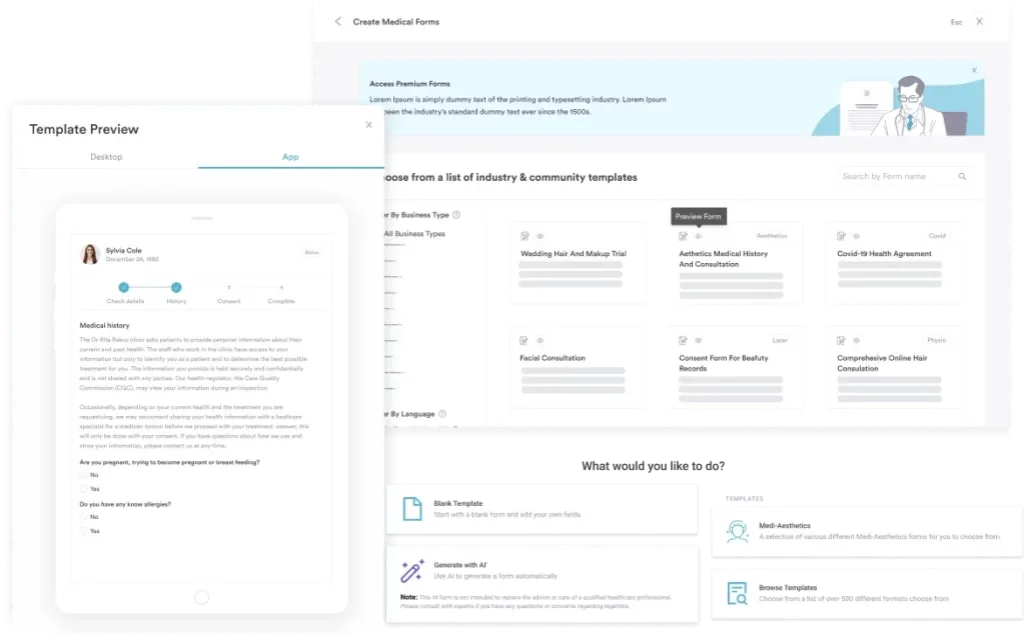
Pabau, the practice management platform we build, moves the questionnaire online. With Pabau’s digital forms, patients complete the BHS before or during their visit, and the completed form is saved to their patient record. The clinician then scores it, records the interpretation and compares it with earlier forms in the same file.
Pabau Scribe, our AI scribe, transcribes the session in real time and turns it into a structured clinical note, such as a SOAP note. Your score interpretation, the risk discussion and the safety plan end up in one note per encounter, with no retyping.
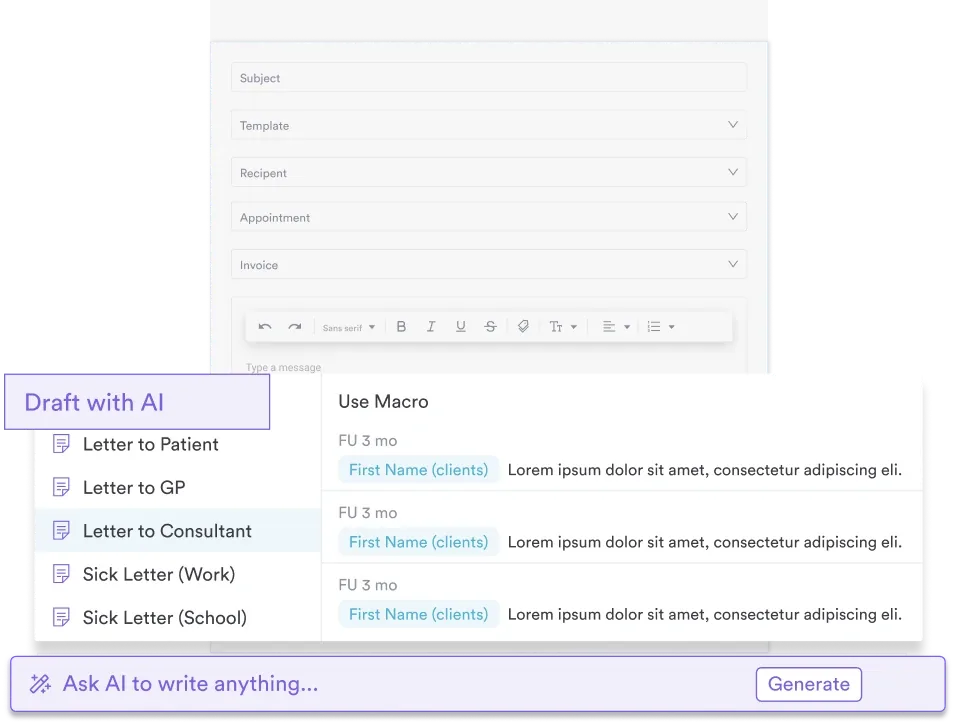
When a moderate or severe score calls for a referral, Pabau can draft the letter with AI from the patient’s record. You review it and send it.
Scheduling, billing and patient communication run in the same system. That gives you simpler therapy practice management instead of a patchwork of disconnected tools.

Send validated screening tools like the Beck Hopelessness Scale as digital forms, and keep every completed questionnaire and risk note in the patient record.

A BHS score earns its place when it changes what you do next. Treat 9 as the point where a structured suicide risk assessment begins. Never let a low score overrule what you observe in the room, because self-report is easy to minimize.
Repeat the scale on a set schedule, since one score is a snapshot and a trend tells you whether treatment is working. Book a demo to see how Pabau keeps each completed BHS, its interpretation and the session note together in the patient record.

Need a fuller intake for a high-risk patient? Psychiatric evaluation template walks clinicians through mental health history, diagnostic formulation and risk assessment.
Want to measure suicidal thinking directly? Suicidal ideation scale rates the frequency and intensity of suicidal thoughts alongside a hopelessness score.
Screening for depression at the same visit? PHQ-9 and GAD-7 template pairs the two most common depression and anxiety screeners in one form.
Tracking hope as well as hopelessness? Adult Hope Scale measures goal-directed thinking, a useful counterweight to a BHS score in therapy.
The Beck Hopelessness Scale measures the severity of negative expectations about the future in adolescents and adults. Clinicians use it to screen for hopelessness, assess suicide risk and monitor treatment response in depression and mental health care.
Each answer that matches the hopelessness key scores 1 point, and every other answer scores 0. Totals range from 0 to 20. Scores of 9 or higher indicate moderate-to-severe hopelessness and elevated suicide risk that warrant prompt clinical assessment.
Yes. Research by Aaron Beck and colleagues showed that hopelessness is a strong predictor of suicidal behavior, including attempts and deaths by suicide. A score of 9 or more is linked to elevated risk and calls for a structured risk assessment. It should never be used as a standalone prediction tool.
No. Pearson Clinical Assessments publishes the BHS, and it is proprietary. Clinicians and organizations must purchase test materials or obtain a valid license from Pearson to administer and reproduce the scale.
The Beck Depression Inventory (BDI-II) measures overall depression severity across mood, cognitive and physical domains. The BHS targets hopelessness and negative future expectations specifically. It predicts suicide risk more strongly than the BDI-II, which makes it especially valuable for risk assessment.
Scores of 9 to 14 indicate moderate hopelessness and warrant a formal suicide risk assessment. Scores of 15 to 20 indicate severe hopelessness and require urgent psychiatric evaluation, safety planning and possibly hospitalization.