Mental health self-care checklist
A mental health self-care checklist is a structured daily tool for tracking the ...

5
Last Updated: Oct 20, 2026
The checking the facts DBT worksheet is a clinical tool that helps patients test whether an emotional reaction matches the situation behind it. It takes the patient through four steps and ends on one question: Does this emotion fit the facts?
The skill belongs to the emotion regulation module of dialectical behavior therapy (DBT), developed by Marsha Linehan. Below you’ll find the free PDF, a session guide, two worked examples, and when to switch to opposite action.
Eight guided prompts walk the patient from a recent emotional episode to one small step for the week. A final box collects notes to bring to the next session.
Download template
Checking the facts is a DBT emotion regulation skill that tests whether an emotion fits the objective situation, before opposite action or problem-solving.
The four steps are the prompting event, the interpretations, an emotional intensity rating, and a judgment on whether the emotion fits.
The worksheet helps patients separate facts from thoughts, which lowers emotional reactivity when an emotion does not fit the situation.
In Pabau’s practice software, therapists send the worksheet as a digital form and see completed copies in the patient record.
Checking the facts is an emotion regulation skill within DBT that evaluates whether a patient’s emotional response is justified by the facts of the situation. When an emotion is too intense or aimed at the wrong target, the skill offers a structured way to compare interpretation with events.
The skill rests on a core principle: Emotions arise from our interpretations of events, not from events themselves. Two people in identical situations may feel very differently, depending on what they believe happened. Checking the facts puts a pause between the triggering event and the emotional response, so patients can judge whether their intensity matches the circumstances.
Linehan developed this technique within DBT’s emotion regulation module, originally for treating borderline personality disorder (BPD). Patients with BPD often experience intense, rapidly shifting emotions.
Today the skill is used in individual work, group skills training, community mental health, and private practice. The reason is that the principle applies universally: Emotions that fit the facts warrant action; emotions that do not fit warrant re-examination.
The emotion regulation module in DBT contains several interrelated skills, and checking the facts sits early in the sequence. The module’s logic flows like this:
This positioning makes checking the facts a gatekeeper skill. It answers one question: “Is my emotional response appropriate to what happened?” If yes, the patient moves to action-oriented skills. If no, checking the facts becomes the intervention itself.
As distorted thoughts are examined and softened, emotional intensity often drops without additional techniques. Patients who keep landing on the same thinking errors can work through them on a cognitive distortions worksheet.
The skill unfolds in four steps. Teaching patients this sequence, and practicing it repeatedly, embeds the skill so they can apply it on their own between sessions.
Patients who find a bare number abstract can pair the rating with a color-based intensity scale, which makes the before-and-after shift easier to see.
The power of this sequence is that it slows the automatic emotional response down. Instead of reacting immediately, patients pause to examine their thoughts before they decide how to act. The diagram below runs the workplace example from the next section through all four steps.
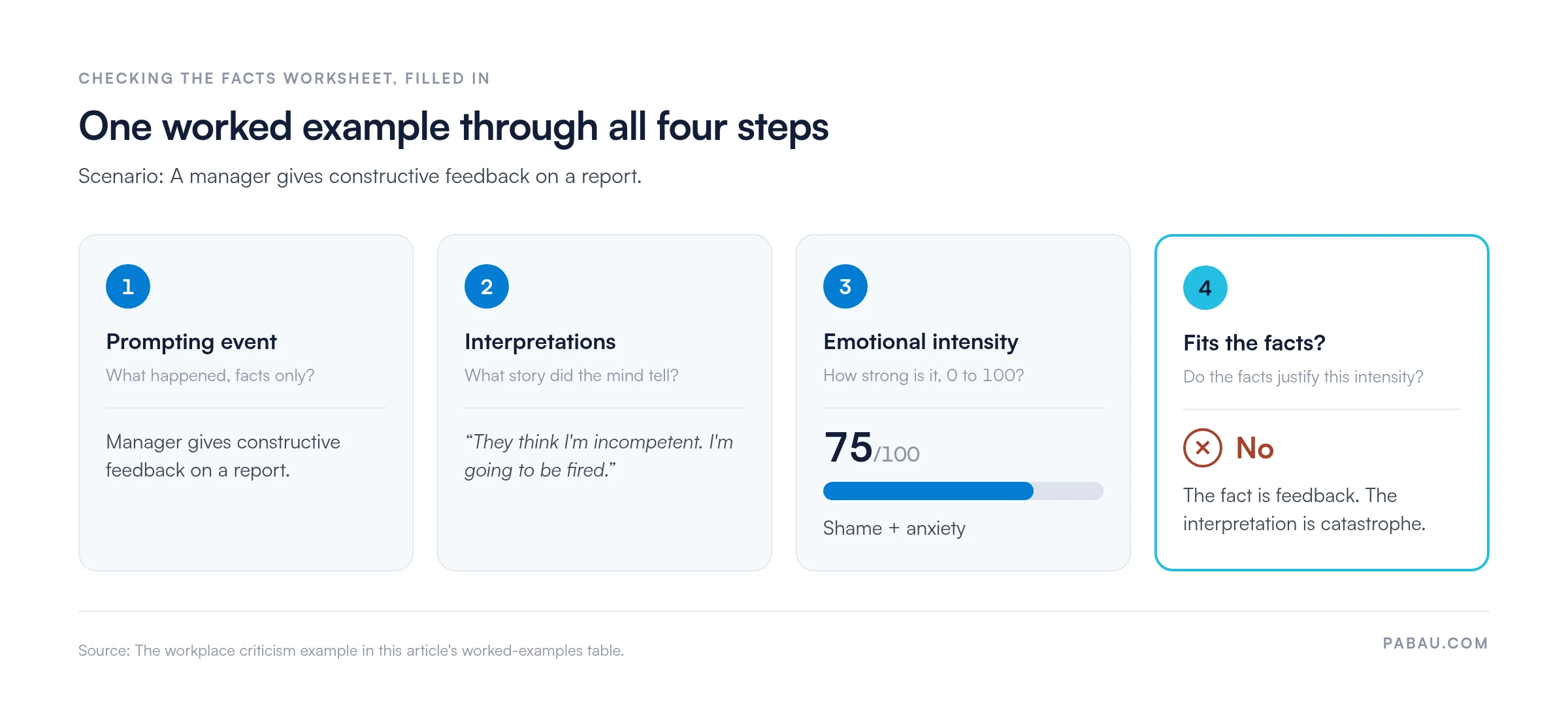
Concrete examples help therapists and patients see how the skill works outside the therapy room. Below are two scenarios showing checking the facts in practice.
In the first example, the emotion does not fit the facts at all, because the patient has catastrophized a routine feedback conversation. In the second, the emotion is partially justified (rejection is possible) but incomplete (busyness is equally possible).
Both examples show why checking the facts matters: It interrupts the automatic cascade from event to emotional certainty, and creates room for more balanced responses.
The worksheet turns the four-step skill into a fillable tool. Therapists introduce it during emotion regulation skills training, or whenever a patient’s reaction seems out of proportion to the triggering event.
Common in-session challenges: Patients who struggle to separate facts from thoughts need practice with non-emotional examples first. “It is raining” is a fact, while “the weather is ruined” is an interpretation. A fact or opinion worksheet drills the same distinction with neutral statements.
Patients who rate the emotion but see no shift need reassurance, because checking the facts prevents escalation rather than resolving it instantly. Some patients use the worksheet to avoid action. For them, frame it as a decision tool: If emotion fits, take action; if not, use opposite action to shift mood.
The worksheet works on paper or as a digital form sent through the Client Portal. Its eight prompts move from a recent example to the smallest step the patient could take this week. Therapists can add the four steps above as practice-specific instructions, or adapt the layout to their branding.
A common question in DBT training is: When do I teach checking the facts versus opposite action? The distinction is straightforward, and the outcome of checking the facts itself decides it.
The decision tree is clear: Check the facts first. The outcome determines which emotion regulation skill comes next. This sequencing prevents common errors, like using opposite action on a justified emotion when the situation itself needs solving.
It also stops patients ruminating on distorted interpretations when opposite action would be faster. When the outcome points to opposite action, the opposite action worksheet takes the patient through that skill in the same format.
DBT therapists running individual sessions, skills groups, or multi-week modules hand out a steady stream of worksheets. On paper, completed copies come back late, crumpled, or not at all. Tracking who finished their homework before the next session becomes a job of its own.
Pabau is therapy practice management software that moves this workflow online. Therapists store the checking the facts worksheet and other DBT handouts as digital intake forms, ready to send in a couple of clicks.
Patients open them through the Client Portal and complete them before the session. Each finished worksheet is stored with the patient’s medical records, so you can compare intensity ratings from week to week.
For skills groups, automated workflows remind patients to complete their homework between sessions. You spend session time on the debrief instead of chasing paper.

Pabau sends the checking the facts worksheet as a digital form, reminds patients to finish it, and stores each completed copy in their record. You start every session with the homework already on file.

Start with the worksheet on the next emotion that seems too big for its trigger, and rate the intensity before and after. That before-and-after number is the patient’s own evidence that the skill works, and it keeps them doing the homework.
The trade-off is time. Checking the facts is slower than reassurance in the moment, and it rarely settles an emotion instantly. What it builds is a habit patients can run alone, plus a clear signal for whether opposite action or problem-solving comes next.
Book a demo to see how Pabau sends DBT worksheets, reminds patients to finish them, and keeps each one in the patient record.

Building a full DBT skills plan? DBT therapy worksheet gives patients a structured DBT handout to work through between sessions.
Want daily data between sessions? DBT diary card tracks emotions, urges, and the skills a patient used each day.
Working on emotion regulation more broadly? Emotional regulation worksheet helps patients name an emotion and plan a steadier response.
Is the emotion a crisis rather than a misfit? DBT distress tolerance skills explains the crisis-survival skills that sit alongside emotion regulation in DBT.
Does the patient treat feelings as proof? Emotional reasoning worksheet targets the “I feel it, so it must be true” thinking that checking the facts also challenges.
Checking the facts is an emotion regulation skill that evaluates whether an emotional response matches the objective situation. It examines the prompting event (what happened), the interpretations (what you thought), and the emotional intensity (how strongly you felt). It then assesses whether the emotion fits the facts or rests on distortion.
Therapists introduce the worksheet when a patient experiences an intense emotion. Complete four steps together: Identify the prompting event (facts only) and list interpretations (thoughts about the event). Then rate emotional intensity (0-100) and decide whether the emotion fits the facts. Use it in session and assign as homework for independent practice.
Checking the facts comes first and tests whether an emotion fits the facts. If it does not fit, opposite action comes next: The patient acts against the emotion’s urge, such as approaching a feared situation. If it does fit, problem solving changes the situation. Opposite action can still help when acting on a justified emotion wouldn’t be effective.
Yes. Once you have learned the skill from a therapist, you can use the worksheet independently whenever you notice an intense emotion. Many people find that writing through the four steps slows their automatic emotional reaction. It also shows whether the emotion matches the situation or rests on a worry.
No, although the two overlap. Checking the facts is simpler and focuses on whether an emotion fits the facts. Cognitive distortion worksheets typically list specific thinking errors, such as catastrophizing and mind-reading, and challenge them directly. Both tools examine interpretations, but checking the facts is faster and emotion-focused.