Mental health self-care checklist
A mental health self-care checklist is a structured daily tool for tracking the ...

5
Last Updated: Oct 20, 2026
A stress worksheet is a structured form that helps patients name their stress triggers, spot their warning signs, and choose coping strategies.
The free PDF below covers all five parts on one worksheet, from triggers to a one-week action plan.
Therapists, counselors, occupational health teams, and coaches use it to turn a vague “I’m stressed” into something specific the patient can act on. Patients can complete it in session or at home. Either way, you both come away with a shared language for every check-in that follows.
The Managing Stress Worksheet walks patients through their triggers, a physical, emotional, cognitive, and behavioral symptom checklist, and the fight-or-flight response. It closes with coping options and a one-week action plan.
Download template
A stress worksheet helps patients name their triggers, recognize their symptoms, and choose personalized coping strategies.
It covers physical, emotional, cognitive, and behavioral stress signs, plus relaxation and problem-solving techniques drawn from CBT and mindfulness.
Completing it together in session gives you a structured record to compare at later reviews.
The session ends with one coping commitment for the coming week, which moves the patient from awareness to action.
Pabau’s digital forms let patients complete the worksheet before a session, with their answers saved to their record.
A stress worksheet is a guided assessment form that moves a patient from general stress to named triggers and concrete next steps. It asks them to pin down what sets their stress off and how it shows up in body, mood, thinking, and behavior. The final sections turn that picture into coping strategies and a commitment for the week ahead.
Therapy practices, occupational health services, wellness centers, and coaching practices all use them. The form works as an assessment tool and as patient education at the same time. It normalizes the stress response while building the patient’s confidence that they can do something about it.
The Managing Stress Worksheet is built around five sections:
Stress runs from short, event-driven spikes to long-term overload. Knowing which type the patient is dealing with tells you which part of the worksheet to lean on:
Spotting stress early can help stop it from escalating into anxiety disorders, burnout, or physical health problems. The worksheet helps you and the patient identify the cluster of signs that belongs to them:
Naming these signs in session builds metacognitive awareness. Patients start to notice stress as it builds, instead of only recognizing it in hindsight. If you want a score to track alongside the checklist, the Perceived Stress Scale gives you a short measure to repeat at each review.
Run the worksheet as a shared conversation in five steps. The flow below shows which part of the sheet each step fills, and the list explains how to handle it.
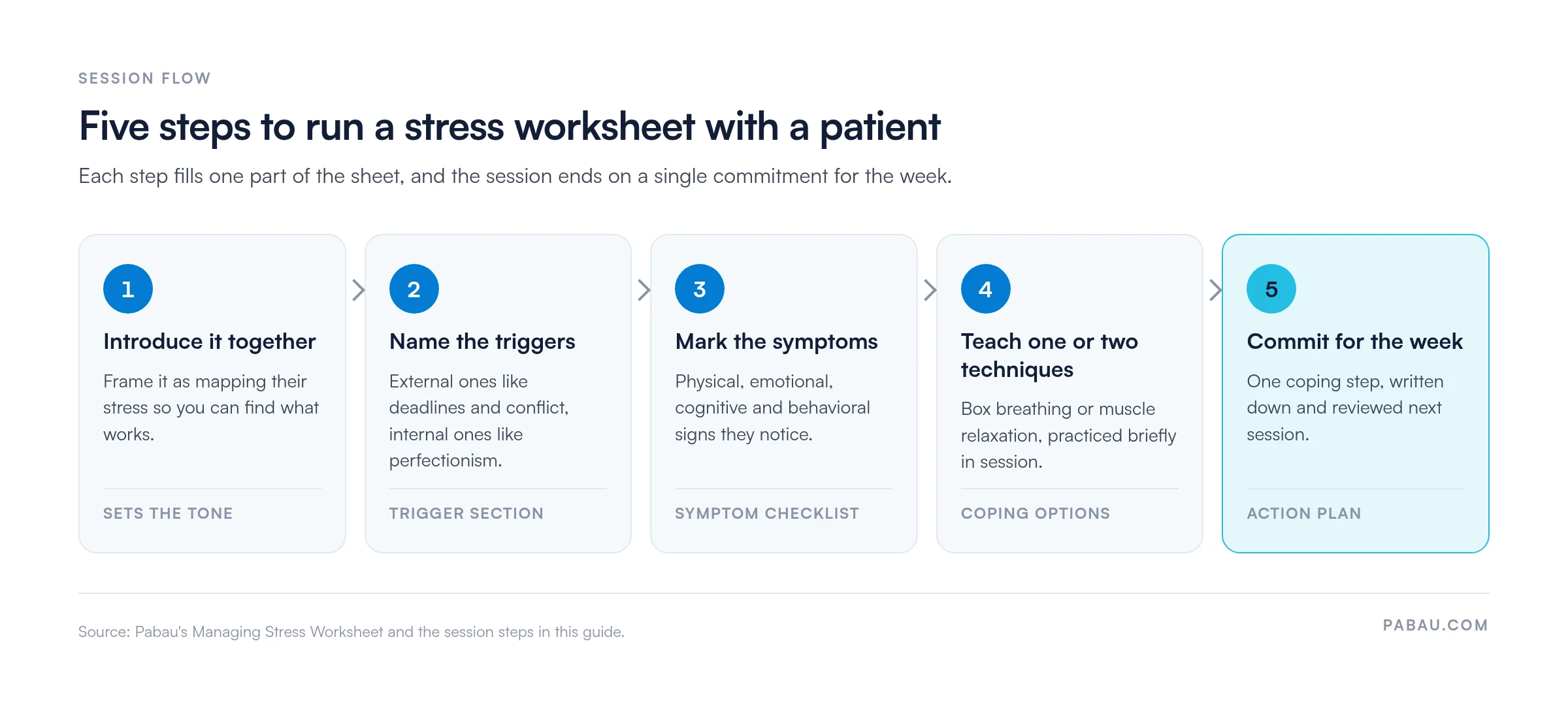
Store completed worksheets in the patient record alongside your session notes. You can then track stress patterns over time and point out progress when it happens.
The worksheet draws on cognitive behavioral therapy (CBT). CBT helps patients break the loop where a trigger sparks automatic thoughts that feed more stress. Three elements carry that approach:
Once patients start writing down the thoughts behind their triggers, a cognitive restructuring worksheet takes the next step of weighing those thoughts against the evidence.
The worksheet introduces five evidence-based techniques:
For in-session practice, our progressive muscle relaxation script gives you ready-made wording to read aloud, one muscle group at a time.
Adults often carry stress from work, caregiving, money, and health all at once. When you use the worksheet with adult patients, keep these patterns in mind:
Paper worksheets work, but completed copies tend to end up in a folder that nobody opens at the next review. Moving the form online keeps each completion attached to the patient it belongs to.
Pabau, the software built for therapists and other mental health practices, lets you rebuild the worksheet as one of your digital intake forms. Patients complete it through the Client Portal before a session or ahead of a telehealth appointment. Their answers save to their record, so earlier completions sit beside the new one at each review.
Automated workflows send the worksheet as part of intake or after a difficult session, so it goes out without manual reminders. Pabau Scribe, our AI medical scribe, can turn your discussion of the completed worksheet into structured session notes automatically.
Want to see how digital forms and patient records work together for stress assessments? Book a demo with Pabau.

Pabau sends the worksheet through the Client Portal and saves every answer to the patient record. You can compare completions at each review without chasing paper copies.

Start with one patient who describes their stress in vague terms, and complete the worksheet with them in session instead of sending it home cold. The trigger and symptom sections land better when you fill them in together.
The payoff shows up at the second and third reviews. You can point to the triggers they named, the coping step they chose, and whether it held up in a hard week. The trade-off is session time, so plan the first pass as a main activity rather than a quick add-on at the end.
Book a demo to see how Pabau sends the worksheet before sessions and keeps every completed copy in the patient record.

Want patients to build a wider toolkit? Coping skills worksheet helps patients build a personal list of coping strategies.
Need to dig deeper into what sets stress off? Identifying triggers worksheet helps patients pin down what sets off their strongest reactions.
Looking for a quick in-session rating? Stress thermometer template gives patients a simple visual scale for rating their stress.
Teaching breathing techniques? Breathing exercises handout gives patients breathing exercises to practice at home.
Working with patients who spiral into worry? Grounding techniques worksheet offers exercises that bring attention back to the present moment.
A stress worksheet is a structured assessment tool that helps patients identify their stress triggers, recognize physical and emotional symptoms, and develop personalized coping strategies. It draws on evidence-based techniques like CBT and mindfulness.
Introduce the worksheet collaboratively and complete the trigger and symptom sections together in session. Teach one or two evidence-based coping techniques, then ask the patient to commit to one strategy this week. Store completed worksheets in their record to track patterns over time.
Stress worksheets vary by approach (CBT-based, mindfulness-based, problem-solving), age group (adult, teen, child), and setting (workplace, clinical, educational). The Managing Stress Worksheet is a general-purpose tool for adults in therapy, counseling, occupational health, and coaching.
Stress worksheets focus on external and internal triggers plus coping responses. Anxiety worksheets usually focus on worry patterns, physical anxiety symptoms, and exposure-based or cognitive-restructuring techniques. Stress and anxiety often occur together, so clinicians frequently use both.
Yes, the Managing Stress Worksheet builds in CBT principles, including thought-trigger connections, behavioral activation, and skill-building. It helps adults link situational triggers to their automatic thoughts, then develop behavioral and cognitive coping responses.
Burnout results from stress that builds up unmanaged over weeks or months. The worksheet helps identify the specific triggers and cumulative load behind it. It then guides patients toward realistic recovery strategies such as rest, boundary-setting, and meaningful activity, instead of pushing harder.
Yes, the Managing Stress Worksheet is available as a free downloadable PDF near the top of this page. You can print it, adapt it for your practice, or send it through a patient portal if you use digital forms software.
A stress worksheet should include trigger identification and a symptom checklist covering physical, emotional, cognitive, and behavioral signs. It should also explain the stress response, offer evidence-based coping options, and leave space for one or two strategies the patient will practice this week.