Montgomery-Åsberg Depression Rating Scale (MADRS)
The Montgomery-Åsberg Depression Rating Scale (MADRS) is a clinician-administer...

Last Updated: Oct 6, 2026

A suicide risk assessment checklist walks a clinician through ideation, intent, plan, access to means, prior attempts, psychiatric history, substance use, and isolation.
Protective factors such as social support, reasons for living, and treatment engagement belong in the same record as the risk factors.
Our free checklist is a general screening and documentation form. It carries no scoring key, no named instrument, and no safety plan template.
Validated tools differ by setting. ASQ suits brief medical screening, SAFE-T structures a full assessment, and C-SSRS tracks severity over time.
Practice management software like Pabau holds the assessment as a reusable intake form, so every clinician records the same domains every time.
A printable clinical form covering suicide risk factors, warning signs, mental health status, social and environmental context, and protective factors. It closes with a high, medium, low or none risk summary, plus free-text space for your explanation and action plan.
Download templateAsking a patient directly about suicide is the hardest part of a mental health assessment. Writing the answer down in a form that still makes sense to another clinician months later runs it close.
A structured checklist handles both jobs. It walks you through the domains that matter. It also leaves a dated record of what you asked, what you found, and what you did next.
This guide sets out what belongs in the assessment and how the main validated instruments differ. It also covers how to document your reasoning so it holds up under review. The free checklist above gives you a printable form to work from.
A suicide risk assessment checklist is a structured evaluation tool that clinicians use to assess a patient’s risk of self-harm or suicide. It guides you through the core risk domains: ideation, intent, plan, access to means, prior attempts, and psychiatric history. It also prompts you to identify the protective factors that lower risk.
The checklist serves two purposes. The first is clinical, since it drives your risk determination and the interventions that follow. The second is evidentiary, since it creates a defensible record of how you reached that judgment. Validated frameworks such as SAFE-T, the Suicide Assessment Five-Step Evaluation and Triage, give that process a standard shape.
Clinicians in psychiatry, psychology, primary care, emergency medicine, and therapy settings all use this approach to identify high-risk patients early. A structured psychiatric evaluation framework in your workflow makes it far less likely that a domain gets skipped on a busy day.
The downloadable form is a general screening and documentation checklist. It runs to three pages and uses simple yes markers against each item, so you can complete it during or straight after the session.
The form deliberately leaves two judgments to you. There is no scoring key, so the risk rating is your integrative clinical judgment rather than an arithmetic total. There is also no safety plan section, so pair it with our Stanley-Brown safety plan template when the assessment calls for one.
The form does not reproduce the ASQ, the C-SSRS, or the SAFE-T card. Those instruments have their own wording, permissions, and training requirements, and you should download each one from its own publisher.
Revisit the assessment as circumstances change. A checklist completed six months ago describes a patient who may no longer exist in the same situation.
The form suits any licensed clinician who assesses suicide risk as part of routine care. That includes psychiatrists, psychologists, counselors, clinical social workers, psychiatric nurse practitioners, and primary care clinicians with behavioral health responsibilities.
It is not a self-assessment tool and should not be handed to a patient to complete alone. It also does not replace formal suicide risk assessment training, which professional bodies expect clinicians to refresh regularly.
In a group practice, keeping the completed form inside your therapy practice management software means every clinician works from the same version.
Effective suicide risk assessment covers eight core risk domains. Each one needs a specific finding written against it, not just a screening question that was asked.
Mental health practice software with structured intake forms lets clinicians capture these domains the same way at every encounter. That cuts the typing and makes an incomplete assessment easy to spot.
Risk factors describe standing vulnerability. Warning signs describe what is happening right now, and they change the urgency of your response.
Any of these alongside stated intent belongs in the high-risk pathway, whatever the rest of the checklist shows. Document the sign in the patient’s own words where you can.
Protective factors are the resources, relationships, and beliefs that lower risk. Recording them matters as much as recording the risks, because they are what the safety plan and the treatment focus are built on.
Ask the question plainly. What keeps you alive, and what reasons do you have not to act on these thoughts? The answers set your treatment priorities and your follow-up goals.
The three domain sets sit in separate sections above, but you weigh them together in one sitting. The chart below puts them side by side.
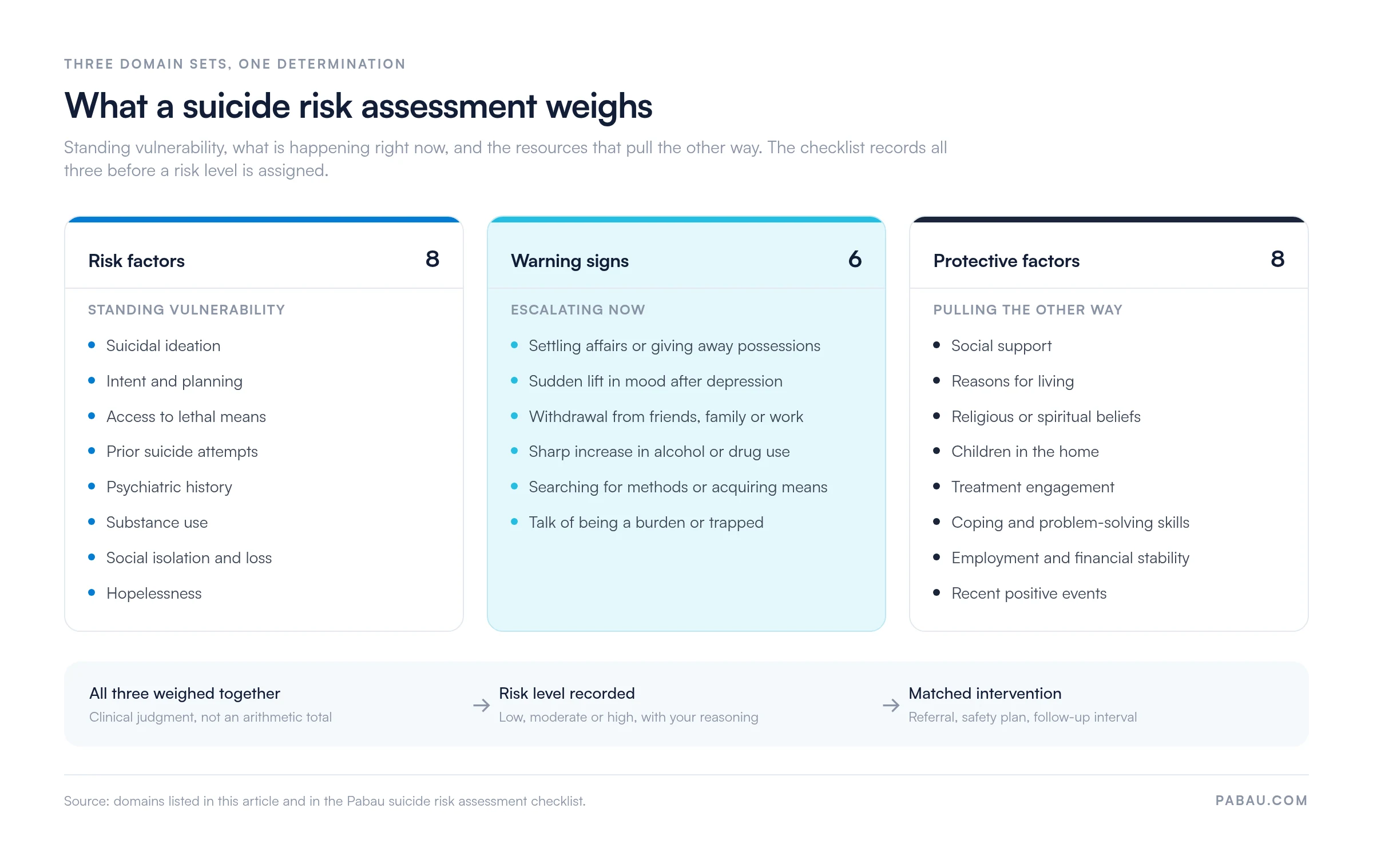
Four validated instruments dominate clinical practice. Your checklist should sit alongside at least one of them.
Setting usually decides the choice. The NIMH ASQ toolkit describes the ASQ as four questions that take about 20 seconds, for medical patients aged 8 and over. NIMH reports validation in emergency departments, inpatient medical and surgical units, and outpatient primary care and specialty clinics.
SAMHSA’s SAFE-T card is built for the fuller mental health assessment rather than for a quick screen. The C-SSRS is the usual choice where severity has to be measured the same way on repeated visits.
One caution applies to all of them. No instrument predicts which patient will die by suicide, so a screening result opens a conversation rather than closing one. The risk level you record still rests on your own clinical judgment.
SAFE-T is a standardized framework published by SAMHSA. It structures the assessment into five sequential steps that end in a risk determination and a documented plan.
A structured crisis response framework keeps that sequence consistent when the assessment happens under pressure.
Once you have weighed the risk and protective factors, you assign a level and pick a pathway. The level drives how urgently you act and how closely you monitor.
Clinical judgment overrides the pattern in the table. A patient with clear intent and ready access to means is high risk, whatever the tally of factors suggests.
A safety plan is a short written agreement between clinician and patient. It sets out what the patient will do when suicidal urges rise, and it turns the assessment into something the patient can act on.
The patient keeps the plan, so make it portable. A wallet card or a phone photo beats a form filed in the chart. Walk through it together so the patient understands their part and agrees to it.
Remote assessment needs extra safeguards. You cannot see the room, confirm who else is there, or step in physically if the session turns into a crisis.
With those precautions, telehealth assessment is clinically sound for low and moderate risk. Many practices now build remote screening into routine care to catch problems earlier.
Documentation of a suicide risk assessment serves two ends at once: continuity of care and legal defensibility. Vague notes weaken both.
Here is a useful test. Write the note you would want to find if you read this chart in five years, with a lawyer sitting opposite you.
Paper checklists work, but someone has to retype or scan them into the chart afterwards. That delay is where detail gets lost. Digital intake forms and structured clinical records put the assessment inside the workflow instead of beside it.
Practice management software like Pabau lets you save the assessment as a reusable form. Patients can complete the initial screening at check-in, and the clinician reviews those answers in the chart before running the full assessment in session.
Pabau Scribe, our AI scribe, can then draft the clinical note from that session, so the clinician edits and signs rather than types. The record still reflects your judgment, and it lands in the chart the same day.
For practices carrying a large mental health caseload, automated clinical workflows handle what happens next. They can flag a high-risk patient for next-day contact, book the safety planning appointment, or generate the referral letter. The assessment stops being a one-off form and becomes a process the system keeps alive.

Hold suicide risk assessment as a reusable intake form, review responses in the chart before the session, and let automated workflows drive the follow-up. Clinicians spend less time typing and more time with the patient.

What makes a suicide risk assessment checklist worth using is the discipline behind it. You ask the same questions in the same order, then write down why you reached the judgment you did.
Use the free form above for the assessment itself, and add a separate safety plan when the risk level calls for one. Keep formal training current, because no template substitutes for it.
The remaining problem is consistency across clinicians and across months, and that is a systems problem rather than a clinical one. Book a demo to see how Pabau keeps suicide risk assessments, safety planning, and follow-up in one patient record.

Need the safety plan this checklist points to? Stanley-Brown safety plan gives you the structured format patients keep with them.
Want work the patient can do between sessions? Suicide prevention worksheet is the patient-facing form for that period.
Screening for depression alongside risk? Depression self-assessment covers PHQ-9 scoring and the severity bands.
Assessing the wider psychiatric picture? Psychiatric evaluation template covers the evaluation this checklist sits inside.
Preparing for a session that turns into a crisis? Crisis intervention strategies for clinicians sets out how to respond under pressure.
A suicide risk assessment checklist is a structured clinical tool for evaluating a patient’s risk of suicide. It covers ideation, intent, plan, access to means, prior attempts, psychiatric history, substance use, and social isolation. The checklist also identifies protective factors and leads to a risk level determination (low, moderate, high) and matched interventions, including safety planning.
The eight core risk factors are suicidal ideation, intent, and a specific plan with method and timing. The list continues with access to lethal means, prior suicide attempts, and psychiatric diagnoses such as depression, bipolar disorder or psychosis. It ends with active substance use and social isolation or recent loss. Each one needs a specific finding written against it, not just a screening score.
Conduct a full risk assessment immediately. Moderate or high-risk indicators include a specific plan, stated intent, access to means, and few protective factors. Where they emerge, escalate to psychiatric emergency services, arrange an urgent psychiatric review, restrict access to means, and start safety planning. High-risk patients should not be discharged without a concrete safety plan, emergency contact verification, and clear follow-up plan. If the patient is in imminent danger, contact emergency services (911 in the US).
Telehealth assessments require extra safeguards. Verify the patient’s location and confirm the environment is safe. Take emergency contact names and numbers upfront. Ask about access to lethal means in the immediate environment. Agree on a backup contact protocol in case the call drops. Document that the patient consented to the limits of a remote assessment. Telehealth works for low and moderate-risk assessments. High-risk cases may need in-person care or emergency services, depending on jurisdiction.