Journal prompts for mental health
Journal prompts for mental health are guided questions that help people process ...

2
Last Updated: Oct 13, 2026

A suicidal ideation scale is a validated instrument that measures how often, how intensely, and how concretely a patient thinks about suicide.
The SSI, the C-SSRS, and SIDAS are the three instruments most widely validated for routine use in mental health settings.
Totals never transfer between instruments. The SSI runs 0-38, SIDAS runs 0-50, and the C-SSRS returns a risk level instead of a score.
Practice management software like Pabau can deliver the scale as a digital form and file the score straight into the client record.
Your note has to record the instrument, the date, the total, your risk interpretation, and the action you took.
A clinical assessment form for rating the severity and frequency of a patient’s suicidal thoughts. This standardized instrument helps you identify patients at risk and record the ideation pattern behind your intervention plan.
Download templateA suicidal ideation scale turns a clinical impression into a score you can document, compare, and act on. This guide covers the four validated instruments in routine use and how each one is scored.
It also explains what the totals do and do not tell you, plus the ICD-10 code and the note structure that make your assessment defensible.
A suicidal ideation scale is a standardized, validated tool that measures the presence, frequency, intensity, and characteristics of a patient’s suicidal thoughts. It converts a subjective clinical read into a number you can put in the record. That number lets you sort patients onto a risk gradient and match the resources you commit to each one.
Structured scales do something informal questioning cannot. They reduce individual bias, hold up across different clinicians, and give you a documented baseline to measure the next visit against. They also appear in the suicide risk assessment protocols recommended by The Joint Commission and the American Psychiatric Association. The Substance Abuse and Mental Health Services Administration (SAMHSA) recommends them too.
Between them, the instruments assess five dimensions. Each scale weights them differently, which is why their totals are not comparable.
The first distinction any instrument draws is between passive and active ideation. It is the distinction that decides how fast you have to move.
Every validated instrument carries screening items that separate the two states. The Columbia Suicide Severity Rating Scale does it in the first two questions. Where a patient lands decides whether you manage them as an outpatient, hand them to crisis services, or refer for admission.
Four instruments account for most suicidal ideation assessment in clinical and research settings. The table below compares their structure, who can administer them, and what a completed form gives you back.
The choice comes down to setting, population, and how much of the session you can spend on it.
Scoring procedures differ by instrument, and a total only means something next to the instrument’s name. Collecting responses through patient intake forms lets the software sum the score and removes the transcription step.
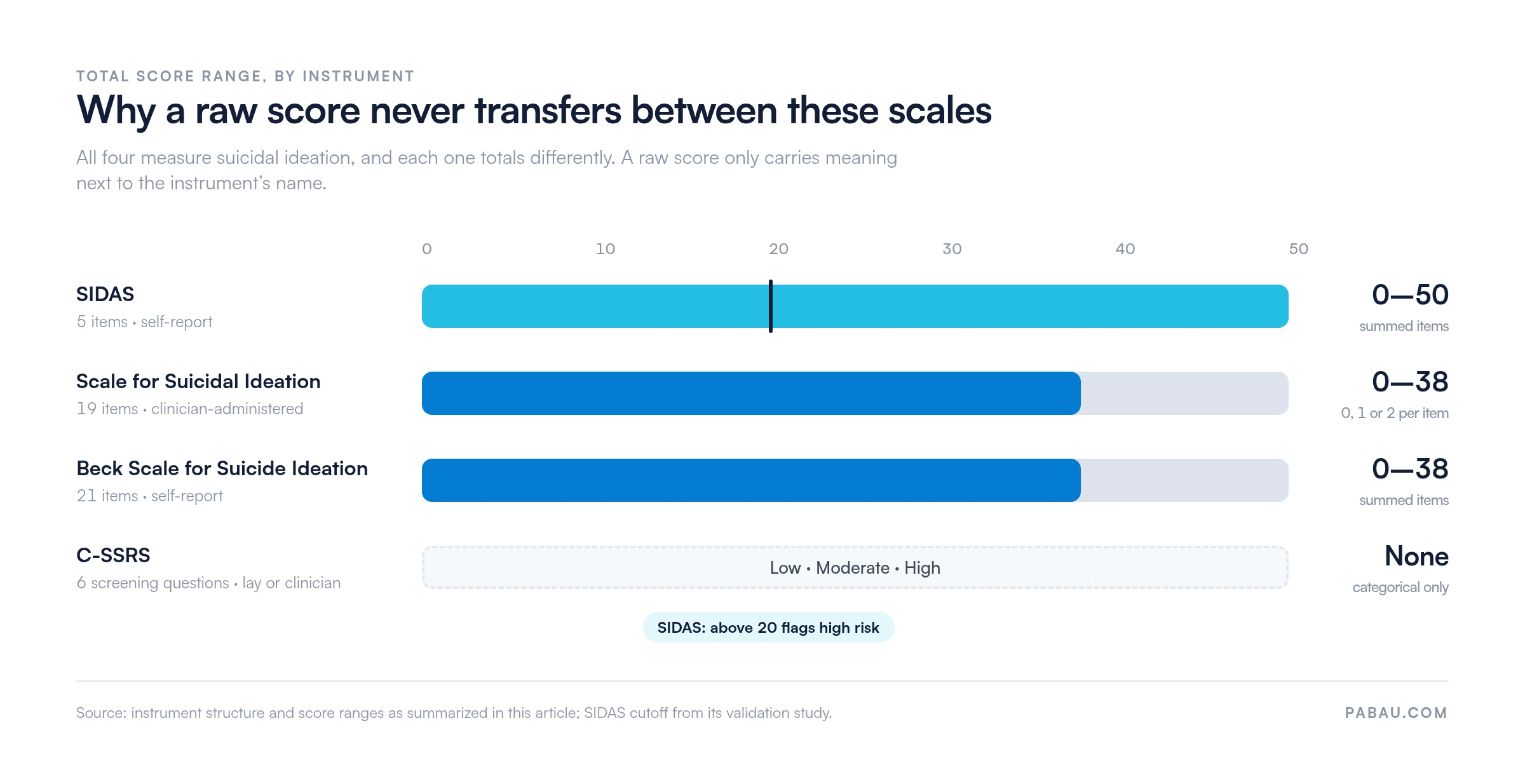
Scale for Suicidal Ideation (SSI): Each of the 19 items scores 0, 1, or 2, giving a total between 0 and 38. Higher totals reflect more severe ideation. Published studies use widely varying cutoffs, so treat no single number as the clinical standard.
Columbia Suicide Severity Rating Scale (C-SSRS): The six screening questions cover the frequency and intensity of ideation. A positive answer opens follow-up questions about intent and behavior. The result is a categorical risk level of low, moderate, or high, which maps onto a care decision.
Suicidal Ideation Attributes Scale (SIDAS): Five items cover frequency, controllability, closeness to attempt, distress, and interference with daily life. The items sum to a total between 0 and 50, and higher totals mean greater severity. The scale’s validation study flags high risk at a score above 20.
Administration works best as a fixed sequence rather than a judgment call each time. Five steps cover it, from the first screen to the note that closes the visit.
Documentation practice here follows HIPAA and your licensing board’s standards. Always log the instrument used, the date, the score, your interpretation, and the plan. A mental health EMR keeps those five fields on one screen, and automated workflows can prompt the next assessment before it slips.
Suicidal ideation is coded in ICD-10-CM as R45.851. Assign it whenever the record documents suicidal thoughts, and add the codes below when the context calls for them.
These codes carry the diagnosis into billing, into quality reporting to CMS, and into the suicide-prevention metrics SAMHSA tracks. They also make the patient’s risk status visible to every clinician who opens the chart, including referring providers.
Your note carries the clinical, legal, and safety record of how you handled the risk. Three elements have to be in it. Name the assessment method, the risk level you concluded, and the response you initiated.
Assessment: Record the instrument, the date and time, the total, and what you read into it. Write it plainly, as in “Patient scored 28 of 38 on the SSI, with passive ideation and no stated intent.” Add your own observations about affect, agitation, or behavior alongside the patient’s self-report.
Risk level and response: State the level you concluded, whether low, moderate, high, or acute. Then name what you did about it, whether that was outpatient discharge, referral for admission, a crisis-service handoff, or closer monitoring. Tie the plan back to the assessment so your reasoning is visible to the next reader.
Safety planning and follow-up: If the patient stays in your care, attach the plan you built together. A suicide safety plan holds the crisis numbers, the emergency contacts, and the coping strategies the patient named. Then book and record the date of the next assessment.
In most practices the scale still lives on paper. A staff member prints it and the patient fills it in. Someone else adds up the total, and the number gets typed into the note later that day. Any one of those steps can lose the score or delay it past the point where it changes the visit.
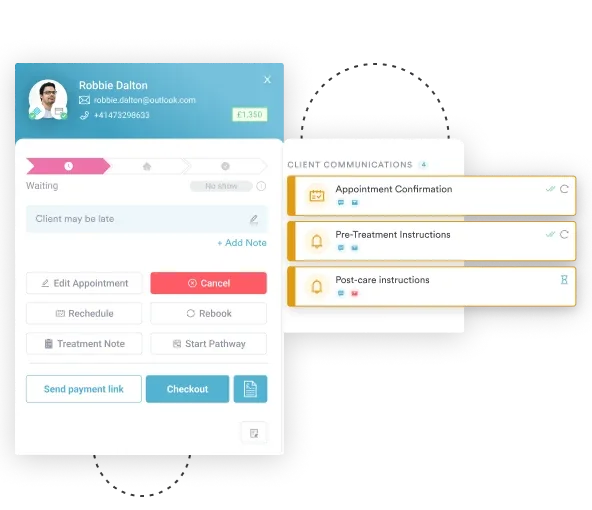
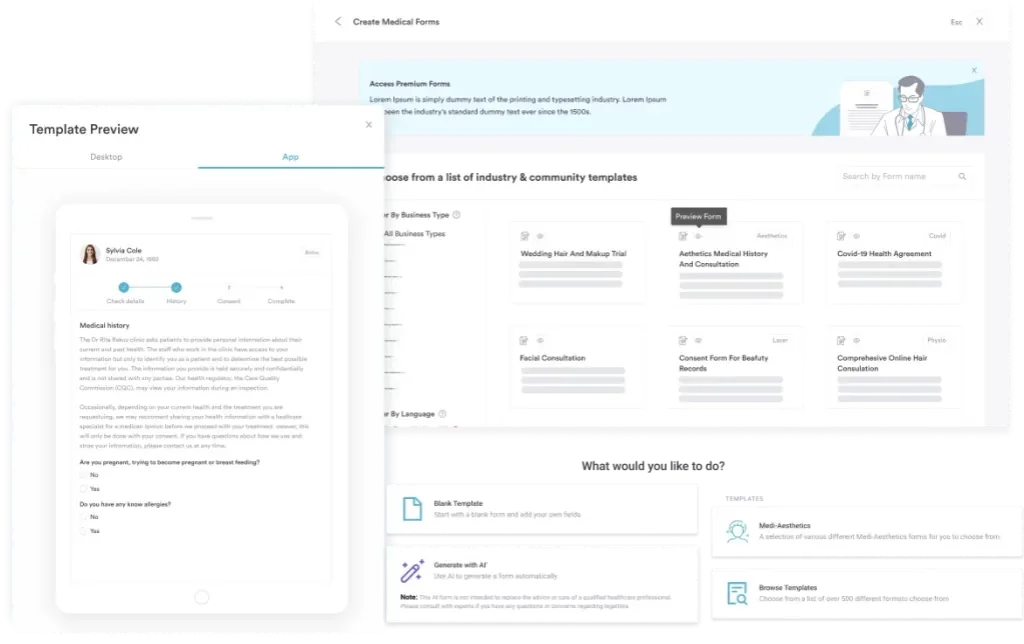
Pabau sends the scale as a digital form before the appointment, adds up the total on submission, and writes it into the client record. Conditional logic holds back the follow-up items until a screening answer opens them, so a low-risk patient answers five questions instead of nineteen.
The assessment, the note, and the follow-up then sit in one therapy practice platform, rather than in a form drawer and a separate chart.
A flagged result appears on the clinician’s dashboard before the patient walks in, so nobody discovers a high score mid-session. Reassessment reminders fire on the interval your protocol sets, which keeps a monitored patient from going a quarter without a score.

Pabau delivers the suicidal ideation scale as a digital form, totals it on submission, and files the score in the client record. Reassessment reminders keep monitored patients on schedule.

Pick one instrument and use it consistently. A C-SSRS at every intake beats a different scale each quarter, because a score is only useful next to the last one you recorded.
Treat the score as evidence rather than a verdict. It tells you where the patient sat on one instrument on one day. Your judgment about intent, plan, and access to means still decides the disposition, and the instrument’s job is to make that judgment repeatable.
Whichever scale you choose, the workflow around it decides whether it actually gets done. Book a demo to see how Pabau delivers, scores, and files a risk assessment without adding a step to the visit.

Need the next step after a positive screen? Suicide safety plan gives you a structured form for crisis contacts, warning signs, and coping strategies.
Working with a patient between visits? Suicide prevention worksheet hands the patient exercises that reinforce the safety plan you built together.
Documenting a first psychiatric assessment? Psychiatric evaluation template covers history, mental status, and baseline risk factors in a single form.
Need a protocol for an acute presentation? Crisis intervention strategies for clinicians walks through de-escalation and the disposition decision that follows it.
Screening for depression alongside ideation? Beck Depression Inventory gives you a scored severity measure that pairs with your risk assessment.
A suicidal ideation scale is a validated clinical instrument that measures the presence, frequency, intensity, and characteristics of suicidal thoughts. It turns a subjective clinical impression into a score you can document and compare. That score helps you place a patient on a risk gradient and match the intervention to it.
Passive ideation is wishing to be dead or hoping not to wake up, with no plan and no intent to act. Active ideation involves a conscious plan or intent, including thoughts about method, timing, or access to means. Active ideation is acute risk and needs immediate intervention, while passive ideation warrants close monitoring.
The C-SSRS is a six-question screening tool covering the frequency and intensity of suicidal ideation. Trained lay people or clinicians can administer it, which is why emergency departments, primary care, and crisis lines rely on it. A positive answer opens follow-up questions about intent and behavior, and the result is a low, moderate, or high risk level.
The C-SSRS is six screening questions and can be given by a trained lay person, which suits emergency departments, primary care, and crisis lines. The SSI is a 19-item clinician-administered interview that reads ideation in more detail, so it belongs in inpatient and specialty mental health settings.
Both formats are valid. The C-SSRS and SIDAS can be self-administered, with the patient answering alone or with brief staff support. The SSI is designed for clinician administration, and the BSS is a self-report form. Self-report speeds up screening in a busy practice, while a clinician interview lets you read affect and nonverbal cues.
No score triggers hospitalization on its own. The total informs a judgment that also weighs intent, plan specificity, access to means, comorbidities, and protective factors. A high SSI score with no intent, no plan, and strong support can be managed as an outpatient. A moderate score with a specific plan and intent may warrant admission.
Suicidal ideation is coded as R45.851 in ICD-10-CM. Related codes include T14.91XA for a suicide attempt and X83.8XXA for intentional self-harm by other specified means. Accurate coding supports diagnosis-based billing and quality reporting, and it keeps the patient’s risk status visible to referring providers.
Reassess at every visit for any patient with a history of suicidal ideation. A hospitalized or acutely at-risk patient may need daily or twice-daily assessment. For a stable outpatient with no recent ideation, every appointment or at least monthly is reasonable. Follow your own protocols and record why you chose that interval.
The SSI, C-SSRS, and SIDAS have all been validated in a range of age groups and populations. Interpretation still has to account for context. Adolescents often describe ideation differently from adults, and attitudes to death vary between communities. Check the validation evidence for the population you serve, and ask for guidance where it is thin.