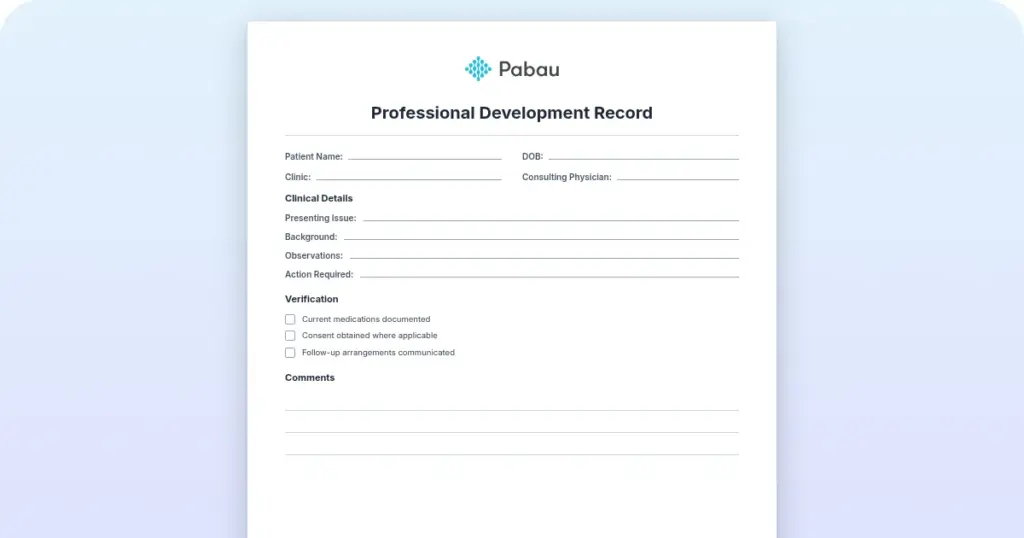
Professional development record
A professional development record is a structured log of a healthcare practition...

8
Last Updated: Oct 8, 2026

An allergy action plan is a written medical document that outlines a patient’s known allergens, symptom severity levels, emergency response steps, and medication instructions.
Every allergy patient needs a documented action plan to ensure rapid, consistent treatment during allergic reactions and to guide schools, workplaces, and caregivers in emergency situations.
A complete plan includes patient information, allergen list, symptom-severity classification, emergency contacts, medication dosing, and healthcare provider authorization signature.
Practice management software like Pabau’s digital forms and patient records system lets clinicians create, store, and share allergy action plans securely across clinical teams and directly with patients via the patient portal.
A ready-to-use clinical form documenting patient allergens, symptom severity levels, emergency response steps, medication instructions, and healthcare provider authorization. Customizable for allergists, GPs, school nurses, and occupational health settings.
Download templateAn allergy action plan is a critical clinical document that protects patient safety during allergic reactions. This guide explains what belongs in a complete plan, why it matters, and how to implement it across your practice, schools, and workplace settings.
An allergy action plan is a written, signed medical document that outlines a patient’s known allergens, severity of potential reactions, step-by-step emergency response protocols, and medication instructions. It serves as a reference guide for the patient, their caregivers, schools, workplaces, and any clinician who may need to manage an allergic reaction.
Unlike a general allergy history in a medical record, an action plan is a standalone, portable document designed for immediate use during an emergency. It distinguishes between mild/moderate reactions and severe reactions requiring epinephrine. Schools, camps, and workplaces keep copies on file so staff can act quickly without needing to contact the practice.
The plan is typically issued by an allergist, immunologist, or primary care physician and updated annually or whenever the patient’s allergy status changes.
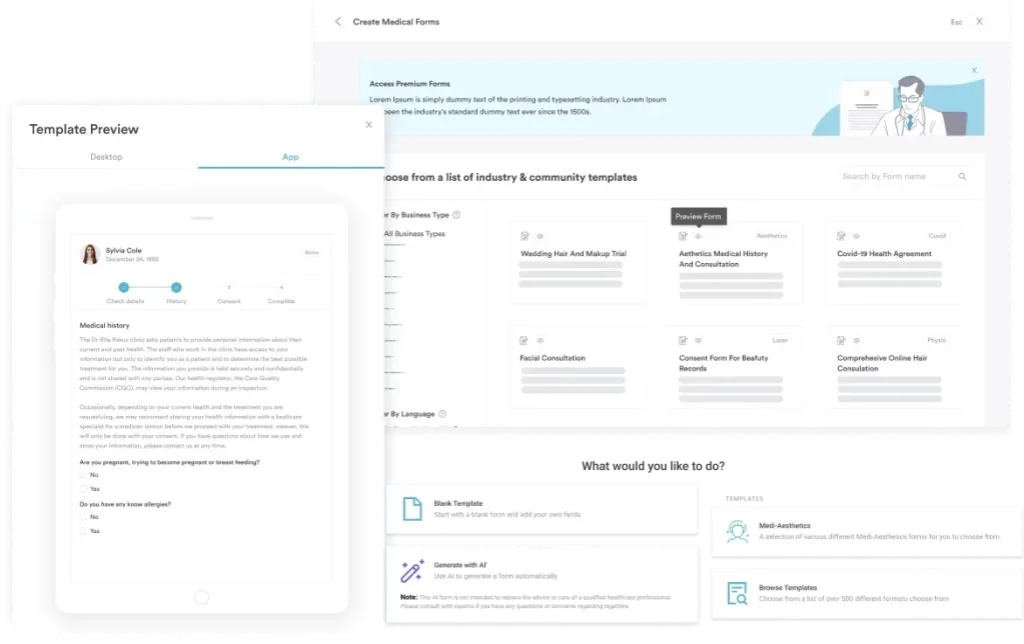
Creating and deploying an allergy action plan involves five clinical and administrative steps. Each step ensures the plan is accurate, authorized, and accessible to everyone who needs it.
These steps ensure the plan is medically sound, legally defensible, and ready to use the moment an emergency happens. Without clarity at any step, the plan’s effectiveness during an acute reaction is compromised.
Step two often turns on separating a pollen cross-reaction from a food allergy. An oral allergy syndrome chart maps each pollen group to the raw foods that cross-react with it.
Software designed for GP practices can attach this form to the consultation record automatically.

Pabau’s digital forms and patient records system streamline how clinicians create, authorize, and distribute allergy action plans across teams and patient populations.

Allergy action plans serve multiple clinician and institutional contexts. Any practice managing patients with documented allergies should issue them routinely.
A documented, authorized allergy action plan delivers four critical benefits: immediate clinical response, regulatory compliance, caregiver confidence, and liability protection.
Update allergy action plans annually and whenever a patient’s allergy status changes (new triggers, discontinued medications, emergency epinephrine availability). Version control is critical – keep old plans on file for legal documentation, but ensure schools, workplaces, and patients receive the most current version immediately.
The most critical component of any allergy action plan is the anaphylaxis response protocol. Anaphylaxis is a severe, life-threatening allergic reaction that requires immediate epinephrine administration followed by emergency transport.
According to FARE (Food Allergy Research & Education), anaphylaxis symptoms can develop within minutes and include difficulty breathing, throat tightness, wheezing, loss of consciousness, or shock. The action plan must explicitly state: “If the patient shows ANY of these signs, give epinephrine immediately. Do not wait for symptoms to worsen.”
Mild or moderate reactions (localized itching, single area hives, mild abdominal discomfort) are managed with antihistamines. But any sign of multi-system involvement (two or more body systems affected), airway involvement, or cardiovascular symptoms demands immediate epinephrine injection into the lateral thigh.
After epinephrine, call 911 immediately. Emergency transport is mandatory even if symptoms appear to improve.
Food allergy action plans share the same core structure as general allergy plans but include food-specific triggers and cross-contamination warnings. Many clinicians use the FARE-issued food allergy action plan template, which is widely adopted by schools nationwide.
Food-specific considerations: list the exact allergen (e.g., “tree nuts” or specifically “cashews”), note whether processed foods with trace amounts are safe, specify whether accidental ingestion requires treatment even without symptoms, and include instructions for reading food labels.
Schools implementing food allergy plans also restrict sharing of snacks and require hand-washing after eating to prevent accidental exposure. A detailed food list, similar to those used for other dietary restrictions, gives caregivers one reference for safe and unsafe items.
The UK and Commonwealth countries follow BSACI guidance (British Society for Allergy and Clinical Immunology) for allergy action plans. The BSACI template differs slightly from the US FARE version in medication names (adrenaline instead of epinephrine), dosing conventions, and NHS referral pathways.
UK practices and GPs should use the BSACI allergy action plan template available at bsaci.org to ensure alignment with NHS protocols and UK clinical standards.
For private UK practices, storing the plan in Pabau’s digital forms and patient records system makes updates instant and keeps every location working from the same signed version, with a full history of prior versions on file.
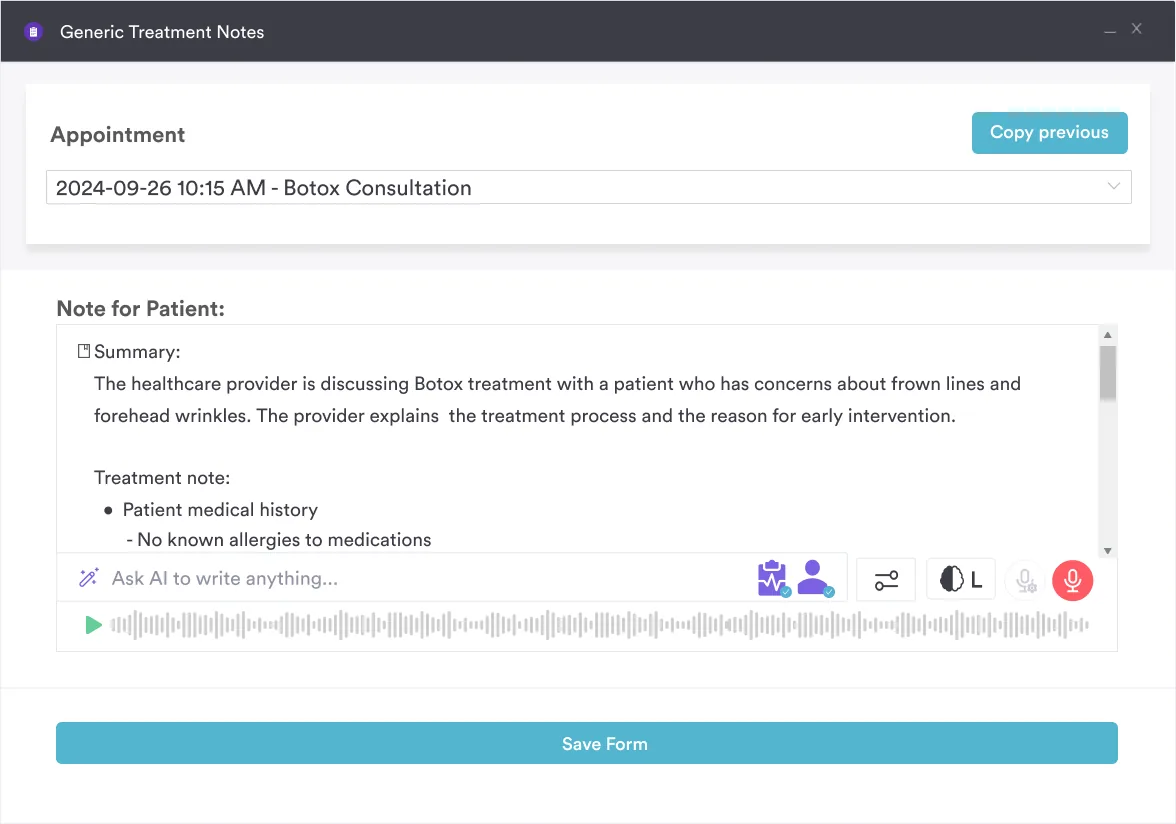
Allergy action plans contain sensitive patient health information (PHI) and must be stored and shared securely under HIPAA (US) or GDPR (UK/EU) regulations. Digital practice management systems provide role-based access control so only authorized staff can view or print the plan.
When sharing with schools, workplaces, or caregivers, use encrypted email or a secure patient portal rather than plain text attachments.
An allergy action plan is a non-negotiable clinical and safety tool for any practice managing patients with allergies. A clear, signed, portable document ensures rapid emergency response, regulatory compliance, and peace of mind for patients and caregivers. Book a demo with Pabau, practice management software, to see how digital forms streamline plan creation, authorization, and secure distribution.

Need cardiac reference values by age? Normal ejection fraction by age chart lists age-banded LVEF and RVEF values with notes on echocardiography, cardiac MRI, and CT.
Need a structured patient assessment sequence? EMT patient assessment guide walks through the five-step sequence from scene size-up to reassessment in order.
An allergy action plan is a written, signed medical document that outlines a patient’s known allergens, emergency response steps, medication instructions, and severity-based treatment protocols. It guides clinicians, schools, caregivers, and emergency responders in managing allergic reactions safely and consistently.
A complete plan includes patient identification, a list of known allergens, symptom severity classification (mild/moderate vs anaphylaxis), medication names and doses, emergency response steps, emergency contact numbers, and healthcare provider signature and date. Food-specific plans should note cross-contamination risks and label-reading guidance.
Update allergy action plans annually as standard practice, and immediately whenever the patient’s allergy status changes, such as new triggers identified, medications discontinued, or new epinephrine auto-injectors prescribed. Always notify schools, workplaces, and caregivers of changes promptly to ensure they have the current version.
FARE (Food Allergy Research & Education) publishes the standard template used in US schools and clinics, using “epinephrine” and US dosing conventions. BSACI (British Society for Allergy and Clinical Immunology) publishes the UK/Commonwealth standard, using “adrenaline” and NHS-aligned protocols. Use the template from your region to align with local clinical and regulatory standards.
Yes. Most US states mandate school allergy action plans for students with diagnosed allergies. The plan satisfies Section 504 legal requirements and health department regulations. Even if not mandated, schools benefit from having a signed clinical plan on file for any student with a known allergy for liability and emergency response purposes.
Yes. FARE and BSACI both publish free downloadable templates on their websites. This article includes a free Pabau template you can customize for your practice. However, the template should always be reviewed, customized with the patient’s specific allergens and medication doses, and signed by the treating physician before use.