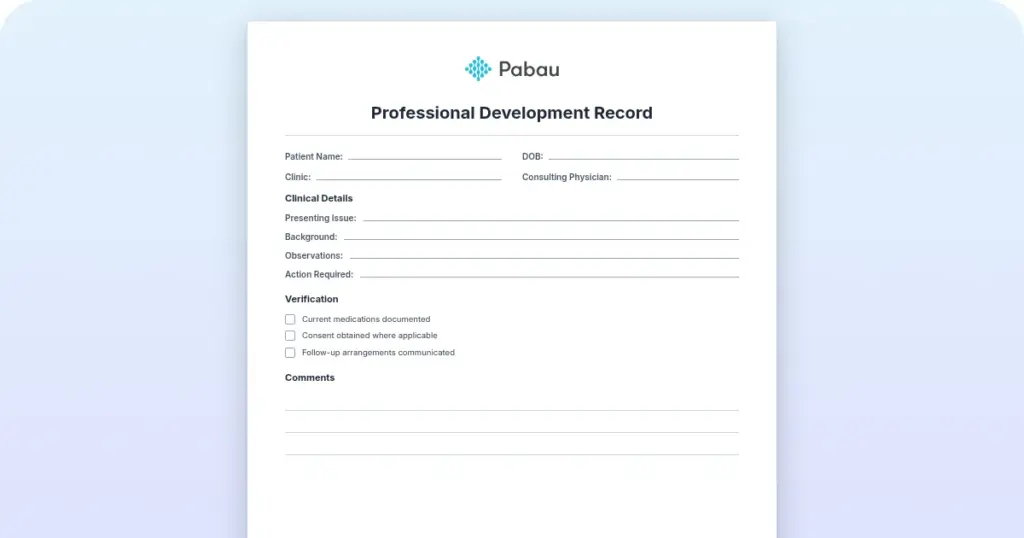
Professional development record
A professional development record is a structured log of a healthcare practition...

8
Last Updated: Oct 8, 2026

In short, a case management note documents client interactions, interventions, and progress toward treatment goals.
In addition, essential elements include date, client ID, presenting issue, action taken, client response, and next steps.
Overall, SOAP, DAP, BIRP, and GIRP are the four main structured formats used across healthcare and social services.
Pabau’s digital templates auto-populate client data and maintain audit trails, reducing documentation time while ensuring compliance.
This template covers client demographics, the presenting issue, interventions provided, client response, progress toward goals, and next steps. Once it’s filled in, print it or complete it on screen, then use it across social work, mental health, and care coordination caseloads.
Download templateA case management note records a single client contact. In short, it captures what the client reported, what you did about it, and what happens next.
Most of the value shows up later. In fact, the note you write today is what a covering clinician reads next month, and what an auditor reads next year.
Below are the four standard formats, the fields a complete note needs, and two worked examples you can copy.
A case management note is a detailed record of a client interaction. Specifically, it documents the services provided, the interventions delivered, and the client’s progress toward treatment goals. In turn, the note captures what the clinician observed, what was assessed or planned, and what happens next.
In practice, each note does three jobs at once:
Progress notes focus purely on measurable outcomes. By contrast, a case management note carries the wider picture: who was contacted, what resources were coordinated, what barriers turned up, and how the clinician responded.
Thorough notes protect both clinicians and clients. For instance, a well-documented file shows that services were delivered appropriately and that professional judgment was exercised. That is the first thing an auditor or an attorney looks for.
That extends to keeping a current notice of privacy practices on file for every client.
When a client moves from outpatient therapy to psychiatric care, a detailed note is what stops something critical being lost in the handoff.
For context, the National Association of Social Workers (NASW) makes a broader point about documentation. Done consistently, it reduces risk, supports evidence-based practice, and shows the client that someone is accountable for their case.
Every note needs the same set of fields, so information can be found quickly and compliance can be verified. Formats vary, but these elements are common to all of them:
Using digital intake forms fills the demographic and presenting-issue fields for you, so your time goes on clinical detail instead of retyping basics.
Between sessions, journal entry prompts can give clients material to bring back, which then feeds the subjective section of the next note.
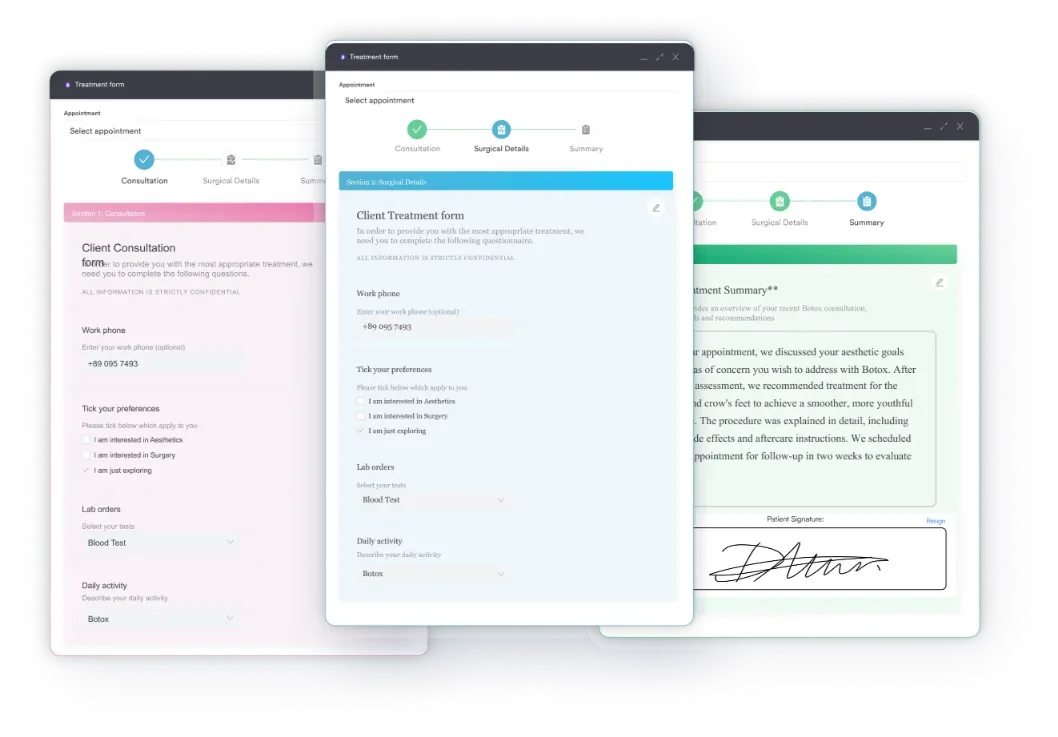
GP practices often build forms like this into GP clinic software so records stay complete and auditable.
The four most widely used formats are SOAP, DAP, BIRP, and GIRP. Each follows a fixed sequence, and as a result, that sequence is what keeps documentation complete and consistent across a team.
Choose the format by who reads the note next, rather than by personal preference:
As an example, here is a housing-instability contact written in SOAP.
SOAP suits clinicians billing insurance, because the assessment line shows the reasoning behind the plan. It travels well outside mental health too.
When a client struggles to name what they feel, an identifying emotions worksheet can sharpen the subjective section before you write it.
By comparison, the same caseload written in DAP is noticeably leaner.
DAP folds subjective and objective information into a single section, instead of splitting them the way SOAP does. That is why it holds up for brief contacts and crisis work, where the note has to be finished fast.
Unlike DAP, BIRP puts the client’s own behavior at the front of the note.
Overall, BIRP is the standard in behavioral health and addiction services. The response line is the reason: it evidences whether the intervention landed, which is what funders tend to ask about. A BIRP note template structures those four components: behavior, intervention, response and plan, in a single record.
For clients working on impulse control, self-regulation worksheets can give you material for the intervention line.
To make that concrete, worked examples show how those fields land in a live file. Below are two notes from common settings, written the way they would appear in the record.
Date: 08/05/2026 | Client: Sarah M., ID 4521 | Presenting issue: Discharge planning from a residential program, with support needed on housing and a job search.
Summary: At the start of the session, Sarah met her case manager for 60 minutes at the agency office. She expressed anxiety about leaving the residential program after eight months, but said she felt ready for independence. Together they reviewed three housing options in her price range.
They also identified a job training program starting in September. Sarah will then contact landlords by the end of the week, and her case manager will follow up by phone on Thursday. In addition, a referral went to vocational rehabilitation, with an intake appointment on 08/10.
Date: 08/05/2026 | Client: James T., ID 2834 | Presenting issue: Follow-up therapy session to monitor mood and medication response.
Summary: James attended his weekly therapy session as scheduled. Notably, he reported sleeping seven to eight hours a night, up from four to five last month, and less social withdrawal. He also took an active part in cognitive-behavioral exercises targeting catastrophic thinking.
Between sessions, clients like James sometimes keep a mindfulness journal to track mood day to day.
James noted one minor side effect, a mild tremor in the hands. As a next step, that will be raised with his prescribing psychiatrist at the next medication review. In the meantime, weekly therapy continues. Overall, no safety concerns were identified.
A thorough note does not take extra time. Instead, it takes clarity and a fixed order. Follow these five steps:
Left unchecked, the most frequent errors weaken legal protection and create compliance risk. Watch for these five:
Following clinical note best practices reduces errors and strengthens your position if the file is ever reviewed.
In practice, paper files and loose word-processor documents invite errors and wasted time. Practice management software like Pabau embeds case management templates in the clinical workflow instead. Each note then sits with the client record, the appointment, and the invoice.
Open a client record, and the demographics and appointment history populate the template automatically. From there.
As a result, timestamped, locked notes with full audit trails meet HIPAA, CMS, and accreditation requirements without extra work. On top of that, every note stays searchable, shareable with the team, and available on any device.
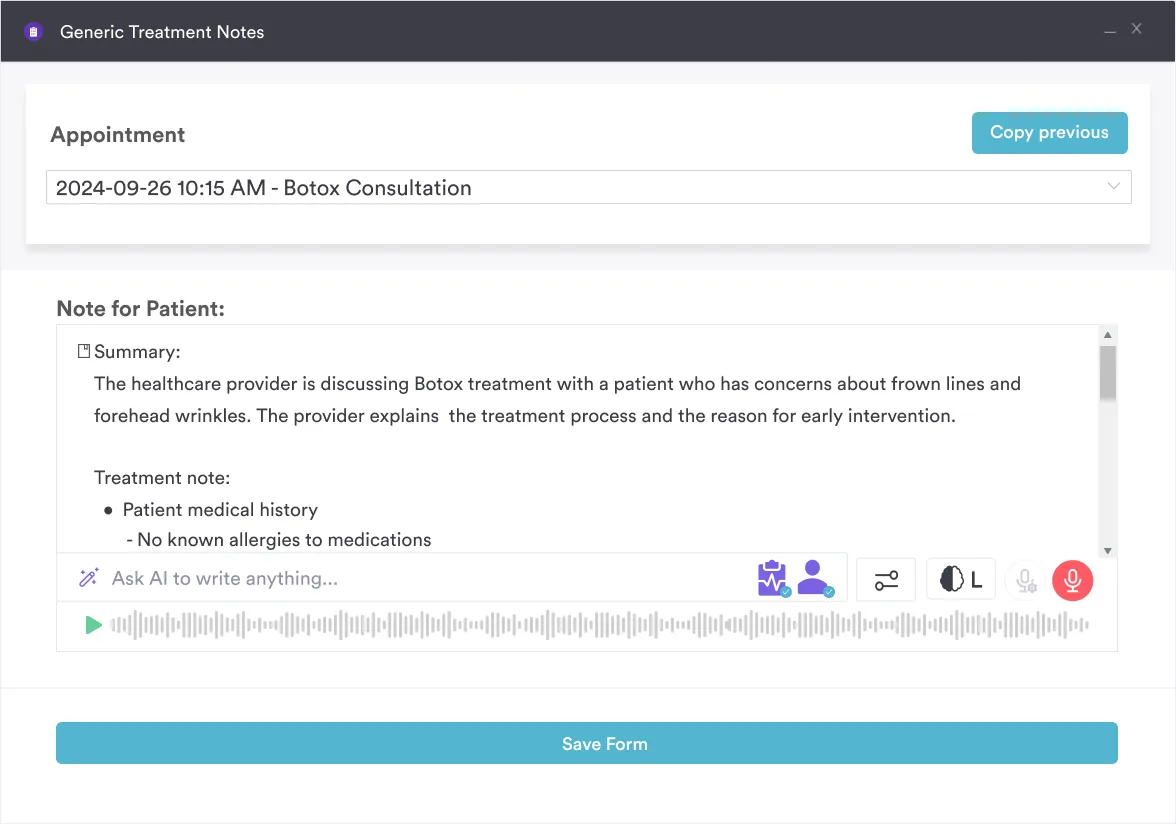
The templates are customizable, so the format follows the caseload. Social work teams can lead on goal tracking with GIRP.
Different caseloads pair well with different intake tools. A couples counselor might run a relationship check-in template between sessions, and a strengths-based clinician might use a positive psychology worksheet during assessment.
Put together, the result is one place where the note, the client history, and the billing record agree. Care continuity then survives staff changes, holiday cover, and a caseload handover.

Watch how Pabau’s templates and AI scribe reduce documentation time while ensuring compliance.

Above all, pick one format for your caseload and use it for every contact. A consistent DAP note beats an occasional, beautifully written SOAP note, because colleagues and reviewers learn where to look.
In practice, the trade-off is time, and it is not evenly spread. Whatever you save by writing less today, you pay back the first time somebody has to reconstruct a case from a thin file.
If your team shares a caseload, keep the template and the record in the same system. In turn, client records with built-in templates remove the retyping and keep the audit trail intact.
Book a demo to see how Pabau handles case notes across a shared caseload.

Need a self-appraisal tool for staff? Self reflection worksheet covers achievements, challenges, strengths, and goals, ending with an action plan.
Helping a client rebuild self-worth? Self worth worksheet template helps clients explore and strengthen their sense of personal value.
Need a safety plan on file? Suicide prevention worksheet gives you a structured record of risk and the coping steps you agreed.
Tracking a client’s sleep patterns too? Sleep diary template turns two weeks of morning entries into a sleep efficiency score you can act on.
Need a handout on sleep habits? Sleep hygiene handout checks sleep schedule consistency, bedroom environment, and pre-bed routine on one page.
A complete note carries the date and time, the client identifier, the presenting issue, and both subjective and objective information. It then records your assessment, the interventions provided, the client response, and the plan for next steps. A structured template stops any of them being missed.
SOAP stands for Subjective, Objective, Assessment, and Plan. Subjective is what the client reports, and objective is what you observe. Assessment is your clinical judgment, and plan is what happens next. It is the most widely used format in medical and mental health settings.
DAP stands for Data, Assessment, and Plan. It is shorter than SOAP, which makes it useful for brief sessions, crisis counseling, and rapid-turnaround documentation. Data combines subjective and objective information into a single section.
BIRP stands for Behavior, Intervention, Response, and Plan. It emphasizes what the client did in session and how they responded to the intervention provided. The format is popular in behavioral health, addiction treatment, and school-based mental health.
Document every client contact, ideally within 24 hours of the session. Most insurance and regulatory standards require a note after each billable visit. Best practice is to write while the session is still fresh.
Progress notes focus on measurable change toward treatment goals, such as a mood score moving from 4 out of 10 to 6 out of 10. Case management notes carry the broader context of who was contacted, what resources were coordinated, and what barriers remain. A case management note often contains a progress note inside it.