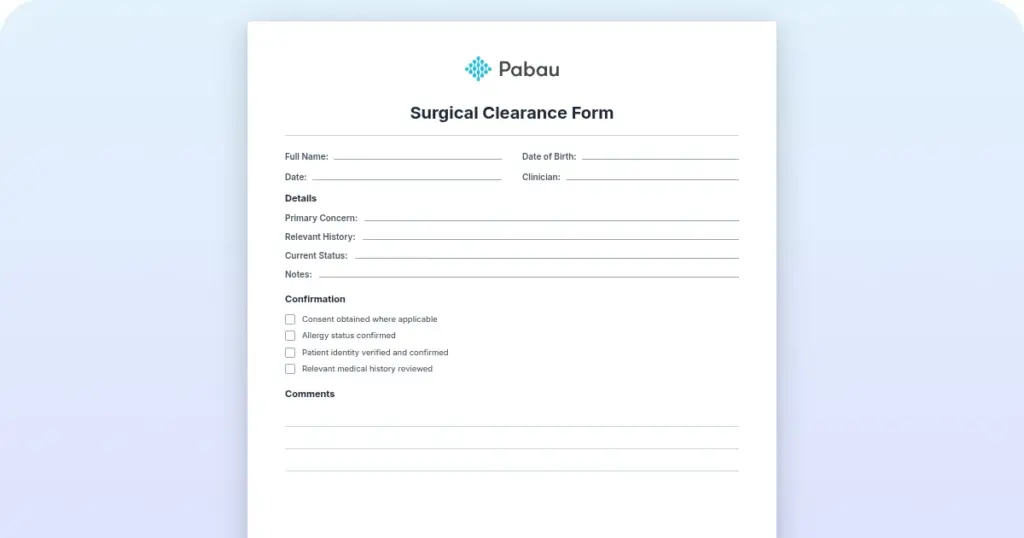
Surgical clearance form to download: What it is and who completes the form
A surgical clearance form is the document a surgeon uses to record whether a pat...

1
Last Updated: Oct 22, 2026
An against medical advice form is a legal document. It formally records when a patient chooses to leave a healthcare facility or decline recommended treatment without medical clearance. This template gives clinicians a structured, compliant against medical advice (AMA) form that documents informed decision-making and disclosed risks.
A properly completed against medical advice form serves as evidence of informed consent and patient autonomy. It demonstrates that the patient understood the specific risks communicated, considered alternative options, and made a deliberate decision to refuse or leave treatment. Without this documentation, healthcare providers face significant medico-legal exposure if the patient experiences adverse outcomes.
This guide covers the components every AMA form must include, step-by-step completion guidance, and the legal, insurance, and coding requirements around AMA discharge. It also covers how digital form capture streamlines AMA documentation across hospital, emergency department, and outpatient settings.
A ready-to-use against medical advice form covering patient identification, risk disclosure, informed consent, alternative treatment options, and signature blocks for the patient, physician, and witness. Built to meet HIPAA and clinical documentation standards.
Download template
An against medical advice (AMA) form documents that a patient chose to leave or decline treatment without medical clearance. It protects the clinician and the patient with evidence of informed consent.
Every against medical advice form must include patient identification, specific risks disclosed, alternatives offered, patient understanding confirmation, and signature blocks for patient, physician, and witness.
Signing the form alone does not provide complete legal protection. It is valid only when combined with documented clinical discussion of capacity, risks, and alternatives.
Pabau’s digital consent forms capture AMA documentation directly into the patient record, eliminating manual filing and supporting compliance with HIPAA and medico-legal requirements.
An against medical advice form is a formal clinical document. It is used when a patient chooses to leave a healthcare facility or discontinue treatment without the treating physician’s approval. It serves three functions:
AMA forms are used across acute inpatient settings (hospital wards), emergency departments (where AMA discharge rates are highest), outpatient clinics, and specialist practices. The document explicitly states that the patient has been informed of the medical risks of their chosen course of action and chooses to proceed anyway.
A clinically complete and legally defensible against medical advice form must contain specific mandatory fields and sections. Each component serves a distinct medico-legal purpose:
The patient information section establishes identity and creates the audit trail. Document the patient’s full legal name, date of birth, medical record number (MRN), and the exact date and time of the AMA decision. Include the facility name, unit or department, and the treating physician’s or clinician’s full name and credentials (M.D., D.O., N.P., P.A., R.N., etc.).
The core of an against medical advice form is the detailed clinical record of which specific risks were communicated to the patient. Avoid generic language like “risks of leaving the hospital.” List the concrete risks relevant to this patient’s condition and proposed treatment instead:

The patient must confirm in writing that they understand these specific risks and choose to accept them. This is the linchpin of informed consent and the element that distinguishes a valid AMA form from a meaningless signature line.
Every against medical advice form requires three signatures:
If the patient refuses to sign, the form must document the refusal. The form must also be signed by the clinician and witness, confirming the patient’s stated reason.
Completing an AMA form correctly requires a structured clinical workflow. The following steps ensure that the form serves its medico-legal function and that the patient’s autonomy is genuinely respected.
A signed against medical advice form provides important but incomplete legal protection. The form alone does not shield a clinician from negligence liability. A patient can still claim the risks were not adequately explained, or that their decision-making capacity was compromised at the time. Courts and regulatory bodies examine the process of informed consent, not just the existence of a signature.
To maximize liability protection, combine the signed AMA form with detailed clinical notes. Document the specific risks communicated, the alternatives offered, the patient’s demonstrated understanding, and the capacity assessment. The form is the documentary evidence. The clinical note is the proof that an informed consent conversation actually took place.
Insurance coverage after an AMA discharge depends on the payer and the clinical scenario, not an automatic denial. Medicare and Medicaid do not categorically deny AMA claims. Instead, they review whether medically necessary treatment was delivered before the patient left. Private insurers (BCBS, UnitedHealth, Aetna) have varying AMA policies.
The most important protection is documenting the services already rendered and the risks of leaving before completion. The ICD-10 code for this discharge is Z53.21 (“Procedure and treatment not carried out because patient left against medical advice”). Submit the claim with full documentation of what was done and recommended.
When a patient leaves against medical advice, the event must be coded for billing and revenue cycle management purposes. The primary ICD-10-CM code for this scenario is Z53.21, which specifically denotes “Procedure and treatment not carried out because patient left against medical advice.”
Always code the AMA discharge. This ensures accurate tracking of AMA events, supports billing transparency with insurers, and satisfies regulatory audit requirements.
AMA discharge procedures and form emphasis vary by clinical setting. Hospital inpatient AMA discharges require bed-exit protocols, belongings confirmation, and discharge summary documentation. Emergency department AMA is often faster but still requires the signed form and note. Outpatient and telehealth AMA require adapted approaches to signature capture and consent documentation.
Inpatient AMA discharges follow formal protocols involving nursing, physician, and discharge planning teams. The patient is asked to sign the AMA form before leaving the unit. The nursing team documents the time of departure, belongings released, and any safety concerns (e.g., “patient ambulating without assistance, alert and oriented”).
ED AMA discharges occur at higher rates than inpatient AMA. National estimates put the figure at roughly 1-2% of ED visits, driven by long wait times and patient impatience. The ED physician must complete the AMA form in real time before the patient leaves the department. Telehealth and remote monitoring options can keep the patient connected to care after they leave.
When an outpatient declines a recommended treatment or abandons an appointment, document the AMA decision in the patient’s chart. If the patient is present, ask them to sign the form. If they depart without signing, document the attempted form completion and the patient’s refusal or absence.
After a patient leaves against medical advice, nursing staff must document the departure event in the medical record. This documentation supports liability protection and creates the clinical record of what happened. Key nursing note elements include:
Sample nursing note language: “Patient informed that he/she has chosen to leave the facility against medical advice at [time]. Risks of departure discussed including [specific risks]. Patient verbalized understanding. Belongings released. Patient ambulatory and alert. Signed AMA form obtained / Patient refused to sign AMA form. Attending physician notified. Patient departed via [exit route].”
Pabau Scribe, our AI scribe, can streamline AMA note generation. It auto-populates the discharge summary with standard fields and prompts the clinician to add the risks and responses discussed. This reduces documentation burden without sacrificing completeness.

Pabau’s digital consent and patient documentation platform lets practices capture AMA forms electronically and link them to the patient record. Practices can retrieve them instantly for audit or medico-legal review. HIPAA-compliant form capture removes the need for manual scanning and paper filing, cutting the risk of lost or misfiled forms.
Clinicians complete the form on a tablet or computer, and the patient signs electronically. If e-signature isn’t available, the patient can confirm verbal consent instead. The form is then time-stamped and stored automatically in the patient’s digital record.
Pabau’s audit trail shows who accessed the form, when, and from which device. This supports regulatory compliance and speeds up document retrieval for insurance disputes or legal review.

Pabau’s digital forms and patient records platform helps practices capture, store, and retrieve AMA forms in seconds. This eases documentation burden and supports medico-legal audit.

A signed AMA form only holds up when the clinical note behind it does the same work. The note needs to name the specific risks, confirm the patient’s capacity, and record that the practice offered alternatives.
Practices that still rely on paper AMA forms risk losing them at the worst possible moment. That moment is often an audit or a malpractice review months later. Digital form capture keeps the signed form attached to the patient’s record from the moment it’s completed, so it surfaces the same way every time.
Book a demo to see how Pabau keeps AMA documentation and the supporting clinical notes in one place.

Need guidance on informed consent workflows? Informed Consent for Group Therapy provides a framework for structuring consent conversations that applies across clinical settings.
Want to streamline patient records and compliance? Patient Portal Software enables secure document storage and retrieval, supporting compliance with HIPAA and medico-legal audit requirements.
Looking to improve clinic compliance documentation? Medical Billing Compliance Guide covers documentation standards and error prevention across all clinical documentation types, including AMA discharge.
A signed AMA form is evidence of informed consent and patient autonomy but is not binding in the sense of a contract. It demonstrates that the patient understood the risks and chose to leave anyway. Courts view the form as supporting evidence; the clinician’s clinical notes documenting the risks discussion are equally or more important than the signature itself.
If the patient refuses to sign, document the refusal in the clinical record and ask a witness (nurse or staff member) to sign confirming the patient’s refusal and the clinician’s statement that risks were discussed. The clinician should also document the patient’s stated reason for refusing to sign (e.g., “Patient states ‘I don’t need to sign anything'”).
In most jurisdictions, minors cannot legally sign an AMA form without parental or legal guardian consent. If a minor wishes to leave against medical advice, the clinician should attempt to contact the parent/guardian and obtain their signature on the AMA form. If the parent/guardian is unavailable and the minor insists on leaving, document the attempted parental contact and the minor’s stated reason for leaving.
It depends on the payer. Medicare and Medicaid do not automatically deny AMA claims; they review whether medically necessary treatment was provided before departure. Private insurers have varying policies; some deny all AMA claims, others pay for services rendered. Always submit the claim with full documentation of treatment provided and coded with Z53.21.
The primary ICD-10-CM code for AMA discharge is Z53.21, which denotes “Procedure and treatment not carried out because patient left against medical advice.” This code must be included in the discharge summary and claim submission for billing and regulatory compliance.
Medicare covers the hospital stay and services delivered up to the point the patient left AMA. The denial risk arises if the patient later claims the hospital was negligent or failed to provide necessary treatment; the AMA form and clinical notes protect the hospital by documenting that the patient chose to leave despite medical advice to stay.