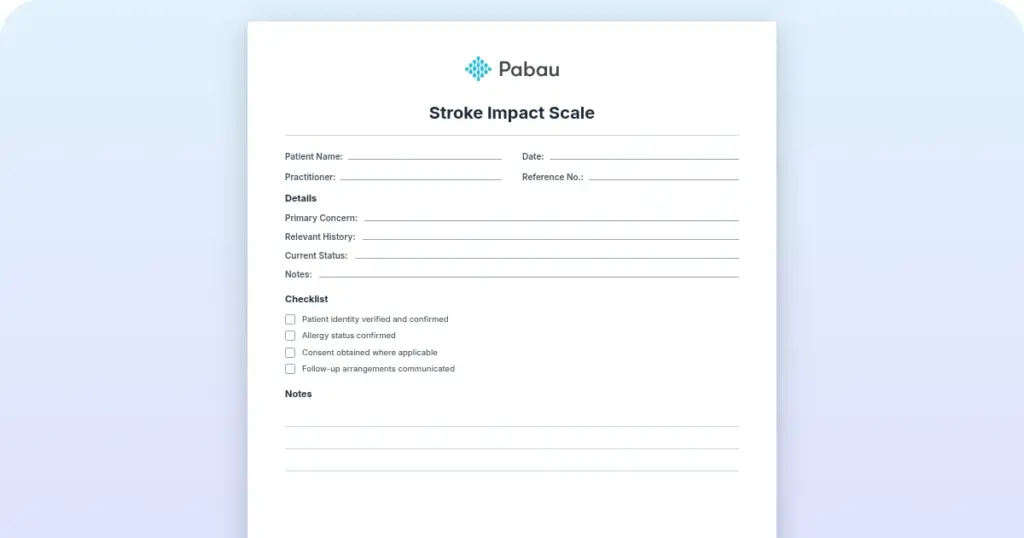
Stroke impact scale: Free PDF, scoring and MCID by domain
The stroke impact scale (SIS) is a 59-item questionnaire in which stroke survivo...

7
Last Updated: Oct 13, 2026

An ADL assessment tool measures a patient’s functional independence across six basic domains: bathing, dressing, toileting, transferring, continence, and feeding.
The Katz ADL is the gold-standard instrument for assessing older adults; the Barthel Index is widely used in stroke rehabilitation; the Lawton IADL evaluates complex independent living skills.
Valid ADL assessment data guides clinical decision-making, predicts future functional decline, and informs discharge planning and adaptive strategy selection.
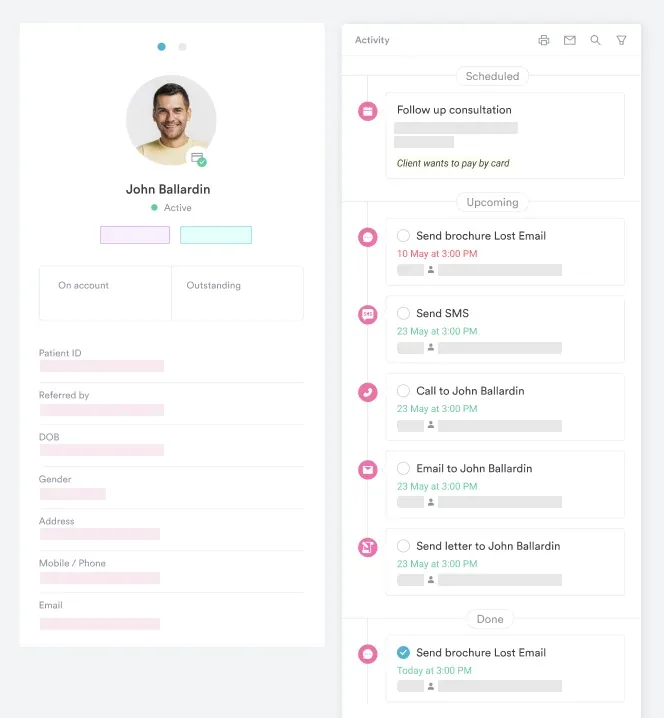
Practice management software like Pabau uses digital forms and client records to streamline ADL documentation, enable secure data storage, and support multi-disciplinary care coordination.
A comprehensive, printable PDF form covering basic and instrumental activities of daily living, used by occupational therapists, nurses, and rehabilitation specialists.
Download PDF templateAn ADL assessment tool is a standardized form that healthcare professionals use to measure a patient’s ability to perform activities of daily living independently. Whether you’re an occupational therapist evaluating an older adult, a nurse assessing post-stroke recovery, or a rehabilitation specialist planning discharge care, an ADL assessment tool guides clinical decision-making and documents functional status objectively.
Download the free PDF template above to use as a printable ADL checklist, then read on for the most widely validated instruments — the Katz ADL, Barthel Index, Lawton IADL, and FIM — and how to score each one in clinical practice.
An ADL assessment tool is a structured evaluation instrument that measures a patient’s functional independence across basic self-care activities. ADLs (Activities of Daily Living) include bathing, dressing, toileting, eating, transferring between surfaces, and maintaining continence — the fundamental tasks required for personal hygiene and bodily function.
The term “functional assessment” describes the process of observing or asking about a patient’s ability to perform these tasks independently, with assistance, or not at all.
According to the Hartford Institute for Geriatric Nursing (HIGN), functional assessments provide objective data that may indicate future decline or improvement in health status — allowing clinicians to intervene early and adjust care plans appropriately.
Unlike subjective clinical impressions.
This is particularly important in complex cases where multiple disciplines (PT, OT, nursing, social work) need aligned understanding of a patient’s functional status. Purpose-built systems.
Basic ADLs are distinct from Instrumental ADLs (IADLs). IADLs include more complex skills such as meal preparation, medication management, shopping, housekeeping, money management, and using transportation.
A patient may be independent in basic ADLs (can bathe and dress) but need support with IADLs (cannot manage finances or cook safely). This distinction informs care planning: a patient recovering from stroke may need PT/OT to restore basic self-care first before tackling complex household tasks.
Administering a functional ADL assessment tool involves five practical workflow steps that fit into routine clinical evaluation.
When upper limb pain is the limiting factor, a targeted orthopedic test names the cause behind the score. Mill’s test checks for lateral epicondylitis in a patient whose elbow pain restricts dressing, grooming, or lifting.
Most practices perform ADL assessment at intake and then reassess weekly (acute rehab) or monthly (outpatient therapy) to track progress and adjust interventions.
An ADL assessment tool is essential across multiple healthcare settings and professional roles.
Many practices log scores like these in measurements tracking software, so progress charts update the moment a reassessment is saved.
Systematic ADL assessment delivers measurable benefits across clinical, operational, and financial domains.
Clinical benefit: Objective functional data reduces guesswork and bias in care planning. Rather than “patient seems independent,” a structured ADL tool documents precisely which tasks the patient can do alone, which require setup help, and which need hands-on assistance. This precision guides realistic goals and prevents unsafe discharge or unnecessary prolonged care.
Predictive value: ADL scores predict functional trajectory. Research shows that baseline ADL score correlates with future risk of institutionalization, functional decline, and mortality. Patients with declining ADL function benefit from patient engagement in treatment planning — discussing the findings motivates compliance and helps set priorities together.
Documentation and compliance: CMS and other payers require objective functional assessment data to justify occupational or physical therapy billing codes. A paper-based, inconsistent assessment may not defend billing; a standardized tool with clear documentation does.
Outcome tracking: Readministering the same ADL tool at regular intervals shows whether the patient improved, plateaued, or declined. This evidence of progress (or lack thereof) justifies continued therapy or signals the need for a care plan change.
Broader patient-reported outcome tools.
Document ADL assessment at every major clinical touchpoint: initial intake, significant medical event (surgery, infection, fall), therapy transition (hospital to rehab, rehab to home), and prior to discharge. Consistent reassessment creates a functional timeline and flags decline early.
Multiple validated tools measure ADL function. Each has strengths, suited to different populations and care settings.
The Katz ADL is the gold-standard instrument for assessing functional status in older adults. It evaluates six domains: bathing, dressing, toileting, transferring, continence, and feeding. Each domain is scored as either independent or dependent (binary scale).
The tool is quick to administer (5-10 minutes), requires minimal training, and has decades of validation research supporting its reliability across diverse populations. Many geriatric clinics and nursing homes use Katz as their primary functional screening tool.
The Barthel Index is widely used in stroke rehabilitation and post-acute care. It scores 10 ADL domains (feeding, grooming, bathing, dressing, bowel control, bladder control, toileting, transfers, mobility, and stairs) on weighted scales reflecting assistance level (0-100 total).
The weighted scoring captures gradations between independence and dependence, making it more sensitive to functional change than the binary Katz. Rehabilitation units favor the Barthel because it tracks incremental progress and predicts discharge destination. A printable Barthel Index template keeps scoring consistent between reassessments.
The Lawton IADL Scale assesses eight more complex independent living skills: telephone use, shopping, food preparation, housekeeping, laundry, medication management, money management, and transportation. These skills are prerequisites for community living.
The Lawton is particularly sensitive in detecting early cognitive decline (someone may manage ADLs but fail at IADL task sequencing due to dementia). Geriatric practices and memory clinics often use Lawton alongside Katz to capture the full functional picture. When IADL failures point that way, MoCA cut-off scores and what they mean explain the next screening step.
The FIM is a more comprehensive 18-item instrument covering self-care, sphincter control, mobility, locomotion, communication, and social cognition. Each item is scored 1-7 (complete dependence to complete independence).
The FIM is widely used in inpatient rehabilitation programs and provides detailed documentation of cognitive and communication status alongside ADL function. Rehabilitation hospitals often use FIM at admission and discharge to demonstrate functional gain and justify length of stay.
Sound documentation transforms assessment data into actionable clinical records. When documenting ADL findings, include: the specific tool used, date of assessment, observation method (direct observation vs interview), scores or ratings per domain, and clinical interpretation.
Rather than writing “patient independent with ADLs,” write: “Katz ADL: 6/6 independent in bathing, dressing, toileting, transferring, and feeding; continent. Patient able to manage personal hygiene without assistance.”
A decline in ADL scores signals a change in health status that warrants clinical action. A patient previously independent in toileting who now requires supervision suggests new mobility loss (which may be coded as ICD-10 code R26.89 for other abnormalities of gait and mobility), cognitive decline, or medical instability.
Document the change, alert the physician, and adjust the care plan — whether that means increasing therapy frequency, prescribing mobility aids.
Conversely, improvement in ADL scores (especially in rehabilitation settings) is measurable evidence of progress and justifies ongoing intervention. This data also informs patient motivation: showing a patient their Barthel Index score improved from 45 to 70 over three weeks reinforces the value of therapy effort and supports continued engagement.
An ADL assessment tool is a cornerstone of functional evaluation across geriatric care, rehabilitation, occupational therapy, and nursing. The Katz ADL, Barthel Index, Lawton IADL, and FIM each serve specific clinical contexts, but they all share the same fundamental purpose: to measure functional independence objectively, guide care planning, predict outcomes, and document progress over time.
Whether you’re discharging an older adult to home care, tracking post-stroke recovery, or screening for early cognitive decline, a validated functional assessment tool gives your team the evidence it needs to deliver safe, person-centered care.
Want to see how ADL assessments could fit into your practice’s day-to-day? Book a demo to see how practice management software like Pabau captures functional assessments in digital forms and ties them straight to the client record — so scores, care plans, and progress notes all live in one place your whole care team can see.

Need a way to share assessment findings with patients securely? Pabau client portal lets patients view appointment notes, functional goals, and progress summaries — building transparency and engagement in their recovery journey.
Interested in benchmarking functional outcomes across your practice? Reporting and analytics, included in every Pabau subscription, aggregates assessment data and generates reports on functional improvement trends, helping you demonstrate clinical impact to payers and stakeholders.
An ADL assessment tool is a standardized form that measures a patient’s ability to perform basic self-care activities (bathing, dressing, toileting, eating, transferring, and continence) independently, with assistance, or not at all. Tools like the Katz ADL, Barthel Index, and Lawton IADL provide objective data that guides clinical decision-making, predicts functional trajectory, and documents progress in rehabilitation or aging populations.
ADLs (Activities of Daily Living) are basic self-care tasks: bathing, dressing, toileting, eating, transferring, and continence. IADLs (Instrumental ADLs) are more complex independent living skills: meal preparation, shopping, money management, medication management, and transportation. A patient may be independent in basic ADLs but require help with IADLs, reflecting functional complexity and cognitive demand.
The Katz ADL is best for quick geriatric screening; the Barthel Index is ideal for stroke and post-acute rehabilitation because it tracks incremental change; the Lawton IADL detects early cognitive decline; and the FIM provides detailed assessment across 18 domains for comprehensive inpatient rehabilitation. Choose based on your patient population, setting, and clinical goals.
Reassess ADL function at major clinical touchpoints: initial intake, after significant medical events (surgery, fall, infection), at therapy transitions (hospital to rehab, rehab to home), and prior to discharge. In acute rehabilitation, weekly reassessment is standard; in outpatient therapy, monthly assessment tracks progress; in stable elderly care, semi-annual or annual reassessment may suffice unless there is clinical concern.
Yes. Research shows baseline ADL score correlates with risk of institutionalization, functional decline, and mortality. A patient with low baseline ADL function is at higher risk of decline and complications; one who shows improvement in ADL scores over time demonstrates positive functional trajectory and justifies continued therapy.
Yes. CMS and most payers require objective functional assessment data to justify occupational and physical therapy billing. Documentation of baseline ADL score, functional goals, and progress on reassessment demonstrates medical necessity and supports coding defensibility.
Yes. Pediatric ADL assessment uses instruments built around child development rather than the adult Katz or Barthel. The WeeFIM (the pediatric version of the FIM) and the Pediatric Evaluation of Disability Inventory (PEDI) measure self-care, mobility, and social function against age-appropriate milestones, typically in children from around six months to seven years. Use a pediatric tool when assessing a child, since adult ADL scales assume fully developed baseline skills.